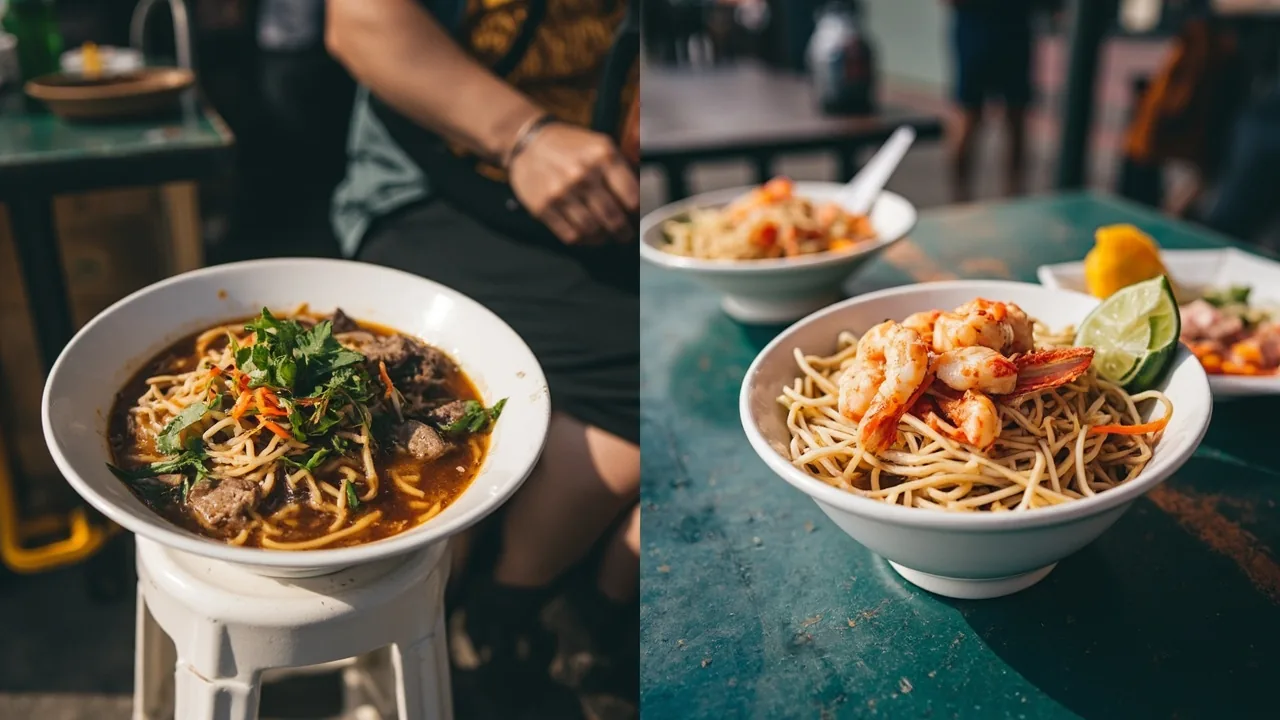
Bangkok vs Hanoi: Which City Wins the Food Fight?
Hanoi vs bangkok for food? Bangkok has the widest street-food variety on earth, with different meals under ₹287 (~100 THB or ~$2.98). Hanoi has slower, deeper bowls: pho, bun cha, egg coffee, refined over generations. Both are cheap by Indian standards. The choice is variety or depth.
Subodh’s Pro Tip: The “which is better, Bangkok or Hanoi for food” debate usually settles on the second day. By day two in Bangkok, you’ve eaten ten different things. By day two in Hanoi, you’ve eaten the same bowl of pho twice and loved it more both times. Know which kind of eater you are.
Quick Answers
| What | Answer | Price (INR) |
|---|---|---|
| Cheapest street meal | Bangkok (pad krapow at a kerb-side wok stall) | ₹144 (~50 THB or ~$1.49) |
| Best single dish | Hanoi (pho bo, eaten on a plastic stool at 7am) | ₹147 (~40,000 VND or ~$1.53) |
| Variety in a single day | Bangkok | Dozens of cuisines within walking distance |
| Best for strict vegetarians | Bangkok (more labelled veg stalls + Indian food) | ₹574 (~200 THB or ~$5.96) |
| Best for non-vegetarian depth | Hanoi | ₹129 (~35,000 VND or ~$1.34) |
| Food tour (per person) | ₹3,446 (~1,200 THB or ~$35.74) | ₹1,289 (~350,000 VND or ~$13.37) |
Quick Comparison Table
| Factor | Bangkok | Hanoi |
|---|---|---|
| Daily food budget (tight backpacker) | ₹1,723 (~600 THB or ~$17.87) | ₹552 (~150,000 VND or ~$5.73) |
| Daily food budget (comfortable) | ₹4,307 (~1,500 THB or ~$44.68) | ₹1,289 (~350,000 VND or ~$13.37) |
| Visa for Indians | Visa-free / VoA (30 days) | e-visa or VoA (~25 USD) |
| Best months for food (dry, cooler) | Nov to Feb | Oct to Dec, Mar to Apr |
| Veg food availability | Easy (labelled stalls, Indian restaurants) | Workable but harder (broth-based tradition) |
| Safety (solo Indian traveller) | High in tourist zones | High in Old Quarter, watch for scooter traffic |
| English on menus | Widespread | Common in tourist areas, less elsewhere |
| Vibe | Sensory overload, 24-hour energy, every cuisine | Slow mornings, broth steam, low-rise streets |
| Best for | First-time SEA visitor who wants it all | Traveller who wants to slow down and eat one bowl properly |
Choose Bangkok If…
- You want ten meals a day, from ten cuisines, within walking distance of your hostel. Bangkok is the only SEA city where you can do Thai for breakfast, Indian for lunch, Japanese for a snack, and Isaan grilled meat for dinner, all under ₹287 (~100 THB or ~$2.98) per plate.
- You eat strictly vegetarian and need labelled options. Bangkok has more “jay” (Thai-vegetarian) stalls, more Indian restaurants, and more 7-Eleven fridge options than Hanoi.
- You want food as a nightlife activity. Chinatown (Yaowarat) at 9pm is one of the great street-food experiences on earth, with the whole road turned into a moving kitchen.
- You have a short trip (3 to 4 days) and want maximum variety per hour.
Choose Hanoi If…
- You care more about depth than variety. Hanoi’s food scene is narrower (northern Vietnamese cuisine, plus French colonial leftovers), but every dish has been refined over generations.
- You want to eat what locals eat at 6am. Pho for breakfast, bun cha for lunch, egg coffee at 3pm, banh mi for a snack, and bo la lot for dinner. That rotation is the entire city.
- You’re okay with sitting on a plastic stool on the pavement and ordering from a menu that only exists in the cook’s head.
- You have a bit more time (5 to 7 days) and want food as part of a slower, more contemplative trip.
Bangkok. Pros and Cons
Pros:
- The widest street-food variety of any city in the world. Thai central, Thai Isaan, Thai southern, Chinese-Thai, Muslim-Thai, plus every international cuisine you could want.
- Late hours. Many stalls run until 2am or 3am. Some run 24 hours.
- Easy to navigate as a vegetarian. Look for the yellow “jay” flag, or the Chinese-tofu shops in Chinatown.
- Cheap. A full meal + drink at a hawker stall rarely exceeds ₹287 (~100 THB or ~$2.98).
- The Thai dessert and fruit scene (mango sticky season runs March to May) is on a different level from Hanoi.
Cons:
- Quality is uneven. The ₹144 (~50 THB or ~$1.49) pad krapow can be the best meal of your trip, or a tourist-trap MSG bomb. You have to know where to go.
- Heat + crowds + noise. Eating at street stalls in Bangkok in April is a sweat-fest.
- Bangkok rewards English speakers and repeat visitors more than Hanoi does. First-timers without research get steered to tourist zones.
- Hygiene anxiety is higher for first-time Indian travellers. It’s mostly fine, but the visual of open-air meat on a hot street takes adjustment.
Hanoi. Pros and Cons
For the full breakdown of Hanoi costs and hostel options, see our Hanoi Budget Guide.
Pros:
- Pho. Just pho. If you eat one bowl a day for a week at different shops, you’ll never think about pho the same way again.
- The Old Quarter is compact and walkable. Every meal is a 10-minute walk from your hostel.
- Coffee culture is real. Vietnamese egg coffee (ca phe trung) at a lakeside cafe is a defining Hanoi experience.
- Prices are low. A full meal + drink rarely exceeds ₹221 (~60,000 VND or ~$2.29).
- French colonial baking is everywhere. Banh mi from a corner cart at ₹92 (~25,000 VND or ~$0.96) is a legitimate rival to any sandwich you’ve eaten.
Cons:
- Variety is genuinely narrower. Hanoi is northern Vietnamese cuisine. That’s the draw and the limit.
- Strict vegetarian travel is harder. Most “veg” options involve fish sauce in the broth unless you go to specific veg restaurants.
- Air pollution and winter cold (Dec to Feb, can drop below 10°C) make street eating less pleasant than Bangkok.
- Less English on the menu. Pointing and smiling works, but the surprise factor is higher.
Cost Comparison in Local Currency
| Expense | Bangkok (THB) | Hanoi (VND) |
|---|---|---|
| Street food meal (avg) | ₹144 (~50 THB or ~$1.49) | ₹129 (~35,000 VND or ~$1.34) |
| Restaurant meal (mid-range) | ₹718 (~250 THB or ~$7.45) | ₹442 (~120,000 VND or ~$4.58) |
| Local dessert / coffee | ₹172 (~60 THB or ~$1.79) | ₹92 (~25,000 VND or ~$0.96) |
| Hawker dinner + drink | ₹431 (~150 THB or ~$4.47) | ₹295 (~80,000 VND or ~$3.06) |
| Cooking class | ₹4,307 (~1,500 THB or ~$44.68) | ₹3,131 (~850,000 VND or ~$32.47) |
| Food tour (per person) | ₹3,446 (~1,200 THB or ~$35.74) | ₹1,289 (~350,000 VND or ~$13.37) |
| Daily food (tight budget) | ₹1,723 (~600 THB or ~$17.87) | ₹552 (~150,000 VND or ~$5.73) |
| Daily food (comfortable) | ₹4,307 (~1,500 THB or ~$44.68) | ₹1,289 (~350,000 VND or ~$13.37) |
| 5-day total food (tight) | ₹8,614 (~3,000 THB or ~$89.36) | ₹2,762 (~750,000 VND or ~$28.65) |
| 5-day total food (comfortable) | ₹21,536 (~7,500 THB or ~$223.40) | ₹6,475 (~1,750,000 VND or ~$67.05) |
FX rates verified 2026-07-17: 1 THB = ₹2.87, 1 VND = ₹0.0037, 1 USD = ₹96.33. Both cities are far cheaper than any metro in India for food. Hanoi wins on raw food cost, but Bangkok wins on price-per-variety.
What to Eat
Bangkok
The food scene is too big to cover in one paragraph, so here are the actual moves.
For pad krapow (Thai basil stir-fry over rice, the unofficial national dish), find a wok stall with a queue. Order it “sab poo” (with vegetables) if you’re vegetarian. Add a fried egg on top (kai dao) for the full local experience. Cost: ₹144-₹201 (~50-70 THB or ~$1.49-$2.09).
For something sit-down with real ambience, The Island Bangkok is a top-rated Thai spot with strong reviews and a more polished menu. Worth it for a break from plastic stools.
If you want to understand old Bangkok beyond the food, Bangkokian Museum tour is a small, charming museum that pairs nicely with a slow lunch in the Bang Rak area.
For temple-hopping between meals, the Wat Suthat Thepwararam Ratchaworamahawihan tour gives you the towering red swing and the mural halls, both within walking distance of some of the best hawker stalls in town.
And if you only do one cultural stop, The Temple of the Emerald Buddha tour inside the Grand Palace complex is non-negotiable. Pair it with the surrounding food scene in Rattanakosin.
Hanoi
For a full Hanoi itinerary, see our 3 Days in Hanoi guide.
Pho bo (beef pho) at any of the small shops on Bat Dan Street or near St. Joseph’s Cathedral. Order it for breakfast, around 7 to 9am, when the broth is fresh. Cost: ₹129-₹184 (~35,000-50,000 VND or ~$1.34-$1.91). Don’t ask for chopstick instructions, just follow what locals do.
Bun cha (grilled pork with cold noodles, the dish Obama ate with Bourdain) at a kerb-side shop in the Old Quarter. Cost: ₹110-₹166 (~30,000-45,000 VND or ~$1.15-$1.72).
Egg coffee at any of the small cafes around the lake. Cost: ₹74-₹110 (~20,000-30,000 VND or ~$0.76-$1.15).
Banh mi from any street cart. The baguettes are a French legacy and the fillings are uniquely Vietnamese. Cost: ₹55-₹92 (~15,000-25,000 VND or ~$0.57-$0.96).
For a sit-down local meal, Hello Hanoi Restaurant is a well-rated option in a casual setting, useful when you want air-conditioning and a menu in English.
To understand the city beyond the bowl, walk the Hanoi Old Quarter tour, the 36 streets, each one historically named for the trade that lived there. The food map makes sense after that walk.
When You Need a Dal-Chawal Fix
Both cities have solid Indian food, but Bangkok’s scene is more developed.
- Indique in Bangkok is a top-rated Indian fine-dining spot, around ₹1,350 (~14 USD) per person, where the butter chicken gets consistent praise. Good for a treat meal.
- Shree Gangour Pure Veg Restaurant Bangkok is a popular pure-veg spot for when you need a guaranteed meat-free Indian meal.
Hanoi has Indian options too (mainly around the Old Quarter and Tay Ho), but the menus are shorter and the prices are higher than Bangkok. Most Indian travellers in Hanoi end up eating Vietnamese food for most meals and saving Indian for the homesick days.
Where to Stay (Bangkok)
For the full breakdown of Bangkok neighbourhoods and hostel options, see our Bangkok Budget Guide.
| Hostel | Rating | Area | Book |
|---|---|---|---|
| Mad Monkey Bangkok | 9.64 | Khao San area | Check prices |
| Nomads Bangkok Khao San Road Hostel | 9.86 | Khao San | Check prices |
| Hide Bangkok Hostel | 10.0 | City centre | Check prices |
| Line Bangkok Hostel | 9.66 | Silom / Patpong | Check prices |
| For a full multi-country backpacking route across the region, see our Southeast Asia Backpacking Hub. |
The Bananarchy Take
For a first-time Southeast Asia visitor who wants food as a primary reason to travel, Bangkok wins. The variety, the late hours, the labelled vegetarian options, and the sheer density of choice mean you cannot go hungry, and you cannot eat the same thing twice unless you choose to. For a second or third trip where you want food to slow you down instead of speed you up, Hanoi wins. The broth culture, the ritual of one bowl at a time, and the French-Vietnamese crossover give it a depth Bangkok doesn’t bother with.
If you’ve already done the Bangkok-in-three-days standard itinerary, Hanoi will feel like the real Southeast Asia. If Hanoi sounds too quiet, Bangkok will wake you up in the best way.
Getting Connected
Both cities are easy for SIMs. Bangkok has the AIS, dtac, and TrueMove tourist SIMs at the airport (8-day unlimited for ₹859 (~299 THB or ~$8.91)). Hanoi has Viettel and Mobifone tourist SIMs at Noi Bai airport, typically ₹737 (~200,000 VND or ~$7.64) for a week of data.
If you’d rather skip the airport kiosk, Get Nomad eSIM works in both Thailand and Vietnam, activates before you fly, and covers the whole region if you’re doing both cities.
Can You Do Both?
Yes, and most backpackers do. The standard route is 4 to 5 days Bangkok, fly to Hanoi, 4 to 5 days Hanoi, then continue south (Hue, Hoi An, Da Nang) or return to Bangkok for the southern Thailand leg. Bangkok to Hanoi flights are cheap if booked a week ahead, often under ₹10,050 (~$104.25) on AirAsia, VietJet, or Thai VietJet Air.
The overland route through Laos exists (Bangkok to Vientiane to Hanoi) but adds three days of bus and is only worth it if Laos is on your list. For a food-focused trip, fly.
Safety Alert: Before you go, check the Indian Ministry of External Affairs travel advisory for Thailand and Vietnam at mea.gov.in, plus each country’s own tourism advisory. For Bangkok, watch for taxi and tuk-tuk scams around tourist sites. For Hanoi, scooter traffic in the Old Quarter is the main day-to-day risk, so look both ways (twice) before crossing.
For a broader Thailand vs Vietnam comparison that covers beaches, trekking, and culture alongside food, Thailand vs Vietnam for First-Timers is the next read.
Subodh’s Take
Bangkok is the loud win. Hanoi is the quiet one. Bangkok gives you ten different meals before Hanoi finishes its first bowl of pho, and both are cheaper than a single plate of chole bhature in a mid-range Delhi restaurant. Pick the mood, not the city.
FAQ
Is Vietnam cheaper than Thailand for Indians for food? Yes, on raw numbers. Hanoi’s daily food budget at ₹552 (~150,000 VND or ~$5.73) works out to roughly ₹555 (~$5.76). Bangkok’s tight backpacker food budget at ₹1,723 (~600 THB or ~$17.87) works out to roughly ₹1,720 (~$17.84). Vietnam is meaningfully cheaper, but Bangkok delivers more variety per rupee spent.
Which city is better for vegetarian Indian travellers? Bangkok. More labelled “jay” vegetarian stalls, more pure-veg Indian restaurants (Indique, Shree Gangour), and 7-Eleven fridge options for backup. Hanoi has vegetarian spots but the broth-based tradition means fish sauce sneaks into most “veg” dishes unless you go to dedicated veg restaurants.
Can I do both cities on one trip? Yes, and most backpackers do. The standard split is 4 to 5 days Bangkok, fly to Hanoi (cheap AirAsia and VietJet flights), then 4 to 5 days Hanoi. Total 10 days covers both food scenes comfortably.
Do I need a visa for both? Thailand is visa-free for Indian passport holders for 30 days. Vietnam requires either an e-visa or visa on arrival, around ₹2,410 (~25 USD). Apply for the Vietnam e-visa online at least three working days before you fly.
Which city is safer for solo Indian women? Both are safe in tourist zones. Bangkok has more policing and CCTVs in tourist areas like Khao San, Silom, and Sukhumvit. Hanoi’s Old Quarter is walkable and safe but watch for scooter traffic, especially at intersections. Stick to well-lit areas after 11pm in either city.
- Subodh
