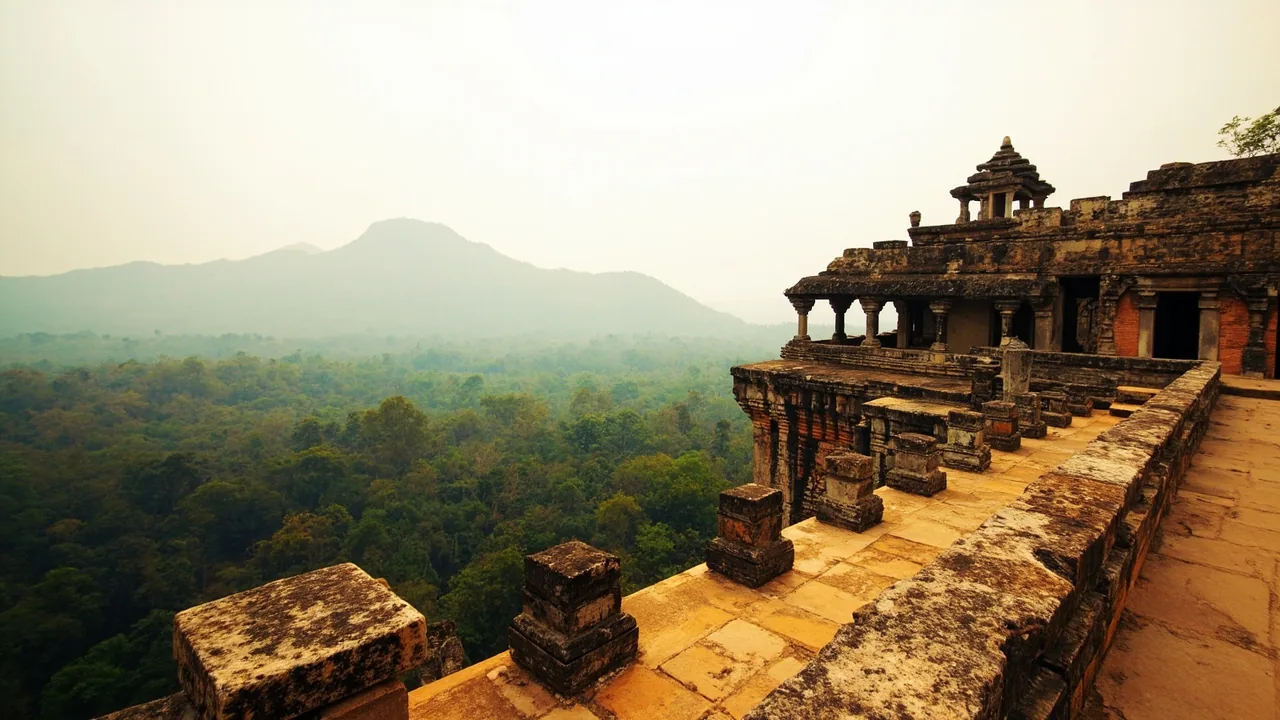
Preah Vihear Temple Explained: The Cambodia vs Thailand Border Dispute
Cambodia vs Thailand: Preah Vihear Temple Guide for Backpackers
Planning a trip to compare cambodia vs thailand temple preah vihear routes? Perched on a cliff in the Dângrêk Mountains along the Thai-Cambodian border, Preah Vihear (Prasat Preah Vihear) is one of Southeast Asia’s most spectacular UNESCO World Heritage sites.
For years, access to this 11th-century Khmer temple was a source of border tension between Thailand and Cambodia. Today, the border area is calm, but accessing the site requires understanding entry routes, visa rules, and transport options from both sides.
For the full SEA trail, check our SEA backpacking hub.
Quick Answers
| What | Answer | Price (INR) |
|---|---|---|
| Where is Preah Vihear? | Cliff-top Khmer temple in the Dângrêk Mountains, Cambodian side | , |
| Who owns it now? | Cambodia (ICJ ruling, 1962, reaffirmed 2013) | , |
| Is it a UNESCO World Heritage Site? | Yes, since 2008 | , |
| Can Indians visit from Cambodia? | Yes, e-Visa or VoA covers the province | ₹3,000 (~36 USD) |
| Can Indians visit from Thailand? | Possible, but requires a separate Thai permit and the border checkpoint has closed repeatedly | , |
Subodh’s Pro Tip: The temple is a one-day detour from Siem Reap or a half-day detour from Surin in Thailand. Don’t try to combine it with Angkor Wat on the same day unless you enjoy 8 hours of driving on bumpy red-dirt roads.
The Temple Itself: Why It’s Worth the Argument
Before the dispute, the architecture. Preah Vihear is an 11th-century Khmer temple complex dedicated to Shiva, built in stages during the reigns of Yasovarman I, Suryavarman I, and Suryavarman II (the same king who commissioned Angkor Wat). The complex stretches roughly 800 metres along a north-south axis, climbing the cliff in five sanctuaries connected by causeways and stepped galleries.
What makes it unusual among Khmer temples is the setting. Where Angkor Wat lies flat across a 400-hectare plain, Preah Vihear climbs. Each successive gopura and sanctuary sits higher up the escarpment, and the final prasat at the southern end opens onto a sheer drop into the Cambodian lowlands. On a clear morning the view runs to the horizon. Travellers report the climb takes 30 to 45 minutes from the lower car park to the top sanctuary, with shade patchy after the first set of stairs.
The site was inscribed as a UNESCO World Heritage Site in 2008, on Cambodia’s nomination alone. Thailand objected to the listing at the time, arguing the nomination should have been joint. That objection is part of why the temple ended up on UNESCO’s List of World Heritage in Danger from 2008 to 2011, before being removed once the ICJ clarified the management arrangements.
So when competitors talk about the “UNESCO World Heritage status and architectural significance,” they are describing this 11th-century Shiva sanctuary set on a Dângrêk cliff, not just a pile of contested stones. The dispute is famous, but the building is genuinely worth seeing on its own terms.
The Dispute, in 90 Seconds
- 1907: The Franco-Siamese Treaty draws the border between French Indochina (which included Cambodia) and Siam (Thailand). The map places the cliff-top temple, and the land beneath it, on the Cambodian side. The accompanying map uses the watershed line of the Dângrêk ridge.
- 1953: Cambodia gains independence. Thailand, never fully accepting the 1907 map, occupies the temple in 1954 after French Indochina collapses.
- 1962: The International Court of Justice rules in Cambodia’s favour. Thailand is ordered to withdraw troops and return any removed artefacts. The ICJ cites the 1907 map and notes the temple’s historical religious function has always been tied to Cambodian communities.
- 2008: The temple is listed as a UNESCO World Heritage Site. Tensions flare. Armed clashes in October 2008 near the temple leave soldiers on both sides wounded. Cambodia’s prime minister and Thailand’s prime minister both attend the UN General Assembly the same week and trade accusations.
- 2011: A more serious round of fighting, centred on the temple and the Ta Moan and Ta Kwai temple complexes further west. Heavy weapons are used. Several soldiers die on each side. The clashes last roughly three weeks. Civilians are evacuated from both sides of the border.
- 2013: The ICJ issues a second ruling, interpreting its 1962 judgment. The court reaffirms Cambodian sovereignty over the temple and the surrounding “vicinity,” rejecting Thailand’s attempt to interpret “vicinity” narrowly.
- 2020 to present: Quiet. The border checkpoint on the Thai side opens and closes based on the bilateral mood of the month. Travellers can cross from Cambodia without much fuss.
Who Controls It in 2026
Cambodia. The Thai side of the cliff still has roads and a viewing area, but the temple itself, every sanctuary, every gallery, every wall, sits on land the ICJ has twice confirmed as Cambodian. Thai tourists visit, but they visit as foreign guests at a Cambodian heritage site. The Cambodian Ministry of Culture runs conservation, the Cambodian military maintains a garrison below the temple, and the Cambodian Tourist Authority issues the access tickets at the base camp.
That said, the access road on the Thai side still exists, and on a normal day Thai day-trippers can drive up to a Thai military outpost at the foot of the cliff for a view from below. They cannot enter the temple itself from that side without first clearing Thai immigration and crossing into Cambodia.
How to Visit Preah Vihear from the Cambodian Side
This is the route 95% of Indian travellers will use.
Step 1: Get to Siem Reap
Siem Reap is the standard jumping-off point. Direct flights from Bangkok, Kuala Lumpur, and Singapore land at Siem Reap-Angkor International. From India, the cheapest route in mid-2026 is a self-connect through Kuala Lumpur or Singapore on AirAsia or Scoot, with round-trip airfares starting around ₹18,000 (~$186.86) from Chennai or Bengaluru in low season. Bangkok is the busiest hub if you’re already doing a Thailand-Cambodia loop. For timing your flight, see our cheapest months to fly to Thailand.
Step 2: Cambodia Visa for Indians
Indian passport holders can use either the e-Visa or visa-on-arrival.
| Type | Fee | Where | Notes |
|---|---|---|---|
| e-Visa | ₹3,000 (~36 USD) | Apply at evisa.gov.kh | Faster, no queue at airport |
| Visa-on-arrival | ₹2,500 (~30 USD) | Phnom Penh, Siem Reap airports, land borders | Bring passport photo (4x6 cm, white background), USD cash |
| Extension | ₹4,083 (~45 USD) | Cambodia Immigration offices | +30 days, single entry |
Both give 30 days single entry. The e-Visa is the easier option for first-time visitors because there’s no queue and no fumbling for passport photos at the counter.
Step 3: Siem Reap to Preah Vihear
The drive is roughly 220 km and takes 5 to 6 hours depending on road conditions. Options:
- Shared minivan (most common): Around ₹2,408 (~25 USD) to ₹3,372 (~35 USD) per person one-way, departing early morning. Most guesthouses in Siem Reap can book this the day before.
- Private car with driver: ₹8,670 (~90 USD) to ₹12,523 (~130 USD) for the round trip, worth it if you’re 2 or more people.
- Motorbike: Not recommended. The last 60 km are dirt, and the route passes through military-controlled zones where you’ll be stopped multiple times for ID.
The last 30 km climb steeply into the Dângrêk ridge. The road surface is good tarmac until the final stretch, then graded dirt. Rain makes the dirt greasy. Travellers in the wet season (June to October) report getting stuck; travellers in the dry season (November to February) report easy driving.
Step 4: At the Base Camp
You buy the temple ticket at the Cambodian Tourist Authority office at the foot of the cliff. Bring your passport. From the office, shared trucks run to the upper car park for about ₹482 (~5 USD) per person round trip. The walk up from the upper car park to the first sanctuary is about 20 minutes of uneven steps. From there it is another 20 to 30 minutes to the summit sanctuary, depending on how often you stop for photos.
Where to Stay Near the Temple
The town at the base of Preah Vihear is Tbeng Meanchey, the capital of Preah Vihear province. Guesthouses are basic but clean, and most travellers stay one night to catch sunrise. For the full range of Siem Reap accommodation options, see our Siem Reap city guide.
Where to Eat Near the Temple
| Restaurant | Rating | Cuisine | Notes |
|---|---|---|---|
| Preah Vihear Derm Mean | 4.2 | Cambodian | Traditional local dishes, generous portions |
| BS Restaurant | 4.8 | Cambodian | Simple, clean, the local favourite |
Both sit in Tbeng Meanchey. Preah Vihear Derm Mean and BS Restaurant both serve standard Cambodian fare (rice, noodle soup, grilled fish, amok, num pang). Travellers who want familiar Indian vegetarian food before the sunrise climb usually stock up in Siem Reap; the Tbeng Meanchey options are basic provincial kitchens with limited vegetarian variety.
How to Visit Preah Vihear from the Thai Side
This is the route for travellers already based in Thailand’s Isaan region, in Surin, Si Sa Ket, or Ubon Ratchathani.
Step 1: Get to Surin or Si Sa Ket
The closest Thai town with good bus connections is Surin. Bangkok to Surin by bus is around 5 to 6 hours.
Step 2: Thai Permit and Border Crossing
You will need:
- Indian passport holders get visa-free entry to Thailand (60 days by air, 30 days at land borders)
- A Thai border crossing permit issued by the Thai military at the Chong Sa Ngam or Chong Bok checkpoint, depending on which is open
- A Cambodia e-Visa if you plan to cross into Cambodia on the same trip
Travellers report that the Thai military routinely denies access to non-Thai nationals on security grounds, even with valid entry status. The checkpoint at Chong Sa Ngam has been closed on multiple days in 2024 and 2025 for “security exercises” with no notice. Do not plan your Thailand trip around Preah Vihear unless you have at least 3 days of slack in the schedule. For more on Thai visa rules, see our visa comparison guide.
Step 3: The Thai Side Viewpoint
If you are allowed to drive up the Thai access road, you reach a Thai military outpost and a viewpoint below the cliff. The view is fine, but you are looking up at the back of the temple rather than walking through it. Most travellers report this as a letdown after the 5-hour drive.
Cambodia vs Thailand: Side-by-Side Comparison for Visiting Preah Vihear
| Factor | From Cambodia (Siem Reap) | From Thailand (Surin) |
|---|---|---|
| Daily budget (USD) | ₹2,890-₹4,816 (~30-50 USD) | ₹2,408-₹3,853 (~25-40 USD) |
| Visa for Indians | e-Visa ₹3,000 (~36 USD) or VoA ₹2,500 (~30 USD) | Visa-free (60 days by air, 30 days at land border) + Thai military permit |
| Drive time to temple | 5-6 hours from Siem Reap | 3-4 hours from Surin |
| Permit required | Just the temple ticket | Thai military permit + Cambodia e-Visa |
| Crowds at the temple | Low to moderate | Almost none |
| Border checkpoint reliability | Open daily | Opens and closes without notice |
| Best months | Nov-Feb (dry) | Nov-Feb (dry) |
| English spoken | Basic | Limited |
| Vibe | Slightly more effort, proper temple visit | Easier drive, viewpoint-only |
Choose the Cambodia Side If…
- You want to walk through the temple and reach the summit sanctuary
- You’re already doing a Cambodia trip and don’t want to add a Thai visa application
- You want a more reliable access situation
- You don’t mind the 5 to 6-hour drive from Siem Reap
Choose the Thailand Side If…
- You’re already based in Isaan and want a half-day detour
- You only want a view of the temple from below
- You enjoy checkpoint uncertainty as part of the adventure
- You already have visa-free entry to Thailand (30 days at land border) and don’t want to re-enter Thailand
Cambodia Side Pros and Cons
Pros:
- Guaranteed access to the temple interior and summit sanctuary
- Standard Cambodia tourist infrastructure at the base camp
- The dramatic cliff-side architecture is fully visible from inside the complex
Cons:
- Long drive from Siem Reap through sparsely populated province
- Basic accommodation options in Tbeng Meanchey
- Mobile signal drops in and out along the last 30 km
Thailand Side Pros and Cons
Pros:
- Shorter drive from Surin or Si Sa Ket
- Combines easily with Khmer-era ruins at Prasat Ta Muen and Prasat Ban Pluang further west
- Smaller crowds, if you make it up at all
Cons:
- Checkpoint closures without notice
- Military permit can be denied even with valid paperwork
- You do not enter the temple itself, only view it from below
Cost Comparison for a 3-Day Preah Vihear Detour
| Expense | From Cambodia (USD) | From Thailand (THB) |
|---|---|---|
| Dorm bed (avg/night) | ₹771 (~8 USD) | |
| Temple ticket | ₹963 (~10 USD) | Free (viewpoint only) |
| Street food meal | ₹193 (~2 USD) | |
| Restaurant meal | ₹385 (~4 USD) | |
| Transport (per day, shared) | ₹2,408 (~25 USD) | |
| SIM card (tourist) | ₹482 (~5 USD) | |
| Visa fee | ₹3,000 (~36 USD) | Free (visa-free 30 days at land border) |
| Top activity (e.g. Day trip) | ₹3,372 (~35 USD) | |
| Beer | ₹72 (~0.75 USD) | |
| 3-day total (budget) | ₹11,560 (~120 USD) | ** (~₹10,042)** |
| 3-day total (comfortable) | ₹21,192 (~220 USD) | ** (~₹17,215)** |
Subodh’s Pro Tip: The Thailand side is slightly cheaper on paper, but the moment you factor in a ₹12,523 (~130 USD) private car if the checkpoint sits in an awkward spot, the gap closes fast. For Indian travellers, the Cambodia side is more expensive up front but far more predictable.
The Bananarchy Take
If you came to Southeast Asia to see Khmer temples and you skipped Angkor Wat, fix that first. If you’ve done Angkor and want a second, different temple experience with far fewer tourists, Preah Vihear is one of the best choices on the continent. Go from the Cambodian side. The Thai side is a curiosity for Isaan-loop travellers, not a substitute for the real visit. For a deeper comparison of Cambodia’s two main cities, see Phnom Penh vs Siem Reap.
Bananarchy’s one trip does not currently stop at Preah Vihear, but our fixed-cost loop through Thailand, Cambodia, Laos, and Vietnam covers Siem Reap, Phnom Penh, Angkor Wat, and the Thai-Cambodian border region. If you want a structured way to see both sides of the dispute without booking transport yourself, that’s the easiest path.
Book Your Cambodia-Thailand Temple Trip
Can’t decide which side to start from? Our one trip loops through both countries on one fixed price, see dates and grab a seat.
Getting Connected
Cambodia mobile coverage in Tbeng Meanchey and along the Dângrêk road is patchy. Smart and Cellcard both sell tourist SIMs at Siem Reap airport for around ₹482 (~5 USD), with 5 to 10 GB of data. Coverage drops to 2G or no signal on the last 30 km of dirt road, so download offline maps before you leave Siem Reap. If you prefer to skip the physical SIM, Get Nomad eSIM before flying, which lets you land connected. On the Thai side, AIS and dtac work fine along the highway but lose signal at the cliff base.
Is It Safe for Indian Travellers in 2026?
The temple area itself is calm. There has been no significant military incident at Preah Vihear since the 2011 clashes. The Cambodian garrison is professional and accustomed to foreign tourists. The Thai side is unpredictable in terms of access but not physically dangerous; the worst outcome is being turned back at the checkpoint and losing a day.
Before you go, check two sources: the official Indian Ministry of External Affairs travel advisory at mea.gov.in, and the Cambodian Ministry of Foreign Affairs site for any current border-zone notices. Do not rely on travel blogs older than 6 months for this specific destination.
FAQ
Can Indians visit Preah Vihear in 2026?
Yes. From the Cambodian side, your standard e-Visa or visa-on-arrival covers Preah Vihear province. From the Thai side, Indians get visa-free entry (60 days by air, 30 days at land borders), but you still need a separate Thai military permit, plus a Cambodia e-Visa if you plan to cross into the temple itself.
Do I need a separate Cambodia visa if I’m entering from Thailand?
Yes. The Cambodian e-Visa is not issued at the Thai-Cambodian border checkpoint. Apply in advance at evisa.gov.kh.
How much does the Cambodia e-Visa cost for Indian passport holders?
₹3,000 (~36 USD), valid for 30 days single entry. The visa-on-arrival alternative is ₹2,500 (~30 USD) at the airport.
Is Preah Vihear safer than Angkor Wat?
In terms of petty theft and tourist scams, both are safe. In terms of political situation, Angkor Wat has none, while Preah Vihear sits in a border region that has seen armed clashes. None since 2011, but the situation warrants checking current advisories before you go.
When is the best time to visit Preah Vihear?
November to February, during the dry season. The dirt road access becomes difficult in the wet season (June to October), and fog can obscure the cliff-top view from June to August.
Can I combine Preah Vihear with Angkor Wat in one trip?
Yes. Most travellers base in Siem Reap for Angkor, then do a 2-night, 1-day side trip to Preah Vihear. The reverse (Preah Vihear first, Angkor second) also works.
Why was Preah Vihear on UNESCO’s List of World Heritage in Danger?
From 2008 to 2011, after the armed clashes between Cambodia and Thailand threatened the site. It was removed once the ICJ clarified management and tensions eased.
