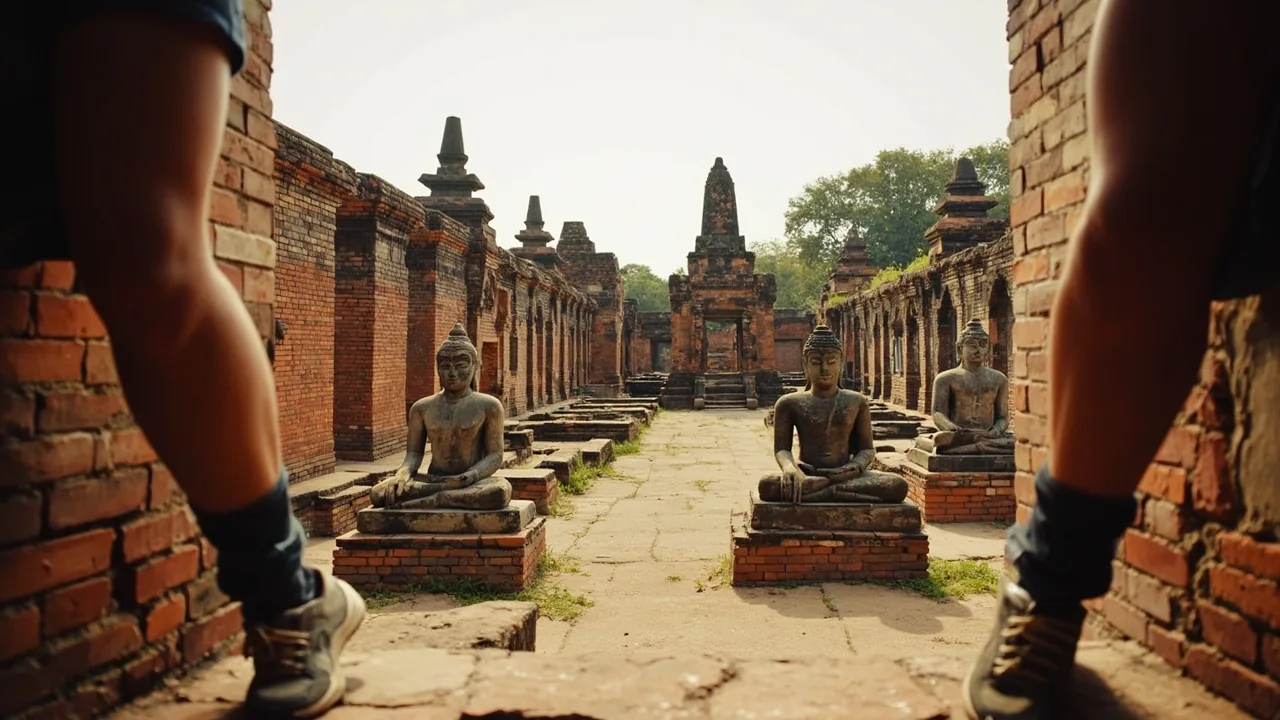
Ayutthaya Day Trip from Bangkok: The Honest Indian Backpacker Briefing (2026)
Ayutthaya is Thailand’s old capital, an hour and a half north of Bangkok, ringed by river-fortress ruins. Most backpackers do it as a rushed 10-hour bounce from Bangkok, then wonder if they should have stayed the night. This guide answers that question with specifics, not hedge words, citing the Thai State Railway’s published July 2026 timetable, Bangkok. Ayutthaya ticket pricing from 12go, and GetYourGuide tour listings as of July 2026.
If you only have one day in Bangkok and one free slot for an excursion, Ayutthaya earns that slot over Kanchanaburi, or the floating markets, because the ruins are worth seeing and the logistics are simple. Read on to plan it properly.
Quick Answers
| What | Answer | Price (INR) |
|---|---|---|
| Bangkok to Ayutthaya by train (cheapest) | 1.5 hrs, Krung Thep Aphiwat station | ₹70 (~20 THB or ~$0.70) for third-class |
| Bangkok to Ayutthaya by minivan | 1 hr 15 min, departure from Mo Chit or Victory Monument | ₹300 (~100 THB or ~$3) one-way |
| Wat Phra Si Sanphet entry | Free (park fee only) | ₹60 (~20 THB or ~$0.60) historical park ticket |
| Bangkok to Ayutthaya by tour bus | 8-10 hrs with hotel pickup, includes 4 temples | ₹1,500-2,500 (~500-850 THB or ~$16-27) |
| Day-pass scooter / bicycle rental in Ayutthaya | Bicycle is the right call, traffic-light | ₹150 (~50 THB or ~$1.50) for the day |
Bangkok to Ayutthaya: The Transport Decision
You’ve got four real options, each with a specific trade-off. Pick based on how much of the day you want to spend looking at temples and how much you want to spend in transit.
Train (best for budget + scenery). Hop on at Krung Thep Aphiwat for ordinary class, around ₹57 (~20 THB or ~$0.59) third-class, ₹89 (~31 THB or ~$0.92) second-class air-con, ₹186-₹861 (~65-300 THB or ~$1.93-$8.92) first-class with a reserved seat. Trains on the northern line from Krung Thep Aphiwat run roughly hourly in the morning and evening, with a midday gap; the 1.5-hour ride is scenic, and you step off right inside the old city. Book on 12go for confirmed seats, especially on weekends when locals flood the line.
Subodh’s Pro Tip: Sit on the left-hand side heading north. Halfway through the ride you cross the Chao Phraya near the Bang Pa-In area, which is the best stretch of views on the route.
Minivan (best for speed). Departures from Mo Chit (BTS Mo Chit, Exit 4) or Victory Monument run every 40 minutes from 06:00 until around 19:00. Around ₹287 (~100 THB or ~$2.97) one-way, 1 hour 15 minutes if traffic behaves. Drop-off is usually outside the historical park, not in the old town proper. Book on 12go to lock the time slot in advance.
Join-in tour (best if you’re solo or hate logistics). A standard day tour from Bangkok hotels runs around ₹1,434-₹2,439 (~500-850 THB or ~$14.86-$25.26) including pickup, transport, an English-speaking guide, and four or five temple stops. Lunch is usually included. The trade-off: 8 hours door-to-door, fixed schedule, you don’t get to linger at what you like. Book your day tour here.
Private driver (best for groups of 3-4). Roughly ₹7,173-₹10,042 (~2,500-3,500 THB or ~$74.30-$104.03) for the vehicle and driver for the day, split four ways that’s about ₹1,721-₹2,582 (~600-900 THB or ~$17.83-$26.75) each, same as a tour but you set the schedule. Ask your hostel to arrange it, or book on the day at Khao San.
Safety Alert: Whoever you book with, confirm the return ticket is open-dated. Travellers report being quoted round-trip minivan fares and sold only one-way tickets because the driver “forgot” to confirm the return. Pre-booking on 12go removes that risk entirely.
What to See in One Day (The Only Worthwhile Itinerary)
Ayutthaya’s ruins sprawl across an island the size of a small city. You can’t see everything, and any guide that tries to fit it all in is rushing you. Here’s a single-day plan that hits the marquee sights and adds Bang Pa-In (the part that most “5 temples in 6 hours” tours skip).
07:30 - Train to Ayutthaya
Coffee at the station, board the northbound train. Eat the pad thai from the platform vendors, it’s better than it should be at ₹143 (~50 THB or ~$1.49).
09:30 - Wat Phra Si Sanphet
The first stop and the one that grounds the whole trip. Wat Phra Si Sanphet was the royal temple of the Ayutthaya kings, three Sri Lankan-style chedis towering over the courtyard, with the ruins of the ordination hall behind them. Most day-trippers’ top photo comes from this spot. Entry is included in the historical park ticket (₹143 (~50 THB or ~$1.49) foreigners, free for Thais).
11:00 - Wat Mahathat + Wat Ratchaburana (walking distance)
Five minutes’ walk from Sanphet, both inside the same historical park compound. Wat Mahathat has the famous Buddha head entwined in tree roots. Wat Ratchaburana has a prang you can climb (steep, dark, worth it for the view).
12:30 - Lunch in the Old Town
Lunch is covered separately in the food section below. Eat where the locals eat, not where the tour buses stop.
14:00 - Bang Pa-In Summer Palace (the half-day version)
This is the part most day-trippers skip, and the one piece that makes the trip genuinely worth doing in a day. Bang Pa-In sits 15 km south of the historical park, or 15 minutes on a hired scooter. It’s the king’s summer retreat, a bizarre mix of Thai, Chinese, European, and Khmer architecture, set on a lake island with manicured gardens and pavilions. Most tours skip it because it doesn’t fit a 6-hour loop. Foreign entry is around ₹200-₹400 (~70-140 THB or ~$2.08-$4.16); check the official counter on arrival for the current ticket price.
Subodh’s Pro Tip: If you only have time for one of the two (ruins vs palace), pick the ruins. Bang Pa-In is a better stop when you’re doing the overnight version. Travellers who skip both Bang Pa-In and the riverside Wat Chaiwatthanaram end up with a rushed half-trip.
16:00 - Wat Chaiwatthanaram (the river view)
Sunset over the Chao Phraya from this prang is the cover-shot moment, and the bonus is that almost every day-tripper is already on the bus back to Bangkok.
18:00 - Train Back to Bangkok
Board at Ayutthaya station around 18:30. You’re back at Krung Thep Aphiwat by 20:00, and the third-class fare is around ₹57 (~20 THB or ~$0.59).
Or: The Overnight Counterargument
Staying one night flips the day-trip math: you get the sunset and sunrise, slow temple time, and the riverside night market without watching the clock. The honest answer is the same one you’ll find on r/Ayutthaya threads: if you’ve got the time and a hostel booked, stay. If you’ve got one day, it’s still worth doing.
Where to Stay (If You Stay the Night)
If the day-trip logic above convinced you overnight is the right call, these five hostels cover every backpacker budget tier.
| Hostel | Cost/night | Vibe | Book Here |
|---|---|---|---|
| Plus Hostel Ayutthaya | ₹1,721 (~600 THB or ~$17.83) | Highest-rated hostel in town, clean dorms, central | Check prices |
| Nakara Hostel Ayutthaya | ₹1,434 (~500 THB or ~$14.86) | Newer build, social common area, near the night market | Check prices |
| Early Bird Hostel Ayutthaya | ₹1,004 (~350 THB or ~$10.40) | Budget pick, basic but clean, walking distance to Wat Phra Si Sanphet | Check prices |
| Banchan Hostel Ayutthaya | ₹1,148 (~400 THB or ~$11.89) | Quiet, good for early-train departures | Check prices |
| PK Hostel | ₹861 (~300 THB or ~$8.92) | Cheapest decent bed in town, basic | Check prices |
| Subodh’s pick: If you’re staying overnight, Plus Hostel is the right call. The location saves you a 20-minute walk to the historical park at sunrise, and the dorms are quieter than the nightlife-heavy options downstream on Koh Phangan (different island, but same hostel-vibe benchmark). |
What to Eat
Ayutthaya is a small town, so the food scene is half local Thai joints and half “go-to-Bangkok-for-anything-special” reality. Here’s how to handle it.
Boat noodles (the local dish). When in Ayutthaya, eat boat noodles. The Ayutthaya version uses a dark, slightly sweet broth with thin rice noodles, pork, and herbs. Small bowls around ₹86-₹143 (~30-50 THB or ~$0.89-$1.49). Best eaten at one of the stalls near the night market, not the air-con restaurants around the historical park.
Pad thai at the train-station vendors. This is one of the few places where I’d rather eat from a stall than a restaurant. ₹172 (~60 THB or ~$1.78) a plate, cooked in front of you, eaten standing up with a cold bottle of water at ₹20 (~7 THB or ~$0.21). Use them for breakfast on arrival.
CQK Hotpot Ayutthaya. Hotpot in Thailand is a different beast than what you’re used to in Bangkok or Phuket. CQK is a small local chain doing Ayutthaya-style hotpot, around ₹574-₹861 (~200-300 THB or ~$5.94-$8.92) per person for the broth + ingredients. Worth booking if you’re staying overnight and want a sit-down meal. Veg-friendly: order the clear-tomato or mushroom broth and the vegetables tray.
Mango sticky rice. Classic Thai dessert, and Ayutthaya does it better than Bangkok in my experience because the fruit is local. ₹143 (~50 THB or ~$1.49) at any night market stall.
Indian food (when you need it). Ayutthaya doesn’t have a strong Indian restaurant scene. If you need dal-chawal on the overnight, the best option is to eat in Bangkok before or after the train. For North Indian fine dining in Bangkok, Indique is a commonly cited option in central Bangkok at roughly ₹1,351 (~14 USD) per person. For a known pure-veg option in central Bangkok, Shree Gangour Pure Veg is the comparable choice; check their official site or a listing site for the current menu and hours.
Safety Alert: Pork-heavy broths (boat noodles, ramen stalls) are common around the historical park, since pork is the default Thai-Chinese protein. If you’re strict-veg or avoid pork, clarify “no pork” with hand signs before ordering, or stick to the rice-and-vegetable stalls.
What to Do Beyond the Temples
The ruins pull 95% of visitors, but if you’ve got an overnight or you’ve already done the standard temple loop, these three things round out the trip.
Ayutthaya Boat & Travel River Cruise. A 1-1.5 hour slow boat along the Chao Phraya past the riverside temples. Around ₹574-₹861 (~200-300 THB or ~$5.94-$8.92) per person, departure points scattered around the old town. The golden-hour departure is the better pick over midday. Book Ayutthaya Boat & Travel River Cruise departure tour.
The Wonder Blue Classic Boathouse Ayutthaya. A more upscale boat-tour option, includes dinner and pickup, around ₹4,304 (~1,500 THB or ~$44.58) per person. Skip if you’ve already done the cheaper river cruise. Book The Wonder Blue Classic Boathouse Ayutthaya tour.
Cooking class with a chef. Ayutthaya cooking schools are quieter and cheaper than Bangkok’s, mostly because most tourists do Bangkok only. A half-day class with a chef runs ₹2,295-₹4,304 (~800-1,500 THB or ~$23.78-$44.58). Worth it if you’ve already done a Bangkok class elsewhere on your trip and want a second take. Book Herbs, Flavours & Cooking with a professional chef tour.
Optional add-on: Bang Pa-In Summer Palace. Worth a half-day if you’re staying overnight. Already covered in the itinerary section above.
Getting Connected
You’ll be in Thailand, AIS and TrueMove are the two tourist SIMs that matter. Either works in Ayutthaya, 4G coverage is solid, signal drops a little inside the older temple compounds but every hostel has Wi-Fi.
Physical SIM option. AIS Traveller SIM or TrueMove tourist SIM, ₹1,145 (~399 THB or ~$11.86) for 15 days, includes around 15 GB of data. Available at Suvarnabhumi Airport kiosks (the markup is small) or any 7-Eleven (tell them you want the tourist pack, not the prepaid credit). Get Nomad eSIM if you’d rather skip the airport kiosk and load the plan on your phone before flying.
Wi-Fi note. Ayutthaya hostel Wi-Fi is fine for messaging and maps, weak for video calls. Don’t plan on remote-working from Plus Hostel’s common room.
Daily Budget Breakdown
A realistic Ayutthaya day trip from Bangkok, per person in Thai baht. If you’re staying overnight, add a hostel bed at ₹861-₹1,721 (~300-600 THB or ~$8.92-$17.83).
| Category | Budget/day |
|---|---|
| Train (round-trip, third-class) | ₹172 (~60 THB or ~$1.78) |
| Lunch + dinner | ₹574 (~200 THB or ~$5.94) |
| Entry tickets (park 50 + Bang Pa-In 100) | ₹430 (~150 THB or ~$4.46) |
| Bicycle rental | ₹143 (~50 THB or ~$1.49) |
| Drinks / snacks / water | ₹287 (~100 THB or ~$2.97) |
| Total | ₹1,607 (~560 THB or ~$16.64) |
If you go the tour-bus route, swap the train (60) + bicycle (50) for a day-tour fare (₹1,434-₹2,439 (~500-850 THB or ~$14.86-$25.26)), and the total lands between 1,000 and ₹4,017 (~1,400 THB or ~$41.61), almost double the DIY cost, which is the right benchmark for deciding whether the convenience is worth the money to you.
Thailand Entry & TDAC for Indians
If you’re flying into Bangkok first, the Thailand visa guide for Indian passport holders walks through the bilateral visa-free agreement (60 days, free), but here’s the headline for any Ayutthaya day trip: the TDAC digital arrival card is mandatory for every entry type, including visa-free entry. Apply at the official portal before you board, no fee, takes around 5 minutes. You’ll need a QR code or PDF printout at immigration.
Bangkok has the standard Thai embassy section, but for a 60-day visa-free trip, you don’t need to touch an embassy at all.
Common Mistakes
Mistake #1: Treating Ayutthaya like Bangkok’s day-trip bus. Khao San operators advertise “Ayutthaya day tour” packages that pick up at 07:00, drop back at 18:00, and include one rushed stop per temple. Travellers report these feel like trolley tours, not trips. Book train + bicycle if you want agency, or pay ₹7,173 (~2,500 THB or ~$74.30) for a private driver.
Mistake #2: Going on a Thai public holiday. Travellers report the historical park hits 4-5x normal crowd on weekends and Buddhist holidays. September-October weekdays are quietest, November-February is peak season for a reason.
Mistake #3: Forgetting to dress modestly. It’s Buddhist temple rules, not strictness: covered shoulders, covered knees, no shoes on the ordination hall platforms. Lightweight long pants and a scarf cover this in any weather.
Mistake #4: Skipping Bang Pa-In entirely. Most day-trip tours skip it because of the timing, but Bang Pa-In is one of the highlights of the entire Bangkok-north region. If you’re doing the overnight, Bang Pa-In plus sunset at Wat Chaiwatthanaram is the right route.
Subodh’s Take
Ayutthaya is the rare Thai day-trip that rewards the day-trip format. Most other Bangkok-area excursions (Damnoen Saduak floating market, Khao Yai, even Kanchanaburi) want a full day minimum and give you maybe 60% of the value. Ayutthaya gives you the temples, the river, Bang Pa-In if you’re willing to push, and you’re back in Bangkok by 8 PM with time to spare. The honest take is this: do it on the train, rent a bicycle, skip the join-in tour. The buses make it feel rushed; the train makes it feel like a real trip.
FAQ
Is Ayutthaya worth a day trip from Bangkok?
Yes, for most backpackers it’s the highest-value one-day excursion reachable from Bangkok. The train ride is scenic, the ruins are dense and walkable, and you’re back in Bangkok by evening.
Can you do Ayutthaya as a day trip from Bangkok?
Yes. Train is the cheapest and most popular route, around 1.5 hours, ₹57-₹861 (~20-300 THB or ~$0.59-$8.92) depending on class. Most people do it as a day trip, but backpackers staying overnight report they got more value from the trip.
How much does a Bangkok to Ayutthaya day trip cost?
Roughly ₹1,607 (~560 THB or ~$16.64) DIY (train + bicycle + park entry) or ₹2,869-₹4,017 (~1,000-1,400 THB or ~$29.72-$41.61) on a join-in day tour with hotel pickup. Both include the main temples.
What is Bang Pa-In Palace, and should I include it?
Bang Pa-In is the king’s summer palace, 15 km south of the main historical park, with a mix of Thai, Chinese, and European-style pavilions on a lake island. Worth including if you’re staying overnight or starting early; skip if you’re on the tight day-trip bus schedule.
Is Ayutthaya safe for solo Indian travellers?
Yes. Ayutthaya is a small town with a tourist-friendly old city, low scam density compared to Bangkok. Common sense and dress-code checks apply, but solo women travellers report no issues in the historical park area.
How long should you spend in Ayutthaya?
One full day is enough to see the main temples and Bang Pa-In if you start early. Two nights gives you sunrise, sunset, the boat cruise, and Bang Pa-In without rushing.
— Subodh
