Baguio Local Transport Guide: Getting Around the City of Pines
Here is what works for Baguio transportation in 2026, based on current operator schedules and on-the-ground fares.
Quick Answers
| What | Answer | Price (INR) |
|---|---|---|
| Cheapest way around Baguio | Jeepney (shared, set route) | 13 PHP (₹23 (~$0.24)) |
| Baguio to Manila by bus | Victory Liner / Genesis, 5–6.5 hours | 700–1,100 PHP (₹1,224-₹1,924 (~$12.69-$19.94)) |
| Short hop across town by Grab | GrabCar or GrabTaxi, 10–20 min | 80–170 PHP (₹140-₹297 (~$1.45-$3.08)) |
| Main long-distance terminal | Victory Liner / Genesis Baguio terminal (Shanum Street, near Porta Vaga Mall) | Walk-up tickets on site |
| One-way Baguio jeepney fare | Flat rate by distance | 13–25 PHP (₹23-₹44 (~$0.24-$0.46)) |
Subodh’s Pro Tip: Jeepneys in Baguio have a fixed minimum fare, so a 2-block ride costs the same as a 5-km ride. That makes them cheaper than any taxi for anything inside Session Road, Camp John Hay, or Burnham Park.
Manila to Baguio (How to Get There)
Almost every Indian backpacker arrives in Manila first. The bus is the standard overland route into Baguio, and buses leave from Cubao or Pasay in Manila and pull into the main Baguio transport terminal on Shanum Street near Porta Vaga Mall. For the Manila end of the trip, plan the NAIA-to-Cubao or NAIA-to-Pasay leg before boarding the overnight bus.
| Mode | Duration | Price | Operator | Book |
|---|---|---|---|---|
| bus | 5–6.5 h | 700–1,100 PHP (₹1,224-₹1,924) | Victory Liner / Genesis / Solid North / JoyBus | Walk-up at terminal |
Overnight buses leave Manila around 11 pm and arrive in Baguio between 5 and 6 am, which is the cleanest pattern if you do not want to lose a sightseeing day to the road. The bus terminal in Baguio sits near the boundary of the CBD and Burnham Park, and jeepneys fan out from there into the rest of the city. If you are routing through NAIA on a late arrival, plan to overnight near Cubao or Pasay so you can board the first morning bus up to Baguio without a midnight transfer. The Bangkok airport to city center pattern of pre-booking a sleeper bus is a useful mental model for the overnight Manila-to-Baguio leg.
Safety Alert: Baguio sits at around 1,500 m and Kennon Road from Manila is famous for tight switchbacks and fog. Night buses are fine, but if you drive yourself up, do not attempt Kennon Road after heavy rain, landslides get posted on NLEX-SCTEX bulletins and on local radio.
Jeepneys: The Backbone of Baguio Transport
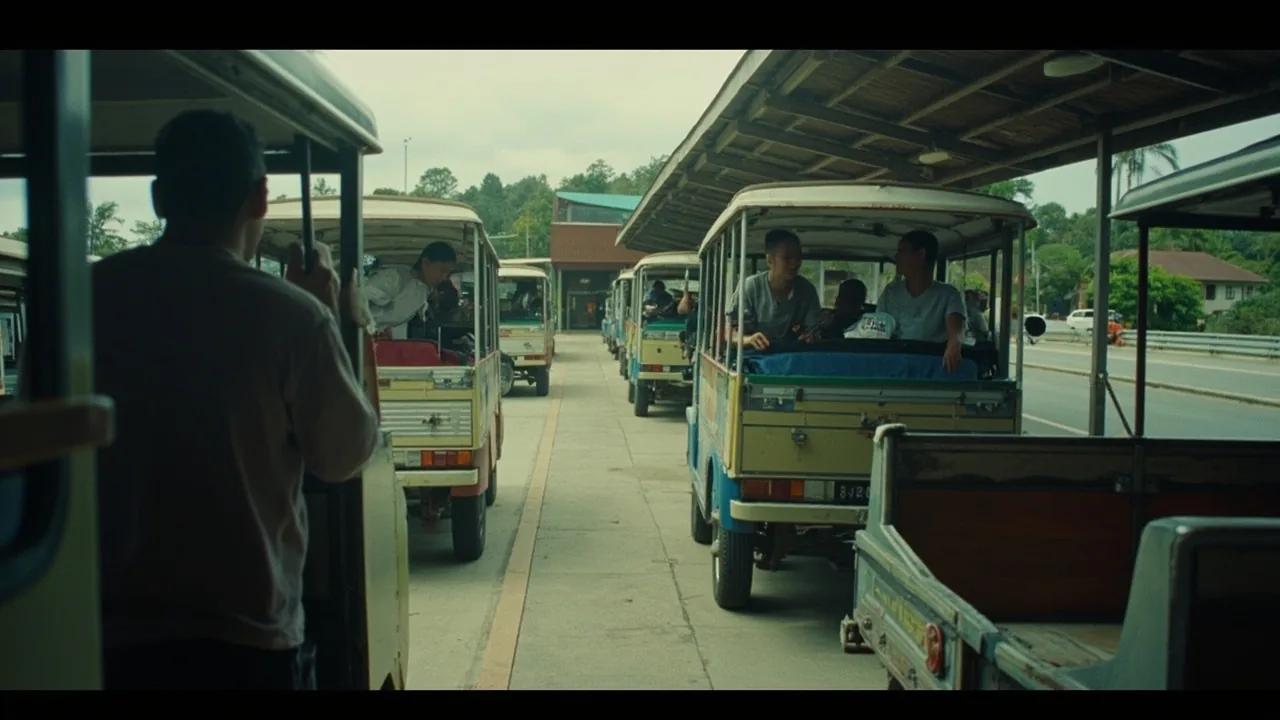
Jeepneys are the cheapest and most local way to move around Baguio. They look like stretched auto-rickshaws with bench seats on the sides, run fixed routes along main roads, and you flag them down on the street by waving your arm. If you’re new to Philippine public transport, jeepney etiquette and flagging rules are straightforward once you know the basics.
How Jeepneys Work in Baguio
- Minimum fare: 13 PHP per person for the first 4 km. Every km after that adds another 2 PHP per km, but most routes from the terminal to Burnham, Session Road, or SM City Baguio fall inside that first 4 km window.
- Payment: Cash to the driver’s assistant (called the “barker”) as you step off. Small bills only, drivers cannot break 500 PHP, so bring 50s and 100s.
- Routes are painted on the windshield: Each jeepney has its destination and number displayed up front. Common ones Indian travellers use:
- Route to Mines View / Camp John Hay (passes the Loakan airport area)
- Route to Burnham Park / Session Road loop (the central shuttle)
- Route to SM City Baguio (the mall corridor)
For the Camp John Hay Eco-Trail, the Camp John Hay jeepney route drops you at the main gate, then it’s a 15-minute uphill walk to the trailhead. Check at the Camp John Hay gate office for current visitor information before heading up.
Subodh’s Pro Tip: Skip the jeepney if you have heavy luggage. The seats are narrow and there is no luggage rack, just your knees and the aisle floor. Take a Grab instead.
Taxis and Grab in Baguio
Baguio has both regular metered taxis and Grab. Grab is cleaner, fixed-price, and you don’t have to argue with a driver about whether the meter is “broken.”
Taxi Fares in Baguio (Metered)
- Flag-down rate: 40 PHP (₹70 (~$0.73)) for the first 500 m
- Per 200 m after that: 3.50 PHP (₹6 (~$0.06))
- Typical cross-town ride: 80–130 PHP (₹140-₹227 (~$1.45-$2.35)), Burnham Park to Mines View is at the upper end of that range
Grab in Baguio
Grab works in Baguio but coverage is patchy outside the CBD. Inside Session Road, Burnham, SM City, and Camp John Hay you will usually get a car in under 5 minutes. In Mines View after 8 pm, expect to wait longer for a car to be assigned. The same Grab payment rules that apply in Manila work here: set payment to “cash” in the app before booking.
Grab payment note: To avoid auto-charge issues, set the payment method to cash in the app before booking, then pay the driver directly in PHP.
Where to Stay Near Transport Hubs
Most backpackers stay in transient houses or budget hotels near Session Road. For a transport guide, what matters is choosing a base near the jeepney loops so you spend less on every ride. The area around the Victory Liner terminal on Shanum Street has several budget options within walking distance, and jeepneys to Session Road, Burnham Park, and SM City depart right outside the terminal gate. For a full Baguio breakdown including where to stay and what to do, see our complete Baguio guide.
If you’re arriving on an overnight bus from Manila, the terminal area is well-lit and has jeepneys running until around 9 pm, so you can reach your accommodation without needing a taxi.
Baguio Transport Terminal
The main long-distance bus terminal in Baguio is on Shanum Street, just outside the CBD near Porta Vaga Mall. This is where Victory Liner, Genesis, Solid North, and JoyBus drop off Manila arrivals and pick up departures heading back down.
What the Terminal Has
- Waiting area: Open-sided shed, bring a jacket even in April, Baguio mornings are cold
- Ticketing: Walk-up counters for each operator. Bookings open 3–5 days ahead for premium buses like JoyBus
- Toilets: 10 PHP per use, bring tissues
- Jeepney stand: Right outside the terminal exit, jeepneys to Session Road, Burnham, and SM City line up here
Safety Alert: At night, the area around the bus terminal has informal tricycle touts who quote inflated flat rates (“200 PHP to Session Road”). Walk 50 m out of the terminal gate to flag a metered taxi or a passing jeepney instead.
Getting Connected
You need working data to book Grab in Baguio, no question about it. Local SIMs are cheap, and there’s an eSIM option if you don’t want to swap your Indian number out.
- Globe / Smart physical SIM: Sold at the airport and at any 7-Eleven, with 7-day tourist data packages commonly available.
- Tourist eSIM alternative: One tap install before you fly, no passport photocopy at a kiosk. Get Nomad eSIM is the easiest option for Indian travellers landing at NAIA or Clark.
What to Eat Between Rides
Baguio’s cool weather makes you hungry faster. Eat at one of these near the jeepney routes so you don’t waste a transfer.
- [Tong Yang, SM City Baguio] for unlimited hotpot, around 599 PHP (₹1,047 (~$10.85)) per head with broth and a sauce bar. Worth it on a foggy Baguio evening.
- [Manam SM Baguio] for Filipino comfort food, the sinigang (sour soup) and kare-kare (peanut stew) make a warming rice bowl for around 350 PHP (₹612 (~$6.34)).
- Baguio Night Market (Food Stalls) for cheap eats after dark, try the grilled sweet corn (25 PHP / ₹44 (~$0.46)) and the taho (silken tofu, 20 PHP / ₹35 (~$0.36)).
- [Canto] a short jeepney ride from Session Road, the truffle sisig (480 PHP / ₹839 (~$8.70)) is what regulars order, with calamansi sorbet (180 PHP / ₹315 (~$3.26)) to follow.
- [GOODTASTE RESTAURANT] for the pinikpikan, a traditional Igorot chicken stew, around 380 PHP (₹664 (~$6.88)) per serving. Substantial meal, the kind of plate you want after a cold morning at Camp John Hay.
For dessert or a warm drink near the terminal, the night market runs till around 10 pm and has strawberry taho (40 PHP / ₹70 (~$0.73)) which is hard to find anywhere else.
Common Transit Mistakes Indians Make
1. Flagging the wrong jeepney and ending up at the edge of town. Jeepney destinations are painted in small script on the windshield. If you can’t read it, the barker will help, ask before hopping on. Otherwise you’ll ride 20 minutes out to a residential area you didn’t want to visit.
2. Paying taxi drivers before they start the meter. Some drivers quote a flat 200–300 PHP (₹350-₹525 (~$3.63-$5.44)) to go anywhere. Refuse politely and ask them to use the meter. Or book Grab, the price is fixed in the app.
3. Forgetting that Baguio is colder than Manila. You will need a jacket after sunset, even in May. Waiting 20 minutes at the terminal without one is miserable. Pack a light layer in your daypack.
4. Taking a tricycle for “short distances” without negotiating. Tricycles (motorbike with sidecar) are useful for steep streets jeepneys don’t serve, but they quote high. Counter-offer 50 PHP (₹88 (~$0.91)) for a 1-km ride. If they refuse, walk. Streets in Baguio are walkable.
5. Driving yourself up via Kennon Road without checking the bulletin. Kennon Road closes occasionally for landslides. The NLEX-SCTEX Facebook page and the City of Baguio Facebook page post closure notices the same day. Check before you leave Manila if you rented a car.
How to Get Out of Baguio
| Mode | Destination | Price | Operator | Book |
|---|---|---|---|---|
| bus | Manila | 700–1,100 PHP | Victory Liner / Genesis / Solid North / JoyBus | Walk-up at terminal |
| bus | Sagada | 350 PHP | Coda Lines | Walk-up at terminal |
| bus | Vigan | 700 PHP | Partas | Walk-up at terminal |
If you’re heading to Cebu next, the bus-to-Manila-then-fly route is standard. Check our Cebu airport guide for the cheapest ways from Mactan airport to the city.
If you came up on Kennon Road, ride back on Marcos Highway (also called the Tarlac-Pangasinan-La Union Expressway extension). It is faster, less winding, and the buses that use it arrive in Manila with fewer complaints. Marcos Highway is the standard return route for most Manila-bound buses leaving the Shanum Street terminal.
Subodh’s Take
Baguio is one of the few Philippine cities where you genuinely don’t need to rent a scooter, the jeepney grid covers everything a tourist wants to see and the hills are short enough to walk if you pace yourself. Spend your money on the Night Market and the bus fare, skip the tricycle rip-offs, and book the Grab when the rain hits. Book a jeepney, pay the barker, and keep small change handy. Manila to Baguio is the route where most Indian backpackers just take the bus, the same logic that keeps Bangkok arrivals using the airport-to-city bus instead of a taxi.
FAQ
Is Grab available in Baguio?
Yes, GrabCar and GrabTaxi operate inside Baguio CBD, Session Road, Burnham, SM City, and Camp John Hay. Coverage drops in outlying areas like Mines View or Loakan. Set payment to “cash” since Indian cards often fail on auto-charge.
What is the jeepney minimum fare in Baguio in 2026?
13 PHP (₹23 (~$0.24)) per passenger for the first 4 km. Every km after adds 2 PHP.
Where is the main bus terminal in Baguio?
The Victory Liner / Genesis / Solid North terminal is on Shanum Street near Porta Vaga Mall. All Manila, Vigan, and Sagada buses depart from here.
Can I use an Indian driving license in Baguio?
Yes, for renting a car (with an International Driving Permit). You must have the IDP; the LTFRB runs checkpoint stops on Marcos Highway, and carrying your passport and the IDP together is the standard way to clear them.
Is Baguio walkable in one day?
Yes, the CBD (Session Road, Burnham, Baguio Cathedral, SM City) is walkable in a long day. Mines View, Camp John Hay, and the night market require jeepneys or a Grab.
How safe is the jeepney ride at night?
Generally safe, jeepneys run until around 9 pm on most routes. After that, switch to a metered taxi or book Grab if a car is available.
- Subodh
