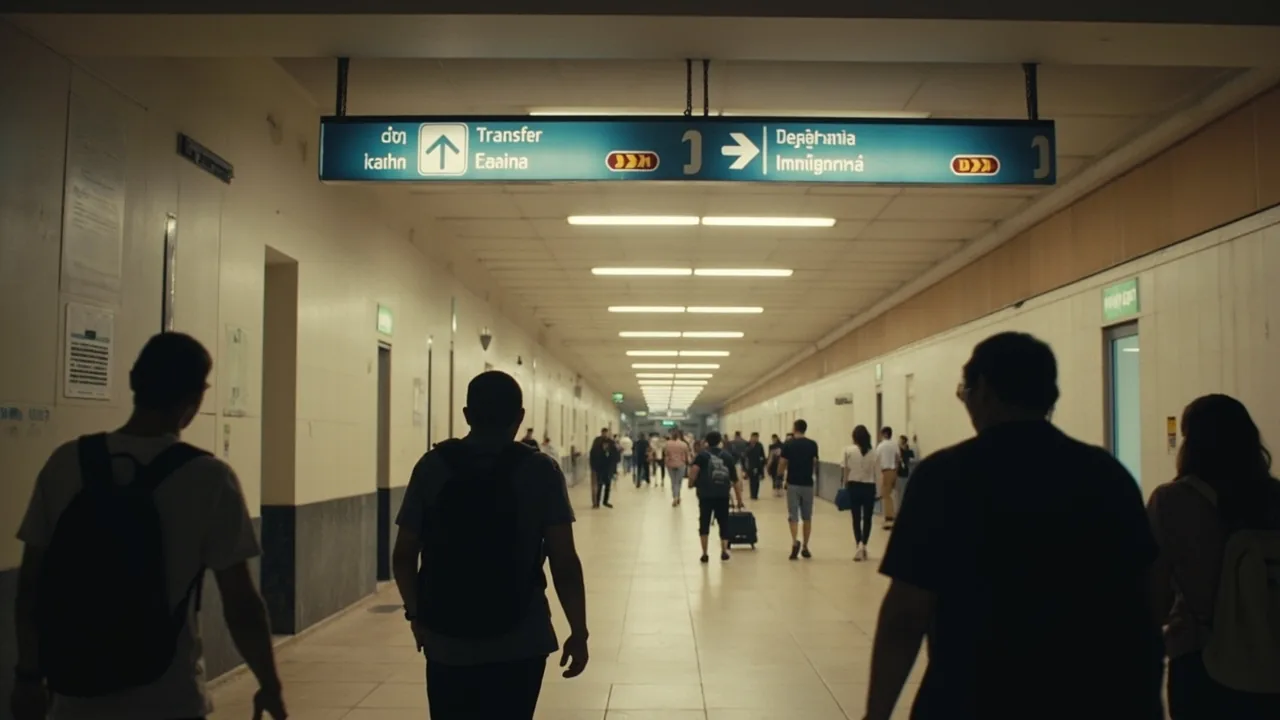
Bangkok Suvarnabhumi Airport (BKK) Guide: Transit Rules, Layover Tips & Arrival
Bangkok’s Suvarnabhumi (BKK) is one of Southeast Asia’s busiest hubs, and the bangkok airport transit rules are traveller-friendly: single-ticket airside connections need no Thai visa, while longer layovers let Indians use Thailand’s visa-free entry. The catch is BKK’s size.
Subodh’s Pro Tip: Verified against the Thai Immigration Bureau’s current visa-exemption list and the Airports of Thailand (AOT) terminal map as of 17 July 2026. Always double-check your specific airline’s minimum connection time before booking.
Quick Answers
| What | Answer | Price (INR) |
|---|---|---|
| Do Indians need a transit visa at BKK? | No, if you stay airside on the same ticket. For leaving the airport, Thailand’s visa-free entry applies. | ₹0 |
| How long is visa-free entry for Indians? | 60 days (visa exemption, extendable once by 30 days at immigration). | ₹0 |
| Is a 2-hour layover enough at BKK? | Tight. BKK is huge, immigration for transit-onward is fast, but gate walks are long. Aim for 3+ hours. | , |
| Cheapest way from BKK to central Bangkok? | Airport Rail Link (ARL) to Phaya Thai, then BTS. | ₹129 (~45 THB or ~$1.34) |
| How much is a metered taxi from BKK to Khao San? | Around ₹1,005 (~350 THB or ~$10.43) plus ₹144 (~50 THB or ~$1.49) airport surcharge and tolls. | ₹1,005-₹1,436 (~350-500 THB or ~$10.43-$14.89) |
| Where can I sleep at BKK during an overnight layover? | Airside sleep pods near Gate F, free quiet zones, or transit hotels inside the terminal. | ₹1,723-₹5,743 (~600-2,000 THB or ~$17.87-$59.57) |
| SIM card at BKK for Indian phones? | AIS, dtac, or TrueMove kiosks airside and landside. | ₹859 (~299 THB or ~$8.91) |
Understanding Transit at BKK
The single biggest confusion for first-time travellers is the difference between transit (airside) and entering Thailand (landside). They are two completely different situations with different rules.
Airside Transit (Staying Inside the Terminal)
If your itinerary is booked on a single ticket (for example, Air India Delhi to BKK to Chiang Mai, all on one PNR), you physically stay inside the international transit area. You walk from your arrival gate, follow the purple “Connecting Flights” signs, go through a brief transit security check, and walk to your departure gate. You do not pass through Thai immigration. You do not need a Thai visa.
This applies whether your next flight is domestic or international. The domestic gates (for Thai Vietjet to Krabi, AirAsia to Phuket, Nok Air to Chiang Mai) are accessible airside via the same transit corridor.
Landside Transit (Leaving the Airport)
If you have a separate ticket, or you want to leave the airport during a long layover (say, 12 hours overnight and you want to sleep in a Bangkok hostel in the backpacker district), you must clear Thai immigration. This is where visa rules apply.
Indian passport holders do not need a pre-arranged visa for short tourist visits. Thailand’s bilateral visa-exemption arrangement lets Indians enter for up to 60 days without a visa. You will get a stamp at the immigration counter. This counts as a “visa-free entry,” not a “transit visa.” There is no separate transit-visa category for Indians at BKK.
Safety Alert: If you leave the airport on a separate ticket (booked separately from your inbound flight), you need at least 4 hours of buffer, plus 2 hours for re-check-in. A 6-hour total layover is the minimum for a same-day Bangkok exit-and-return. For overnight, 10+ hours is more realistic.
Is a 2-Hour Layover Realistic?
Honestly, no. BKK is enormous. It handles over 60 million passengers a year and stretches across a single terminal building that is roughly 3 km end-to-end. The minimum connecting time officially set by most airlines for international-to-international connections is 90 minutes. International-to-domestic is usually 2 hours minimum because domestic gates sit on a different concourse.
In practice, you will spend 15-25 minutes walking (or taking the underground shuttle train), 10-15 minutes in transit security, and another 5-10 minutes waiting for a gate to open. That leaves zero margin if your inbound is delayed. If you are on a single PNR and the airline short-checks your bag, you are fine. If you are on separate tickets and need to re-check bags, 2 hours is asking for trouble.
For 3-4 hours, you can reasonably make an international-to-international connection, get a snack, and stretch. For 5+ hours, you can leave the airport for a quick central Bangkok meal at spots like The Island Bangkok. For 8+ hours overnight, you have real choices: sleep pods, transit hotels, or a hostel in town.
BKK Terminal Layout
BKK has one main terminal building split into a central concourse and seven concourses (A through G). The structure is:
- Level 1: Ground transport, taxis, buses, Airport Rail Link
- Level 2: Arrivals (immigration, baggage, customs)
- Level 3: Meeting point, some shops
- Level 4: Departures (check-in, security)
- Concourse F and G: Most international carriers (Air India, Thai Airways, Emirates)
- Concourse D and E: Some international and domestic
- Concourse A, B, C: Domestic and regional low-cost carriers
For international-to-international transit, you will mostly stay between F, G, E, and D concourses. The transit corridor is air-conditioned, well-signed, and has the underground shuttle (Automated People Mover) between concourses.
Subodh’s Pro Tip: If your next flight departs from Concourse A (AirAsia domestic, for example), the shuttle train from the main concourse is the fastest way. Walking takes 15-20 minutes with luggage.
Getting from BKK to Central Bangkok
You have four main options, ranked roughly by cost versus convenience.
Airport Rail Link (ARL)
The ARL is the best balance of speed and price. It runs from BKK’s basement level (Level 1) to Phaya Thai station in central Bangkok in about 30 minutes, with stops at Makkasan (for MRT interchange) and Ratchaprarop (for Pratunam area). Trains leave every 10-15 minutes from roughly 6 AM to midnight. A standard one-way ticket costs ₹129 (~45 THB or ~$1.34).
From Phaya Thai you can connect to the BTS Skytrain. From Makkasan you can connect to the MRT Blue Line.
For a traveller with a backpack heading to Khao San or the old town, take ARL to Phaya Thai, then a short tuk-tuk or Grab to your hostel. Total: under ₹574 (~200 THB or ~$5.96) and 50 minutes.
Metered Taxi
Metered taxis queue outside Level 1 (Gate 4 and 7 are common pickup points). The trip to central Bangkok (Khao San, Silom, Sukhumvit) takes 30-60 minutes depending on traffic and costs around ₹1,005-₹1,436 (~350-500 THB or ~$10.43-$14.89) total, including the ₹144 (~50 THB or ~$1.49) airport surcharge and ₹215-₹287 (~75-100 THB or ~$2.23-$2.98) in expressway tolls. Insist the driver uses the meter. If they refuse, walk to the next taxi.
Public Bus
Buses run from the Public Transport Centre (a separate building accessible by free shuttle from Level 1). Routes S1 (to Khao San via expressway) and S2 (to Sanamluang) are useful. Cost: ₹172 (~60 THB or ~$1.79). Time: 60-90 minutes, depending on traffic. Cheapest, but slow with luggage.
Grab / Bolt
Grab and Bolt both serve BKK, but pickup is at a specific zone on Level 1 (Gate 3-4 area). The app shows the exact zone. Fares are ₹861-₹1,436 (~300-500 THB or ~$8.94-$14.89) to central Bangkok and you can pay cash to the driver or via card in the app. Use Grab for the most predictable service; Bolt is often cheaper but has fewer drivers at the airport.
Sleeping at BKK During an Overnight Layover
If your layover is 8 hours or longer and you do not want to leave the airport, you have three real options, including Miracle Transit Hotel and the Suvarnabhumi Airport Sleep Box.
Airside Sleep Pods
The “NapCubes” and similar capsule-style sleep pods are scattered around the international concourses, mostly near Gate F and Gate G. They cost roughly ₹574-₹1,149 (~200-400 THB or ~$5.96-$11.91) per hour, or ₹2,297-₹4,307 (~800-1,500 THB or ~$23.83-$44.68) for 6-8 hours. They are quiet, dark, and you stay airside. You need a boarding pass showing a same-day connection to access the airside area after midnight (when security restricts landside entry to ticketed passengers only).
Transit Hotels
There are two full-service transit hotels inside the terminal: the Novotel Suvarnabhumi (between Concourse D and E, landside) and a few smaller capsule hotels. The Novotel rooms start around ₹10,050 (~3,500 THB or ~$104.25) per night. Capsule hotels inside the terminal are cheaper at roughly ₹4,307-₹7,179 (~1,500-2,500 THB or ~$44.68-$74.47) for a night. These are technically landside, so you need to clear immigration to reach them. Nearby budget chains like ibis Bangkok Suvarnabhumi and the Suvarnabhumi Residence are a short shuttle ride away.
Free Sleep Spots
If you want to save money, BKK has free rest zones on the airside level. Look for the “Relax Zones” with reclining chairs near the central concourse. They are first-come-first-served, dimly lit, and surprisingly quiet after midnight. Bring a thin travel blanket and eye mask. There is also free airport Wi-Fi throughout.
Safety Alert: If your layover lands between 10 PM and 5 AM, immigration queues can be unpredictable. The free shuttle to the Public Transport Centre stops running around midnight. If you arrive late, a meter taxi (or pre-booked Grab) is your only guaranteed option.
Food Options at BKK
BKK’s food scene is solid for an airport. You will find everything from Thai street-food-style vendors to international chains.
For a real Thai meal landside, The Island Bangkok and Aonchorn Thai restaurant get strong reviews from travellers for authentic Thai cooking. G’s Bangkok is a popular pick for Thai-Western fusion with the Volcano Beef as a standout. Expect ₹574-₹1,149 (~200-400 THB or ~$5.96-$11.91) per dish.
For Italian or Western comfort, Medici Playhouse is well-rated and familiar to backpackers staying near Khao San or Riverside.
For Indian food when the spice cravings hit (and they will), Indique serves North Indian fine dining at around ₹1,350 (~14 USD) per person with strong reviews for butter chicken. Amritsr Restaurant Sukhumvit Soi 22 is the spot for stuffed parathas and North Indian thalis at ₹2,872-₹5,743 (~1,000-2,000 THB or ~$29.79-$59.57) per person. Shree Gangour Pure Veg Restaurant Bangkok is the pure-veg fallback, useful if you keep strict vegetarian hours.
Airside, the food court on Concourse G has pad thai, som tam, and grilled meat for ₹431-₹718 (~150-250 THB or ~$4.47-$7.45). Landside (after immigration), the options are more varied, and you can find all the chains.
Getting Connected
Pick up a SIM before you leave arrivals. AIS, dtac, and TrueMove all have booths in the public arrivals hall on Level 2, and you can walk out with a working tourist SIM in about 5 minutes. Prices start at ₹859 (~299 THB or ~$8.91) for 7 days with 15 GB. Bring your passport; registration is mandatory.
For Indian travellers who prefer eSIMs to skip the booth queue, Get Nomad eSIM plans cover Thailand and most of Southeast Asia, and activation is instant via QR code. Either option works with an unlocked Indian phone.
Subodh’s Pro Tip: If you are continuing onward to Vietnam, Laos, or Cambodia, regional SIM plans from AIS (My Asia) cover all four countries and save you the hassle of buying a new SIM at every border.
Where to Go from BKK
BKK is the main launchpad for the standard Thailand backpacker loop. Here are the most common onward routes.
| Mode | Destination | Duration | Price | Operator | Book |
|---|---|---|---|---|---|
| Flight | Chiang Mai | ~1h 15m | varies | Nok Air | Book on 12go |
| Flight | Phuket | ~1h 20m | varies | Thai AirAsia | Book on 12go |
| Flight | Krabi | ~1h 15m | varies | Thai Vietjet | Book on 12go |
| Flight | Hanoi | ~2h 30m | varies | Thai AirAsia | Book on 12go |
For overland connections, the train to Chiang Mai from Hua Lamphong (KR station) is a classic. The night train takes 12-14 hours and costs ₹2,872-₹5,743 (~1,000-2,000 THB or ~$29.79-$59.57) depending on class. For shorter hops, buses to Kanchanaburi, Ayutthaya, and the eastern islands depart from Mo Chit or Ekkamai bus terminals (MRT and BTS accessible).
For rides around central Bangkok, find local options on 12go.
Common Transit Mistakes Indians Make
1. Booking separate tickets without checking minimum connection time. If your Delhi-BKK and BKK-Chiang Mai tickets are on separate PNRs, the airline is not responsible for rebooking you if the first flight is late. You need your own buffer of at least 3 hours for international-to-domestic.
2. Assuming transit visa exists for Indians. There is no Thai “transit visa” for Indian passport holders. You either stay airside (no visa needed) or you enter Thailand under the visa-exemption program (60 days, free). Travellers who show up at the embassy asking for a transit visa get redirected.
3. Missing the immigration queue cutoff. Immigration counters are staffed 24/7, but queue times spike between 7-10 AM and 6-9 PM. A flight arriving at 8 AM during winter high season can mean 45-minute immigration queues.
4. Going landside when the layover is too short. If your layover is under 5 hours and you are tempted to “pop out for a meal in town,” do not. The round-trip (immigration out, transit back, security, gate walk) takes 90-120 minutes minimum. Eat airside.
5. Forgetting to declare cash. If you are carrying more than USD 3,000 (or equivalent) on arrival, Thai customs requires a declaration. Most Indian travellers ignore this until they are walking out with INR-equivalent of about 2.9 lakhs, which is below the threshold, so do not worry unless you are carrying large foreign currency.
6. Buying SIM after immigration before exiting. The AIS/dtac/TrueMove booths are on Level 2 (public arrivals). If you pass through and go straight to the taxi queue without stopping, you will have to come back, lose your place in the line, or buy from a more expensive in-town shop.
FAQ
Do I need a transit visa for BKK if I am connecting on the same ticket? No. You stay airside and do not pass through immigration. No visa is needed.
What if my layover is 8 hours overnight? Can I leave the airport? Yes. Indian passport holders get 60 days visa-free entry, so you can clear immigration, sleep in a Bangkok hostel, and come back the next morning. Allow at least 3 hours for the round-trip airport transfer.
Is 2 hours enough for a layover at BKK? Not really. Aim for at least 3 hours for international-to-international, and 4+ for international-to-domestic.
Where can I sleep at BKK without leaving the airport? Airside sleep pods near Concourse F/G cost ₹2,297-₹4,307 (~800-1,500 THB or ~$23.83-$44.68) per night. Free recliner zones are scattered around the terminal. The Novotel and other capsule hotels are landside, between ₹4,307-₹10,050 (~1,500-3,500 THB or ~$44.68-$104.25) per night.
How much is a taxi from BKK to Khao San Road? About ₹1,005-₹1,436 (~350-500 THB or ~$10.43-$14.89) total, including the ₹144 (~50 THB or ~$1.49) airport surcharge and expressway tolls. Use the meter.
Can I use UPI at BKK? Most airport shops and restaurants do not accept UPI. Carry Thai baht in cash or use a forex card. Grab accepts international Visa/Mastercard.
Is BKK safe for solo travellers at night? Yes. BKK has 24/7 security, well-lit terminals, and visible police presence. Standard airport precautions apply: watch your bags and do not accept help from unofficial “guides.”
What if my flight is delayed and I miss my connection? If you are on a single PNR, the airline rebooks you at no cost. If you are on separate tickets, you bear the cost. Travel insurance covers some of this, but only specific delay scenarios.
Subodh’s Take
BKK is well-oiled for international transit, but it is not the place to gamble on a tight connection. If you are booking a cheap separate-ticket itinerary through Bangkok, give yourself at least 4 hours of buffer, especially for international-to-domestic. And if you have an overnight layover, you have three real options (sleep pods, transit hotels, or going into town) and all of them work, so do not stress about it. Just decide before you land.
