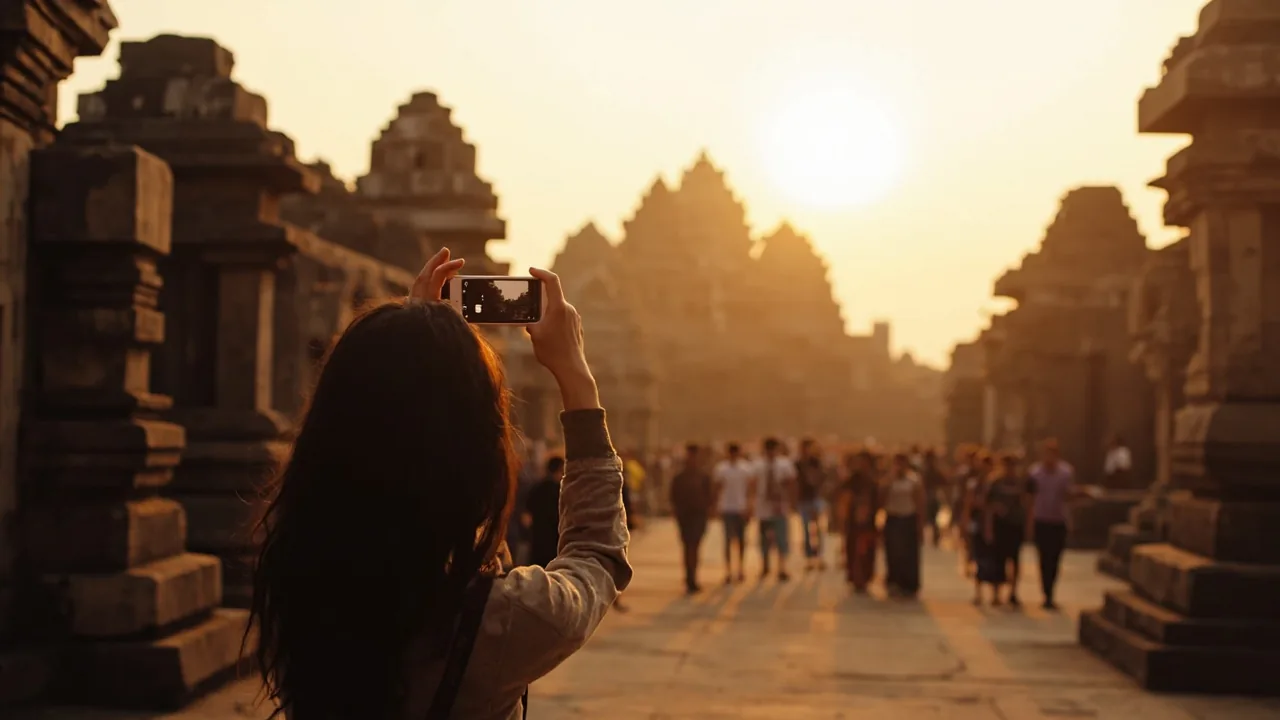
Best Instagram Spots in Siem Reap (2026)
Siem Reap is a small Cambodian town that owes its entire reason for existing to a pile of stones built 900 years ago by people who understood composition. The temples of Angkor are some of the most photographed ruins on the planet, but the town’s cafe scene, lotus farms, and floating villages give you at least three full days of photo material beyond the standard sunrise crowd shot. Indian backpackers tend to rush through in 48 hours, miss half the interesting angles, and end up with a phone full of photos that all look like everyone else’s. This guide fixes that. For related planning, see our guides on Sea Backpacking Hub and Cat Ba Island Complete Guide for Indian Travelers Beaches Caves Budget Tips.
Quick Answers
| What | Answer | Price (INR) |
|---|---|---|
| Angkor Wat 1-day pass | ₹3,565 (~37 USD), available at the main ticket center, photo at sunrise is the main event | ₹3,572 (~$37.08) |
| Bayon Temple entry | Covered by Angkor pass | Included |
| Ta Prohm entry | Covered by Angkor pass | Included |
| Lotus silk farm visit | Free, donations welcome at the on-site workshop | Free |
| Kampong Phluk floating village half-day tour | ~₹2,408 (~25 USD) with shared boat from Siem Reap | ₹2,413 (~$25.05) |
How to Get Here
If you are on the standard Banana Pancake Trail loop, you will most likely arrive from Bangkok or Phnom Penh. You may also find Kanchanaburi Hostels Where to Stay on a Budget Prices Areas What to Expect useful for this trip.
From Bangkok, the smart play is a direct flight to Siem Reap-Rep (SAI), 1 hour 10 minutes, with AirAsia, VietJet, and Cambodia Angkor Air running the route. Budget fares from Bangkok land around ₹10,006-₹17,153 (~3,500-6,000 THB or ~$103.86-$178.05) one way. Book early because these flights fill up around full moon weekends. From Phnom Penh, you can either fly (45 minutes, similar fares) or take the giant ibis or Mekong Express bus, 6 to 7 hours overland, around ₹1,252-₹1,734 (~13-18 USD). Most backpackers pick the bus for the day route since it drops you directly in central Siem Reap. Overnight sleeper buses also run but the road is decent, so day buses win on safety and sleep quality. See also: Where to Stay in Ipoh Best Hostels Hotels Picked By Indian Backpackers.
The Thai border crossing at Poipet (Aranyaprachom from the Thai side) is technically an option from Bangkok via Aranyaprachat, but the border is a known hassle for Indian passport holders, with visa-on-arrival queues, occasional tout pressure, and shared taxi markups on the Cambodian side. For your first crossing into Cambodia, pay the extra ₹1,500 (~$15.57) for the flight and keep your sanity intact. For related planning, see our guide on Where to Stay in Siem Reap Best Areas Hotels Honest Picks for Every Traveler.
Book Bangkok to Siem Reap on 12go
Where to Stay
| Hostel | Cost/night | Vibe | Book Here |
|---|---|---|---|
| Tipsy Passport Siem Reap | ₹771-₹1,349 (~8-14 USD) | Rooftop pool, social bar, the loudest pregame in town | Check prices |
| Onederz Siem Reap | ₹963-₹1,541 (~10-16 USD) | Pool, clean dorms, central, near Pub Street | Check prices |
| Lub d Siem Reap | ₹1,156-₹1,927 (~12-20 USD) | Polished, slightly older crowd, coworking lobby | Check prices |
| White Rabbit Hostel Siem Reap | ₹674-₹1,156 (~7-12 USD) | Budget, social, a bit rough around the edges | Check prices |
| THE PLACE Hostel Siem Reap | ₹771-₹1,349 (~8-14 USD) | Quiet, courtyard, walking distance to night market | Check prices |
| Siem Reap Pub Hostel | ₹867-₹1,445 (~9-15 USD) | Bar attached, central Pub Street location, party hostel | Check prices |
| Subodh’s pick: Onederz for the pool-and-pool-bar combo after a hot day of temple hopping. Tipsy Passport if you want the social scene. |
The Actual Instagram Spots, Ranked
Most lists online put Angkor Wat sunrise first and call it a day. Here is what photographs well across three days, in an order that makes sense for Indian backpackers juggling temple fatigue, heat, and a phone that runs out of storage by noon.
1. Angkor Wat sunrise (the obvious one, but you have to do it)
You cannot skip it and you will regret skipping it. Get to the main western causeway by 4:45 AM, find your spot near the reflecting pool, and wait. The light breaks behind the five central towers between 5:30 and 6:10 depending on the month. November to February gives the cleanest skies (dry season). March to May haze cuts the contrast and the humidity fogs your lens, so wipe it every 15 minutes.
The shot everyone gets is the reflection from the lotus pond in front. To stand out, walk 100 meters left of the main crowd and shoot from the corner, you get the same towers with cleaner water and no elbows in frame. A 24mm wide on a phone is enough, but a polarizing filter helps cut the morning glare off the pond. Check Angkor Wat availability
Subodh’s Pro Tip: Buy your Angkor pass the evening before. The ticket center opens at 4:30 AM and the queue at 5 AM is brutal. Most drivers know this and will suggest it without you asking.
2. Ta Prohm, the tomb raider trees
Ta Prohm is the temple with the silk-cotton and strangler fig trees growing through the gallery roofs. This is the one that looks like a movie set because it literally was one, Lara Croft rode through here in 2001. It is also the busiest temple after Angkor Wat, so the trick is to enter from the east gate (less common access point) and walk the inner gallery clockwise instead of counterclockwise. You will run into fewer tour groups and get cleaner corridor shots.
Best light: late morning, around 10 to 11 AM, when the sun clears the canopy and the dust motes light up. Wide shots of the root systems gripping the stonework beat portrait shots here. Check Ta Prohm Temple availability
3. Bayon, the faces
Bayon has 216 giant stone faces carved into its towers, all smiling in four directions. The temple sits at the dead center of Angkor Thom, so you will pass through it on the standard grand circuit. The portrait shot people go for is one face filling the frame, taken at eye level on the upper terrace, with no other tourists visible.
The trick at Bayon is to walk up to the third level around 3 PM. The crowds thin out after the morning bus crowds leave, and the low-angle sun starts raking across the carved faces. You will get one or two of the best temple portraits of your trip here. Check Bayon Temple availability
4. Banteay Srei, the pink one
Skip if you only have one day. Drive 35 minutes north of central Siem Reap for the citadel of women, a small temple with the most intricate pink sandstone carvings in Cambodia. The detail is so fine that some panels look like woodcuts. Photographically it is the opposite of the giant temples, all close-ups and texture shots, and a dream for macro work.
Tuk-tuks to Banteay Srei from town run around ₹1,734-₹2,408 (~18-25 USD) return, and drivers wait. Leave at 2:30 PM for the late afternoon light on the pink stone. Most Indian travelers skip this and regret it.
5. Pre Rup at sunset
Most people fight for sunset spots at Phnom Bakheng (limited, crowded, tickets required). Locals and serious photographers go to Pre Rup instead. It is a 10-tier temple mountain east of the main Angkor complex, much less crowded, with the same western horizon. Get there by 5:15 PM, climb to the top, and shoot the stone towers against an orange sky. Best between February and April when the dry-season haze turns the sunset pink-to-orange.
6. Siem Reap Lotus Silk Farm
A working silk farm on the edge of town, run by a women’s cooperative that makes lotus silk fabric by hand. The process takes one artisan about a month to produce enough thread for a single scarf. You can walk through the weaving rooms, watch them spin lotus stems into thread, and photograph the drying racks of dyed silk against the lake.
The Instagram shot here is the racks of bright pink, gold, and indigo silk drying outside the workshop, lake in the background, no tourists. Free entry, donations to the cooperative are appreciated. Go in the morning for the cleanest light and the most working looms. Check Lotus Silk Farm availability
7. Kampong Phluk floating village
A stilted village on the Tonle Sap lake, about 45 minutes from Siem Reap by tuk-tuk. The standout photo is the morning boat ride through the mangrove flood forest at sunrise, when the water is glassy and the fishermen pole their boats between the trees. You can also shoot the stilt houses stacked four meters above the water line.
The full-day tour from most guesthouses costs around ₹2,408 (~25 USD) per person with shared boat, and most include a stop at the floating houses on the lake itself. November to February gives the highest water levels, so the houses look most dramatic.
8. Phare, the Cambodian circus
Less of a photography location and more of an evening plan, but Phare Ponleu Selpak runs a 90-minute circus performance at their big-top venue near town. Acrobatics, live music, fire spinning, and Cambodian social-issue storytelling, all performed by graduates of a local arts school. The performance shots are good if you have a fast lens, but the social mission (training at-risk youth) is the actual story. Tickets around ₹1,734-₹3,661 (~18-38 USD) depending on tier.
9. Pub Street at night
Yes, it is touristy. No, you should not skip it for the photos. The neon signs, the street food carts under red lanterns, and the river of scooters parked along the sides make for great low-light phone shots. Best after 9 PM when the crowds peak and the heat drops.
Walk down to the side alleys off Pub Street for the actual interesting photo material. The reggae bar with the full wall of guitar stickers. The grilled-skewer carts. The kids playing in front of a temple mural. You will get five good shots in 20 minutes.
10. APOPO Visitor Center
APOPO trains giant African pouched rats to detect landmines and tuberculosis. The visitor center lets you watch the rats work, learn about the demining program, and yes, take photos. It is a 20-minute tuk-tuk from town and runs by donation. The storytelling and the science are the real draw, but the rats are photogenic enough that this lands on the list. Check APOPO availability
What to Eat
Food in Siem Reap is more interesting than the standard Cambodian rice-and-curry reputation suggests. Three things to know: street food is dirt cheap and safe at the busy stalls, vegetarian Khmer food exists but requires asking (a lot of dishes hide fish sauce), and Indian food is widely available if you need a dal fix.
Local Khmer
MAOM Khmer Cuisine is the best sit-down spot for traditional Khmer food, with a menu that covers fish amok, lok lak beef, and Khmer red curry. Mains run ₹578-₹1,156 (~6-12 USD). The amok (a coconut-fish curry steamed in banana leaf) is the dish to try, it is Cambodia’s national dish and MAOM does it well.
Street Three Eatery is the budget pick, a street-food-inspired Asian kitchen with mains from ₹385-₹771 (~4-8 USD). Order the banana flower salad and the pork belly rice.
For a break from Asian food, Fellini Siem Reap does proper Italian pasta and wood-fired pizza in a candlelit courtyard, mains around ₹674-₹1,349 (~7-14 USD). Chubby Gonzo’s is the burger spot, ₹578-₹963 (~6-10 USD) for a proper smashburger, popular with the late-night Pub Street crowd.
Indian and Vegetarian
Paratha House & Academy Siem Reap is the top-rated Indian spot, serving Pakistani and Indian dishes like Hyderabadi chicken dum biryani. Individual mains run ₹289-₹771 (~3-8 USD). Strict veg options are marked.
Dakshin’s restaurant Siemreap covers South Indian, dosas, idli, sambar, the works, with veg-friendly mains around ₹385-₹674 (~4-7 USD). Madira Indian Tapas Bar does a North Indian tapas-style menu with smaller portions, great for groups.
Drinks
Seven Bar and Infusion Bar are the two cocktail spots worth your evening. Seven Bar runs a strong Angkor Sunset cocktail (rum, pineapple, ginger), around ₹482-₹771 (~5-8 USD). Infusion has a more upscale cocktail program built around local herbs and fruits. Embargo Craft Beer & Spirits is the craft beer pick, with rotating Cambodian and regional taps, around ₹289-₹578 (~3-6 USD) per pint.
Getting Connected
Smart Axiata and Cellcard are the two main mobile networks in Cambodia. A tourist SIM from either with 30 days of data (around 30 to 40 GB) runs ₹482-₹674 (~5-7 USD) at the airport counter or any Smart/Cellcard shop in town. Buy at the airport on arrival, since the vendors in town occasionally try to charge ₹193 (~2 USD) extra.
For travelers who do not want to swap physical SIMs, the Get Nomad eSIM option works in Cambodia on the Smart network, with regional Asia plans starting around ₹482 (~5 USD) for 5 GB. Useful if you are coming from Thailand and want to keep your Indian number active on roaming.
WiFi at every hostel and cafe listed above is reliable enough for image uploads and video calls, no issues to flag here.
Daily Budget Breakdown
| Category | Budget/day |
|---|---|
| Dorm bed | ₹771-₹1,349 (~8-14 USD) |
| Food (3 meals, mixed local + one Indian) | ₹771-₹1,349 (~8-14 USD) |
| Local transport (tuk-tuks, e-bike) | ₹771-₹1,445 (~8-15 USD) |
| Activities (one temple pass day) | ₹2,890-₹3,854 (~30-40 USD) |
| Misc / drinks | ₹578-₹1,156 (~6-12 USD) |
| Total | 60-95 USD per day |
At current rates, 1 USD = ₹96.53, so 95 USD = ₹9,170. That is the realistic daily budget if you include an Angkor pass day. On non-temple days drop the activity line and the budget lands closer to ₹3,372-₹4,817 (~35-50 USD).
Visa Notes for Indian Passport Holders
Indian passport holders get a visa on arrival at Siem Reap airport and at all major land borders. The fee is ₹2,890 (~30 USD) plus a ₹578 (~6 USD) processing charge. Bring two passport photos, a USD bill in good condition (torn or wrinkled bills get refused at some counters), and your hotel address. The line moves faster if you fill out the arrival form on the plane.
E-visa is available through the official evisa.gov.kh portal for ₹2,890 (~30 USD) plus a ₹578 (~6 USD) processing fee, with a 3-day processing time. Apply at least a week before departure to be safe.
Common Mistakes Indian Backpackers Make Here
-
Buying the Angkor pass at 5 AM and waiting in line for 30 minutes. Buy it at 4:45 PM the day before at the ticket center, no queue.
-
Only visiting Angkor Wat and calling it done. Bayon, Ta Prohm, and Pre Rup together produce 80 percent of the better photo material. Plan at least two days.
-
Exchanging money at the airport. The airport rate is around 4,000 KHR per USD. In town at any of the money changers on Pub Street, you get 4,100-4,150 KHR per USD. Small difference per dollar, but adds up if you are changing ₹19,268 (~200 USD).
-
Skipping lotus silk farm and Banteay Srei for the second temple pass day. Both are photogenic, both are close to town, and both reward the extra half-day.
Where to Go from Here
| Destination | Mode | Duration | Price | Book |
|---|---|---|---|---|
| Bangkok | flight | 1h 10m | from ₹5,780 (~60 USD) | Book on 12go |
| Phnom Penh | sleeper bus | 6 to 7 h | ₹1,252-₹1,734 (~13-18 USD) | Book on 12go |
| Sihanoukville | sleeper bus | 9 to 11 h | ₹1,734-₹2,408 (~18-25 USD) | Book on 12go |
| Kampot | sleeper bus | 7 to 9 h | ₹1,927-₹2,697 (~20-28 USD) | Book on 12go |
| Chiang Mai | flight | 2h 40m | from ₹8,671 (~90 USD) | Book on 12go |
| Phuket | flight | 2h 20m | from ₹7,707 (~80 USD) | Book on 12go |
| Koh Samui | flight | 2h 50m | from ₹9,152 (~95 USD) | Book on 12go |
FAQ
Is Siem Reap safe for solo Indian travelers? Yes. Siem Reap is one of the safer stops on the Southeast Asia backpacker circuit. Petty theft is rare, the main scams are tuk-tuk overcharging and temple guide touts. Standard precautions apply after dark on Pub Street.
Do I need a drone permit for Angkor? Yes. Drone flights over Angkor Wat and the surrounding temples are prohibited without a permit from the APSARA authority. Permits exist but are slow to process. Most travelers skip the drone here and use a phone gimbal instead.
Can I get Indian vegetarian food easily? Yes, three solid Indian restaurants in central Siem Reap (Paratha House, Dakshin’s, Madira), all with marked veg menus. Pure veg travelers do fine here.
How many days do I need for Siem Reap? Three full days is the sweet spot. Day 1 for Angkor sunrise, Bayon, and Ta Prohm. Day 2 for Banteay Srei and Pre Rup sunset. Day 3 for lotus farm, Kampong Phluk, and a slow Pub Street evening.
What is the best camera setup for temple photography? A wide-angle lens (16 to 24mm on full frame, or the 0.5x ultrawide on your phone) for the architecture, and a polarizing filter for cutting the morning glare. Most of the best shots are wide. You can skip the telephoto for this stop.
Should I visit during monsoon season? You can. August and September are wet, with daily showers that clear the air and bring out the green. Crowd levels are lower, prices drop around 10 to 15 percent, and the rain photographs well against the temple stone. The downside is muddy temple paths and the occasional temple closure during heavy rain.
Are there good Instagram spots beyond the temples? Yes, this whole guide covers nine non-temple spots. Lotus silk farm, Kampong Phluk floating village, Phare circus, Pub Street, APOPO, and the cafe street behind Pub Street all give you material most lists miss.
Subodh’s Take
Most travelers do Siem Reap in 36 hours and complain it felt rushed. That is on the planning, not the town. Give it three days, get out of bed for the Angkor sunrise once, and spend your non-temple hours at the lotus farm, the floating village, and the pub street alleys. The temples are the headline, but the rest of the town is what makes the trip feel like Cambodia and not just an Angkor pilgrimage.
