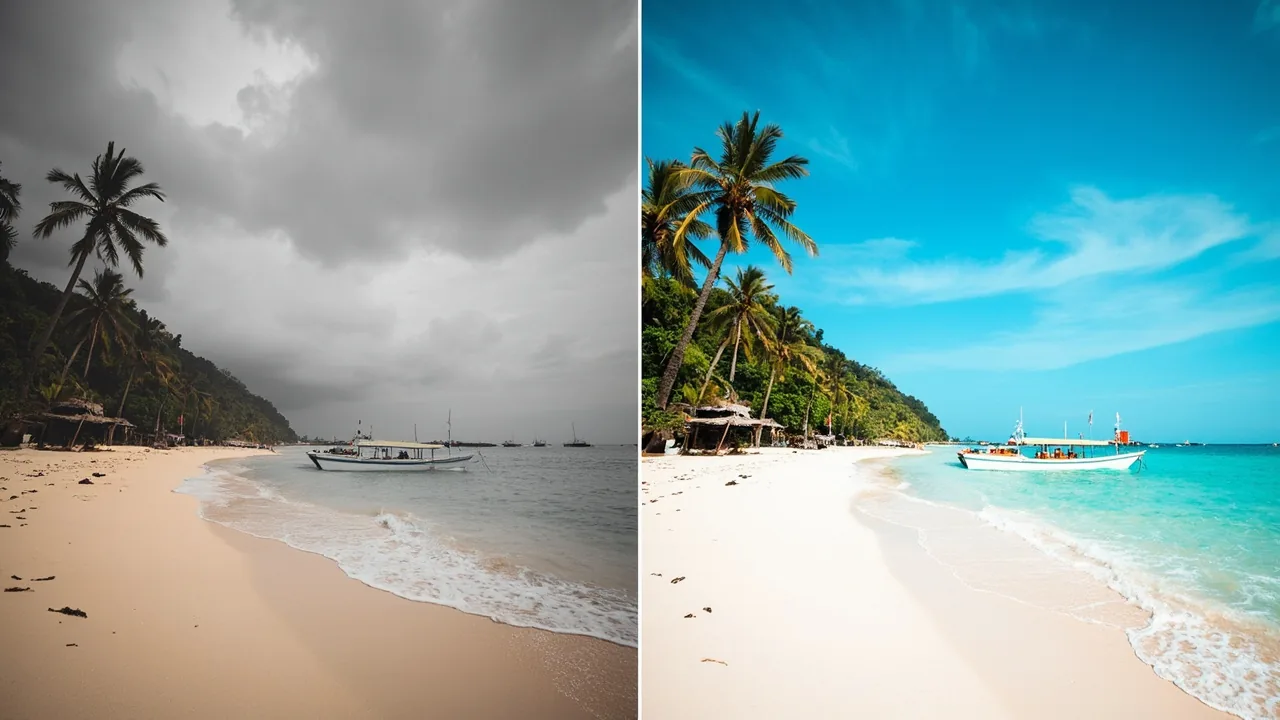
Best Time to Visit Philippines for Indian Travelers: Weather & Typhoon Season
The best time to visit Philippines for Indian travelers is December through May (dry season). July through October is typhoon peak. For related planning, see our guides on Sea Backpacking Hub and How to Travel to Philippines Cheap.
Quick Answers
| What | Answer | Price (INR) |
|---|---|---|
| Best months overall | December to May (dry season) | — |
| Months to avoid | July to October (typhoon peak) | — |
| Cheapest flight window from India | February to early March, plus October shoulder | — |
| Peak flight prices | December mid to January mid, plus Holy Week | — |
| Typhoon risk months | June (rising), July to October (peak), November (falling) | — |
| Coolest weather | January to February (25 to 29°C average) | — |
| Hottest weather | April to May (32 to 38°C in Manila) | — |
| Visa for Indians | Visa-free, 30 days, extendable | — |
| Airport terminal fee | PHP 550 to 850 (~₹825 to 1,275) | ₹825 |
| Best for island hopping | March to May (calmest sea) | — |
| Best for surfing (Siargao) | August to November (Cloud 9 swell) | — |
Philippines Weather Month-by-Month
The Philippines sits across the typhoon belt, so the year splits into three clear phases: dry, shoulder, and wet. Here’s how each month behaves on the ground, not just on a climate chart. You may also find How to Travel Abroad Cheap useful for this trip.
December. Dry season kicks in across Luzon, the Visayas, and Palawan. Manila averages 26 to 30°C, sea is calm, almost zero typhoon risk. This is the start of peak season and the airfare window from India starts climbing from mid-December onward. Book 6 to 8 weeks ahead if you want under ₹30,000 round trip (approx. ~$360 at 2026 exchange rates; check current rates before booking). See also: How to Travel Cheap.
January. Peak dry season. Coolest month in the highlands (Baguio and Sagada drop to 12 to 18°C at night), and sea conditions across the Visayas and Palawan are at their calmest. Airfare from India is at peak. Expect ₹35,000 (~$363.30) to ₹55,000 (~$570.90) round trip on Manila and Cebu routes (approx. ~$420 to ~$660 at 2026 exchange rates; check current rates before booking). For related planning, see our guide on Cebu to Bohol Ferry Price.
February. Same dry pattern, slightly warmer. This is the sweet spot for Indian travellers chasing a February school break or a long weekend: weather is identical to January but flight prices soften 15 to 20% once New Year traffic clears. Manila to Boracay, Cebu to El Nido, and Manila to Siargao all run on schedule.
March. Dry season holds but humidity starts climbing. Holy Week (Semana Santa, the week before Easter Sunday) falls in late March or early April and is the single most expensive week of the year for domestic flights and hotels. If your dates are flexible, fly in before Palm Sunday or after Easter Monday.
April. Hottest month, 32 to 38°C in Manila and the lowlands, sea stays calm. Perfect for island hopping but tiring for city walking. Airfares from India drop back to shoulder pricing once Holy Week clears around April 10 to 15.
May. Dry season officially ends mid to late May, but the first half of the month is still mostly rain-free. Temperatures peak. Travellers report May 2025 had isolated thunderstorms by the second week on the eastern seaboard. Airfares from India are at their lowest before the wet-season slump.
June. Wet season begins. Rain comes in short, heavy bursts rather than full-day downpours. Typhoon formation starts picking up in the Pacific, and the first named storm usually hits northern Luzon or the Batanes by late June. Airfare from India dips sharply (₹22,000 (~$228.36) to ₹28,000 (~$290.64) round trip is normal on Manila routes; approx. ~$265 to ~$340 at 2026 exchange rates, check current rates before booking), and hotel rates follow.
July. Typhoon season proper. Ferry cancellations between Cebu and Bohol, El Nido and Coron, and Siargao jump noticeably. Manila floods in heavy storms; Tondo and parts of Quezon City go underwater for hours at a time. If you must travel in July, stick to Palawan (western side, sheltered from Pacific storms) and accept that 30 to 40% of your days will see rain.
August. Peak typhoon month. The single worst time for Indian travellers flying into Manila and connecting to island ferries. Travellers report entire Bohol and Cebu itineraries getting wiped out by a single 48-hour typhoon landfall. Sea conditions make island hopping unsafe on smaller bangka boats.
September. Second typhoon peak. Conditions are nearly identical to August. Manila flights get cancelled more often than Cebu routes because NAIA sits in a flood-prone zone. Avoid this month unless you’re a serious surfer chasing Cloud 9 on Siargao (which is exactly when the swell is biggest).
October. Typhoon frequency starts tapering in the third week, but the first two weeks can still see major storms. This is the cheapest flight month from India to Manila, with round trips occasionally dropping below ₹20,000 (~$207.60) on low-cost carriers (approx. ~$240 at 2026 exchange rates; check current rates before booking). Travellers who book October deliberately treat it as a budget gamble: if no typhoon hits your island, you’ve saved serious money; if one does, you lose 2 to 3 days.
November. Shoulder month. The eastern Visayas and northern Luzon still see occasional storms, but Palawan, Boracay, and Cebu clear up fast. Late November is the unofficial start of peak season and airfares from India start climbing back toward ₹30,000 (~$311.40)+ round trip.
Best Months by Indian Travel Window
Indian travellers plan around three windows: summer break (May to June), Diwali and winter break (October to January), and ad-hoc long weekends. Here’s how each maps.
Summer break (May to June). Late May is the best bet: still dry, airfares softening, sea calm. June 1 onward gets riskier every week. A 7-day Boracay or Palawan trip in late May runs roughly ₹55,000 (~$570.90) to ₹75,000 (~$778.50) all-in from India (flights, mid-range hotel, island tours), versus ₹70,000 (~$726.60) to ₹95,000 (~$986.10) in January.
Diwali break (mid-October to mid-November). Avoid the first two weeks of October if your dates overlap. Book Diwali week (late October to early November) with a Palawan or Boracay itinerary rather than Cebu-Bohol, because western-facing coasts recover faster. Round-trip airfare from India spikes to ₹40,000 (~$415.20) to ₹55,000 (~$570.90) for the Diwali week and stays elevated through Christmas.
Winter break (December to January). Peak season. Best weather, worst prices, fully booked ferries 2 to 3 weeks out. Book El Nido and Coron tours before you fly, not after.
Long weekend escapes (February, March, August, November). February is the sleeper hit. Weather identical to January, flights 20% cheaper, ferries uncrowded. August is the worst time to use your long weekend.
Cost of Philippines Trip from India by Month
| Month | Round-trip airfare from India (Delhi/Bombay to Manila) | Manila mid-range hotel/night | El Nido tour day rate |
|---|---|---|---|
| January | ₹38,000 (~$394.44) to ₹55,000 (~$570.90) | PHP 4,500 to 7,000 | PHP 1,400 to 1,800 |
| February | ₹30,000 (~$311.40) to ₹42,000 (~$435.96) | PHP 3,800 to 5,500 | PHP 1,200 to 1,500 |
| March (pre-Holy Week) | ₹28,000 (~$290.64) to ₹40,000 (~$415.20) | PHP 3,500 to 5,000 | PHP 1,200 to 1,500 |
| Holy Week (late March/early April) | ₹45,000 (~$467.10) to ₹70,000 (~$726.60) | PHP 6,000 to 10,000 | PHP 1,800 to 2,500 |
| April (post-Holy Week) | ₹26,000 (~$269.88) to ₹38,000 (~$394.44) | PHP 3,000 to 4,500 | PHP 1,000 to 1,400 |
| May | ₹22,000 (~$228.36) to ₹32,000 (~$332.16) | PHP 2,800 to 4,000 | PHP 900 to 1,300 |
| June | ₹20,000 (~$207.60) to ₹30,000 (~$311.40) | PHP 2,500 to 3,800 | PHP 800 to 1,200 |
| July to September | ₹20,000 (~$207.60) to ₹28,000 (~$290.64) | PHP 2,300 to 3,500 | PHP 700 to 1,100 (frequently cancelled) |
| October | ₹18,000 (~$186.84) to ₹26,000 (~$269.88) | PHP 2,200 to 3,200 | PHP 700 to 1,000 |
| November (late) | ₹28,000 (~$290.64) to ₹40,000 (~$415.20) | PHP 3,200 to 4,800 | PHP 1,000 to 1,400 |
| December (mid onward) | ₹40,000 (~$415.20) to ₹60,000 (~$622.80) | PHP 4,500 to 7,500 | PHP 1,400 to 1,800 |
The pattern is clean: airfare and hotel rates track typhoon risk inversely. The cheapest month to fly (October) is also the month most likely to strand you on an island for two extra days. Travellers who deliberately book July to October are usually chasing surf (Siargao August to November) or accepting a 30 to 50% budget discount in exchange for typhoon flexibility.
For the visa itself, Indians get 30 days visa-free, extendable at Bureau of Immigration offices for PHP 3,030/month (~₹4,545). The terminal fee at Manila NAIA and most international airports runs PHP 550 to 850 (~₹825 to 1,275), paid separately at the airport on departure. Check current visa rules at the Bureau of Immigration before you fly because fee structures shift without much fanfare.
Step-by-Step: Picking Your Dates
Step 1: Lock your Indian travel window first
If your dates are fixed (school break, Diwali week, wedding back home), start there. If they’re flexible, the rest of this article matters. If they’re fixed and you have no real choice, book Palawan over the eastern seaboard in typhoon months because the western coast is geographically sheltered.
Step 2: Check the JTWC and PAGASA typhoon outlook
PAGASA (the Philippine weather agency) publishes a typhoon track bulletin every six hours during typhoon season (June to November). The Joint Typhoon Warning Center also tracks active systems across the Pacific. If a named storm is sitting 800 km east of Mindanao within 10 days of your flight, change your dates or your destination. Travellers report PAGASA’s 3-day forecast is more accurate than the 5-day, so don’t trust the longer window.
Step 3: Book airfare 6 to 8 weeks out for peak months, 4 weeks for shoulder
Round-trip Manila from Delhi or Mumbai follows a fairly predictable pattern. Book before mid-October for December and January travel, before late November for February, before mid-February for Holy Week travel. Off-peak months (May, June, late October, early November) can be booked 4 weeks out for the same fares you would have paid 3 months ahead.
Step 4: Reserve ferries and island tours 2 to 3 weeks out in peak season
Bohol ferries from Cebu, Coron to El Nido boats, and Siargao island tours fill up 2 weeks ahead in December, January, and Holy Week. In typhoon months the opposite is true, and walk-up bookings the day before usually work because operators over-cancel when a storm is forecast.
Step 5: Buy typhoon-refundable tickets where possible
Cebu Pacific and Philippine Airlines both offer refundable fare add-ons for 800 to 1,500 PHP (~₹1,200 to 2,250). If you’re booking July through October, the add-on pays for itself the first time your flight gets cancelled. Insurance also covers typhoon-related trip interruption. Get SafetyWing travel insurance covers Indian travellers from around ~$62/month and includes trip interruption (~$62 ≈ ₹5,200 at typical rates; check current conversion before booking).
Step 6: Plan around a 2 to 3 day buffer in wet months
If you’re flying into Manila in September or early October and connecting to an island the next morning, give yourself one full rest day in Manila. Typhoons are slow-moving systems; NAIA cancels outbound flights 6 to 12 hours before the storm hits, but the recovery takes another 24 to 48 hours. Travellers who tried to “push through” report losing 3 days of their trip to cascading cancellations.
What to Pack by Season
Dry season (December to May). Reef-safe sunscreen (the Philippines banned oxybenzone sunscreens in 2022, and most beach towns enforce it), quick-dry shirts, board shorts, a light hoodie for Baguio or Sagada nights, modest cover-ups for visiting churches in Intramuros or Siquijor, and a compact umbrella for May thunderstorms.
Typhoon season (June to November). Everything above, plus a real rain shell (not just a poncho), waterproof dry bag for your phone and passport, water shoes for flood-friendly Manila streets, anti-mosquito spray with DEET, and a small first-aid kit. Pack one less shirt than you think you need because humidity means nothing dries overnight.
Year-round. Universal adapter (the Philippines uses Type A and B, same as the US, so Indian plugs need an adapter), photocopy of your passport kept separate from the original, and an offline Google Maps download for Manila, Cebu, and El Nido because mobile data drops in storms.
Getting Connected (SIM and eSIM)
Globe and Smart both sell tourist SIMs at Manila NAIA and Cebu airport counters for PHP 50 (~₹75) for 7 days, with a PHP 100 (~₹150) data add-on for 5 GB if you need more. The counter version is the same SKU you find at 7-Eleven for a small discount, so buy at the airport only if you need data the moment you land. Get Nomad eSIM is a cleaner option if your phone supports eSIM and you don’t want to swap physical cards.
Common Mistakes Indians Make
Booking August or September to save money. You will save 30% on airfare, then lose 40% of your trip to a typhoon. The math doesn’t work unless you’re flexible by a full week on each end.
Assuming Manila weather equals island weather. Manila is consistently 2 to 3°C hotter and gets more rain than Cebu, which gets more rain than Palawan. If your itinerary is mostly Palawan, the actual weather you experience may be dry while Manila floods on the news.
Flying in the day before a ferry. Ferries get cancelled ahead of typhoons and rough seas more aggressively than flights. Always have a full Manila buffer day before any island ferry.
Skipping travel insurance for “cheap” trips. A typhoon-stranded week in Cebu costs more in rebooked hotels and missed flights than the insurance would have. The SafetyWing link above covers trip interruption specifically.
Booking Palawan tours in October without checking the southwest monsoon. Even when typhoons miss Palawan directly, the southwest monsoon (habagat) brings week-long rain and rough seas in August and September. Coron and El Nido tours cancel more from monsoon than from typhoons.
What Most Guides Don’t Tell You
Siargao surfers want September, not January. If your trip is built around Cloud 9, the typhoon season is when the waves are biggest. Book a flexible flight, plan for one typhoon buffer week, and you’ll surf empty lineups. If you’re a non-surfer on a Siargao trip in September, plan for 60% rain days.
Cebu and Bohol recover faster than Palawan after typhoons. Palawan is geographically more sheltered from Pacific typhoons, but the infrastructure rebuilds slower. After a major storm, Cebu-Bohol ferries usually run within 48 hours; Coron-El Nido boats can take a week.
The terminal fee is paid on departure, not arrival. Travellers report getting caught off guard at NAIA departure because the PHP 550 to 850 fee isn’t included in their ticket. Have the cash ready or your boarding pass gets held.
School calendars drive the worst domestic price spikes. Filipino schools break in late March to early June and again in late October to early January. Holy Week (March/April) and the December break produce the same domestic flight and hotel price spikes you’d see in India during Diwali week.
Indian SIM roaming works but is expensive. Airtel and Jio postpaid roaming runs roughly ₹650 (~$6.75) to ₹900/day (approx. ~$8 to ~$11 at 2026 exchange rates; check current rates before booking). A local Globe or Smart SIM at PHP 50 (~₹75) for 7 days is far cheaper if your trip is longer than 4 days.
FAQ
When is typhoon season in the Philippines?
June to November, with August and September as the peak. PAGASA tracks an average of 20 typhoons a year entering the Philippine Area of Responsibility, but only about half make landfall, and fewer hit the western islands where most tourists go.
What is the cheapest month to fly from India to the Philippines?
October is the lowest fare month, with round trips from Delhi or Mumbai occasionally dipping under ₹20,000 (~$207.60) on Cebu Pacific. Late May and early June are second cheapest.
Is January or February better for the Philippines?
Both are dry and calm. February is slightly cheaper and less crowded after the New Year and Chinese New Year peaks pass. January has cooler nights in the highlands.
Can I visit the Philippines during typhoon season?
Yes, with two conditions: book Palawan over the eastern seaboard, and keep your itinerary flexible enough to absorb a 2 to 3 day disruption per week.
What is the rainy season in the Philippines like?
Short, heavy bursts rather than all-day drizzle. Manila floods in extreme storms, but most rainy days still have 4 to 6 usable hours of sunshine between squalls. Humidity is the bigger issue than rain.
When is Holy Week in 2026 and 2027?
Holy Week falls on the week before Easter Sunday. In 2026 it’s March 29 to April 5, in 2027 it’s March 21 to 28. Avoid these exact weeks for domestic flights and hotels unless you book by late January.
Do I need a visa for the Philippines as an Indian?
No, Indians get 30 days visa-free, extendable to a longer stay at Bureau of Immigration offices for PHP 3,030/month (~₹4,545). The visa-free rule was last re-confirmed in 2024 and is current as of mid-2026, but verify on the Bureau of Immigration site before flying.
Is it safe to travel to the Philippines right now?
Beyond typhoon and petty theft, the standard backpacker concerns apply. Check the Indian Ministry of External Affairs travel advisory at mea.gov.in and the Philippine Department of Tourism advisory page before departure, since regional advisories (Mindanao, Sulu archipelago) shift faster than annual guidebooks update.
Subodh’s Take
If you have any flexibility at all, book February or early March. The weather is identical to peak January, flights are 20% cheaper, ferries aren’t fully booked, and you skip the typhoon gamble entirely. The single biggest mistake I see Indian travellers make is booking August or September to chase a “cheap deal” they saw on a flight aggregator, then losing half their trip to a storm and rebooking everything at peak rates from Manila. The Philippines is gorgeous year-round, but the islands work the way they work because of the typhoon belt. Plan with it, not against it.
Where to stay: Compare hotels across Manila, Cebu, El Nido, and Siargao on Booking.com or Agoda, book refundable rates during typhoon months so a storm doesn’t sink your budget.