BlueSG Car Sharing Singapore: How It Works for Tourists (2026)
BlueSG is Singapore’s electric car-sharing service, and it can be the cheapest way for a tourist to drive around, but only if you fit a narrow profile. This guide covers registration, pricing, eligibility, and how it compares to Grab and MRT, based on published BlueSG tariffs and traveller reports from July 2026.
Quick Answers
| What | Answer | Price (INR) |
|---|---|---|
| Can tourists use BlueSG? | Yes, with a valid foreign licence and International Driving Permit (IDP), but registration needs a local Singapore phone number for SMS | ₹0 to register, deposit ₹3,729 (~50 SGD or ~$38.71) |
| BlueSG per-minute rate | SGD 0.36/min for the Bluecar (subscription plans lower this to SGD 0.25/min) | ₹27/min standard, ₹19/min subscribed |
| Cheapest monthly subscription | SGD 15/month brings per-minute rate from ₹27 (~0.36 SGD or ~$0.28) to ₹19 (~0.25 SGD or ~$0.19), good if you drive over 130 min/month | ₹1,121/month |
| Cheapest physical SIM | Singtel hi!Tourist 100GB/30-day at Changi Terminal 1 counter or 7-Eleven | ₹1,343-₹1,641 (~$13.94-$17.03) |
| Can BlueSG cross into Malaysia? | No. The service is geographically fenced to Singapore, and ending a trip outside the country breaches the member terms | — |
| Cheaper than Grab for a 45-min trip? | Yes. Grab for the same trip runs ₹1,343-₹1,865 (~18-25 SGD or ~$13.94-$19.36), BlueSG is ₹1,215 (~16.20 SGD or ~$12.54) before subscription | ₹1,215-₹1,869 (~$12.54-$19.40) |
Subodh’s Pro Tip: BlueSG’s “A to B” model means you pick up at one station and drop at another, both with parking. If your hotel isn’t within a 5-minute walk of a station, you’ll spend more on the walk plus a connecting MRT ride than you save on the car.
How BlueSG Works
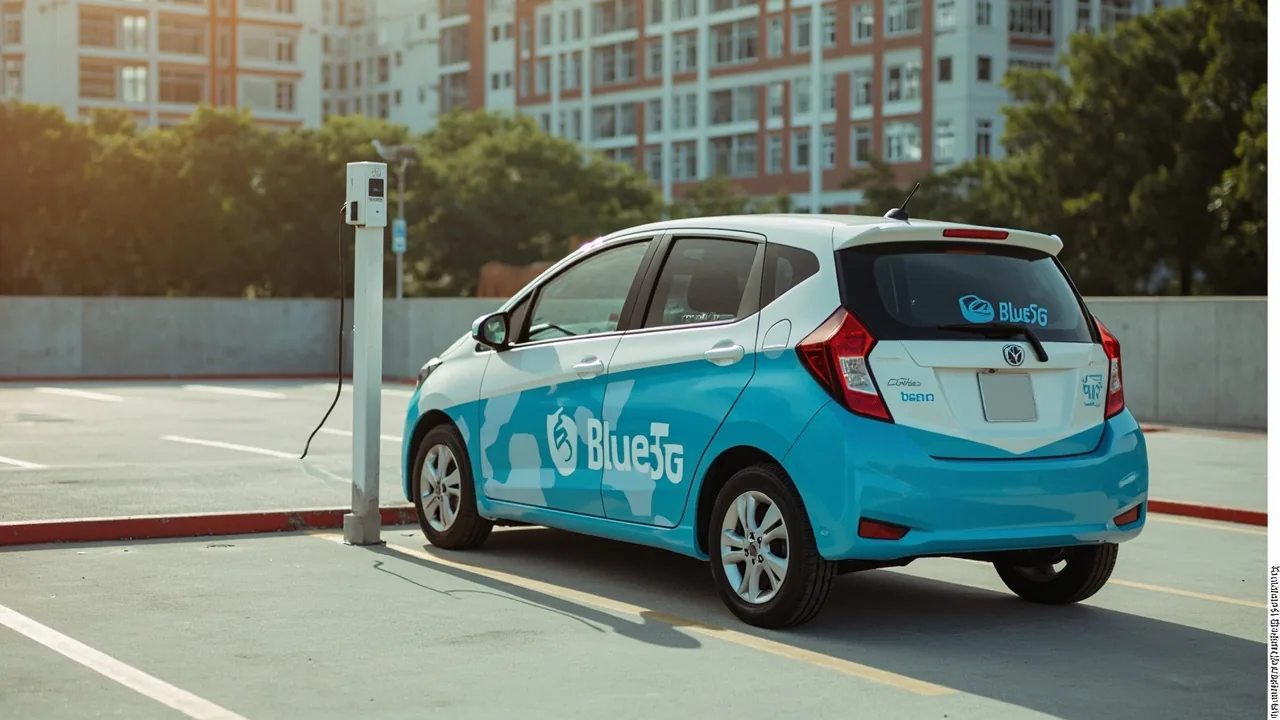
BlueSG is a free-floating, station-based electric car share. There are over 1,600 charging stations across the island, mostly in HDB carparks, a handful in private condominiums, and a growing cluster in commercial districts like one-north, Jurong Lake District, and around Changi Business Park. The cars themselves are Bolloré Bluecars: small three-door electric hatchbacks, automatic transmission, seats four (tightly), with a boot that fits two cabin-sized bags at best.
You book through the BlueSG app, get with the membership card or the app itself, drive, then return the car to any other station. You don’t have to bring it back to where you started. The whole flow is designed around the idea of one-way trips: you grab a car near your hotel, drive to a meeting, drop it at the closest station, walk the last 200 metres. The car-share model is what makes this work for short intra-city hops where a regular rental would cost more in parking than in fuel.
The bit most tourists miss: the cars are EVs, and Singapore is one of the few Southeast Asian cities with a working public fast-charging network (SP Group’s network of 500+ chargers). BlueSG runs its own slower AC chargers at every station. You don’t need to “fill up” the car. When you pick it up, the previous user is contractually required to leave it with at least 20 km of range, and the app shows the battery state at booking. If you arrive at a station with under 20 km left, you must plug it in before walking away, or you get billed a charging-fee surcharge.
Subodh’s Pro Tip: Check the battery percentage in the app BEFORE you walk to the station. BlueSG does not charge idle-walking fees, but if you walk 8 minutes to a station and find the assigned car has 12% battery left, you’ll spend the next hour topping it up before you can drive anywhere.
Who Can Drive: Tourist Eligibility
BlueSG’s official line is that foreign drivers are eligible, but the eligibility list is narrower than it sounds.
The licence rule. You need either a valid foreign driving licence in English (accompanied by an official translation), OR a foreign licence plus an International Driving Permit (IDP). Indian licences are in English, so the IDP is technically optional, but BlueSG’s app asks you to upload both during registration. From traveller reports, the safer bet is to carry both and submit both.
The phone number rule. This is where most tourists hit a wall. The BlueSG registration flow needs an OTP at three separate steps (account creation, payment The age rule. Minimum age is 21, and you must have held a valid licence for at least one year. There’s no upper age limit in the terms.
The credit card rule. BlueSG does not accept Indian debit cards, prepaid forex cards, or UPI for the deposit. A Visa or Mastercard credit or debit card (issued in or outside India, but with international transactions enabled) is the only working path. The app pre-authorises ₹3,729 (~50 SGD or ~$38.71) at registration; this is held, not charged, and is released when your membership ends.
Safety Alert: If your card gets declined at the ₹3,729 (~50 SGD or ~$38.71) pre-auth, the registration flow silently fails on the third OTP step and you’re stuck on a “verify payment” screen. There is no fallback to PayNow or GrabPay at registration, only in-app after your account is set up.
Pricing: Per-Minute, Subscription, Real Costs
BlueSG pricing is per-minute, with two layers.
Pay-as-you-go (default). SGD 0.36/min (~₹27) for the Bluecar. There is no hourly or daily cap, and there is no “free” kilometre allowance. You pay for every minute the car is unlocked, whether the engine is on or not. The clock starts at get and stops only when you end the trip at a valid station.
Subscription plans. Three tiers: SGD 15/month drops the per-minute rate to ₹19 (~0.25 SGD or ~$0.19). SGD 30/month to ₹15 (~0.20 SGD or ~$0.15). SGD 50/month to ₹11 (~0.15 SGD or ~$0.12), and includes a free 60 km of driving per month. The break-even point for the cheapest ₹1,119 (~15 SGD or ~$11.61) subscription is roughly 130 minutes of driving per month, which is more than most tourists need in a single Singapore stay. A 4-day tourist trip with one 90-minute drive a day falls just over the line.
Other charges. Trip fees include ERP (Electronic Road Pricing) gantries. BlueSG pays ERP for you and bills it back at the same rate private cars pay, with a ₹45 (~0.60 SGD or ~$0.46) admin fee per ERP-charged trip. There are no parking fees inside BlueSG stations, even in private carparks, but you cannot park in non-BlueSG lots without ending the trip. Late return fees (more than 30 seconds past your reserved end-time, or after your reservation window) run ₹746-₹3,729 (~10-50 SGD or ~$7.74-$38.71).
Sample 45-minute trip cost. Pay-as-you-go: 45 × ₹27 (~0.36 SGD or ~$0.28) = ₹1,215 (~16.20 SGD or ~$12.54). With SGD 15/month subscription: 45 × ₹19 (~0.25 SGD or ~$0.19) = ₹855 (~11.25 SGD or ~$8.71). Same trip on Grab: ₹1,343-₹1,865 (~18-25 SGD or ~$13.94-$19.36). Same trip on a one-day rental car (cheapest local operator): ₹4,475-₹6,713 (~60-90 SGD or ~$46.45-$69.68) including petrol and ERP.
So BlueSG is roughly a third the cost of Grab and a fifth the cost of a rental car, but only on a per-trip basis. If you drive fewer than 4-5 times in your trip, the subscription is a waste, and the absolute price you save versus Grab is small.
Subodh’s Pro Tip: If you’re doing a 5-day Singapore stay with 2-3 planned drives (East Coast for supper, a Mandai Zoo morning, a Changi Village seafood trip), skip the subscription and stick with pay-as-you-go. The break-even math doesn’t work for short stays, and you’ll still come out ahead versus Grab on any drive over 25 minutes.
Picking Up and Dropping Off: The Station Model
BlueSG is not free-floating in the scooter sense. You can only end a trip at a designated station, and there are about 1,600 of them across the island. Stations are concentrated in residential HDB carparks (heartland Singapore), CBD office buildings, and selected shopping malls. Tourist-area density is uneven: Marina Bay has 12 stations within a 1 km radius, Orchard has 8, Sentosa has 6, but Chinatown and Clarke Quay have only 4 between them, all in HDB carparks a 10-minute walk from the riverside.
Picking up. You reserve a car through the app (reservation is free for up to 30 minutes). The app shows the car’s battery percentage and walking distance. You walk to the station, scan the QR code on the windscreen with the app, and the doors get. The keycard attached to the dashboard starts the ignition.
Returning. You drive to any station with at least one empty bay (the app shows real-time bay availability). You must plug the car into the charger (the cable is in the boot), then end the trip. If the cable is damaged or the charger is faulty, you report it in the app and get a credit. If you end a trip at a station with zero available bays (rare, but it happens during peak lunch hours at CBD stations), the app redirects you to the next-closest station with availability.
Where tourists struggle. Hotel areas without nearby stations are the single biggest practical issue. If you’re staying around Bugis, Bras Basah, or Bencoolen, you’ll walk 10-15 minutes to the nearest BlueSG station. For those stays, MRT is faster door-to-door. Around Marina Bay, Tanjong Pagar, and one-north, the station density is high enough that BlueSG beats MRT for any cross-island drive.
Singapore’s EV Push: Why BlueSG Exists
BlueSG launched in 2017 as part of Singapore’s Land Transport Master Plan 2040, which targets nine in ten peak-period trips on public transport and a fully electric-vehicle fleet for car-sharing and ride-hailing by 2040. The government-backed investment arm Temasek holds a stake in Bolloré’s wider EV business, and the Land Transport Authority (LTA) underwrites a portion of the charging-station rollout. In plain terms, BlueSG isn’t a private startup trying to win customers from Grab. It’s a state-supported piece of a national transport decarbonisation plan.
This is why ERP gantries still charge BlueSG cars but exempt them from the COE (Certificate of Entitlement) system that pushes private car ownership prices to ₹7,458,960 (~100,000 SGD or ~$77,424.10)+ (₹7,476,490 (~$77,606.06)+) for a basic Toyota. The policy goal is to make private car ownership painful and shared electric car use cheap. BlueSG is the carrot.
The practical consequence for tourists is that BlueSG’s pricing is genuinely lower than what the equivalent cost would be in a private EV, and you don’t have to deal with the COE queue or the 300% Additional Registration Fee. The ESG framing (sustainability, lower emissions, Singapore’s Climate Action Plan) is real, not marketing fluff: the Bluecar fleet clocks about 25 million km a year on Singapore’s grid, which is one of the cleanest in Asia at roughly 95% natural gas.
Can BlueSG Cross Into Malaysia?
No. BlueSG cars cannot be taken across the Causeway to Johor Bahru or the Second Link to Tuas. There are three hard barriers:
- GPS geofence. The car’s telematics enforces a Singapore-only zone. If you attempt to drive past Woodlands or Tuas checkpoint, the dashboard shows a “Stay in Singapore” warning and the trip-end function disables.
- Insurance. BlueSG’s policy is a Singapore-domestic motor policy. It does not extend to Malaysian territory, and there is no extension option, even for an extra fee.
- End-trip requirement. You can only end a trip at a Singapore BlueSG station. There’s no station in JB, and the system will not let you end the trip at the checkpoint carparks either.
For the Singapore-to-JB leg, your options are: walk across and take a bus on the other side (the JB CIQ to Woodlands bus is the cheapest at ₹373 (~5 SGD or ~$3.87)), drive your own car or rental across (you’ll need Autopass/CIQ cards and Malaysian road tax), or take a private-hire car like Grab, which can legally cross but charges a ₹1,492-₹2,238 (~20-30 SGD or ~$15.48-$23.23) cross-border fee on top of the metered fare. The Singapore to Johor Bahru Grab guide covers that route in detail.
How BlueSG Stacks Up Against MRT, Grab, and Rental
Vs MRT. A single MRT ride is ₹75-₹186 (~1-2.50 SGD or ~$0.77-$1.94). An EZ-Link card costs ₹746 (~10 SGD or ~$7.74) deposit, of which ₹373 (~5 SGD or ~$3.87) is non-refundable and ₹373 (~5 SGD or ~$3.87) is stored value. MRT is faster than BlueSG for any trip under 30 minutes, because BlueSG’s per-minute rate doesn’t include the time it takes to walk to and from stations. MRT wins for short hops, especially to/from Changi Airport (the airport to city centre comparison breaks it down).
Vs Grab. Grab is more convenient (door-to-door), but it loses on per-minute cost for any trip longer than 25 minutes. A 45-minute Grab runs ₹1,343-₹1,865 (~18-25 SGD or ~$13.94-$19.36) versus BlueSG’s ₹1,215 (~16.20 SGD or ~$12.54). For short trips under 15 minutes, Grab is cheaper because you don’t pay the 10-minute walk each way to a BlueSG station. The Grab booking guide covers payment setup since Indian cards fail on GrabPay without a workaround.
Vs rental car. A one-day rental from a Singapore operator runs ₹4,475-₹6,713 (~60-90 SGD or ~$46.45-$69.68) for the cheapest cars, plus petrol/ERP. BlueSG wins by a factor of 3-5x on price for any single-day use. Rental only beats BlueSG if you need to leave Singapore (impossible with BlueSG anyway) or if you want a bigger car for family luggage.
Getting Connected: SIM and eSIM
You need a Singapore phone number to register for BlueSG, and you need data to use the app at all. The two cheapest paths:
Physical SIM. Singtel, StarHub, and M1 all sell tourist SIMs at Changi Airport counters. The Singtel hi!Tourist 100GB/30-day plan runs ₹1,641 (~22 SGD or ~$17.03) at the airport counter. The same SKU at any 7-Eleven after you exit is ₹1,343 (~18 SGD or ~$13.94). For budget travellers hitting the Wisma Geylang Lor 9 convenience cluster or the Mustafa Centre area, similar tourist SIMs are also stocked at the Sim Lim Square mobile shops and at selected 7-Eleven outlets along Orchard Road near Centrepoint. Activate before you leave the airport; the registration SMS to BlueSG needs to come from a working +65 number.
eSIM. If you don’t want to swap physical SIMs, a Singapore eSIM with a virtual local number works. Several providers (Nomad, Airalo, etc.) sell Singapore plans starting around ₹597 (~8 SGD or ~$6.19) for 5GB/30 days, and some include a +65 number that receives SMS OTPs. Confirm the plan explicitly includes an SMS-capable number before buying, data-only eSIMs will not work for BlueSG registration.
Safety Alert: A handful of eSIM brands market Singapore plans but only provide data, no SMS-receiving number. Those will not work for BlueSG registration. Confirm the plan explicitly lists “SMS” or “voice number” before purchasing.
Common Mistakes Indians Make With BlueSG
1. Registering on the Indian SIM roaming and assuming SMS will work. Indian roaming SMS rates to Singapore OTP numbers vary by carrier and plan, and many Indian carriers block automated SMS from Singapore shortcodes entirely. The registration flow hangs on “waiting for SMS” and there’s no fallback.
2. Leaving valuables in the car between trips. BlueSG trips end the moment you plug in the car. The next renter can get it within minutes. Anything you leave behind is gone. Travellers report losing personal items this way, always check the boot and under the seats before walking away.
3. Driving to a station with zero battery. The app shows battery state at booking, but if you reserve a car from a different station (e.g., your hotel is next to Station A but you reserve from Station B which has more available cars), the battery shown at Station B may not match the car you pick up at Station A. Check battery percentage on the windscreen display before unlocking.
4. Forgetting to plug in on return. A ₹3,729 (~50 SGD or ~$38.71) charging fee applies if you leave the car at a station without plugging in. The plug is in the boot, the cable is short, and the bay is marked. Plug in before you walk away.
5. Reserving a car and not showing up. A no-show fee of ₹746 (~10 SGD or ~$7.74) applies if you reserve and don’t get within 30 minutes. Cancelling the reservation in the app before the 30-minute window expires waives this.
6. Driving without an IDP when the licence is not in Roman script. Indian licences are in English, so IDP is technically optional, but BlueSG support may ask for one during manual account review. If your registration is stuck in review, an IDP from the AA India or your local RTO is the fastest fix.
BlueSG for One-Way Trips: Sample Itineraries
A few realistic trips where BlueSG beats both Grab and MRT.
Marina Bay to Mandai Zoo. MRT requires a transfer at Buangkok and a bus shuttle; total door-to-door is 75-90 minutes and ₹224-₹298 (~3-4 SGD or ~$2.32-$3.10). BlueSG: 30-minute direct drive, ₹806 (~10.80 SGD or ~$8.36) at pay-as-you-go. Worth it if you’re with family or luggage.
Changi Village to East Coast Parkway seafood. MRT requires a transfer at Tanah Merah and a connecting bus; 60-75 minutes total, ₹149-₹224 (~2-3 SGD or ~$1.55-$2.32). BlueSG: 25-minute direct drive, ₹671 (~9 SGD or ~$6.97). Worth it if you’re heading back to a hotel near East Coast.
Sentosa day visit from Marina Bay. MRT: ₹298 (~4 SGD or ~$3.10) including the Sentosa Express link. BlueSG: 15-minute drive to the Sentosa station, ₹403 (~5.40 SGD or ~$4.18), plus the ₹448-₹746 (~6-10 SGD or ~$4.65-$7.74) Sentosa gantry entry. MRT wins on cost; BlueSG wins on luggage convenience.
For most short-hop tourist itineraries, Grab booking and MRT are the better default. BlueSG makes sense when you have luggage, kids, or a specific cross-island destination the MRT doesn’t serve directly.
Subodh’s Take
BlueSG is a great service, but it’s not built for the average 4-day Singapore tourist. The SMS registration, the ₹3,729 (~50 SGD or ~$38.71) deposit hold, the limited stations in tourist-heavy areas, and the per-minute pricing that only beats Grab on longer trips add up to a service that makes sense for residents and Singapore-based business travellers. For a first-time visitor, Grab and the MRT will cover 95% of your trips at a lower total cost and zero setup friction. If you’ve been to Singapore before and have a clear sense of where the BlueSG stations sit near your usual hotel, then yes, the subscription is worth it for a week. For everyone else, treat BlueSG as an option for one or two specific cross-island drives, not your default.
FAQ
Do I need an International Driving Permit (IDP) to use BlueSG as an Indian tourist? Technically no, since Indian licences are in English. Practically, BlueSG support occasionally asks for one during manual registration review. Carry both to avoid a stuck-registration situation.
Can BlueSG drive to Malaysia (Johor Bahru)? No. The cars are geofenced to Singapore and the insurance does not extend across the Causeway. Use a Grab cross-border booking or a public bus instead.
How do I end a BlueSG trip? Drive to any station with at least one empty bay (shown in the app in real time), plug the charging cable into the car and the bay, then press “End Trip” in the app. The trip ends the moment you end it in the app, not when you plug in.
What’s the minimum age? 21, with at least one year of licence holding. There’s no upper age limit.
Can I use BlueSG to get to Changi Airport? Yes, there are BlueSG stations at Changi’s Terminal 1, 2, and 3 carparks. End your trip at the airport station and walk to the terminal.
Does BlueSG cover ERP charges? BlueSG pays ERP for you and bills it back at cost plus a ₹45 (~0.60 SGD or ~$0.46) admin fee per ERP-charged trip.
Can I share the BlueSG account with my partner/spouse? No. BlueSG membership is single-driver. Each driver needs their own registration, licence upload, and credit-card hold.
