Karaoke Bars in Southeast Asia: The Complete KTV Guide
Yes, there are karaoke bars across Southeast Asia in every major city, and this guide covers how KTV private rooms work. KTV is the heart of the region’s nightlife: private rooms, touchscreens, and group singing for a few dollars a head. Whether you’ve done a private-room sing-along with eight friends or you’re planning your first, here’s what to book, what to pay, and what to skip. Planning the wider region? Our Southeast Asia backpacking hub covers the full multi-country route.
Quick Answers
| What | Answer | Price (INR) |
|---|---|---|
| What is KTV? | Karaoke TV. Private room + touchscreen + song library. Friends only, no audience. | Free to enter, room charges apply |
| How much is a KTV room per hour? | Thailand ₹574-₹1,436 (~200-500 THB or ~$5.96-$14.89), Vietnam ₹368-₹1,105 (~100,000-300,000 VND or ~$3.82-$11.46), Singapore ₹2,242-₹4,484 (~30-60 SGD or ~$23.26-$46.51) per room | Room rate varies by city and chain |
| Is there food inside? | Yes, full menus, often better value than the bar outside | ₹287-₹1,436 (~100-500 THB or ~$2.98-$14.89) per dish |
| Can I bring my own alcohol? | Rarely. Most chains charge corkage ₹574-₹2,872 (~200-1,000 THB or ~$5.96-$29.79) | ₹574-₹2,872 (~200-1,000 THB or ~$5.96-$29.79) |
| Do KTVs run all night? | Most close between midnight and 2am, with weekend and outlet-specific exceptions | Hours vary by city |
The Golden Rule of KTV in Southeast Asia
Pick the songs, not the singer. Western karaoke is a stage, a spotlight, and one brave person pretending they can hold a note. Southeast Asian KTV is the opposite. You and your group lock a private room, kick off shoes (most chains expect this, you get house slippers), grab a mic each, and queue up whatever you want. No strangers watching, no DJ judging. The room is yours until the timer runs out or the staff taps the door. The whole point of karaoke bars in Southeast Asia is the group, not the performance.
Subodh’s Pro Tip: Bring a queue of 8-10 songs pre-loaded on your phone or YouTube. Most KTVs have international libraries, but the interface is built for locals. If you can’t find a Hindi track on the touchscreen, ask the staff for “Bollywood” or “Indian song.” They hear this request a hundred times a week.
KTV vs Noraebang vs Karaoke Box: What’s the Difference?
The terms float around interchangeably, but they trace to different origins.
KTV (Karaoke Television) is the Southeast Asian default, popular in Thailand, Vietnam, Malaysia, Singapore, and the Chinese diaspora. Originated in Japan but commercialised hard in Hong Kong and Bangkok. Rooms are plush, lighting is moody, food menus are restaurant-grade, and the song library leans C-pop, K-pop, Thai, English, plus a Hindi section in tourist zones.
Noraebang (노래방) is the Korean name, literally “singing room.” Korean chains have expanded across the region, especially in Bangkok, Kuala Lumpur, Singapore, Ho Chi Minh City, and Manila. The vibe is more casual, cheaper, sometimes coin-op. Korean expats and Korean-tourist zones are where you’ll find the densest cluster.
Karaoke box is the Japanese term, used in Japan and a few chains in Singapore and KL. Think slightly more polished than noraebang, similar in concept to KTV.
For you as an Indian backpacker: any of the three is the same activity. Don’t get hung up on the label, just walk in.
The Main KTV Hubs by Country
KTV quality and price spread a lot across the region. Here’s where it’s worth the trip.
Thailand: Bangkok, Pattaya, Phuket
Bangkok is KTV central in Southeast Asia, with tourist clusters in several neighbourhoods and upscale locals spots in others. Rooms run small (4-6 people) to large (15+ people with a sofa section). Pattaya’s Walking Street has late-night spots, popular with mixed crowds. Phuket (Bangla Road, Patong) is a tourist zone, prices are higher than Bangkok, the song libraries tilt to English.
Vietnam: Ho Chi Minh City, Hanoi
Vietnamese KTV is the cheapest in the region. Ho Chi Minh City District 1 (De Tham, Bui Vien, Pham Ngu Lao area) has dozens of places, often advertised as “Karaoke” with no English. Walk in, point at how many people, get assigned a room. Hanoi is similar, Old Quarter plus the street-food-nightlife belt. Expect a heavier Vietnamese and C-pop library, but most places have a Hindi section by request. Rooms are simpler than Bangkok, beer is cheaper.
Malaysia and Singapore
KL and Singapore are where the KTV chains have gone corporate. Pricing is 2-4x Thailand, but the rooms are spotless, the song libraries are massive, and English/Hindi are well-supported. Malaysia’s Bukit Bintang and Singapore’s Plaza Singapura / Orchard area are the main clusters. Family-friendly in the afternoon, party-heavy from 9pm. Read our Kuala Lumpur Bukit Bintang budget guide for Indian backpackers for the full KL scene.
Cambodia, Laos, Philippines, Indonesia, Myanmar
Phnom Penh and Siem Reap have KTV but it’s quieter, mostly expat and Chinese-tourist. Vientiane has a few karaoke places on the main strip but the scene is small. Manila has the densest KTV-in-mall culture in the world, every big mall has a floor of small private rooms. Our Manila nightlife guide covers where to head after the session ends. Bali and Jakarta are a mixed bag, KTV exists but bars and beach clubs dominate the tourist night. Yangon and Mandalay have KTV but the tourist-facing scene is thin.
How KTV Pricing Works (And What to Watch For)
Subodh’s Pro Tip: Always ask, in writing or in person, whether the room rate includes a minimum spend on food and drink. The two main pricing models look similar on a menu but cost differently by the end of the night.
Two models, often combined:
Hourly room rate + pay per food/drink. Common in Bangkok and Vietnam. ₹574-₹1,436 (~200-500 THB or ~$5.96-$14.89) per hour for a small room, ₹368-₹1,105 (~100,000-300,000 VND or ~$3.82-$11.46) in Vietnam. Then you order from the menu at normal prices, slightly marked up.
Minimum spend model. Common in Singapore, KL, and upscale Bangkok. You pay a fixed amount (e.g., ₹2,242-₹4,484 (~30-60 SGD or ~$23.26-$46.51) per room in Singapore) and the food and drink are included or discounted against that minimum. For a group of 6-8, this usually works out cheaper than ordering à la carte.
Peak vs off-peak. Most chains run cheaper rates Sunday-Thursday, especially before 8pm. After 10pm Friday and Saturday, prices jump 30-50%. Some places have a “happy hour room” deal for early slots.
What to avoid: unclear “service charge” line items at the end of the bill. In Thailand, 10% service + 7% VAT is normal. In Vietnam, 10% VAT is normal. Anything beyond that is negotiation territory.
What to Expect Inside a KTV Room
The first time is disorienting. Here’s the layout, room by room.
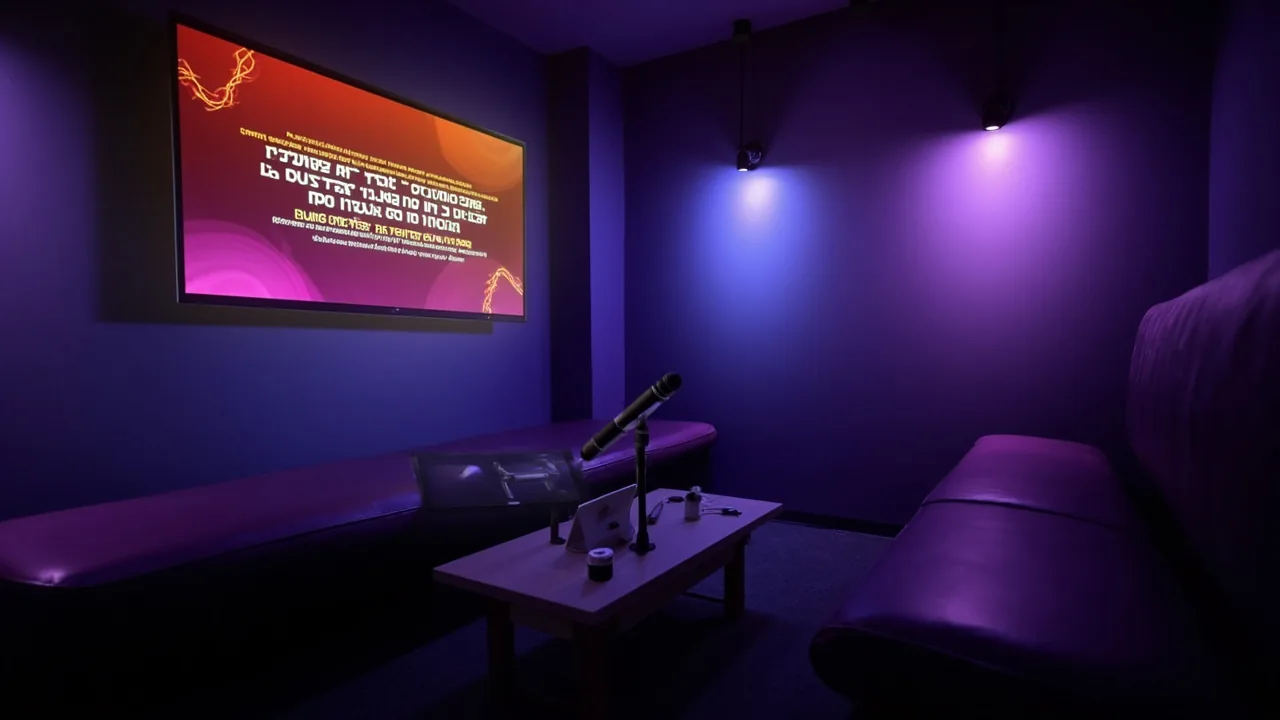
The room is small, often windowless, soundproofed. A wall-mounted touchscreen runs the song library. A shortlist of English, Hindi, Thai/Vietnamese/Korean songs sits on the main screen, with a search bar and a queue. Some chains give you a tablet controller, others use the wall screen only. Microphones (usually two, more for big rooms) plug into the wall. A sofa or bench seats 4-15 people. A coffee table holds the drinks. Lighting cycles through colours. The speakers are louder than you expect, start at 3 out of 10.
Safety Alert: Watch your drink. KTV rooms are private, staff enter and exit, and the crowd is mixed. Travellers in late-night Bangkok and Phnom Penh KTVs have reported drink spiking incidents. Never leave a glass unattended, order bottle or can instead of mixed, watch the bartender pour if you order cocktails.
Etiquette Indian Travellers Should Know
- Shoes off at the door. House slippers provided. This is non-negotiable in Thailand, Malaysia, Singapore.
- Order at least something. A room with zero food/drink orders is suspicious to staff. Even a soft drink or a snack plate gets you goodwill.
- Queue your songs. Don’t hog the mic. The whole point of a group room is the rotation.
- Tipping. Not expected in Thailand or Vietnam, appreciated in Singapore. Round up to a convenient note.
- Smoking. Most chains are non-smoking inside, some have a smoking room or a balcony. Ask at reception.
- Religious dry days. In Malaysia, certain state-level alcohol restrictions apply on Islamic holidays. In Thailand, Buddhist holidays occasionally restrict alcohol sales in some provinces (check locally). In Laos and Cambodia, alcohol is generally available daily.
Where to Eat Before or After
KTV rooms have menus, but if you want a proper meal outside, plan it. Most KTV clusters in Bangkok, KL, and Singapore are inside or next to malls and food courts, so the food choices are dense. Indian food exists in every KTV tourist zone in those cities. Don’t try to do Indian food inside the KTV, the menus tilt Thai/Chinese/Korean.
For more on the surrounding nightlife, our Bangkok rooftop bars guide and Ho Chi Minh District 1 rooftop bars guide cover the post-KTV drink.
Getting Connected
Safety Alert: KTV rooms are basement-level, your hotel Wi-Fi won’t reach, and a working phone is how you call a Grab back when the night ends at 2am. Don’t rely on café Wi-Fi you grabbed at 6pm. If you’re crossing over from Johor, our Johor Bahru weekend trip guide covers the logistics on the Singapore side.
A local SIM is still the cheapest option in Thailand, Vietnam, Cambodia, and Laos. ESIM is faster to activate when you land and works in Malaysia and Singapore if you’d rather skip the airport SIM counter.
Common KTV Mistakes Indian Travellers Make
- Treating KTV like a bar. The room is yours, you order everything to it. Walking out mid-song to “see the bar” doesn’t exist here, the bar is the touchscreen on the wall.
- Splitting the bill unevenly. Eight people, one room, food and drink piled in. Sort the bill before you walk in, or the cheapest person pays for the loudest one. Use a single card or one person pays and you Venmo/CashApp/UPI later.
- Not checking room size. A “small room” is 4-6 people. Cramming 10 in is a 30-minute mistake. Ask the staff to see the room first.
- Showing up unannounced on Friday at 11pm. Peak hours in Bangkok, KL, Singapore, you will queue 30-60 minutes or get turned away. Book ahead via phone or app, or shift to Thursday/Sunday.
- Drinking and driving back. Don’t. The KTV cluster in every city is also a Grab/Bolt zone. Save a fraction of the room cost for the ride back.
Closing Hours and 24-Hour Exceptions
Bangkok and KL chains often close 1am on weekdays, 2-3am weekends. For Penang after-hours, our Penang nightlife guide lists the spots still serving at 2am. Singapore’s licensing is tighter, 2am weekdays, 3am weekends (varies by outlet). If you want a guaranteed late-night KTV, check the local tourist zones for the latest opening hours.
FAQ
Is KTV safe for solo travellers? Yes, solo travellers are common, especially in Bangkok and KL. Solo = smaller room, smaller bill. The chains are used to 1-2 person walk-ins.
Do they have Hindi songs? In Bangkok, KL, Singapore, and tourist Vietnam, yes. In local Vietnamese and Cambodian KTVs, the Hindi library is thin. Ask for “Bollywood” or “Indian song,” staff will know.
Can I bring my own alcohol? Rarely, but most chains charge corkage ₹574-₹2,872 (~200-1,000 THB or ~$5.96-$29.79) if they allow it. Cheaper to just order from their menu.
Is it family-friendly? Afternoon sessions (before 8pm) in Malaysia and Singapore are family-heavy, including kids’ birthday parties. After 10pm, the crowd skews adult.
What’s the legal drinking age? Thailand 20, Vietnam 18, Malaysia 21, Singapore 18, Laos 18, Cambodia 18. Most KTVs don’t check ID for entry but will for drinks.
Do KTVs accept cards? Bangkok, KL, and Singapore, yes. Vietnam and Cambodia, cash is safer.
Subodh’s Take
KTV in Southeast Asia is the cheapest, most fun night out you can have without standing in a club. The rooms cost what a couple of cocktails cost in Mumbai or Delhi, the food is decent, and the only thing standing between you and a great night is the willingness to sing badly in front of your friends. Pick the chain, pick the room, queue the songs, and let the mic rotate.
SafetyWing Insurance CTA: Travel insurance matters more on a KTV night than a temple visit. Get SafetyWing travel insurance covers Indian travellers from ~$62/month (~₹5,900). Includes COVID, trip interruption, and medical evacuation across Southeast Asia.
