Loy Krathong 2026: Thailand’s Festival of Lights Guide for Indians
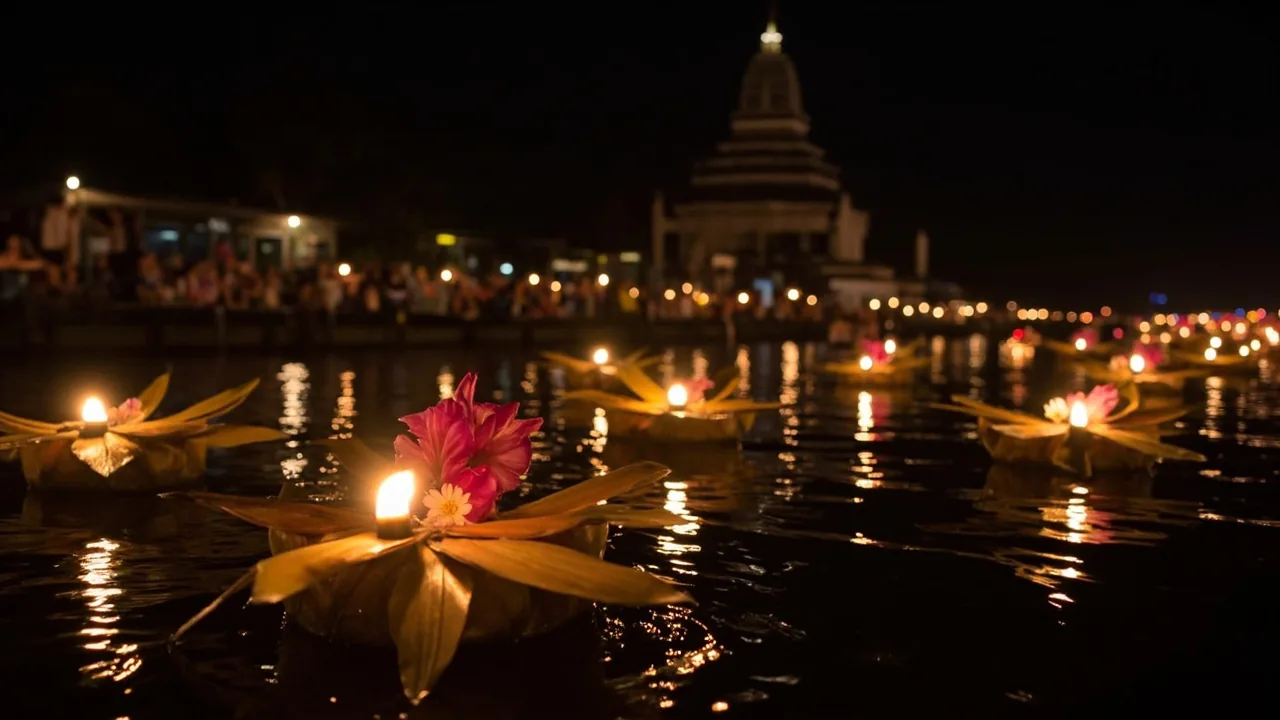
The loy krathong festival is one of those rare Thai festivals that pulls everyone outdoors at the same time: couples, monks, kids, grandmothers, and a thick wave of tourists all crouching at the same canal edge at the same minute, holding a small floating basket made of banana leaves, flowers, incense, and a candle. The lantern goes on top, the candle is lit, you close your eyes for a second, you push it off, and the canal quietly carries it away. It is free to take part in, which, in Thailand, deserves to be said out loud. For related planning, see our guide on Sea Backpacking Hub.
This is the festival that the Thai tourism board markets as the Festival of Lights. There is also Yi Peng, the Lanna (northern Thai) lantern festival that runs on the same dates and overlaps heavily, especially in Chiang Mai. You will see both names on every poster, every blog, and every airline campaign, and both refer to the same general period on the Thai lunar calendar. If you are flying from India for the festival, Chiang Mai is the version you want. You may also find Bangkok Rooftop Bars Budget Cocktail Prices Guide useful for this trip.
Quick context for Indian travellers: you can enter Thailand visa-free for 60 days on an Indian passport, the Thai baht sits at roughly 1 THB = ₹2.87, and the festival falls on a full-moon night in the 12th lunar month, which means the exact date shifts every year in the Gregorian calendar. All arrivals must also complete the Thailand Digital Arrival Card (TDAC) at https://tdac.immigration.go.th before boarding. Read on for the 2026 dates, the venues that deliver, what to wear, the Thai greeting you will need, and the scams that come out around festival week.
Subodh’s Pro Tip: Book Chiang Mai accommodation for festival week before August. The city roughly triples its room inventory online for that one week, and decent dorm beds under ₹1,715 (~600 THB or ~$17.81) disappear by September. If you wait until October, you are paying Bangkok prices in Chiang Mai, in monsoon season, for a shared bathroom.
Quick Answers
| What | Answer | Price (INR) |
|---|---|---|
| Loy Krathong 2026 dates | Evening of 25 November 2026 (full moon night of the 12th lunar month); Yi Peng lanterns in Chiang Mai run 24-26 November | Free entry (₹0) |
| Best main venue | Chiang Mai old city moat (especially Thapae Gate area) for both Loy Krathong and Yi Peng | Free (₹0) |
| What to launch | A krathong (banana-leaf basket with flowers, incense, candle, sometimes a hair strand or coin) | ₹143-₹286 (~50-100 THB or ~$1.48-$2.97) |
| Thai greeting to learn | ”Suk san wan Loy Krathong” (Happy Loy Krathong) | Free (₹0) |
| Getting connected | Local AIS tourist SIM at the airport, or a Nomad eSIM before you fly | ₹855 (~299 THB or ~$8.87) for 8 days |
All prices above in Thai baht, the local currency. At current rates, 1 THB ≈ ₹2.87. Keep this rough conversion in your head for festival week, especially when you are quoted a “festival price” for a krathong, a lantern, or a sky lantern release. Anything more than ₹429 (~150 THB or ~$4.45) for a single krathong is the tourist tax, not the real price. You may also find Palawan Nightlife Where to Drink Dance and Stay Out Late useful for this trip.
When Loy Krathong Falls in 2026
Loy Krathong is set by the Thai lunar calendar, not a fixed Gregorian date, so the date shifts every year in the Gregorian calendar. The festival takes place on the full moon night of the 12th month of the Thai lunar year, which in 2026 corresponds to the evening of Tuesday, 25 November 2026. Yi Peng, the northern lantern festival, runs across 24-26 November, with the main mass sky-lantern release happening in Chiang Mai on the night of the 25th as well.
If you are booking flights from India, you want to arrive in Chiang Mai at least one full day before the 25th. The 23rd is when the city starts decorating, when the moat gets cleaned out, when the bridge crowds start forming, and when the street food around Thapae Gate switches into festival mode. Showing up on the 25th itself is doable, but you will land in the middle of the chaos with no accommodation buffer.
Safety Alert: The Thai government periodically restricts or bans sky lanterns in Chiang Mai city centre because of fire risk and aviation safety. As of 2026, the official sanctioned mass release happens at designated zones (historically Nawarat Bridge area and around Tha Phae Gate), and lanterns are banned from being released inside the old city moat perimeter. Do not just light a lantern and let it go from your hostel rooftop or a random street corner: there have been fines, and the official zones are the ones that get to do it.
The Two Festivals: Loy Krathong vs Yi Peng
This trips up a lot of first-timers, including travel agents selling festival packages out of Delhi and Mumbai. They are related but distinct.
Loy Krathong is the pan-Thai water festival. You float a krathong (a small decorated basket) on a river, canal, pond, or even a hotel pool. The act is symbolic: you let the krathong carry away your bad luck, your grudges, your failed relationships, whatever you want to release. Bangkok does Loy Krathong along the Chao Phraya, Sukhothai does it in the old moat of the historical park (one of the most photogenic settings in the country), and Chiang Mai does it in the old city moat.
Yi Peng is the northern (Lanna) festival centred on Chiang Mai and Chiang Rai. The signature image is thousands of paper sky lanterns released at the same time, which is the shot you have seen on every travel Instagram account. Yi Peng lanterns are released into the sky, while Loy Krathong floats on the water.
In Chiang Mai in 2026, both happen on the same night and overlap completely. If you are in Bangkok for the festival, you will get Loy Krathong only. If you are in Chiang Mai, you get both, and the experience is more photogenic, especially from the bridges around the moat.
Best Venues for Loy Krathong 2026
You have three genuinely different festival experiences to choose from, and they are not interchangeable.
Chiang Mai Old City (Thapae Gate and the moat)
This is the main event. The old city moat runs around the walled centre, and on festival night the banks are packed with locals and tourists launching krathongs into the water. The Nawarat Bridge area tends to get the most concentrated crowd. Yi Peng sky lanterns are released at designated zones outside the old city moat (the perimeter ban means you do not release them inside the wall). The vibe is part carnival, part religious ritual, part street-food festival. Expect thousands of people, expect it to take an hour to walk two blocks, and expect to leave with wet shoes.
Chiang Mai is also where the festival infrastructure is best: sound systems at the bridges, designated krathong vendors, lantern zones with volunteers managing safe release, and food stalls running through the night.
Sukhothai Historical Park
This is the photogenic, slightly quieter alternative. The old moat of Sukhothai Historical Park fills with floating krathongs in front of illuminated temple ruins, which is the shot used in most Thai tourism campaigns. It is a 6-7 hour bus ride from Bangkok, or a direct flight from Bangkok to Sukhothai, and accommodation is far cheaper than Chiang Mai. If your Instagram is more important to you than the crowds, this is the better pick.
Bangkok (Chao Phraya riverside)
Bangkok does Loy Krathong along the Chao Phraya, with the main cluster around Wat Arun, Tha Tien pier, and the riverside promenades near Phra Arthit Road. It is more spread out than Chiang Mai, less photogenic than Sukhothai, and the crowds skew more local than tourist. If you are in Bangkok anyway, you do not need to fly to Chiang Mai for the festival, you can just walk down to the river.
How to Participate (Not Just Watch)
You are not a spectator at Loy Krathong. The whole point is that you build (buy) a krathong, light it, and launch it. Here is what you need to know.
Buying a krathong: Vendors set up along the moat, along the Chao Phraya, and at every temple. A traditional banana-leaf krathong with flowers, incense, and a candle runs ₹143-₹286 (~50-100 THB or ~$1.48-$2.97). The tourist-zone markup near major bridges can push this to ₹429 (~150 THB or ~$4.45), which is the price you negotiate down or walk past. Foam krathongs (the white styrofoam kind) are cheaper but worse for the rivers and a lot of festivals are actively phasing them out.
Making your own: Several temples and community centres in Chiang Mai run krathong-making workshops in the days leading up to the festival. They are typically ₹572-₹1,429 (~200-500 THB or ~$5.94-$14.84), materials included, and you get to keep the krathong you made. If you are travelling with kids, or if you want a slightly more meaningful experience than grabbing one off a stall, this is the move.
The ritual: Light the candle and incense, close your eyes and make a wish or a quiet release, kneel and lower the krathong into the water. Do not launch it upstream into someone’s face. Do not launch it with the candle unlit (it will sink). Do not laugh through the moment if you are standing near Thai families: this part of the night is genuinely spiritual for a lot of people, not a performance.
Subodh’s Pro Tip: Push off from the bank, not the bridge. Bridges get so packed that the krathongs jam against the legs of the crowd and immediately sink, which is a bad omen and a waste of ₹229 (~80 THB or ~$2.37). Find a clear spot along the moat wall, kneel down, and release it into open water.
Sky Lantern Release (Chiang Mai)
Sky lanterns (khom loi) are the defining Yi Peng image, but the rules around them have tightened significantly. In 2026, the mass sky lantern release happens at officially designated zones in Chiang Mai, and lanterns are restricted within the old city moat perimeter. You can buy lanterns at street stalls across the city for ₹143-₹429 (~50-150 THB or ~$1.48-$4.45), but you can only release them at the sanctioned zones or at your accommodation (with permission from the property).
Two practical notes: lanterns are made of paper and a small fuel cell, so they are a fire hazard on dry balconies and around overhead wiring. Several hostels in Chiang Mai explicitly ban them on their premises. And the “mass release” moments are at specific times, usually around 7pm and again around 9pm on the main festival night. Ask your guesthouse, hostel, or hotel reception what time the official release happens in your area, because the mass moment is the photo, and missing it is the kind of small regret that ruins a festival.
Thai Greetings and Phrases for the Festival
You do not need to learn much Thai to enjoy Loy Krathong, but a single greeting goes a long way with locals, especially in Chiang Mai where the Lanna culture is more reserved than Bangkok.
- Suk san wan Loy Krathong (สุขสันต์วันลอยกระทง): “Happy Loy Krathong.” Pronounced roughly “sook-saan-wan loy-kra-tong.”
- Sawasdee krub / kaa: “Hello” (krub if you are male, kaa if you are female). Use it for shops, restaurants, monks, and the random auntie selling krathongs.
- Khop khun krub / kaa: “Thank you.”
- Kor thot krub / kaa: “Excuse me / sorry.” Useful when you are pushing through the bridge crowds.
- Chai: “Yes.” You’ll hear this a lot.
- Mai chai: “No.” You will need this when vendors try to charge you ₹572 (~200 THB or ~$5.94) for a krathong.
The single highest-value phrase is Suk san wan Loy Krathong (Thailand Nightlife Safety, Alcohol Laws, and Late-Night Transport has more context on local etiquette). Saying it to a Thai vendor, a tuk-tuk driver, or a stranger on the bridge is the kind of small effort that gets you a free sample of something, a discount, or at minimum a smile. It costs you two seconds and saves you about ₹858 (~300 THB or ~$8.90) across the trip.
What to Wear
Thailand is conservative at festivals, especially around temples, monks, and family crowds. You do not need to dress formally, but you need to dress respectfully.
For the festival evening itself: long pants or a long skirt, a shirt with sleeves, and shoes you do not mind getting wet (the moat banks are muddy). For the sky lantern release: same dress code applies, plus a light jacket if you are in Chiang Mai in late November, when night temperatures can drop to 18-20°C.
A few specifics:
- Avoid white: White is associated with mourning in Thai culture. The festival is celebratory, not funereal. Wear colour.
- Avoid sleeveless tops near temples: You will be turned away from some temple events in Chiang Mai if your shoulders are bare.
- Sneakers beat flip-flops: The moat banks are slippery, the bridges are packed, and you will step on something. Wear closed shoes.
- Pack a dry bag or ziplock: Your phone and wallet are going to get wet or be in a crowd where you cannot feel your pockets. A small dry pouch costs ₹143 (~50 THB or ~$1.48) at any 7-Eleven and saves a phone.
Where to Stay for Festival Week
Chiang Mai fills up for festival week, and the price gradient is steep. The old city, especially the area inside the moat and around Thapae Gate, is the most convenient and the most expensive.
Budget dorm beds in Chiang Mai during festival week run ₹1,715-₹4,288 (~600-1,500 THB or ~$17.81-$44.51), which is 2-3x the normal ₹715-₹1,144 (~250-400 THB or ~$7.42-$11.87) you would pay in low season. Book at least 2-3 months ahead if you want to stay inside the moat. If you are okay with staying outside the moat (a 15-minute walk to the action), prices drop back to ₹858-₹1,715 (~300-600 THB or ~$8.90-$17.81) and availability opens up.
Subodh’s Pro Tip: Stay within a 10-minute walk of Thapae Gate if you can afford it. The festival crowd peaks between 7pm and 10pm, and you do not want to be the person trying to Grab a songthaew back to Hang Dong at 11pm on the one night Chiang Mai’s roads completely jam up. Walk to the festival, walk home, sleep.
Where to Eat During the Festival
The festival pulls in street food vendors from across the city, so you can eat well for ₹143-₹286 (~50-100 THB or ~$1.48-$2.97) a plate without trying. The real question is what to eat, and where, when you sit down.
For Thai food around Chiang Mai festival week, the spots worth walking to include Aonchorn Thai restaurant ออนชอน ราชดำเนิน (Ratchadamnoen, near the old city), The Simple (the name is the whole pitch, simple and reliable Thai meals), For a coffee and a break from the crowds, Chacha Beach Café & Restaurant is one of the more relaxed options.
For vegetarian and Indian food, which is what a lot of Indian travellers will be looking for after two days of pad thai, Chada Vegetarian Restaurant Chiang Mai is a reliable vegetarian spot with local and Indian dishes, and Chai “N” Thai @ Nimman Indian Restaurant in the Nimman area serves North Indian, South Indian, vegan, and halal options. Kunda Vegetarian Vegan Burger Cafe Chiang Rai is the equivalent option if you are heading up to Chiang Rai for the festival instead.
Getting Connected (SIM and eSIM)
You will want data on festival night, mostly for Grab (to get out of the crowds when you have had enough) and for Google Maps (because the moat-side streets do not have signage). Two options:
Physical SIM: AIS, TrueMove, and dtac all have tourist SIMs at Chiang Mai airport and at 7-Eleven. The AIS 8-day tourist SIM is the standard pick at ₹855 (~299 THB or ~$8.87), and it includes enough data for maps, messaging, and Grab for the week. Bring your passport for registration.
eSIM: If you want to land connected, Get Nomad eSIM before you fly. The activation is QR-code based, no passport registration at the counter, and you skip the airport SIM queue.
Night-time Safety Around the Festival
Loy Krathong night is generally safe, but it is also one of the three nights a year when Chiang Mai’s streets are most crowded, and crowd situations create specific scams.
Pickpocket watch: Crowded bridges and the moat banks are pickpocket hotspots. Phone in front pocket, wallet in front pocket, backpack worn on the front, not the back. The festival is not more dangerous than any other crowded night, but it is the night you are most likely to be pressed against strangers for an hour.
Drink spiking: This is more a concern at the bars around Thapae Gate and Loi Kroh Road than at the festival itself, but the festival flows into the bar district late at night. Do not leave drinks unattended, do not accept opened drinks from strangers, and stay with your group.
Fake “festival fees”: Any vendor trying to charge you a ₹572 (~200 THB or ~$5.94) “entry fee” to launch a krathong or to stand at a bridge is scamming you. The festival is free. Walk away.
Sky lantern scams: If a stranger offers to “help you” release a lantern for a ₹1,429 (~500 THB or ~$14.84) fee, it is a scam. You light it, you let it go, that is the whole ritual. Politely say no and walk.
Overpriced tuk-tuks: Festival night is when tuk-tuk drivers in Chiang Mai feel entitled to charge ₹858 (~300 THB or ~$8.90) for a 5-minute ride. Use Grab, agree on a meter price, or just walk. The old city is walkable end to end in 25 minutes.
Common Mistakes Indians Make at Loy Krathong
Treating it like Diwali: It is not Diwali. There are no fireworks shows, no loud celebrations, no week of pre-events. It is one night, it is meditative, and the loudest sound is the river. Coming in expecting a Diwali-scale festival will leave you disappointed.
Wearing all white: White is mourning in Thai culture. This is the most common Indian-traveller mistake. Wear colour.
Lighting lanterns from the wrong place: The old city moat perimeter is restricted. Light lanterns at the sanctioned zones or at your accommodation, not from a bridge.
Booking accommodation “near the festival” without checking the map: “Near Thapae Gate” in Chiang Mai can mean a 20-minute walk in festival traffic. Open Google Maps, drop the pin on your hostel, drop the pin on Thapae Gate, and check the actual walking distance.
Missing the krathong release by arriving late: The peak release window is 7-9pm on the main night. Arrive by 6:30pm or you will be in the back of a 5,000-person crowd with a wet krathong and no space to kneel.
Going on the wrong date: Yi Peng lantern release and Loy Krathong are on the same night, but some events run for three days. Double-check the calendar and book the 24-26 November window.
Festival Day Planning Checklist
- November 23: Arrive Chiang Mai, check in, walk the old city, scout your bridge or moat spot for the night.
- November 24: Yi Peng opening events, lantern displays, smaller crowds. Eat early, sleep early.
- November 25 (main night): Light dinner by 5pm, walk to the moat by 6:30pm, buy your krathong, release between 7-8pm, sky lantern at the official zone around 8:30-9pm, then either head to a bar around Thapae Gate or walk home. For the after-hours crowd scene, our Chiang Mai Nightlife Guide covers the Loi Kroh and Thapae Gate bar strips.
- November 26: Morning recovery, day trip to Doi Suthep, slow lunch, flight out or onward travel.
FAQ
When is Loy Krathong 2026?
Evening of Tuesday, 25 November 2026. Yi Peng lantern festival runs 24-26 November in Chiang Mai. Plan to be in the city from at least the 24th.
Where is the best place to experience Loy Krathong?
Chiang Mai’s old city moat, especially Thapae Gate and the Nawarat Bridge area, is the most concentrated and most celebrated version of the festival. For a quieter, more photogenic experience, Sukhothai Historical Park is the alternative. Bangkok’s riverside is the option if you are already in the capital and do not want to fly north.
Do Indians need a visa for Thailand for Loy Krathong?
Indians enter Thailand visa-free for 60 days on an Indian passport. You also need to fill in the TDAC digital arrival card at https://tdac.immigration.go.th before boarding. Check the Indian MEA advisory page (mea.gov.in) and the Thai immigration site for any updates closer to your travel date.
What is the difference between Loy Krathong and Yi Peng?
Loy Krathong is the pan-Thai water festival where you float a krathong on a river or canal. Yi Peng is the northern Thai (Lanna) sky lantern festival. Both happen at the same time in Chiang Mai. In Bangkok, you only get Loy Krathong.
How much does it cost to participate?
The festival itself is free. A basic krathong costs ₹143-₹286 (~50-100 THB or ~$1.48-$2.97). A sky lantern costs ₹143-₹429 (~50-150 THB or ~$1.48-$4.45). Festival-week accommodation is the expensive part, with dorm beds running ₹1,715-₹4,288 (~600-1,500 THB or ~$17.81-$44.51) versus the usual ₹715-₹1,144 (~250-400 THB or ~$7.42-$11.87).
What is the Thai greeting for Loy Krathong?
“Suk san wan Loy Krathong” (สุขสันต์วันลอยกระทง), pronounced roughly “sook-saan-wan loy-kra-tong.” Means “Happy Loy Krathong.” Say it to anyone who helps you, and watch how fast the room warms up.
Is Loy Krathong safe for solo female travellers?
Yes. The festival is family-oriented, the crowds are dense but friendly, and the main risk is pickpocketing rather than personal safety. Standard precautions: phone in front pocket, do not leave drinks unattended, use Grab instead of walking alone at 1am.
Subodh’s Take
Loy Krathong is the one Thai festival that rewards being present instead of documenting. Most visitors describe the first hour of watching lit krathongs drift down a moat with thousands of people on both banks as the visual that justifies the trip, and the next hour of trying to photograph it in a dense, wet-sleeve crowd as the part that tests your patience. Put the phone down for the release, learn the greeting, and watch the candle float away. That is the whole festival.
