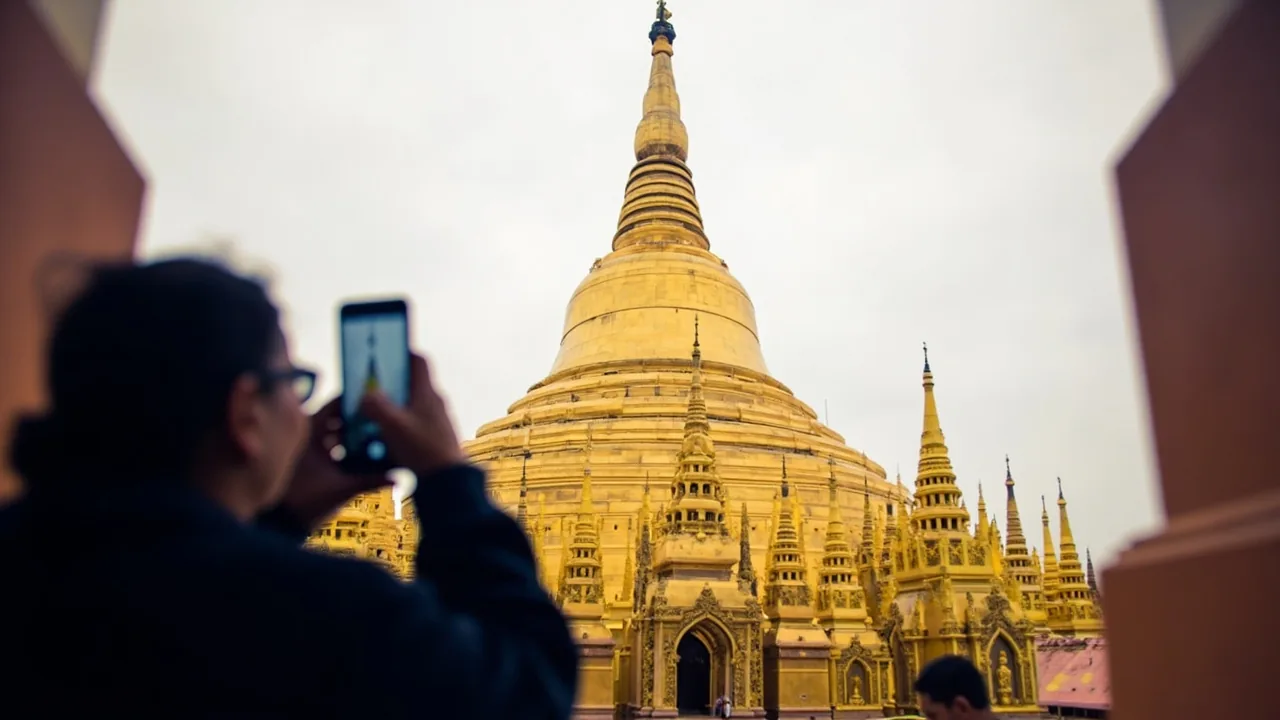
Yangon: The Indian Backpacker’s Photo Guide (2026)
Yangon is Myanmar’s old soul, a faded colonial capital where gold stupas catch the last light of the day and the streets still hum like 1925. The currency is messier than anywhere else in Southeast Asia right now, the eSIM situation is patchy, and the political situation means you have to think harder than usual before booking. If you go, you’ll come back with the strongest photo set of your whole Southeast Asia loop. That’s not hype, it’s the one thing every traveller I’ve spoken to agrees on. For related planning, see our guides on Sea Backpacking Hub and Cat Ba Island Complete Guide for Indian Travelers Beaches Caves Budget Tips.
Quick Answers
| What | Answer | Price (INR) |
|---|---|---|
| Best photo subject in Yangon | Shwedagon Pagoda at sunset (arrive 5:30 PM Nov-Feb) | 10,000 MMK (~₹240 or ~$2.50) |
| Cheapest street food | Mohinga (fish noodle soup) at a teashop | 1,500 MMK (~₹35 or ~$0.40) |
| Where Indian vegetarian travellers eat | Punjabi-Q, Lumbini Garden, MadameEm’s | 5,000 to 8,000 MMK (~₹120 to ~₹190 or ~$1.25 to ~$2) |
| Dorm bed (central Yangon) | HOOD Hostel | 18,000 MMK (~₹430 or ~$4.50) |
| Daily total budget | Dorm + food + transport + entry fees | 55,000 MMK (~₹1,310 or ~$13.75) |
Why Yangon Works for Photographers
Here’s what nobody tells you until you’ve been. Yangon rewards photographers because the light is soft and golden almost every evening, the city has hardly any glass skyscrapers, and the streets are still mostly low-rise, walkable, full of crumbling teak and colonial stucco that catches that warm 6 PM glow beautifully. You can walk a 3 km loop and shoot six genuinely great frames. Bangkok gives you one if you’re lucky. You may also find Kanchanaburi Hostels Where to Stay on a Budget Prices Areas What to Expect useful for this trip.
But Yangon is also one of the harder places in the region to visit right now. Myanmar’s banking system has been disrupted since 2021, ATMs work for foreigners only sporadically, and you need to carry clean, unmarked US dollar bills in small denominations for most hotels, trains and many entry fees. Travellers report that 2013-or-newger USD notes in perfect condition (no folds, no marks, no tears) get accepted, and older or wrinkled bills get refused outright. See also: Where to Stay in Ipoh Best Hostels Hotels Picked By Indian Backpackers.
If you’re a serious photographer with patience for bureaucracy, Yangon is one of the best stops on the Southeast Asia circuit. If you want a smooth trip, skip it. That’s the honest split. For related planning, see our guide on Where to Stay in Lombok Best Areas Neighborhoods for Every Traveler.
How to Get There (From the Trail)
Most Indian backpackers arrive in Yangon by air. There are no overland options from Thailand or Laos that Indian travellers are using right now, the borders have been closed or unreliable since 2021.
Flying from Bangkok: Bangkok Airways, Air Asia and Myanmar National Airlines all run daily BKK-RGN. A one-way runs ₹7,500 (~$77.85) to ₹18,000 (~$186.84) depending on how far ahead you book. 1 hour 20 minutes direct.
Flying from Kolkata: Direct flights on Air India and IndiGo, 2 hours 30 minutes. One-way ₹5,500 (~$57.09) to ₹11,000 (~$114.18), the cheapest airfare from India into the region by a wide margin.
Flying from Delhi: Usually a connection through Kolkata or Bangkok. ₹14,000 (~$145.32) to ₹24,000 (~$249.12) round trip on a good day.
Yangon International Airport (RGN) is about 30 minutes from downtown. A taxi from the official airport taxi counter runs 8,000 MMK (~₹190 or ~$2). Grab doesn’t operate in Myanmar, so you’ll need either the airport taxi or a hotel pickup.
Subodh’s Pro Tip: Carry ₹19,268-₹28,902 (~200-300 USD) in crisp, post-2013 US bills before you land. The airport money changers often refuse worn notes, and almost every hotel, the railway office, and the Shwedagon entry counter will want exact USD for foreigners. Travellers report that even ₹963 (~10 USD) notes with one fold get rejected at the bigger hotels. Photocopy your passport and visa separately, lose neither.
Where to Stay
| Hostel / Guesthouse | Cost/night | Vibe | Book Here |
|---|---|---|---|
| HOOD Hostel | 18,000 MMK (~₹430 or ~$4.50) | Central Yangon, mixed dorm, social common room, strong WiFi | Check prices |
| HOOD is the one hostel Indian backpackers stay at consistently. The dorms are clean, the staff help with SIM cards and SIM registration (which is a whole thing in Myanmar), and the location near Sule Pagoda puts you within walking distance of the colonial downtown and most of the photo spots on this list. Travellers report that the common area is where you’ll meet other people heading to Bagan and Inle, useful if you’re still building your Myanmar route. |
There aren’t many legitimate backpacker hostels in Yangon right now. Most “guesthouses” are family-run and don’t list online. HOOD is the safe bet.
What to Eat
Yangon’s food is Burmese but with strong Indian, Chinese and Shan influences, which is why it works so well for Indian travellers. Vegetarian options are easier to find than in Bangkok, but you still need to know where to go.
Mohinga is the national dish, fish noodle soup with lemongrass and banana stem, eaten for breakfast. Every teashop has it, 1,500 MMK (~₹35 or ~$0.40). It’s not veg but it’s the thing you have to try at least once. Cafè City Yangon does a solid version in a clean, photogenic teashop setting.
Shan Noodles are the vegetarian move, rice noodles with peanuts, tomato, chilli oil and a fermented veg side. Anywhere in downtown serves these for 2,500 MMK (~₹60 or ~$0.65). MadameEm’s does a particularly good version in a quiet courtyard that’s great for a slow lunch and a few camera frames.
Lahpet Thoke (tea leaf salad) is fermented tea leaves with peanuts, tomato, garlic and chilli. Most versions contain shrimp, but MadameEm’s and Nourish Cafe Yangon both do vegetarian lahpet thoke on request.
For Indian food specifically, three solid options:
- Punjabi-Q (4.6 rating): Family-run Punjabi grill, smoky tandoori and hearty vegetarian thalis. The dal makhani is genuinely good, and they do a veg biryani that Indian travellers report is the closest thing to home they’ve found in Myanmar. Around 7,000 MMK (~₹170 or ~$1.75) for a thali.
- Lumbini Garden (4.3 rating): South Indian spot, dosas, idlis, traditional rice dishes. The masala dosa is the right size and the sambar is real. 5,000 MMK (~₹120 or ~$1.25).
- The Square @ Novotel (4.8 rating): Upscale international buffet, ₹2,890-₹3,854 (~30-40 USD) per person. Skip it for daily eating but consider it for one treat-yourself Indian food night. The live cooking stations and the variety make this the safest bet if you’re travelling with family or non-veg-averse friends.
Skip these: Pork-heavy Mohinga variants, beef anywhere (officially discouraged for tourists). Travellers report that pointing at what you want and saying “no meat, no fish, no shrimp” in slow English works at 90% of teashops.
For Burmese fusion in a photogenic setting: DODO Yangon (4.6 rating). The coconut chicken curry is the signature dish, the mural art on the walls is a great backdrop, and the open-air seating catches afternoon light well. If you shoot one meal for Instagram in Yangon, do it here.
What to Do (The Photo Spots)
This is the heart of the guide. Yangon’s most photogenic spots, in the order I’d shoot them.
1. Shwedagon Pagoda at Sunset
The Shwedagon is the single most important photo you’ll take in Myanmar. A 99-metre gold stupa, said to house relics of four previous Buddhas, ringed by 64 smaller pagodas and four massive ones at the cardinal points. The gold catches sunset light in a way that makes every photograph look edited.
See Shwedagon Pagoda tours on GetYourGuide
Time needed: 2 to 3 hours. Cost: 10,000 MMK (~₹240 or ~$2.50) for foreigners.
Best time to arrive: 5:30 PM in winter (November through February) for golden hour. The light shifts from gold to deep orange to violet over about 90 minutes, and you’ll get five genuinely different skies to shoot.
Shoes off, knees covered. There’s a rental counter at the entrance for longyis (the traditional wraparound skirt, 1,000 MMK deposit returned when you bring it back). Wear shorts underneath if you don’t want to rent.
For the photograph: Stand at the south-east corner of the platform around 6:15 PM, the gold stupa against a violet sky with the smaller white pagodas silhouetted in front. Use a 35mm or 50mm prime, f/2.8 or wider, ISO 800 to 1600 as the light fades.
2. Sule Pagoda and the Colonial Downtown Loop
Sule Pagoda is a 2,000-year-old gold stupa sitting in the middle of a roundabout, ringed by British colonial-era administrative buildings. It photographs best at dusk when the office lights come on and the traffic slows.
Check Sule Pagoda availability
Walk: Sule Pagoda → Mahabandoola Garden (3 min) → The Secretariat Yangon (5 min, a red-brick colonial pile currently under restoration) → Yangon City Hall (3 min, a 1930s art deco building) → Strand Hotel (10 min, where Orwell stayed). About 2.5 km total, fully walkable, two hours minimum if you shoot properly.
The Secretariat (4.4 rating) is one of the most striking colonial buildings in the country. Red brick, white trim, full of the political weight of Myanmar’s modern history. Currently closed to the public but the exterior is what you want anyway. See The Secretariat Yangon tours on GetYourGuide
Yangon City Hall (4.1 rating) is the art deco counterpoint across the road, built in 1936, still in use. The clock tower is the photogenic bit. Check Yangon City Hall availability
Time needed: 2 hours minimum. Cost: Free to walk the loop, no entry fees.
Subodh’s Pro Tip: Shoot this loop on a weekday afternoon, not a Sunday. The colonial buildings are lit up after dark on weekdays, the streets are quieter, and you’ll get clean shots without the weekend families and street vendors cluttering the frame.
3. National Museum of Myanmar
The National Museum is where you go to understand what you just photographed. The Lion Throne of the last Burmese king, the eight-metre Pyinmana Buddha, the royal regalia of Mandalay, and a complete working model of how Shwedagon was constructed.
Check National Museum of Myanmar availability
Time needed: 2 hours. Cost: 5,000 MMK (~₹120 or ~$1.25) for foreigners.
Photography note: Photos allowed in most galleries without flash. The Lion Throne room is the single most photogenic interior in Yangon. Use a higher ISO (1600 to 3200) because the museum lighting is dim.
Honest take: The labelling is mostly in Burmese with thin English translations. Go for the objects, not the explanations. The gift shop also has the cheapest decent postcards in the city.
4. Chinatown (19th Street) at Night
Yangon’s Chinatown is one of the best street-photography spots in Southeast Asia. 19th Street, between Anawrahta and Mogok, fills with plastic stools and charcoal grills every evening from 6 PM.
Check Chinatown Yangon availability
What to shoot: The grilled squid vendors, the steel-pan noodle makers, the old men drinking Myanmar Beer under string lights. Travel photographer favourite because the light is warm, the subjects are used to being photographed, and the energy is high.
Cost: Free to walk, skewers 500 MMK (~₹12 or ~$0.13) each, a Myanmar Beer 1,500 MMK (~₹35 or ~$0.40).
5. Kandawgyi Lake and Karaweik Palace
Kandawgyi Lake is east of downtown, a 30-minute walk from Sule or 5,000 MMK (~₹120 or ~$1.25) by taxi. The Karaweik Palace (a concrete replica of a royal barge) sits at the south end and reflects in the lake at sunrise.
Check Kandawgyi Lake availability
Time needed: 1 hour. Cost: Free.
Best time: Sunrise, 5:45 AM in winter. The reflection only works when the lake is still, which it usually is between 5:30 and 6:30 AM. The Karaweik is closed inside but the exterior is the photo anyway.
Getting Connected
Myanmar’s internet situation is the worst in Southeast Asia. The government restricts bandwidth heavily, and most foreign SIM cards work but slowly.
Best physical SIM: MPT (Myanmar Posts and Telecommunications). Available at the airport counter and the MPT shop on Pansodan Street. 10,000 MMK (~₹240 or ~$2.50) for a SIM with 1 GB valid 30 days. You’ll need your passport and 5 to 10 minutes for activation. The airport counter is the easiest if you don’t speak Burmese.
eSIM alternative: If you want to skip the airport SIM counter, Get Nomad eSIM ships a Myanmar data plan over email, you scan a QR code and you’re online in 5 minutes. The coverage is throttled but workable in Yangon downtown.
Honest note: 4G works, 5G doesn’t exist. Speeds are 5 to 15 Mbps in downtown, drops to 1 to 5 Mbps in residential areas. Don’t plan to upload RAW photo files from your hotel, do it at a cafe with WiFi or wait until Bangkok.
WiFi at HOOD Hostel is reliable enough for messaging, weak for video calls. Cafes like Nourish Cafe Yangon and Cafè City Yangon both have decent guest WiFi if you buy a drink.
Daily Budget Breakdown
1 INR = 41.7 MMK at time of writing.
| Category | Budget/day |
|---|---|
| Dorm bed | 18,000 MMK (~₹430 or ~$4.50) |
| Food (3 meals) | 12,000 MMK (~₹290 or ~$3) |
| Local transport | 4,000 MMK (~₹95 or ~$1) |
| Activities | 5,000 MMK (~₹120 or ~$1.25) |
| Misc / drinks | 6,000 MMK (~₹145 or ~$1.50) |
| Total | 45,000 MMK (~₹1,080 or ~$11.25) |
This is what travellers report spending in Yangon right now, not what older blogs claim. The food line goes up fast if you’re eating at The Square @ Novotel even once, drop it if you’re mostly eating at Punjabi-Q and Lumbini Garden.
Transport note: Yangon doesn’t have a metro. You walk, you take a taxi (negotiate 3,000 to 5,000 MMK (~₹72 to ~₹120 or ~$0.75 to ~$1.25) for most central trips), or you use the YangonBus app for the public bus network. No Grab, no Bolt, no ride-hailing.
Visa / Entry Notes
Indian passport holders get a Visa on Arrival at Yangon International Airport. The fee is ₹4,817 (~50 USD), payable in crisp unmarked US dollar bills (post-2013 series, no folds, no marks). You also need:
- A passport valid for 6 more months
- One recent passport photo (white background)
- A printed hotel booking confirmation (the immigration officer asked for it on every traveller I talked to)
- A return or onward flight ticket
Processing time: 15 to 30 minutes at the airport counter. The lines can be long if multiple flights land together. Have your USD ready and your photo pasted to a sheet of A4 so it’s easy to hand over.
Important: The visa rules and political situation in Myanmar change. Check the Indian Ministry of External Affairs travel advisory at mea.gov.in and the Myanmar Ministry of Immigration website before you book your flight. Travellers report the rules sometimes change without much notice.
Common Mistakes
Mistake 1: Bringing wrinkled US dollar bills. Hotels and the Shwedagon entry counter routinely reject notes with even small folds, marks, or stamps. Get your USD from a bank in India and carry it flat in a passport-sized folder. If your bill has a single crease, treat it as a 50% loss and use it only as a last resort.
Mistake 2: Trying to pay for everything with a foreign credit card. Most Yangon businesses don’t take foreign cards. ATMs are unreliable for non-Myanmar accounts. Travellers report Chase, HDFC and SBI cards working at maybe 30% of ATMs, and often capped at 200,000 MMK (~₹4,800 or ~$50) per withdrawal. Bring enough clean USD to cover your whole stay and reconvert to MMK at the official Yangon airport counter or at a licensed money changer in town.
Mistake 3: Photographing military or police personnel, government buildings (especially with armed guards), and the airport perimeter. Myanmar’s security forces are sensitive about being photographed and the consequences are not tourist-friendly. The Secretariat, City Hall and most pagodas are fine. A soldier standing by a checkpoint is not. The single best rule: if someone is wearing a uniform and holding a weapon, do not point your camera at them.
Subodh’s Take
Yangon is the best photo stop on the Southeast Asia circuit right now, and also the one that requires the most preparation. If you go expecting Bangkok, you’ll be frustrated. If you go expecting a working museum of a city with cracked gold under your feet and golden hour every evening, you’ll come home with the best set of your trip. Spend the first day sorting out USD, SIM, and your Shwedagon timing. Spend the next three days walking the loops above and shooting until your card fills up. Skip the night market if you’ve already done one in Bangkok or Hanoi, Chinatown at dusk is the one worth doing here.
FAQ
Is Yangon safe for Indian travellers in 2026?
Yangon downtown is generally safe for tourists. Petty theft is lower than Bangkok or Ho Chi Minh City. The bigger concerns are the banking situation (read the Common Mistakes section above) and political sensitivity around photography. Check the Indian MEA travel advisory at mea.gov.in and the UK FCDO page for Myanmar before you book, both update more often than any blog.
Can I get vegetarian Indian food in Yangon?
Yes. Punjabi-Q for North Indian veg, Lumbini Garden for South Indian, MadameEm’s for Burmese vegetarian options. All three are central and all three understand the word “vegetarian” without explanation.
How many days do I need in Yangon?
Three full days is the minimum to shoot Shwedagon, the colonial loop, Chinatown, and the National Museum without rushing. Five days is the comfortable pace. Less than three and you’re just ticking boxes.
Is Yangon expensive?
Cheaper than Bangkok for food and accommodation, more expensive than Hanoi for everything else, mainly because of the USD cash requirement and the unreliable banking. Daily budget around 45,000 MMK (~₹1,080 or ~$11.25) on a backpacker budget, double that if you want a private hotel room.
Do I need a visa in advance or can I get one on arrival?
Indian passport holders get Visa on Arrival at Yangon International Airport for ₹4,817 (~50 USD). Bring a passport photo, a hotel booking printout and an onward flight ticket. Check mea.gov.in the week before you fly for any rule changes.
What’s the best time of year to visit Yangon?
November through February. The cool dry season, temperatures 20 to 30°C, low humidity, golden light almost every evening. March and April hit 40°C with dust. The monsoon (May to October) brings dramatic skies but also daily flooding in some streets.
