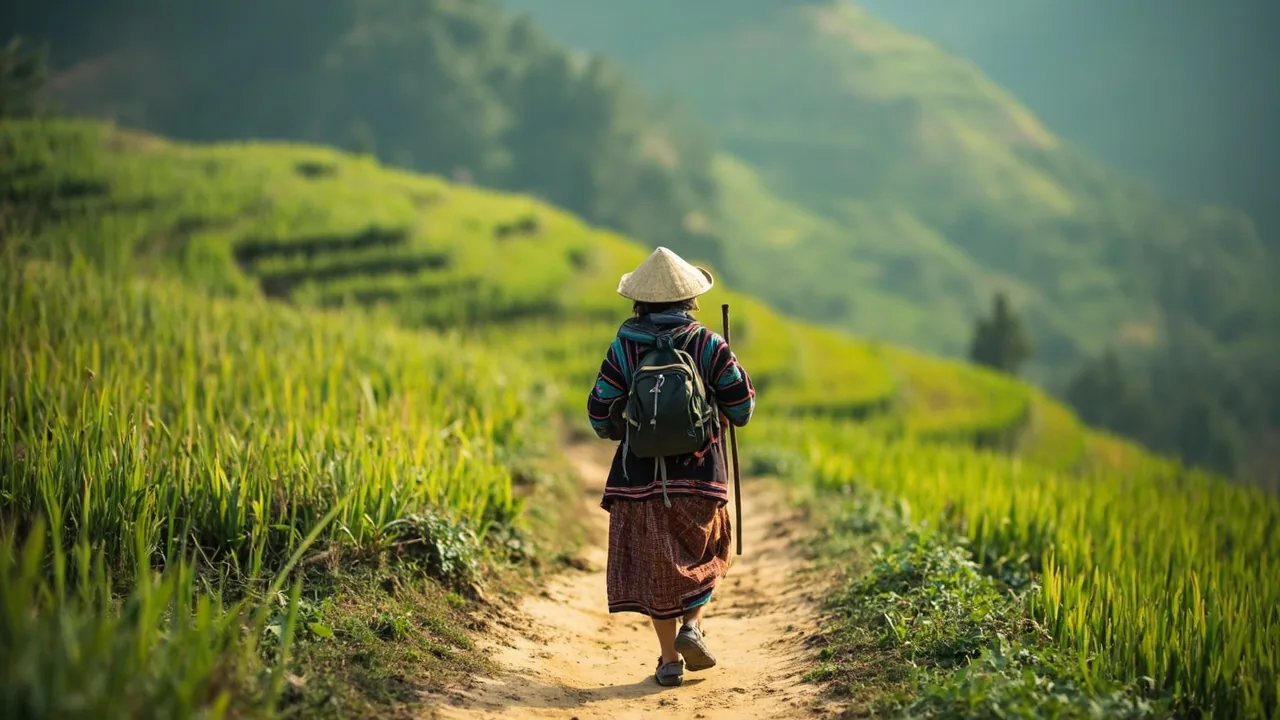
Sapa Rice Terraces: The Indian Backpacker’s Guide (2026)
This Sapa guide covers a hill town in northern Vietnam built on terraces and motorbike exhaust, where Black Hmong and Red Dao women sell bracelets to tourists in the fog. Go if trekking is the reason you came to Vietnam. Skip it if you’re chasing beaches or city food. For related planning, see Sea Backpacking Hub.
The town itself is small, the trekking scene is well-organized, and the bus from Hanoi costs about as much as a nice dinner in Bandra, so it slots easily into a 3 to 5 day detour from the standard north-to-south route. What it is not, in 2026, is a hidden anything. Expect crowds on weekends and a certain kind of souvenir-shop lobby as soon as you step off the bus. The trade is worth it if you go for the right trek, with the right guide, on the right days.
Quick Answers
| What | Answer | Price (INR) |
|---|---|---|
| Cheapest Hanoi to Sapa sleeper bus (one way) | ~₹991 (~270,000 VND or ~$10.29) | ₹900 (~$9.34) |
| 3-day homestay trek (Sapa, all-in with guide) | ~₹9,180-₹12,852 (~2,500,000-3,500,000 VND or ~$95.29-$133.40) total | ₹8,250-₹11,550 (~$85.64-$119.89) |
| Dorm bed in Sapa town | ~₹367-₹661 (~100,000-180,000 VND or ~$3.81-$6.86) per night | ₹330-₹595 (~$3.43-$6.18) |
| Vietnamese e-visa fee (Indian passport, 90 days multiple entry) | ₹2,408 (~25 USD) | ₹2,410 (~$25.02) |
| Tourist SIM with ~6 GB data, 14 days | ~₹477 (~130,000 VND or ~$4.96) | ₹430 (~$4.46) |
| Best months to visit | March-May and September-November | , |
| Sapa town elevation (so you know why you’re puffing) | ~1,650 m above sea level | , |
Subodh’s Pro Tip: The bus from Hanoi is the lazy good option, not the budget option. A sleeper bus at night is cheaper than the train for the same journey, but the train gets you sunrise over the rice terraces. Pick the train once if you have the budget; bus every other time. See also: Dalat.
How to Get There from Hanoi
Hanoi to Sapa is the second-most-clicked route on every Vietnam itinerary after Hanoi to Ha Long Bay, and the transport market has filled every possible niche. Sleeper bus is the default. Train is the upgrade. Motorbike is the adventure you should skip unless you’ve done it before. For where to stay in Hanoi before the bus, see Where to Stay in Hanoi.
| Mode | Duration | Cost (one-way) | Book |
|---|---|---|---|
| Sleeper bus (Standard cabin, most operators) | 6-7 hours | ~₹991 (~270,000 VND or ~$10.29) | Book on 12go |
| Limousine van (smaller, faster, 9 seats) | 5-6 hours | ~₹1,285 (~350,000 VND or ~$13.34) | Book on 12go |
| Night train to Lao Cai + transfer bus | 8 hours train + 1 hour bus | ~₹2,570-₹4,406 (~700,000-1,200,000 VND or ~$26.68-$45.74) depending on cabin class | Book on 12go |
| Private car | 6 hours | ~1,800,000+ VND | Contact your hostel |
Pick the sleeper bus if you want to save money and don’t mind a stiff neck. Pick the limousine van if you can stretch the budget by ₹294 (~80,000 VND or ~$3.05); fewer stops, more space, easier on a bad back. Pick the night train once if you have a long enough Vietnam trip to justify it, because the morning arrival into Lao Cai with the karst cliffs rising out of the fog is one of those rare “I’m glad I did this” travel moments.
Safety Alert: Sleeper buses in Vietnam have a mixed safety record. Stick to large, branded operators (Sapa Express, The Long, Sapa Discovery, Eco Sapa Limousine) and avoid unmarked green buses that tout at Hanoi Old Quarter hotels. Pick an upper berth if you prefer; upper berths are reasonably spacious even for taller travelers.
The 12go listings filter by operator, so do not book the cheapest seat on the screen without checking the company name first.
Where to Stay
Sapa town has a hostel scene that mostly clusters within 5 minutes’ walk of the central square, plus a newer pocket of mid-range guesthouses uphill in the Muong Hoa direction. Choose by what kind of trip you want: in-town hostels are social and you walk to everything, mountain-side stays are quieter and are the places where you see the terraces from your window. For a detailed neighborhood breakdown, see Where to Stay in Sapa.
| Hostel | Cost/night | Vibe | Book Here |
|---|---|---|---|
| Dinh Sapa Trekking Adventures & Hostel | ₹551-₹918 (~150,000-250,000 VND or ~$5.72-$9.53) | Trekking-focused, organizes its own multi-day trips | Check prices |
| The Zen House Sapa | ₹661-₹1,028 (~180,000-280,000 VND or ~$6.86-$10.67) | Quiet, design-conscious, mountain views | Check prices |
| Moc Home Sapa | ₹661-₹1,102 (~180,000-300,000 VND or ~$6.86-$11.43) | Warmer feel, mixed dorms and private rooms with views | Check prices |
| Sapa Hub Hostel | ₹477-₹808 (~130,000-220,000 VND or ~$4.96-$8.39) | Social hostel right in the center, easy to meet other trekkers | Check prices |
| Venus Sapa Hostel | ₹477-₹808 (~130,000-220,000 VND or ~$4.96-$8.39) | Central location, smaller dorms, good for couples and solo female travelers | Check prices |
| Sunset SaPa Hostel | ₹551-₹918 (~150,000-250,000 VND or ~$5.72-$9.53) | Mid-range hostel with a rooftop terrace | Check prices |
| Subodh’s pick: If you’re going for trekking specifically, book Dinh Sapa or Sapa Hub. Both organize departures daily and pair you with a guide group the night before. If you came for the views and don’t mind walking uphill, get a private room at Moc Home. |
What to Eat
Sapa is a smaller food scene than Hanoi or Hoi An, but the dishes you can eat here are some of the best in northern Vietnam, and unlike the south, the climate grows fresh herbs, mushrooms, and root vegetables. Eat the things you cannot get elsewhere: the cold-climate veggies, the Hmong-style pork, the salmon raised locally in cool ponds.
- Salmon tartare with herbs at Sapa Emotion Restaurant: locally farmed salmon cured with lime, dill, and mint, around ₹330 (~90,000 VND or ~$3.43). Skip the cooked version, the raw one is the better deal.
- Thang co (horse stew) at KHOI Restaurant: the most “I’m in northern Vietnam” dish on this list. Earthy, sour, served piping hot, around ₹294 (~80,000 VND or ~$3.05). Strong flavor, your dal-chawal palate might not love it, but worth one try.
- Grilled stream fish with sticky rice and greens at Sapa Center Cafe Restaurant: charcoal-grilled freshwater fish served with a basket of sticky rice and greens, around ₹441 (~120,000 VND or ~$4.57).
- Mushroom and fern hotpot at The Herbalist Sapa: this one is fully vegetarian and the most Indian-traveller-friendly dish in town. Wild mushrooms, fiddleheads, tofu, served in a clay pot, around ₹477 (~130,000 VND or ~$4.96). Order it on a foggy day.
- Andee Sapa vegan platter at Andee Sapa Restaurant & Vegan: a fully vegan set menu with tofu, mountain greens, and brown rice. The only place in town built entirely for non-meat eaters, sets around ₹330-₹477 (~90,000-130,000 VND or ~$3.43-$4.96).
Strict Veg / Indian Food
There are no proper Indian restaurants in Sapa itself. The few spots that put “Indian curry” on the sign are worse than what you’d get at a low-end Dhaba in Pune. For a real Indian meal, you will need to eat back in Hanoi either before or after the trek. If you insist on Indian food in Sapa town, the closest fall-back is pre-cooked dal and rice at upscale hotel restaurants, which run around ₹734-₹1,285 (~200,000-350,000 VND or ~$7.62-$13.34) for a single plate and is rarely worth it.
Subodh’s Pro Tip: If you are strict-veg and worried about a 3-day homestay trek, do this. Tell your booking agent in advance, pay an extra ₹184 (~50,000 VND or ~$1.91) per day for a “veg menu,” and the homestay family will usually do separate vegetarian eggs, tofu, and stir-fried greens for you. Most families are used to the request because it is common in the Sapa trekking market.
If you want Indian food before or after your trek, do it in Hanoi. Eat your Indian meal there, save Sapa for Vietnamese food.
What to Do
The town is small and the activity list is clear: trek, look at rice terraces, ride a cable car, drink craft beer, sleep in a homestay. Here is the order most Indian travelers do them in.
1. Multi-day homestay trek (this is the reason you came)
A 3-day, 2-night trek through the terraces, ending in Ta Van or Lao Chai village, runs about ₹9,180-₹12,852 (~2,500,000-3,500,000 VND or ~$95.29-$133.40) total per person including guide, homestays, and meals. This is the activity to spend the budget on; everything else is filler around it. Compare tour operators carefully: the ₹482 (~5 USD) cheaper operator is usually the one with a guide who speaks three words of English and a homestay without hot water.
The trek is bookable through any hostel in Sapa town once you arrive, or online in advance through GetYourGuide. See Trekking Tour Sapa tours on GetYourGuide
2. Ham Rong Mountain Eco-Tourism Area
A landscaped hill park on the edge of town with flower gardens, a small orchid house, and a near-360° view of the valley. Entry is ₹220 (~60,000 VND or ~$2.29) and the cable car onto the peak is ₹367 (~100,000 VND or ~$3.81) extra. Two hours is plenty. Day-trippers and tour-bus groups fill it after 10 a.m., so get there at 8 a.m. Or skip it. See Ham Rong Sa Pa Eco-Tourism Area availability
3. Cat Cat Village
A Hmong minority tourism village 2 km from Sapa town, walkable downhill or ₹110 (~30,000 VND or ~$1.14) by taxi. The waterfalls and the small-scale weaving looms are the actual sights; the entrance fee is ₹330 (~90,000 VND or ~$3.43). It’s the most touristy of the Sapa “villages” but also the most consistently interesting if you have only one afternoon. Check Cat Cat Tourism Village availability
4. Fansipan Cable Car (if you don’t fancy the trek)
The cable car marketed as one of the world’s longest three-rope systems takes you to the 3,143 m summit of Mt Fansipan. Tickets are ₹2,203-₹2,938 (~600,000-800,000 VND or ~$22.87-$30.49) round-trip, which is a lot for a half-day if you came to trek, but if your legs are tired or the weather is bad, this is a fine consolation. The view on a clear day is genuinely spectacular.
5. Moana Sapa
The Instagram-spot complex on the way to Cat Cat: a glass bridge, a “sky swing,” and the swirling infinity edge on a small artificial pond. ₹367 (~100,000 VND or ~$3.81) entry, half an hour is enough. Skip it if you don’t take photos for Instagram. Check Moana Sapa availability
A Real 3-Day Sapa Itinerary
Most trekking outfits sell you a 1-day version because that’s what Hanoi tour buses buy. Don’t take that one. A 3-day trek is what justifies the bus ride from the capital. Here’s how it goes.
- Day 1 (Y Linh Ho and Lao Chai): Pickup at your Sapa hostel at 8 a.m. Drive 20 minutes out of town. 14 km hike downhill through rice terraces to Lao Chai village, then a further 4 km into Ta Van. Hot lunch at a homestay at noon. Arrive late afternoon, eat a family dinner, sleep on a wooden floor in a stilt house.
- Day 2 (Ta Van to Ban Ho): Real trek day. Cross the Muong Hoa river, climb up through bamboo forest, lunch in a small ethnic-minority school yard, descend into Ban Ho. Hot springs optional, ₹367 (~100,000 VND or ~$3.81) entry. Sleep in a different family homestay.
- Day 3 (Ban Ho back to Sapa): Easy walk in the morning, lunch back in Ban Ho, return transfer to Sapa town by 3 p.m. Walk-in arrival means you can hop a night bus south to Hanoi the same evening.
Pack: a real raincoat (not a poncho), two pairs of trekking shoes since one pair will be wet every day, three sets of socks, sandals for the homestay, and one warm hoodie. Sapa averages 13-15°C year-round at night even in summer. For a more detailed day-by-day plan, see our 3 days in Sapa itinerary.
Where to Go from Here
Most travelers come to Sapa from Hanoi and return to Hanoi. A small number push on eastward into Ha Giang, or southward into Ninh Binh and Hoi An by sleeper bus. These are your options:
| Destination | Mode | Duration | Price | Book |
|---|---|---|---|---|
| Hanoi | Sleeper bus | 6 h | ~₹991 (~270,000 VND or ~$10.29) | Book on 12go |
| Ha Giang | Sleeper bus | 6 h | ~₹1,285 (~350,000 VND or ~$13.34) | Book on 12go |
| Noi Bai Airport (for onward flights) | Sleeper bus | 6 h | ~₹1,652 (~450,000 VND or ~$17.15) | Book on 12go |
| Ninh Binh | Overnight sleeper | 19 h | , | Book on 12go |
| Hoi An | Overnight sleeper | ~22 h | ~₹3,121 (~850,000 VND or ~$32.40) | Book on 12go |
| Da Nang | Overnight sleeper | ~20 h | , | Book on 12go |
The Hanoi return at ₹991 (~270,000 VND or ~$10.29) is the practical default. Pair Sapa with a Hanoi-Ha Long Bay run before or after, not a long sleeper to Hoi An; you’ll lose a day of your trip to that one bus.
Getting Connected
For a 3 to 5 day trip, a tourist SIM is enough. Pick it up at Noi Bai Airport on arrival or in central Hanoi before the bus to Sapa, because the Sapa town’s small shops sometimes run out of stock.
For a physical SIM, Viettel and Mobifone tourist SIMs cost about ₹477 (~130,000 VND or ~$4.96) for a 14-day plan with roughly 6 GB of data, which is more than enough for maps, WhatsApp, and the iPhone camera uploads you’ll be doing from the rice terraces. Viettel has the strongest 4G signal in the mountains if your trek crosses into Lao Cai province.
If you’d rather not handle a physical SIM after a flight, the Get Nomad eSIM covers Vietnam on its regional Asia plan and works before you land.
Subodh’s Pro Tip: WiFi in Sapa town hostels is fine, but it gets patchy once you start trekking. Even at premium treks, families sometimes have intermittent signal. If you’re trekking with a guide from a reputable agency, your guide’s hotspot is faster than the village WiFi. Don’t expect to upload that reel from the morning view in the rice terraces: do it from the homestay kitchen at lunch.
Daily Budget Breakdown
A solo Indian backpacker trekking from Hanoi, doing a 3-day homestay trek plus 1 day in town, spends about ₹14,688 (~4,000,000 VND or ~$152.46) per day on average. The trek day costs more (because your room and food are bundled), the in-town days cost less. Here is how that breaks down.
| Category | Budget/day |
|---|---|
| Dorm bed | ₹367-₹661 (~100,000-180,000 VND or ~$3.81-$6.86) |
| Food (3 meals) | ₹367-₹661 (~100,000-180,000 VND or ~$3.81-$6.86) |
| Local transport (Grab bike, taxis) | ₹73-₹184 (~20,000-50,000 VND or ~$0.76-$1.91) |
| Trek and activities | ₹2,938-₹4,406 (~800,000-1,200,000 VND or ~$30.49-$45.74) |
| Misc / drinks | ₹294-₹551 (~80,000-150,000 VND or ~$3.05-$5.72) |
| Total | 1,100,000-1,760,000 VND |
Right now, 1 INR works out to about 270 VND, so 1,100,000 VND per day is in the ₹4,070 (~$42.25) zone. That is roughly the cost of two meals and a coffee in Mumbai’s Colaba, for a full trekking day with a homestay and three meals in the Vietnamese highlands. The cost difference between a budget traveler and a mid-range one is mainly the trek operator; everything else in Sapa is cheap.
These figures are typical for a 3-day Sapa trek in 2026; adjust the trek cost if you’re willing to skip the homestay and day-hike from town, but lose the village experience with that trade.
Visa Notes for Indian Passports
Vietnam changed the rules for Indian travelers in 2023: no visa-on-arrival is available for Indian passports; Indian travelers must pre-apply. Apply for the e-visa in advance.
Apply through the official portal at https://evisa.xuatnhapcanh.gov.vn. Cost is ₹2,408 (~25 USD) for 90 days, multiple entry. Processing is officially 3 days, usually 24-48 hours. You will need a 4x6 cm photo with a white background, taken within the last 6 months. Print a copy of the approval PDF and carry it for hotel check-in.
If you forget to apply and try to board a flight to Vietnam without the visa, the airline will deny you at check-in. The consulate walk-in route in Delhi takes 5 working days and rarely helps in an emergency. Apply before you fly.
Safety Alert: Before finalizing your dates, check the MEA travel advisory at mea.gov.in. Vietnam is generally a low-advisory destination, but road conditions between Hanoi and Sapa see periodic safety notices during the rainy season (June-August). For trekking risk, the specific current consensus comes from local tourism boards; ask your guesthouse on arrival about trail closures, and don’t trek Fansipan ridge alone without a guide.
Common Mistakes Indian Backpackers Make
1. Booking a 1-day tour bus from Hanoi instead of staying overnight.
The “Hanoi to Sapa return same day” tour exists, and you should never take it. It’s 12 hours of bus round-trip plus 2 hours of walking. You get tired, you skip the homestay, and you fly back to Hanoi with the same photos a day tripper from any country could take.
2. Booking a Sapa package tour online in India.
Vietnam-based tour operators charge less than Indian agents reselling the same treks at a markup. Book your Hanoi-Sapa bus ticket and your hostel yourself, and book the trek with your hostel on arrival. You save 30-40% and you choose the operator you meet in person.
3. Skipping water and electrolytes on trek days.
The Vietnam lowlands are flat. Sapa is at 1,650 m. The combination of altitude plus humid mountain air is more dehydrating than you’d expect. Travellers report a non-trivial number of trekkers get mild AMS-like headaches on day 1. Drink 4-5 liters on trek days, carry oral rehydration powder (ORS packets are sold at any pharmacy in town for about ₹29 (~8,000 VND or ~$0.30)).
4. Buying thick “ethnic” jackets in the markets at inflated prices.
Some Hmong women will walk alongside you through town pointing out their embroidered jackets for “special price” sales, and then the shop you walk into charges 2x. If you want to buy, walk into the shop unaccompanied, ask the actual retail price, and decide from there. The jackets are lovely but the haggling dance around them is annoying.
FAQ
Is Sapa safe for solo Indian women?
Yes. Sapa is one of the safer small towns in Vietnam for solo female travelers. Standard caveats apply after dark: take a taxi rather than walk the unlit back lanes to your homestay. Trek groups bring tourists of mixed ages so solo travelers don’t stand out. There have been no widespread reports of harassment in Sapa in 2026.
Can I get Indian food in Sapa?
No. The handful of restaurants in Sapa claiming Indian cuisine are best skipped. Eat Vietnamese food in Sapa and Indian food in Hanoi before or after your trek. Some homestay families will cook a vegetarian egg-and-veg plate on request if you book ahead.
What is the best time to visit Sapa?
March to May and September to November. The rice terraces are most photogenic when they’re either green-and-flooded (May-June) or gold-and-harvest (late September). June to August is rainy, foggy, and the trails get slippery. December to February is bone-cold at night but can be the most beautiful if you’re chasing clear skies.
How many days do I need for Sapa?
A minimum of 3 nights: night 1 in Sapa town, nights 2 and 3 on the multi-day trek. 4 nights is better; you get a buffer day for bad weather. Anything under 3 nights is just exhausting.
Do I need a guide for the trek?
Yes, and this is the part of Sapa I am firm about. Self-guided trekking exists in the sense that there are signs at the trailheads, but you will get herded into a “souvenir shop where you must buy something before continuing” kind of trap within 2 km, and the trails fork in multiple places without warning. Local guides cost less than ₹1,836 (~500,000 VND or ~$19.06) per day and they’re the difference between a real trek and a tourist photo op.
Is Sapa worth the trip from Hanoi?
If trekking is on your list, yes. If it isn’t, save 2 days and spend them in Ninh Binh instead; it’s closer to Hanoi, cheaper, and the scenery is comparable. Sapa is for trekkers, not for sightseers.