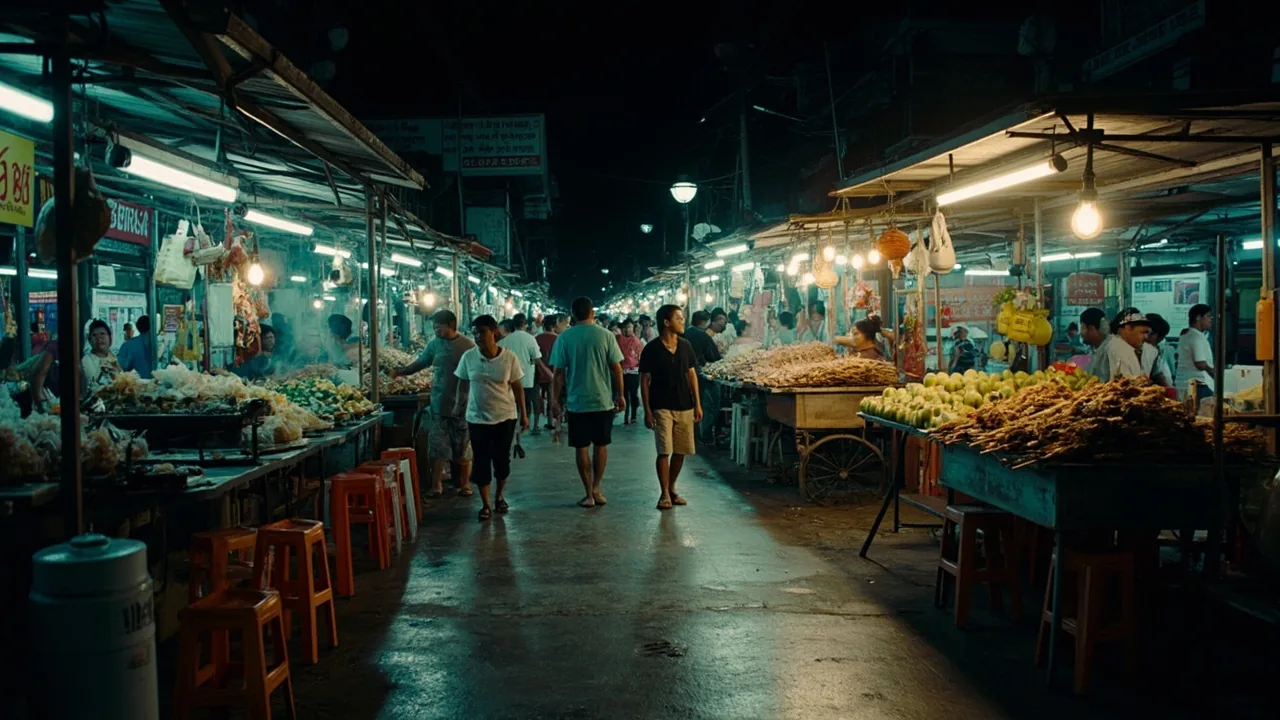
Southeast Asia Night Markets: A Backpacker’s Guide (2026)
Night markets are the single best reason to plan a Southeast Asia trip around food. Forget the guidebook restaurants, forget the hotel breakfast buffets. The real evening of any Thai, Vietnamese, Malaysian, or Lao city happens after sundown, when tarpaulin stalls light up, charcoal grills fire across a row, and locals squeeze into plastic stools to eat what they eat at home. For Indian backpackers especially, this is where the trip flips from “tourist mode” to “I understand this place now.” You will eat vegetarian by accident, you will find samosa-shaped things that are not samosas, and you will pay cash to a granny who does not speak English but knows her spice levels. For related planning, see our guide on Sea Backpacking Hub.
This guide covers what a Southeast Asia night market is, what it costs in 2026 (in THB, VND, MYR, SGD, and USD where it matters), what to eat if you are vegetarian, the scams everyone falls for, and which markets are worth detouring your whole route for.
Quick Answers
| What | Answer | Price (INR) |
|---|---|---|
| When do most night markets open? | Around 5pm to 6pm, peak from 7pm to 10pm | Free entry everywhere |
| Cheapest meal you will find? | A grilled satay stick or a fried snack | ~₹14 (~5 THB or ~$0.15) |
| What should a vegetarian backpacker look for? | Grilled vegetables, papaya salad, stir-fried greens, fresh fruit | ~₹80 (~$0.83) to ~₹150 (~$1.56) per dish |
| Are night markets safe at night? | Yes, mostly. Watch for pickpockets and overcharging | — |
| Average budget for one market visit? | Eat + drink + small souvenir | ~₹800 (~$8.30) to ~₹1,500 (~$15.57) |
All local prices in this article are written in the destination country’s currency. Triple-currency conversion is added by the system. Current rates used: 1 THB ≈ ₹2.87, 1 VND ≈ ₹0.0037, 1 MYR ≈ ₹23.59, 1 SGD ≈ ₹74.76, 1 IDR ≈ ₹0.0054, 1 KHR ≈ ₹0.024, 1 LAK ≈ ₹0.0043.
What a Southeast Asia Night Market Is
A “night market” in this region is not one thing. It is at least four things stacked in the same space: a hawker food court, a wet market that stayed open late, a clothing and accessory bazaar, and a beer garden where everyone ends up eventually. The bigger ones (Rot Fai, Chatuchak Friday section in Bangkok, Ben Thanh night strip in HCMC) have hundreds of stalls and run every weekend. The smaller ones are weekly, neighborhood-level, and usually cluster near a temple or a roundabout. Both are worth visiting.
What you do not get: a sterile “food court” experience with printed menus. What you do get: a stall owner pointing at the wok, asking “spicy?” with raised eyebrows, and then making something that is 70% as good as your favourite back-home restaurant for one-fifth the price. You point, you pay, you eat. You can ask “no meat?” and most stalls will pivot to a vegetable version. You can ask “less sugar?” for Thai desserts. You can ask “halal?” and Malaysian/Indonesian markets will point you to the right row.
The Major Markets Worth Planning Around
Thailand (THB prices)
Thailand is the spiritual home of the night market. Bangkok alone has half a dozen famous ones, and every tourist island has its own walking street.
Rot Fai Market (Bangkok) is the vintage-and-food hybrid that travellers and locals both swear by. It is larger and less tourist-trappy than Chatuchak’s weekend section. Vintage stalls, vintage cars, and a serious grilled seafood zone where you pick your prawns by size and pay by weight.
Chiang Mai Night Bazaar runs every night of the week along Chang Khlan Road. It is heavy on handicrafts, hill-tribe fabrics, and silver. The food court at the back is half the reason to come. Stick around for live music after 9pm.
Walking Street Markets in Pai, Krabi, Koh Samui are smaller, weekly, and more relaxed. Pai’s is famous for a “vegetarian buffet” that locals run on certain evenings of the week.
Subodh’s Pro Tip: Go to a Thai market on an empty stomach. Eat your way through it. A pad thai here is ₹172 (~60 THB or ~$1.78), grilled chicken skewers are ₹29 (~10 THB or ~$0.30) each, fresh mango sticky rice is ₹229 (~80 THB or ~$2.37). Most markets let you carry beer from the 7-Eleven across the street and drink it while you shop.
Vietnam (VND prices)
Vietnamese night markets split into two flavours: the tourist walking streets (Hanoi Old Quarter, HCMC’s Nguyen Hue Walking Street) and the local food markets that stay open till midnight.
Hanoi Weekend Night Market runs Friday to Sunday along the Old Quarter. Clothing, souvenirs, lacquerware. The food section around the edges is what you want. Try bún chả, bánh xèo, and grilled corn on the cob. A full meal for two: ₹367-₹551 (~100,000-150,000 VND or ~$3.81-$5.72).
Ben Thanh Street Food Market (HCMC) is the cleaner, sit-down version. Touristy but worth one visit. A bowl of pho here is ₹184 (~50,000 VND or ~$1.91). The crawfish and beer stalls outside run from 6pm till late.
Da Nang and Hoi An are underrated for night markets. Hoi An’s riverside lanterns make it photogenic, but the actual food scene is at the central market’s night section. Vietnamese vegetarian food (chay) is excellent here because of Mahayana Buddhist influence.
If you are doing the Vietnam nightlife side of the trip at all, the Da Nang nightlife guide is the matching read.
Malaysia (MYR prices)
Malaysia does night markets differently: they are called “pasar malam” and they rotate by neighbourhood on different nights of the week. The same hawker stalls travel between suburbs.
Petaling Street (Kuala Lumpur Chinatown) runs every evening and is heavy on fake watches, pirated DVDs, and decent street food. Satay skewers at 1 MYR each, char kuey teow at 8 MYR.
Jonker Street (Melaka) turns into a weekend night market on Friday and Saturday evenings. Famous for nyonya kuih, grilled fish, and coconut shakes.
Penang has a rotating market scene. The Gurney Drive hawker area is permanent, but the actual pasar malam depends on the night. Check the local Penang food blog or your guesthouse notice board. For the broader nightlife side of Penang, the Penang nightlife guide covers the late-night bars and clubs.
Singapore (SGD prices)
Singapore does not do traditional night markets, but it does hawker centres, which are functionally the same thing with a roof and stricter hygiene rules. Lau Pa Sat, Maxwell Food Centre, and Chinatown Complex stay open till late. Chicken rice at ₹298 (~4 SGD or ~$3.10), sugarcane juice at ₹149 (~2 SGD or ~$1.55). Singapore is the only Southeast Asian country where you will pay premium for what is the same experience.
For the actual club side of Singapore, the Singapore nightlife guide covers it. Note that Singapore has strict alcohol licensing rules: you cannot drink in public after 10.30pm, and most bars close by 1am on weekdays. The Singapore nightlife rules tourists must know article goes into this properly.
Indonesia (IDR prices)
Bali’s night markets are mostly in the Denpasar and Ubud areas, not the Kuta party zone. Ubud Night Market runs from 6pm and is heavy on babi guling (pork, skip if you are halal or vegetarian) and sate lilit.
Seminyak and Canggu have moved to a more “food truck park” model. Prices are higher, Instagram is the decoration. Skip if you are budget travelling.
For Lombok, the Lombok nightlife guide covers the Kuta and Gili side. The actual pasar malam in Mataram runs Thursdays.
Cambodia (USD prices)
Phnom Penh has a small night market near the riverside, but Cambodia’s famous one is Pub Street in Siem Reap, which is a permanent night market plus bar district combined. Prices are in USD. A grilled skewer is 1 USD, a full meal is 3-5 USD. Touristy but functional.
Laos (LAK prices)
Luang Prabang Night Market runs every evening along the main street, closed to traffic. Hill-tribe textiles, lanterns, and some of the best vegetarian buffets in Southeast Asia. The price of a sit-down meal here is ₹64-₹107 (~15,000-25,000 LAK or ~$0.67-$1.11).
For a deeper Vang Vieng scene, the Vang Vieng nightlife guide covers the river bars and tubing culture.
Myanmar (MMK prices)
Yangon’s night market scene has been quieter since 2020, but Chinatown (19th Street) still runs nightly grilled seafood and beer stalls. Closing times have shifted, and you should check the current advisory before going.
For the bar side of Yangon, the Yangon rooftop bars guide is the matching article.
Philippines (PHP prices)
Lapu-Lapu Night Market (Cebu) and Bacolod’s Chicken Inasal strip are the famous ones. Filipino markets are heavier on grilled meat and seafood, lighter on vegetables. If you are doing Boracay, the Boracay nightlife guide covers the beachside bars.
For Manila, the Manila nightlife guide and Best bars in Manila cover the actual club side.
What to Eat: Vegetarian-Friendly Picks
This is where night markets win for Indian travellers. You do not need to hunt for an “Indian restaurant” when the local food is already half vegetarian.
| Dish | Where to find it | Local price |
|---|---|---|
| Pad pak (stir-fried greens) | Every Thai market | ₹114-₹172 (~40-60 THB or ~$1.19-$1.78) |
| Som tam (papaya salad, ask “no fish sauce”) | Thailand, Laos | ₹86-₹143 (~30-50 THB or ~$0.89-$1.48) |
| Bánh xèo chay (Vietnamese veg pancake) | Vietnam | ₹92-₹147 (~25,000-40,000 VND or ~$0.95-$1.52) |
| Gỏi cuốn (fresh spring rolls, tofu) | Vietnam | ₹55-₹92 (~15,000-25,000 VND or ~$0.57-$0.95) |
| Satay veg skewers | Malaysia, Indonesia | ₹24-₹47 (~1-2 MYR or ~$0.24-$0.49) / ₹54-₹81 (~10,000-15,000 IDR or ~$0.56-$0.84) |
| Char kuey teow (ask for veg version) | Malaysia | ₹141-₹188 (~6-8 MYR or ~$1.47-$1.96) |
| Fresh tropical fruit | Everywhere | ₹86-₹229 (~30-80 THB or ~$0.89-$2.37) / ₹37-₹73 (~10,000-20,000 VND or ~$0.38-$0.76) |
For a serious veg approach in Bangkok or Chiang Mai, look for stalls with a yellow Thai flag (the vegetarian festival flag) or that explicitly mark themselves “jay” (Thai-Chinese vegetarian). The food court version of a market is usually safer for vegetarians than the grill section.
Subodh’s Pro Tip: If you cannot find a Jay restaurant and want a guaranteed Indian meal later that night, the Bangkok rooftop bars budget cocktail prices guide area has a few Indian restaurants within walking distance of major markets.
Scams and Gotchas
Every night market has the same three or four traps. Travellers fall for them anyway, every year.
The “closing time” fake discount. A vendor will tell you they are closing in five minutes and offer everything at 50% off. They are not closing. The discount is fake, the original price was inflated. Always check two stalls before buying.
The “fixed price” illusion. Most markets do not negotiate. Vendors quote a price, you pay it. But if you are at a souvenir stall in Chiang Mai, Hoi An, or Luang Prabang, polite haggling is expected. Start at 40% of the quoted price.
The “menu price vs actual price” trap. Sit-down restaurants in or near markets sometimes have two menus: one with photos and prices for tourists, one with the real local prices. Always ask for the “regular menu” or check what the local family at the next table was charged.
Pickpockets in crowds. The Bangkok, HCMC, and Singapore hawker centres are crowded after 8pm. Phone in front pocket, wallet in front pocket, backpack worn on the front. Do not leave your phone on a table.
Drink-spiking. Less common in family-market settings, more common in the bar strips that border markets (Pub Street Siem Reap, Khao San, Bui Vien). Never accept an open drink from a stranger, watch your bartender pour the next one, and avoid the “free shot” ladies walking around.
Getting Connected
You will want data at a night market for three reasons: Grab or Bolt when you leave, Google Translate to read the Thai/Vietnamese menu, and Google Maps to find your hostel again. A local SIM is cheap and works everywhere. AIS, TrueMove, and DTAC tourist SIMs in Thailand run around ₹855 (~299 THB or ~$8.87) for 8 days at the airport counter. In Vietnam, Mobifone or Viettel tourist SIMs are ₹734 (~200,000 VND or ~$7.62). In Malaysia, Hotlink and Celcom prepaid data packs start at ₹236 (~10 MYR or ~$2.45). For an easier option that activates before you even land, Get Nomad eSIM covers Thailand, Vietnam, Malaysia, Singapore, and Indonesia on a single plan.
Local Rules Worth Knowing
Singapore is the strictest. No drinking in public after 10.30pm. Smoking in non-marked areas is a ₹14,918 (~200 SGD or ~$154.85) fine. Hawker centres are usually okay to sit with takeaway beer.
Malaysia and Indonesia are Muslim-majority in many areas. Markets in Kelantan, Terengganu, Aceh, and parts of Java do not sell alcohol at all. Most pasar malams in Kuala Lumpur and Penang have a separate non-alcoholic section.
Thailand’s alcohol sales rules ban sales between 2pm and 5pm on Buddhist holidays (major ones: Makha Bucha, Visakha Bucha, Asalha Bucha). They are national days, so most stalls comply. Check the calendar before your trip.
Laos and Cambodia have no major alcohol restrictions on travellers, but local dry days happen. Your guesthouse will know.
Temple etiquette the next morning. Night markets often run right next to wats and pagodas. If you plan to visit one the next morning, do not wear your market outfit (shorts, sleeveless top). Bring a sarong or long pants for the temple.
Budget Breakdown: One Night, One Market
| Item | Cost (local) | Approx. INR |
|---|---|---|
| Grab/Bolt from hostel to market | ₹229-₹429 (~80-150 THB or ~$2.37-$4.45) / ₹147 (~40,000 VND or ~$1.52) / ₹188-₹283 (~8-12 MYR or ~$1.96-$2.93) | ~₹200-₹300 (~$2.08-$3.11) |
| Pad thai or equivalent main | ₹172-₹286 (~60-100 THB or ~$1.78-$2.97) / ₹110-₹184 (~30,000-50,000 VND or ~$1.14-$1.91) / ₹141-₹236 (~6-10 MYR or ~$1.47-$2.45) | ~₹150-₹250 (~$1.56-$2.60) |
| Two grilled skewers | ₹57-₹114 (~20-40 THB or ~$0.59-$1.19) / ₹37-₹73 (~10,000-20,000 VND or ~$0.38-$0.76) / ₹47-₹94 (~2-4 MYR or ~$0.49-$0.98) | ~₹50-₹100 (~$0.52-$1.04) |
| One fresh fruit shake | ₹114-₹172 (~40-60 THB or ~$1.19-$1.78) / ₹55-₹92 (~15,000-25,000 VND or ~$0.57-$0.95) / ₹118-₹165 (~5-7 MYR or ~$1.22-$1.71) | ~₹100-₹175 (~$1.04-$1.82) |
| One small souvenir (if shopping) | ₹286-₹858 (~100-300 THB or ~$2.97-$8.90) / ₹184-₹551 (~50,000-150,000 VND or ~$1.91-$5.72) / ₹236-₹589 (~10-25 MYR or ~$2.45-$6.11) | ~₹250-₹600 (~$2.60-$6.23) |
| Total | ₹858-₹1,858 (~300-650 THB or ~$8.90-$19.29) / ₹532-₹1,047 (~145,000-285,000 VND or ~$5.53-$10.86) / ₹730-₹1,367 (~31-58 MYR or ~$7.58-$14.18) | ~₹750-₹1,500 (~$7.79-$15.57) |
A two-person dinner at a night market is genuinely cheaper than a single restaurant meal in the same city. If you are on a backpacker budget, this is dinner every night.
If you are doing Singapore, multiply the same meal out by 3x. A chicken rice in Singapore is ₹298 (~4 SGD or ~$3.10), a sugarcane juice is ₹149 (~2 SGD or ~$1.55), and a small beer at a hawker centre is ₹597 (~8 SGD or ~$6.19).
Mistakes Indians Specifically Make
Trusting “veg” labels in Malaysia and Indonesia. “Veg” sometimes means “vegetable-based, but cooked with shrimp paste.” Ask specifically: “no belacan? No udang?” (no shrimp paste, no shrimp).
Assuming the spicy scale matches India. Thai “mild” is Indian “medium.” Lao “medium” is Indian “extreme.” Vietnamese “spicy” is usually mild by Indian standards. Always go one level below what you think you want for the first try.
Paying in USD in markets that quote in local currency. Cambodian and Lao vendors will accept USD but give terrible rates. Pay in local currency (KHR or LAK) for fair value.
Going home before 9pm. Markets between 5pm and 7pm are still setting up. Markets after 9pm are the real show: more food, more locals, lower prices (vendors don’t want to pack up leftovers).
Wearing white to a Thai market. The barbecue smoke will turn your shirt yellow by 8pm. Wear something you can wash on hot.
Subodh’s Take
Night markets are the cheapest, most honest, and most fun activity in Southeast Asia. They are also the only place where you will eat a meal for the price of a chai back home and remember the trip six months later. Plan your route around them. Spend a Tuesday in Chiang Mai, a Friday in Hanoi, a Saturday in Luang Prabang, a Sunday in Melaka, and a Wednesday in Singapore. Eat more than you think you should. Carry small bills. Tip the granny who makes the best som tam. That’s the trip.
FAQ
Is a night market safe for solo female travellers?
Yes, in Thailand, Vietnam, Malaysia, Singapore, and most of Indonesia. Standard city smarts apply: keep your phone in your front pocket, take a registered Grab back, and avoid the bar-strip extensions of the bigger markets (Khao San, Bui Vien, Walking Street Pattaya) after midnight. Laos, Cambodia, and the Philippines are also fine but pickpocketing is more common in the larger Phnom Penh and Manila markets.
What is the legal drinking age across Southeast Asia?
Thailand: 20. Vietnam: 18. Malaysia: 21 (non-Muslims only, varies by state). Singapore: 18. Indonesia: 21. Cambodia: no enforced minimum. Laos: 18. Philippines: 18. Myanmar: 18. In practice, vendors rarely card at night markets, but clubs and bars will.
Do night markets stay open during the monsoon season?
Mostly yes. Thailand’s rainy season (May to October) and Vietnam’s (May to November) see some stalls close on heavy rain days, but the bigger covered markets (Lau Pa Sat, Ben Thanh, Chatuchak) run regardless. Smaller outdoor ones may shut for the night if it pours.
Can I pay by card at a night market?
No. Bring cash in small local denominations. Some larger stalls in Bangkok and Singapore hawker centres take QR code payments via PromptPay or PayNow, but this is still the exception in 2026. Carry enough for what you plan to eat and double it.
Are night markets worth visiting if I do not eat street food?
Yes. Most markets are at least 50% shopping (clothes, bags, shoes, souvenirs, household items). The bigger ones (Chatuchak, Pratunam, Ben Thanh) are full shopping malls under tarp. If food is not your priority, go earlier (5pm to 7pm) before the dinner rush.
What is the etiquette for haggling?
Smile, start at 40% of the quoted price, meet in the middle, walk away if you genuinely don’t want it. Do not haggle on food. Do not haggle at fixed-price stalls (most modern Thai markets have these). Walking away is the most powerful move; 30% of the time, the vendor calls you back with a real price.
Where can I find Indian food near a night market?
Most night market cities have a Little India or a Phuket-style Indian cluster within 2 km. In Bangkok, the area around Pahurat and Phuket Town’s Soi Romanee is the easiest. In Singapore, Little Arcade and Tekka Centre are walking distance from the hawker zones. If you are doing the full Thailand-Vietnam-Laos-Cambodia loop, you will hit Indian food at every major stop anyway.
