Using RuPay Cards in Malaysia: Real Acceptance, Fees, and ATM Tips for Indian Travelers (2026)
Using a malaysia rupay card works in Malaysia, but only at RuPay-enabled Maybank ATMs for cash and at point-of-sale terminals that display the RuPay or JCB logo. Most Indian travelers still end up using a forex card, Visa/Mastercard, or cash for daily spend. Here is exactly what works, what does not, and the fees nobody warns you about. Planning the wider region? Our Southeast Asia backpacking hub covers the full multi-country route.
I cross-checked this against Maybank’s official ATM locator, NPCI’s RuPay international partner list, and traveller reports from the first half of 2026, because RuPay international acceptance has been moving targets for years and old blog posts still confidently say “it does not work anywhere” or “it works everywhere.”
What Is a RuPay Card, and Why Does Malaysia Care?
RuPay is India’s domestic card network, run by the National Payments Corporation of India (NPCI). In Malaysia, RuPay cards run on a partnership with JCB, the Japanese card network, which gives RuPay a real international rails to operate on. Without that JCB link, a pure RuPay card would have no Malaysian acceptance at all.
The practical upshot: a RuPay card functions in Malaysia only where the merchant’s terminal or the ATM’s network is configured to recognize either RuPay or JCB. Outside those two, the swipe or insert fails.
Quick Answers for your malaysia rupay card
| What | Answer | Price (INR) |
|---|---|---|
| POS acceptance in Malaysia | Limited to RuPay/JCB-enabled terminals | , |
| ATM cash withdrawal | RuPay-enabled Maybank ATMs only | , |
| Typical cross-border markup | 1% to 3.5% on the FX rate | , |
| Maybank ATM fee (non-MyDebit) | ₹237 (~10 MYR or ~$2.46) per foreign-card withdrawal | ₹236 (~$2.45) |
| RuPay JCB promo (Indigo cards) | 20% cashback up to a capped monthly amount | , |
| Reliable fallback | Forex card on Visa/Mastercard network | , |
Step-by-Step: Using your malaysia rupay card
Step 1: Check which type of malaysia rupay card you hold
Not every RuPay card has the same reach. Three categories matter in Malaysia:
- RuPay JCB (debit or credit), full JCB acceptance, plus RuPay-JCB partner ATMs. This is the only version that works in Malaysia at scale.
- RuPay Visa/Mastercard co-badged, works wherever Visa or Mastercard works, but that defeats the whole point of using RuPay for FX savings.
- Pure RuPay (no co-badge), does not work in Malaysia. The terminal will decline.
If your card only has the RuPay logo with no JCB or Visa/Mastercard co-badge, leave it at home. Travellers report near-100% decline rates on pure-RuPay cards in Malaysia.
Step 2: Use it at RuPay-JCB partner ATMs for cash
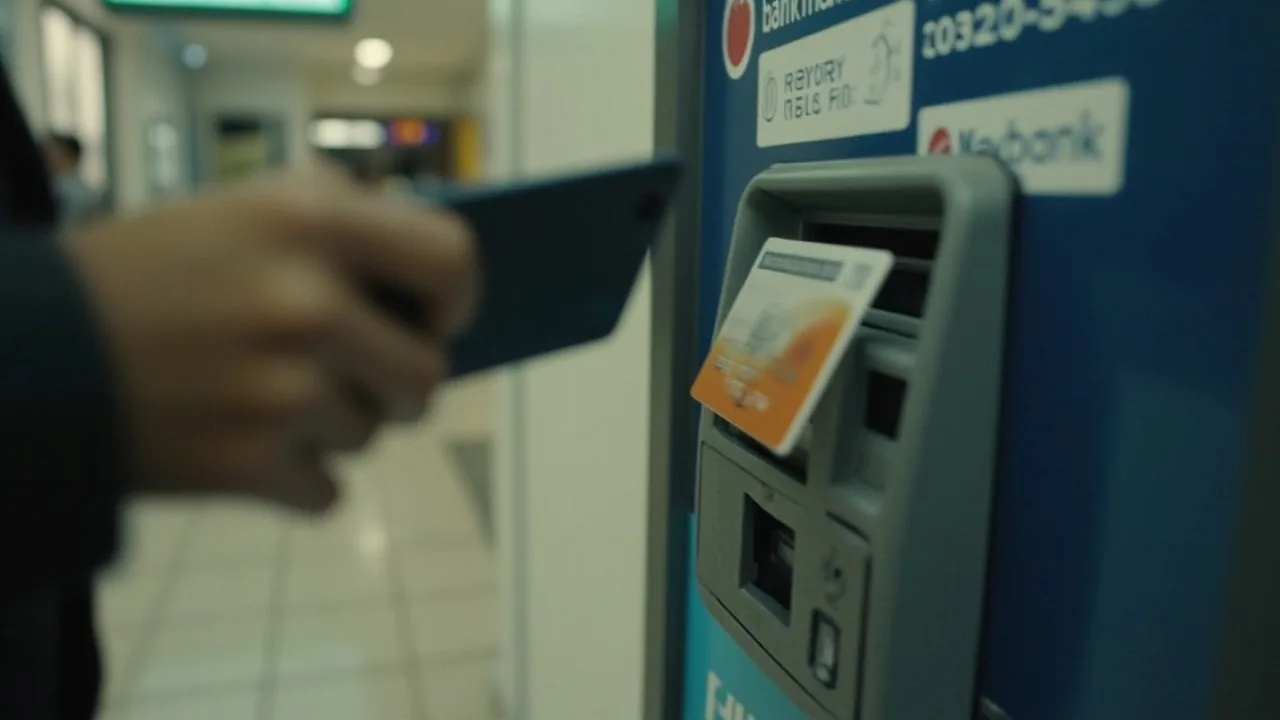
The single reliable way to get ringgit out of a RuPay card in Malaysia is at RuPay-enabled Maybank ATMs. Maybank is the official RuPay partner bank in Malaysia, and select machines display the RuPay logo at the card slot or on-screen.
What to expect at the ATM:
- Withdrawal limit: usually ₹35,509 (~1,500 MYR or ~$368.33) per transaction (check your bank’s daily cap too)
- ATM operator fee: ₹237 (~10 MYR or ~$2.46) per foreign-card withdrawal, charged by Maybank
- Your home bank may add a separate cross-border fee on top
- Receipts show the conversion rate used at the moment of the transaction
You will not see a RuPay logo on every Maybank machine. The reliable test: insert your card before selecting anything. If the terminal reads it and offers “Savings / Current” prompts, you’re at a RuPay-enabled machine. If it spits the card back immediately, try the next branch or the next mall.
Step 3: Try RuPay at point-of-sale terminals
RuPay JCB acceptance at POS is far thinner than at ATMs. In practice:
- Larger malls in Kuala Lumpur, Penang, and Johor Bahru: spotty, works at some chain stores, fails at others
- Independent restaurants and street food stalls: almost never works
- Convenience stores (7-Eleven, FamilyMart): rarely works
- Tourist-heavy attractions: depends entirely on the acquirer
The honest expectation: treat RuPay as your ATM card in Malaysia, not your daily-spend card. Travellers report that maybe 1 in 5 attempted POS swipes on RuPay-JCB clears, and the rest get a “card not supported” or silent decline.
Step 4: Watch the fees stack up
Three fees hide inside every RuPay transaction in Malaysia:
- Cross-border markup: 1% to 3.5% above the wholesale rate, charged by either your home bank or the network. This is the big one.
- ATM operator fee: ₹237 (~10 MYR or ~$2.46) at Maybank for non-MyDebit foreign cards.
- Dynamic currency conversion (DCC): when a terminal offers to charge you in INR instead of MYR. Always decline. The DCC rate is 3% to 7% worse than letting the network convert at wholesale.
If your home bank charges 3.5% markup plus ₹237 (~10 MYR or ~$2.46) per ATM hit, the effective cost of a ₹23,672 (~1,000 MYR or ~$245.55) withdrawal works out to roughly ₹25,093-₹25,329 (~1,060-1,070 MYR or ~$260.29-$262.74) equivalent, before any GST or service tax applies. That is worse than a forex card on the Visa/Mastercard network, which typically costs 1% to 2% total.
Step 5: Stack the RuPay JCB cashback if you have an eligible malaysia rupay card
This is the one situation where RuPay genuinely beats Visa/Mastercard in Malaysia. NPCI’s RuPay JCB partnership has been running promotional cashback offers on international transactions, and the 20% cashback via Indigo (IndiGo co-branded RuPay cards) is the most-cited example across traveller forums and Instagram posts from 2025-2026.
How the offer usually works:
- 20% cashback on international POS transactions and ATM withdrawals
- Capped monthly amount (often ₹5,000 (~$51.82) or ₹10,000 (~$103.65) depending on the specific promo window)
- Minimum transaction value to qualify
- Valid only on RuPay JCB network, not on the underlying bank’s network
- Registration sometimes required via the issuing bank or a partner link
Read the fine print the day you fly. Promos rotate quarterly, and the cap, qualifying merchants, and eligible card variants change. If you are flying IndiGo and already hold an Indigo RuPay JCB card, this offer can cover a meaningful chunk of your Malaysia spend. Otherwise, the cashback story on RuPay in Malaysia is thin.
Step 6: Use RuPay only as a backup, not your primary tool
The practical setup most Indian travelers settle on:
- Primary: forex card (HDFC, ICICI, Axis, Niyo) loaded with MYR or USD, used at POS and ATMs
- Secondary: RuPay JCB card for cashback-eligible merchants, and for the Maybank ATM safety net
- Cash: ringgit from the airport or city money changer for hawker stalls and small shops
- Last resort: standard Visa/Mastercard debit card with the cross-border fees you accept as the cost of convenience
The mistake is treating RuPay as a like-for-like replacement for Visa/Mastercard. It is not. It is a cost-saving tool with narrow but useful coverage in Malaysia.
Common Mistakes Indians Make
Assuming any RuPay card works in Malaysia
The single biggest mistake. Pure RuPay (no JCB or Visa/Mastercard co-badge) is not accepted at any Malaysian ATM or POS. Travellers have reported being stuck at a Maybank ATM with a declined card and a long queue forming behind them. Check your card front: if the only network logo is RuPay, it is dead weight in Malaysia.
Letting the terminal offer to charge in INR
When a RuPay card works at POS, the terminal sometimes prompts to charge in INR instead of MYR. This is Dynamic Currency Conversion, and the rate is 3% to 7% worse than letting JCB or your bank convert at the wholesale rate. Always choose MYR. The merchant sometimes pressures you with “easier to track on your statement” but ignore that.
Withdrawing small amounts frequently
Every Maybank ATM hit on a foreign card costs ₹237 (~10 MYR or ~$2.46) flat. If you withdraw ₹2,367 (~100 MYR or ~$24.56) three times, you pay ₹710 (~30 MYR or ~$7.37) in fees alone. Withdraw larger amounts less often, or use cash from a money changer for small daily spend. Money changers in Bukit Bintang, Petaling Street, and most malls give competitive rates with no fee on amounts over a few hundred ringgit.
Forgetting the cross-border markup is on top of the FX rate
A ₹23,672 (~1,000 MYR or ~$245.55) withdrawal at a 3% markup costs you ₹710 (~30 MYR or ~$7.37) extra. That is real money, and the rate shown on the ATM screen rarely includes the markup. Check the conversion before you fly: at the current rate of 1 MYR ≈ 23.6403 INR, 1,000 MYR is around 23,640 INR before any markup. With a 3% markup, that becomes ₹24,349 (~$252.37) effective. The difference is the fee.
Expecting RuPay to work at LRT, MRT, or Grab
Malaysia’s public transport touch-in/touch-out system (MyRapid) and most ride-hailing terminals run on local schemes and do not accept foreign-network cards. Cash or a local e-wallet is required. Same goes for many Grab transactions if your card is a non-Visa/Mastercard.
What Most Guides Don’t Tell You
RuPay JCB acceptance in Malaysia varies by acquirer, not by country
This is the part that confuses most travelers. Even when a store has a chip-and-PIN terminal, the acquiring bank in Malaysia decides whether RuPay JCB is enabled. Two cafes next door to each other, both with contactless terminals, can have completely different outcomes on the same RuPay card. There is no way to know in advance. Travellers report that hotels and chain retailers (like the big malls) work more reliably than independent shops.
Maybank ATMs in smaller branches are often not RuPay-enabled
KL Sentral, Pavilion KL, and major mall branches tend to have RuPay-enabled machines. Suburban and rural Maybank branches often do not. If you are flying into a smaller city, do not count on Maybank as your only ATM. Bring a forex card backup and at least ₹11,836 (~500 MYR or ~$122.78) in cash from the airport.
The RuPay JCB cashback promo is a moving target
The widely cited 20% cashback on Indigo RuPay cards has changed terms several times since 2024. Sometimes it is 20%, sometimes it is 10%, sometimes it is merchant-specific. Check the issuing bank’s promo page or the Indigo RuPay landing page the week you travel. The promo also usually excludes ATM withdrawals in some versions and includes them in others.
RuPay JCB is accepted in Japan much more reliably than in Malaysia
If you are also doing a Japan leg, the same card works far better in Japan, where JCB is a domestic heavyweight. In Malaysia, JCB penetration is much thinner, and RuPay’s presence is only as deep as the Maybank partnership. Travellers who assume “JCB partner = JCB country” often get surprised at how rarely it works in Malaysian shops.
Some Indian banks do not enable international RuPay transactions by default
A few Indian banks ship RuPay cards with international transactions disabled. You have to enable it via net banking or the bank’s app before traveling. Travellers have found this out at the Maybank ATM, with the card declined and a vague error message. Enable international usage 48 hours before departure.
FAQ
Does RuPay work in Malaysia?
Yes, but only on RuPay-JCB co-badged cards, and only at RuPay-enabled Maybank ATMs for cash, plus a limited set of POS terminals that recognize JCB. Pure RuPay cards (no co-badge) are not accepted.
Which Malaysian bank accepts RuPay?
Maybank is the official RuPay partner in Malaysia. RuPay-enabled Maybank ATMs accept the card for cash withdrawal. There is no other major Malaysian bank with direct RuPay support as of mid-2026.
Can I withdraw cash from a RuPay card in Malaysia?
Yes, at RuPay-enabled Maybank ATMs. Expect a ₹237 (~10 MYR or ~$2.46) per-transaction fee charged by Maybank, plus a cross-border markup of 1% to 3.5% from your home bank.
What are the fees on a RuPay card in Malaysia?
Three fees: the cross-border markup (1% to 3.5% on the FX rate), the Maybank ATM operator fee (₹237 (~10 MYR or ~$2.46) per withdrawal), and any fee your Indian bank adds for international ATM usage. Decline DCC prompts to avoid an extra 3% to 7%.
Is there a RuPay JCB cashback offer for Malaysia?
Yes, NPCI and partners (including Indigo co-branded cards) have run 20% cashback promos on international RuPay JCB transactions. The terms and cap rotate every few months, so verify the current offer with your issuing bank before relying on it.
Should I use a forex card instead of RuPay in Malaysia?
For most travelers, yes. A forex card on the Visa/Mastercard network gives broader POS and ATM acceptance at a competitive 1% to 2% total cost, with fewer declines. Use RuPay JCB for the Maybank ATM safety net and any cashback-eligible merchant.
Does RuPay work at LRT, MRT, or Grab in Malaysia?
No, not reliably. Malaysia’s public transport and ride-hailing ecosystem expects cash, a local e-w wallet, or a Visa/Mastercard. Bring ringgit for transport or top up a Touch ‘n Go card at the LRT station counter.
Subodh’s Take
RuPay in Malaysia is real, but it is a niche tool, not a daily driver. The Maybank ATM hookup is genuinely useful as a cash backup, and the RuPay JCB cashback promos can save you real money if you hold the right card. But if you arrive expecting to tap your RuPay card at every restaurant and shop, you will spend half your trip watching terminals decline it. Bring a forex card as the primary, keep RuPay JCB as the cashback-eligible secondary, and carry some ringgit for the small shops. That setup has worked for every Indian backpacker I have seen do it well.
