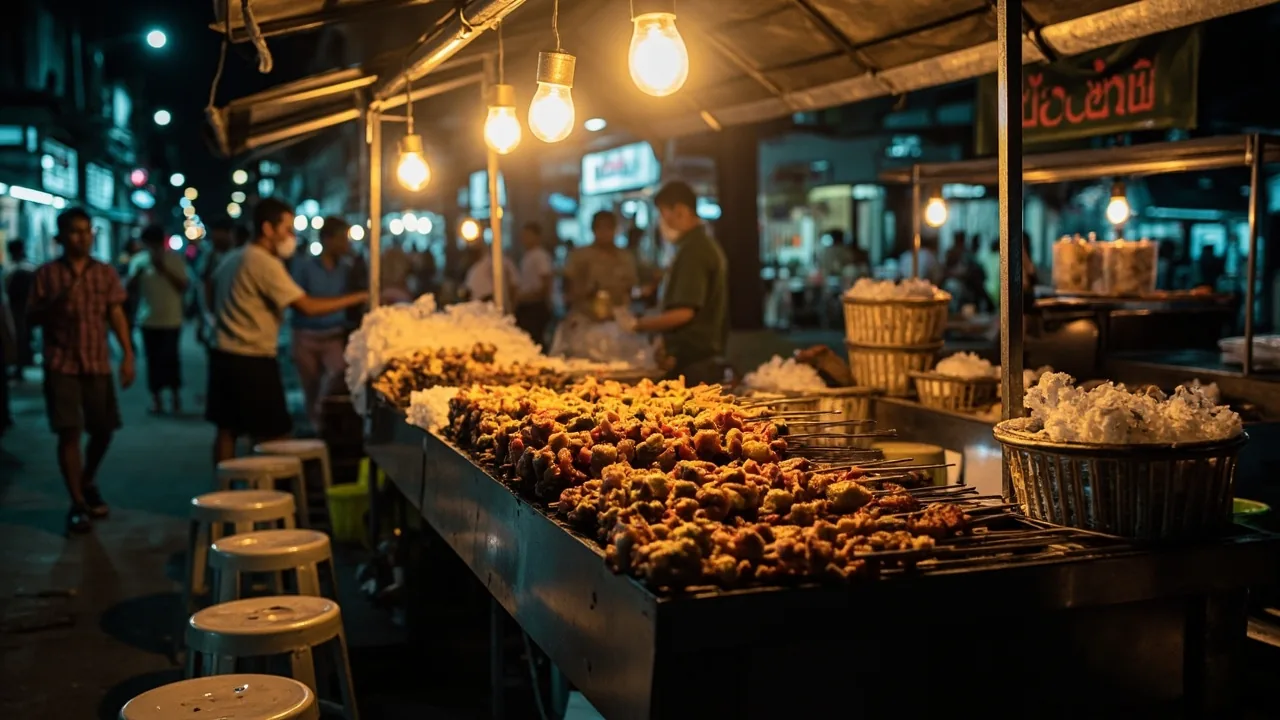
Vientiane Street Food Night Market: What to Eat, Where to Go & What to Skip
Laos is a meat-and-fish-sauce country, and Vientiane at night is no different. But here’s the good news for Indian travellers: the night markets here are smaller, calmer, and easier to navigate than Bangkok’s or Hanoi’s. You’ll eat well on a tight budget, you’ll see almost everything cooking right in front of you, and you can dodge the worst of the tourist-trap stalls with about ten minutes of orientation. For related planning, see our guide on Sea Backpacking Hub.
The trade-off is choice. Vientiane doesn’t have a single giant night market like Chiang Mai or Luang Prabang (the latter has a brilliant one, by the way, covered in my Luang Prabang guide). It has two main evening food spots, a smaller stupa-side market near Pha That Luang, and a clutch of decent Indian restaurants if you need a dal-chawal reset. This guide covers all of them. You may also find Famous Food in Laos useful for this trip.
Quick Answers
| What | Answer | Price (INR) |
|---|---|---|
| Where is the main night food market in Vientiane? | Ban Anou Night Market, near the old French-era train station at the end of Quai Fa Ngum Rd. The riverside Mekong Night Market runs along the promenade as a backup. | ₹108-₹216 (~25,000-50,000 LAK or ~$1.12-$2.24) tuk-tuk from central hotels |
| What time do stalls start cooking? | Vendors start firing grills around 5:30 PM, full swing by 6:30 PM, most wrap up by 10:30 PM. Arrive 6-7 PM for the freshest food. | Free entry |
| What’s a typical meal cost at the night market? | One grilled skewer + sticky rice + a drink = ₹65-₹129 (~15,000-30,000 LAK or ~$0.67-$1.34) | ₹65-₹129 (~15,000-30,000 LAK or ~$0.67-$1.34) |
| Is vegetarian food easy to find? | Harder than Thailand. Most stalls are meat-centric. Carry the phrase “Jay” and you’ll get at least papaya salad, sticky rice, and a few stir-fries. | Stick to Ban Anou’s grills + That Luang stupa market |
| Which Indian restaurant do locals go to? | My Kitchen Indian Authentic Food and Khan Halal Indian and Pakistani restaurant No-3, both around ₹173-₹345 (~40,000-80,000 LAK or ~$1.79-$3.58) per thali | 40,000-80,000 LAK |
Verified 2026-07-17 at 1 INR = 232.56 LAK. Converted using ExchangeRate-API daily mid-market.
The Local Culinary Landscape
Lao food runs on three pillars: sticky rice (khao niao), laap (minced meat salad, often raw or barely cooked), and padaek (fermented fish sauce that shows up in nearly everything that isn’t already on the grill). Vegetarians reading that last sentence just felt their stomach drop. Hold on.
The padaek problem is real, but not universal. Grilled meat skewers, sticky rice, and fresh papaya salad are easy wins. Stir-fries and soups are where things go sideways. Even “vegetable” versions get a splash of fish sauce or a chicken-stock base unless you specifically say otherwise. Indian travellers who assume “vegetable stir-fry” means what it means in Mumbai are about to learn a ₹216 (~50,000 LAK or ~$2.24) lesson about broth.
The local attitude toward vegetarianism is similar to Thailand’s older generation: many Lao people consider chicken, fish, and even pork “not meat” in the religious-merit sense. If you say “gin Jay” (eat vegan/vegetarian), they’ll often try to serve you fish. Specify “Jay sai nyha” if you need to be strict, or just point at the grill and accept that you’ll be on a sticky-rice-and-papaya-salad rotation. Travellers report this exact confusion at Ban Anou almost nightly.
Key Phrases in Local Script
| English | What it Means | Lao Script | Pronunciation |
|---|---|---|---|
| I am vegetarian | No meat, no fish, no seafood | ຂອ້ອຍກິນເຈ | koy gin jay |
| No fish sauce | Critical for vegetarians | ບໍ່ໃສ່ນ້ຳປາ | bo sai nam pa |
| No meat, no seafood | Beef/pork/chicken + fish/shrimp | ບໍ່ໃສ່ຊີ້ນຫມູ ບໍ່ໃສ່ປາ | bo sai sin bo sai pa |
| No egg | Useful for Jains | ບໍ່ໃສ່ໄຂ່ | bo sai khai |
| Spicy, please | Lao food is mild unless asked | ເຜັດ | phet |
| Not spicy | If you’ve made the mistake once | ບໍ່ເຜັດ | bo phet |
Print this table or screenshot it. The phrase “bo sai nam pa” alone will save you from at least one ruined meal per night market visit.
The Two Real Night Markets (and the Stupa-Side Third)
Ban Anou Night Market is the main one. Head to the old French-era train station at the end of Quai Fa Ngum Road, just south of the Mekong. The market spills out behind and beside the station building. It’s not huge, maybe 80 stalls in total, but the food court section is concentrated and easy to walk through. Grilled skewers, papaya salad, khao jee baguettes, fruit shakes. Locals eat here, which is the single best quality signal in any Southeast Asian market.
Mekong Riverside Night Market runs along the riverfront promenade between Chao Anouvong Park and the tourist-boat pier. It’s prettier than Ban Anou (sunset views across the Mekong to Thailand), but the food stalls skew more toward souvenirs and pad thai-style tourist food. Travellers report prices are 20-30% higher here, partly because you’re paying for the river view. Worth one visit for the photos, not for repeat dinners.
That Luang Food Market is the third option most guides skip, and it shouldn’t be skipped. It’s a small evening market that sets up on the eastern side of Pha That Luang, the gold stupa that’s Vientiane’s most famous landmark. Closer to the airport, fewer tourists, and a few stalls do grilled river fish, sticky rice, and proper laap at proper local prices. If you’re visiting Pha That Luang at sunset (a great move, see Pha That Luang hidden gems), the food market is right there.
Book food tour if you’d rather walk the markets with a local guide who speaks English and handles the ordering. Worth it on day one to learn the layout, then go solo the rest of the trip.
Safe Street Food Dishes to Eat at Night
Khao jee baguette is the Lao-French hangover you want. A short baguette split, stuffed with ham, pâté, pickled carrot and daikon, cucumber, cilantro, and a slick of mayo. Around ₹65-₹86 (~15,000-20,000 LAK or ~$0.67-$0.90) from the khao jee carts at Ban Anou. Skip the meat versions and you’ll get a decent vegetarian version with egg and pickles, but make sure to ask them to hold the pâté (it has pork).
Grilled meat skewers (khao sin / ping kai) at ₹65 (~15,000 LAK or ~$0.67) each. Travellers report the chicken skewers are safer than the pork or beef, since the chicken grills longer and hotter. Eat them off the grill, not from the pre-cooked tray, and make sure the marinade doesn’t include oyster sauce (it often does).
Som tam (papaya salad) at ₹43-₹65 (~10,000-15,000 LAK or ~$0.45-$0.67). The Lao version (tam mak hoong) uses padaek instead of fish sauce, so you cannot order a “vegetarian” papaya salad here and assume it’s safe. Say “bo sai nam pa, bo sai padaek” and they’ll typically make you a version with lime, chili, garlic, tomato, and peanut. Travellers report this works about 70% of the time, and the other 30% you’ll get a “Jay” salad with padaek that you only discover after the first bite.
Sticky rice (khao niao) is your safest bet at any Lao market. Served in a small bamboo basket, you tear off chunks with your right hand and dip into whatever’s in front of you. It’s steamed, no seasoning, no hidden meat. ₹22-₹43 (~5,000-10,000 LAK or ~$0.22-$0.45) per basket. Eaten across Laos, this is the one dish where ordering vegetarian is genuinely zero-risk.
Beerlao at ₹43 (~10,000 LAK or ~$0.45) per large bottle. The rice lager of Laos, lighter than a Thai lager, pairs well with grilled everything. Order it cold from the ice bucket. Travellers report it’s the most reliably cheap and safe drink at the night market.
Recommended Restaurants for When the Night Market Isn’t Enough
My Kitchen Indian Authentic Food (4.9 rating). Generous portions, warm hospitality, and what traveller reports describe as the closest dal-chawal-to-home experience in Vientiane. Mains run ₹129-₹259 (~30,000-60,000 LAK or ~$1.34-$2.69), a full thali is closer to ₹345 (~80,000 LAK or ~$3.58). Worth the tuk-tuk ride.
Khan Halal Indian and Pakistani restaurant No-3 (5.0 rating). The chicken biryani is the standout, and the whole menu comes in under five dollars per person. If you’ve been eating sticky rice and grilled skewers for a week, this is the spot.
Roti Fathima Halal Ponpapao (4.8 rating). Fresh rotis, decent curries, halal-certified. The kind of place where the roti tastes like roti. ₹108-₹194 (~25,000-45,000 LAK or ~$1.12-$2.01) per meal.
Jamil Zahid Indian and Pakistani Food (4.6 rating). Family-run, basic setting, authentic curries. ₹216-₹432 (~50,000-100,000 LAK or ~$2.24-$4.48) per person is realistic for a full meal with drinks.
Yum Town Pizza & Pakistani Indian Restaurant (4.9 rating). Yes, they do Indian food, yes, they also do pizza, yes, the chicken tikka pizza is worth the order. ₹345-₹604 (~80,000-140,000 LAK or ~$3.58-$6.27) per person. Higher-end than the others, more “sit-down dinner” than “quick fix.”
Vegan Reunion Cafe (4.7 rating). If you’re plant-based and want something that isn’t Indian or isn’t fried, this is the spot. Creative vegan dishes, full menu, no meat in the building at all. Useful if you’re travelling with veg friends who want variety.
The Shade Restaurant (4.9 rating). Lao food done properly in a garden setting, including a serious green papaya salad and laap. If you want to try real laap in a sit-down setting before committing to it at a market stall, this is the place.
For more Indian-food options across Laos, see my Indian restaurants in Laos guide.
Food Safety & Hygiene for Indian Stomachs
Vientiane’s tap water is not safe. Bottled water runs ₹17 (~4,000 LAK or ~$0.18) for 1.5L at any minimart. Ice at the night markets is generally factory-made and safe, but the small operations might use tap water for their ice. When in doubt, drink Beerlao.
Stalls with high turnover are safer than empty ones. The grilled skewer section at Ban Anou gets constant traffic from 6:30 PM onwards. Eat there. The empty khao jee cart near the entrance with the long-stale baguettes? Skip it.
Raw vegetables are a higher risk than cooked. Som tam is technically raw papaya, so the risk is real. If your stomach is sensitive, either go vegetarian at the grills (fully cooked) or eat at the recommended Indian restaurants above.
Hand sanitizer is essential. Most stalls don’t have running water for hand-washing. Carry a small bottle. The smell of grilled meat will make you forget this; don’t.
If you do get sick, traveller reports put recovery at 24-48 hours with rest and oral rehydration salts. Pharmacies in central Vientiane stock everything you need. See Is Laos safe for Indian travelers for emergency contacts and clinic recommendations.
Getting There and Around
Ban Anou is easy to find. From anywhere in central Vientiane, take a tuk-tuk (₹216-₹432 (~50,000-100,000 LAK or ~$2.24-$4.48) within town, negotiate first) and say “Ban Anou night market” or “sathani rot fai” (train station). The old train station is on Google Maps and is a recognisable landmark: a small yellow French colonial building at the southern end of Quai Fa Ngum Road. The night market fills the lot behind it.
The Mekong Riverside Night Market is a 10-minute walk from most central hotels. Head to the riverfront, turn left (north) at Chao Anouvong Park, walk past the food court area, and you’ll hit the market stalls along the promenade.
That Luang Food Market is on the east side of Pha That Luang, the gold stupa. From central Vientiane, it’s about 20-30 minutes by tuk-tuk depending on traffic, around ₹345-₹432 (~80,000-100,000 LAK or ~$3.58-$4.48). If you’re combining it with a sunset visit to the stupa, this is the cheapest two-fer in Vientiane.
Getting Connected
You’ll want data for Google Maps, Google Translate (camera mode is gold for menus), and a translation app. A local SIM is cheap and works well across Vientiane; Lao Telecom and Unitel both have shops near the Morning Market. Or grab a Get Nomad eSIM before you fly and land connected.
Common Mistakes Indian Travellers Make at Lao Night Markets
Ordering “vegetable” anything without specifying no fish sauce. The single most common mistake. Vegetable stir-fries in Laos almost always start with a garlic-and-fish-sauce base. You’ll get a plate of vegetables that tastes great and quietly violates your vegetarian rules. Always say “bo sai nam pa.”
Assuming papaya salad is safe. It looks vegetarian, it’s mostly vegetables, but padaek (fermented fish sauce) is the soul of Lao papaya salad. Order it specifically: “tam mak hoong, bo sai padaek, bo sai nam pa.”
Eating pre-cooked meat from trays. Pre-cooked skewers sitting out for hours are the highest-risk food at any market. Order fresh off the grill and wait the 5-7 minutes.
Skipping the sticky rice. This is the safest, cheapest, most authentically Lao thing you can eat. A basket of khao niao with grilled vegetables is a complete, satisfying meal for under ₹65 (~15,000 LAK or ~$0.67).
Going too late. After 10 PM, the grills cool down, the fresh batches stop, and what’s left is whatever’s been sitting. Arrive 6-7 PM for the best selection and the freshest food.
Skipping Ban Anou in favour of the riverside market because it looks prettier. The riverside market is a photo op. Ban Anou is where you eat. Most nights you can do both in 90 minutes.
Subodh’s Take
Here’s the honest truth about Vientiane’s night markets: they’re not going to blow your mind. They’re smaller than Chiang Mai, less varied than Hanoi, less atmospheric than Luang Prabang. But they’re cheap, they’re safe, the vendors don’t hassle you, and the food is genuinely good. If you arrive with the right phrases (“bo sai nam pa,” “gin Jay”) and the right expectations (you will eat a lot of sticky rice), you’ll have a great time. Three nights at Ban Anou, one Indian-restaurant reset, one sunset at That Luang with the food market there, and you’ve covered Vientiane’s night food scene completely.
FAQ
Is the Vientiane night market safe for solo female Indian travelers? Yes. Ban Anou is family-heavy in the early evening, well-lit, and busy enough that solo travellers feel comfortable. Standard precautions apply as in any city: don’t walk back to your hotel alone past 11 PM in unfamiliar streets, use a tuk-tuk if it’s late.
Can I find Jain food (no onion, no garlic) at the night market? Realistically, no. The Lao flavour base is garlic-forward, and most stalls won’t understand “no onion, no garlic” as a request. Eat at the Indian restaurants above and ask specifically for Jain options; My Kitchen and Roti Fathima are the most likely to accommodate.
What time does Ban Anou night market close? Vendors start packing up around 10 PM, full close by 10:30-11 PM. Arrive before 9 PM for the best selection.
Is Beerlao safe to drink at the night market? Yes. It’s the national beer, factory-bottled, and the night markets keep it ice-cold. Travellers report it’s the most reliable drink option alongside bottled water.
Can I pay by card at the night market? No. Bring cash in Lao kip (LAK). Smaller denominations (5,000, 10,000, 20,000) are useful. Some stalls will accept Thai baht at bad rates, but don’t count on it. ATMs near the Morning Market in central Vientiane dispense LAK.
Is there a vegetarian section at Ban Anou? Not officially, but the khao jee carts, sticky rice vendors, and fruit-shake stalls are all meat-free. Combine with a papaya salad ordered “Jay” and you have a solid meat-free meal.
How do I get to That Luang Food Market? Tuk-tuk from central Vientiane, ₹345-₹432 (~80,000-100,000 LAK or ~$3.58-$4.48), 20-30 minutes. The market is on the east side of Pha That Luang stupa, easy to spot once you’re near the gold stupa.
