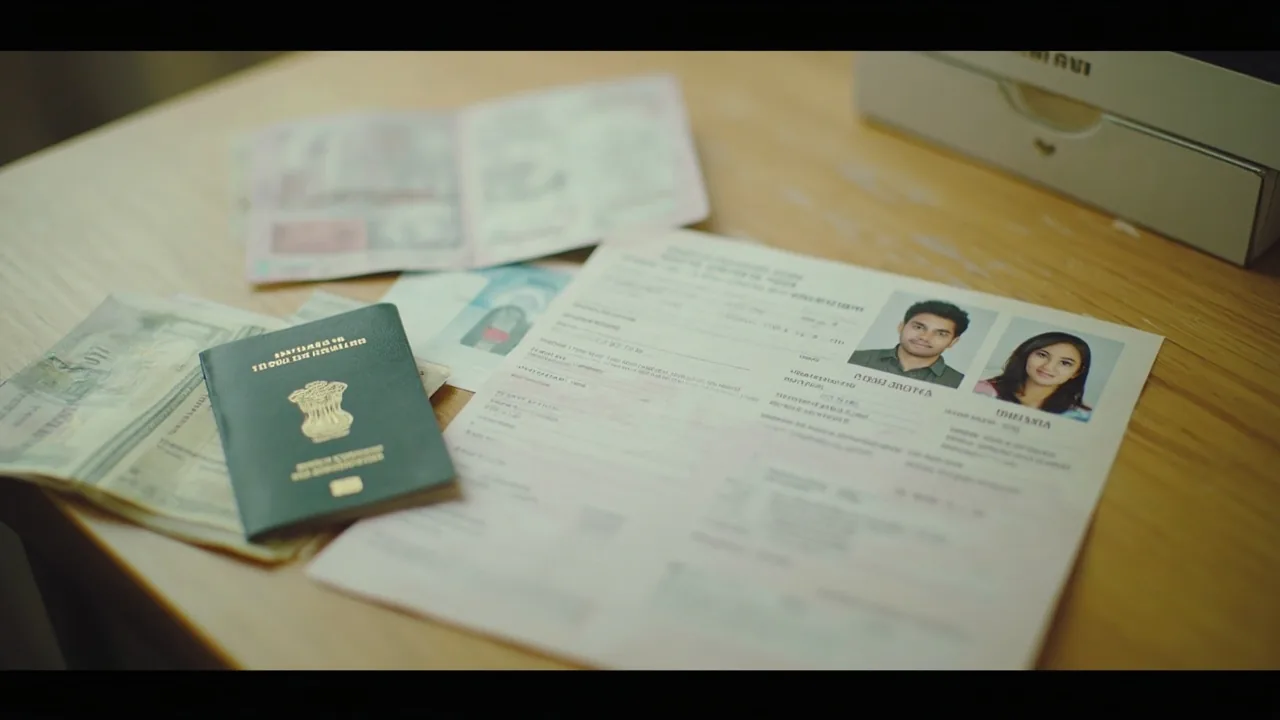
Vietnam Visa on Arrival for Indians + Best Backpacker Travel Insurance (Fees & Process 2026)
Vietnam visa on arrival for Indian citizens fees and travel insurance are the two things every Indian backpacker Googles within an hour of booking the flight. This guide cuts through the outdated forum threads, the visa-agent WhatsApp forwards, and the “apply at the airport” myth that keeps showing up on Quora. For the full SEA trail, check our SEA backpacking hub or our Vietnam vegetarian food guide.
Quick Answers
| What | Answer | Price (INR) |
|---|---|---|
| Vietnam visa type for Indians in 2026 | E-visa only. Visa-on-arrival is not available for Indian passport holders. | ₹2,410 (~25 USD) |
| Processing time | 3 working days standard, sometimes faster | Included in ₹2,410 (~25 USD) fee |
| Max stay | 90 days, multiple entry | Included |
| Photo spec | 4×6 cm, white background, taken within 6 months | Free (click at home) |
| Best backpacker insurance for Indians | SafetyWing Nomad | $62/month (~₹5,900) |
Subodh’s Pro Tip: Forget the visa-on-arrival option completely. It is not available for Indian passport holders in 2026. Apply directly on the official Vietnamese government portal and skip every third-party “visa agent” who quotes ₹5,000 (~$51.87)+ for the same form.
The Real Vietnam Visa Situation for Indians in 2026
There is no Vietnam visa on arrival for Indian citizens. I repeat, there is no Vietnam visa on arrival for Indian citizens in 2026. The Vietnamese government ended that route for Indian passport holders years ago. Anyone telling you otherwise is either quoting an outdated Lonely Planet, running an unofficial agent, or confusing it with the e-visa, which is the only legitimate pre-arrival option now.
The e-visa is honestly easier than the old visa-on-arrival ever was. You fill the form online, upload a 4×6 cm photo with a white background, pay ₹2,410 (~25 USD) by card, and get the approval letter by email in 3 working days. Print it, carry it, show it at immigration. Done.
Visa-on-Arrival Myth vs Reality
| What the forum says | What happens in 2026 |
|---|---|
| ”Pay ₹2,410 (~25 USD) stamp fee at Hanoi airport” | No stamp desk for Indians. You will be turned away to the e-visa counter. |
| ”Get a pre-approved letter online for ₹1,928 (~20 USD)“ | Those letters are for the old VOA. Indian passport holders cannot use them. |
| ”Apply at the airport on arrival” | Not possible. You board the flight without a visa, you fly back. |
The fee breakdown for the actual process:
- Government e-visa fee: $25 USD (~₹2,408 at 1 USD = ₹96.3294)
- Photo print at a Vietnam shop if you forget: ₹74-₹184 (~20,000-50,000 VND or ~$0.76-$1.91)
- Airport SIM for first-day navigation: ₹479 (~130,000 VND or ~$4.97)
- Grab from airport to Old Quarter: ₹552-₹810 (~150,000-220,000 VND or ~$5.73-$8.40)
That is the whole visa cost. No agent commission, no “service fee”, no USD cash on arrival. The ₹2,410 (~25 USD) figure is fixed by the Vietnamese government and is non-negotiable.
Step-by-Step E-Visa Process for Indians
Here is the exact flow that works in 2026, walked through the way I wish someone had done for me before my first trip.
Step 1: Get the Photo Right
Vietnam is strict about the photo, more strict than Schengen or US. The spec is 4×6 cm (not the standard passport 2×2 inch Indian agents use for US visa), white background, taken within the last 6 months, face covering 70 to 80 percent of the frame, no glasses, no smile showing teeth, no head covering unless religious.
You can do this at home:
- Stand against a white wall near a window for natural light.
- Have someone click with a phone in portrait mode.
- Crop to 4×6 cm ratio (use the free tool at iloveimg.com or the official portal’s built-in cropper).
- Resize to between 2MB and 6MB file size, JPEG or PNG.
If you botch this part, your application gets rejected in 48 hours and you lose 3 days of processing. Worth doing once, doing right.
Step 2: Apply on the Official Portal
Go to https://evisa.xuatnhapcanh.gov.vn. Bookmark it. Do not Google “Vietnam visa apply” and click a paid ad. The first three results are all agents charging ₹3,000 ($31.12) to ₹5,000 ($51.87) to fill the same free form.
Fill in:
- Personal details (passport number, DOB, nationality: India)
- Travel dates and entry airport (Hanoi, Da Nang, Ho Chi Minh, or any of the 33 approved checkpoints)
- Upload your 4×6 cm photo
- Upload your passport bio-page scan
Step 3: Pay the Fee
The fee is ₹2,410 (~25 USD), paid online by Visa or Mastercard. At the current rate of 1 USD = ₹96.3294, you are paying ~₹2,408 on your Indian card. Watch the forex markup on your card; the HDFC Infinia and ICICI Emeralde give the closest-to-Mid-market rate, while a basic Visa debit card can land you at ₹2,550 (~$26.45) to ₹2,650 (~$27.49) with the bank’s spread.
Subodh’s Pro Tip: Use a forex card, not your regular debit card, to avoid the 2 to 3 percent forex markup. Niyo Global and Fi Federal bank cards give near-perfect mid-market rates on Visa transactions.
Step 4: Wait and Print
Processing time is 3 working days. Travellers report getting approvals in under 24 hours during low season (September to November) and 5 to 7 days during Tet (late January to early February). Apply at least 2 weeks before your flight to leave margin.
You will receive a PDF. Print two copies (one for immigration, one for your records). It is valid for 90 days, multiple entry, and lets you stay up to 90 days per entry.
Step 5: At the Airport
Walk to the “Foreign Passport / E-Visa” line at immigration, not the “Visa on Arrival” desk. Hand over your passport, the printed e-visa, and your return ticket. The officer stamps you in. Total time: 5 to 15 minutes depending on the queue.
For a complete pre-flight checklist, see our Vietnam budget breakdown for Indian backpackers.
Vietnam Visa Photo Specs at a Glance
| Spec | Requirement |
|---|---|
| Size | 4×6 cm |
| Background | Plain white |
| Age of photo | Within last 6 months |
| File format | JPEG or PNG |
| File size | 2 MB to 6 MB |
| Glasses | Not allowed |
| Head covering | Only for religious reasons |
| Expression | Neutral, mouth closed |
Best Backpacker Travel Insurance for Indians Going to Vietnam
Visa is the easy part. Insurance is where most Indian travellers either overpay for useless coverage or skip it and pray. Both are bad ideas, especially if you are solo.
Once you land, eating well matters as much as staying insured. For your first proper Vietnamese meal near Noi Bai, Hello Hanoi Restaurant serves solid local food at fair prices (rated 4.9). Vietnamese Soul Food offers an authentic street-food experience, and if you need familiar flavours, The One Indian Halong Restaurant in Ha Long has Indian-friendly options.
Here is the honest breakdown of what works for a backpacker doing 2 to 4 weeks in Vietnam.
SafetyWing Nomad Insurance
This is the default for a reason. Indian travellers on Reddit r/SoloTravel and r/india consistently rate it as the best value backpacker plan.
- Cost: $62 USD/month (~₹5,900 at current rates)
- Coverage: Medical emergencies up to ₹24,100,925 (~250,000 USD), trip interruption, medical evacuation, baggage loss
- COVID coverage: Included
- Region: Worldwide, including Vietnam
- Eligibility: Available to Indian citizens and residents
You can buy it while already in Vietnam. No medical check-up required. The first 14 days have a waiting period for illness but accidents are covered from day 1.
Subodh’s Pro Tip: Buy SafetyWing the same day you book your flight. Not because you need the coverage in week one, but because waiting until you arrive in Hanoi means your first week has zero illness coverage if you get food poisoning on day 2 (you will, the water is no joke, see our Vietnam tap water guide).
Other Options Compared
| Plan | Cost (USD/month) | Best for |
|---|---|---|
| SafetyWing Nomad | ₹5,977 (~62 USD) | Default backpacker choice |
| World Nomads Explorer | ₹9,158 (~95 USD) to ₹12,532 (~130 USD) | Adventure sports (motorbike, scuba) |
| Tata AIG Travel Guard | ~₹4,338 (~45 USD) to ₹7,712 (~80 USD) | Indian residents wanting INR billing |
| HDFC ERGO Optima Secure | ~₹2,892 (~30 USD) to ₹5,784 (~60 USD) | Annual multi-trip plans |
For most Indian backpackers doing a one-time 3 to 4 week Vietnam trip, SafetyWing hits the sweet spot. If you plan to ride a motorbike (you will, scooters are the default transport in Da Nang and Hoi An), pay extra for the “Adventure” add-on which covers motorbike-related injuries up to a certain CC limit. Standard plans exclude two-wheeled travel above 50cc.
Common Mistakes Indians Make on the Vietnam Visa
Mistake 1: Trusting the Visa-on-Arrival Forums
Old India Mike and TripAdvisor threads from 2018 still rank high on Google. They tell you to apply for a VOA approval letter, pay ₹1,928 (~20 USD) to an agent, and then pay ₹2,410 (~25 USD) stamp fee on arrival. None of this applies to Indian passport holders in 2026. You will land at Noi Bai or Tan Son Nhat, walk to the wrong desk, lose 2 hours figuring it out, and possibly miss your airport transfer.
Fix: Apply for the e-visa on the official portal. Period.
Mistake 2: Going Through an Indian Visa Agent
Every agent in Karol Bagh, Andheri, or MG Road will quote you ₹4,500 (~$46.68) to ₹6,500 (~$67.42) for “Vietnam visa service.” They fill the same government form you can fill yourself in 15 minutes, and they charge the ₹2,410 (~25 USD) fee on top of your ₹3,000 (~$31.12) to ₹5,000 (~$51.87) service charge.
Fix: Fill the form yourself. Save ₹3,000 (~$31.12)+ for your first week of pho.
Mistake 3: Wrong Photo Specs
Indians commonly upload a 2×2 inch (US visa size) or 35×45 mm (Schengen size) photo. Both get rejected because Vietnam wants exactly 4×6 cm. The rejection email comes 48 hours in, and you restart the 3-day clock.
Fix: Use the 4×6 cm spec. The portal has a built-in cropper if you cannot find the exact ratio.
Mistake 4: Buying Travel Insurance Only After a Friend’s Horror Story
The friend who got dengue in Ho Chi Minh City and paid ₹200,000 (~$2,074.61) out of pocket for hospital bills is the reason you are reading this guide. Do not be that friend. Or rather, be that friend who had SafetyWing, paid $0 out of pocket, and got evacuated properly.
Fix: Buy insurance before you fly. ₹5,900 (~$61.20) for 30 days of coverage is cheaper than one night in a Vietnamese private hospital without insurance.
Mistake 5: Skipping the Return Ticket Proof
Immigration officers in Vietnam occasionally ask for proof of onward travel. Not always, but enough that you should not gamble on it. Without a return ticket or a ticket to a third country (Bangkok, Singapore, Bali), they have the legal right to deny entry.
Fix: Carry a printed return flight confirmation or a Bali/Bangkok onward ticket. If you are genuinely open-ended, book a refundable onward ticket on a budget airline like AirAsia for ₹2,892 (~30 USD) to ₹4,820 (~50 USD) and cancel it within 24 hours.
Quick Packing List for the Visa + Insurance Part of the Trip
You need to physically carry or have digital access to:
- Printed e-visa (2 copies)
- Passport with 6+ months validity
- Printed return or onward ticket
- Printed travel insurance confirmation (SafetyWing sends this by email)
- Digital copies of all four on Google Drive and a backup email to yourself
- Passport photos (4×6 cm, 2 spare copies) for any future visa extensions if you fall in love with Sapa
For more on packing and what to skip, check our Vietnam solo travel vlog guide.
Getting Connected: SIM and eSIM
Vietnam is easy on SIMs. Walk out of the airport, find the Viettel or Mobifone counter, hand over your passport, and walk out with a tourist SIM in 5 minutes.
- Viettel/Mobifone 14-day SIM: ₹479 (~130,000 VND or ~$4.97), includes ~6GB data
- Coverage: 4G across cities and most tourist towns, drops to 3G in Sapa and Ha Giang
- eSIM alternative: Get Nomad eSIM, works before you even board the flight, useful for Grab from the airport and Maps the moment you land
For a deeper dive on connectivity and money exchange on the ground, see our cheap living in Vietnam guide.
FAQ
Is Vietnam visa-on-arrival available for Indian citizens in 2026?
No. Indian passport holders must apply for the e-visa online before travel. Visa-on-arrival is not available at any Vietnamese airport for Indians in 2026.
How much does the Vietnam e-visa cost for Indians?
$25 USD (~₹2,408 at 1 USD = ₹96.3294) for a 90-day, multiple-entry visa. There are no other government fees.
How long does the Vietnam e-visa take to process?
3 working days standard, sometimes faster. Apply at least 2 weeks before your flight to leave margin for photo rejections or peak-season delays.
What photo size does Vietnam e-visa need?
4×6 cm, white background, taken within the last 6 months. Standard 2×2 inch or 35×45 mm photos will be rejected.
Is travel insurance worth it for a 2-week Vietnam trip?
Yes. One dengue case or scooter accident in Vietnam without insurance can cost ₹200,000 (~$2,074.61)+. SafetyWing at $62/month (~₹5,900) covers medical, evacuation, and trip interruption, and is the default pick for Indian backpackers.
Which is the best travel insurance for Indian backpackers in Vietnam?
SafetyWing Nomad is the most common pick for Indian backpackers due to cost ($62/month), flexibility (buy mid-trip), and coverage (medical + evacuation + COVID). World Nomads is better if you are doing adventure sports.
Can I extend my Vietnam e-visa if I fall in love with the country?
Yes. You can extend once for an additional 30 or 90 days through a Vietnamese visa agency. Cost is typically ₹4,820 (~50 USD) to ₹9,640 (~100 USD) plus agent fees. Better to plan your 90 days well than count on extensions.
Subodh’s Take
The Vietnam visa process is one of the easiest in Southeast Asia for Indians in 2026, far simpler than the paperwork-heavy US or Schengen. The ₹2,410 (~25 USD) e-visa, the 4×6 cm photo, and the 3-day wait are all you need to plan around. Skip every Indian visa agent, skip every outdated forum that still says “visa on arrival,” and skip every WhatsApp forward from a friend who last visited in 2019. Pair the visa with a SafetyWing policy the day you book your flight, and you have handled the two biggest pre-trip anxieties in under 30 minutes. Then the only thing left to figure out is whether you start in Hanoi and work south or do the opposite, which is a much better problem to have.