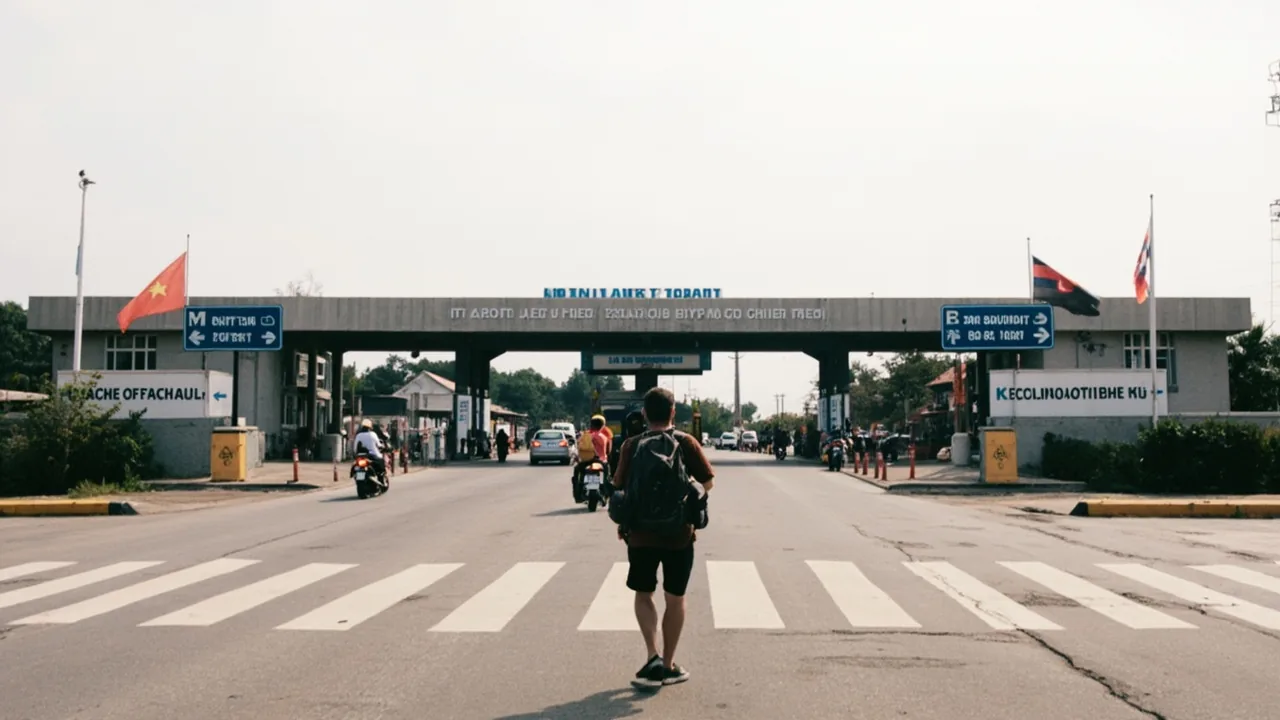
Bavet Border Crossing: The Complete Moc Bai to Bavet Guide for 2026
The Bavet border crossing Vietnam to Cambodia follows the Moc Bai to Bavet land border, the main overland route between Ho Chi Minh City and Phnom Penh, and the cheapest way to move between Vietnam and Cambodia without flying. For Indian backpackers doing the Banana Pancake loop, this is the corridor that turns “two countries” into one continuous bus ride.
For the full Southeast Asia overland network, see our SEA Backpacking Hub. Prices and bus schedules in this guide were cross-checked with traveller reports from June 2026 and the official Cambodia e-visa portal (evisa.gov.kh). Prices below are in Cambodian riel (KHR) and US dollars; Cambodia is a USD-dominant economy and you’ll pay for almost everything in greenbacks.
📍 Distance: 230 km (door-to-door, Saigon hotel to Phnom Penh hostel)
⏱️ Fastest option: 6 hours (direct express bus, no stopping)
💰 Cheapest option: equivalent if you split it
✅ Best option: Giant Ibis or Mekong Express direct bus, door to door
Quick Answers
| What | Answer | Price (INR) |
|---|---|---|
| Cheapest way across? | Local bus + walk + shared taxi | / ₹1,445 (~15 USD) |
| Best bus company? | Giant Ibis or Mekong Express | ₹1,445-₹1,734 (~15-18 USD) |
| Where do Saigon buses drop you? | Moc Bai (Vietnam side, last town before border) | Free with ticket |
| Walk across or take a taxi? | Walk. It’s 800m, no upsell needed | $0 |
| Cambodia visa-on-arrival fee? | ₹2,890 (~30 USD) cash + 1 passport photo | ₹2,890 (~$30) |
Option 1: Cheapest (Local Bus + Walk + Shared Taxi)
The cheapest path is also the most fragmented. You start on a Saigon local bus from Mien Tay bus station heading toward Tay Ninh, get dropped at Moc Bai, walk across the border into Bavet, then scramble for a shared taxi or another local bus up to Phnom Penh. Realistic total: 8 to 10 hours if nothing goes wrong.
Cost: roughly worth of dong, or about ₹1,445 (~15 USD) all-in if you pay the Cambodia leg in dollars. Breakdown:
- Saigon to Moc Bai local bus:
- Border walk: free
- Bavet to Phnom Penh shared taxi or local bus: ₹953 (~40,000 KHR or ~$9.89)
Comfort is where this option loses. The local Vietnamese bus will be cramped, the border crossing involves two stamp-outs and two stamp-ins on foot, and the Cambodian side shared taxis don’t leave until the vehicle fills, so you can wait for the vehicle to fill before departure.
Where to catch it: Mien Tay (Western) bus station in District Binh Tan, Ho Chi Minh City. Buses to Tay Ninh and Moc Bai leave roughly every 30 minutes from 6am. The Phuong Trang (Futa) counter is the easiest for foreign-ticket purchases. Don’t trust anyone offering you a “direct bus to Cambodia” from District 1 for ₹1,927 (~20 USD); that’s a tuk-tuk to a shared minivan scam and you’ll end up paying for both legs anyway.
The honest take: this is the route for hardcore budgeters with a full day to spare. For everyone else, the ₹1,445-₹1,734 (~15-18 USD) direct bus is better value once you factor in your time, the hassle of two border stampings you do yourself, and the risk of getting stitched up at the Bavet end by a taxi driver who’s been waiting all morning for tourists.
Option 2: Best Experience (Giant Ibis or Mekong Express Direct Bus)
This is the option I’d tell a friend to take. Book a direct bus from District 1 in Ho Chi Minh City to Phnom Penh with either Giant Ibis (the gold standard) or Mekong Express (the reliable runner-up). For the full city-to-city breakdown, see our Ho Chi Minh City to Phnom Penh guide. You’ll exit the bus at both borders for immigration stamping, but the bus company handles the logistics and waits for all passengers. Most companies include a Cambodian visa processing service for an extra ₹482-₹963 (~5-10 USD), meaning someone walks your passport to the visa-on-arrival counter and brings it back stamped.
Subodh’s Pro Tip: Pre-pay for the Cambodia e-visa online at evisa.gov.kh before you reach the border. It costs ₹3,468 (~36 USD) instead of ₹2,890 (~30 USD), but you skip the visa-on-arrival queue entirely and walk straight to the immigration line. For Indian passport holders during peak season (Nov-Feb), the queue savings are worth the ₹578 (~6 USD) premium.
What the experience is like: pickup from your hostel in District 1 around 6-7am, 2.5 hours of highway driving to Moc Bai, 30-60 minutes at the border depending on visa pre-clearance, then another 4-5 hours to Phnom Penh with one rest stop for lunch. Drop-off at their office in central Phnom Penh, usually near the riverfront. Total: 6-7 hours door to door.
Two specific tips:
- Sit on the left side of the bus for views of the open countryside crossing into Cambodia.
- Bring snacks. The rest-stop food is mid and overpriced (₹289-₹385 (~3-4 USD) for a tray of rice).
Book this through 12go and you’ll have a confirmed seat and a working pickup window:
For onward transport from Phnom Penh down the coast to Sihanoukville or over to Siem Reap, the same operators run direct buses. See our Phnom Penh to Siem Reap guide for distances and timings:
Option 3: Fastest (Private Car or Taxi)
A private car from Saigon to Phnom Penh runs ₹11,560-₹17,339 (~120-180 USD) total and takes 5-6 hours including the border stop. This is the only option faster than the express bus, and only marginally so. It’s not worth it unless you’re splitting the cost 3-4 ways or you’re on a tight flight connection the next morning.
There are no flights between Saigon and Phnom Penh that beat the bus by enough to justify the airport overhead. The flight is 1 hour but you lose 3 hours to airports and immigration. Skip it.
Border Crossing
Vietnam exit (Moc Bai International Border Gate)
The Vietnamese side is well-organized and quick. Your bus will pull into a large compound, you’ll get off with your luggage, walk to the immigration hall, queue, get stamped out. Have your passport and the bus ticket ready. Vietnam does not require a departure card.
Cambodia entry (Bavet International Border Gate)
This is where the time sink lives. The Cambodia side has three queues: visa-on-arrival (if you didn’t pre-pay), e-visa, and visa-exempt. Indian passport holders join the visa-on-arrival or e-visa line. The visa-on-arrival process:
- Fill out the arrival/departure card (forms available at counters near the entrance).
- Take your passport, one 4x6 cm passport photo, and ₹2,890 (~30 USD) cash to the VoA counter on the left.
- Wait 5-15 minutes for your passport to come back with the visa stamped inside.
- Queue at the immigration desk for entry stamp.
If you pre-paid for the e-visa online, skip steps 2-3 and go straight to the e-visa queue, which can be similar in speed to the VoA line but saves you the paperwork.
Subodh’s Pro Tip: Travellers report that Cambodian immigration sometimes rejects torn, written-on, or heavily creased bills — carry a couple of spare crisp USD notes in a separate pocket as a backup.
Money exchange traps
The official exchange rate inside the Bavet border hall is roughly 5-8% worse than Phnom Penh city rates. Travellers report that the rates quoted at the “official” counters inside the hall are not official; they’re private shops wearing uniforms. If you need USD for the visa and don’t have it, change worth of Vietnamese dong at the first legitimate-looking shop outside the hall rather than inside. Better yet, arrive at the border with ₹2,986-₹3,565 (~31-37 USD) in your pocket so you don’t have to exchange at all.
Border post operating hours
Both Moc Bai and Bavet run from 7am to 9pm Vietnam time. The last express bus from Saigon typically arrives at Moc Bai around 3-4pm, and most direct bus services won’t cross after dark. If you miss your bus window, you can stay overnight in Tay Ninh city (30 minutes back from the border) and cross in the morning.
Scams to watch for
Border scams follow a pattern across Southeast Asia - see our Poipet Border Crossing guide for the Cambodia-Thailand variant. At Bavet specifically:
- “You need a health check” - ₹482-₹963 (~5-10 USD) fake health certificate scam, mostly targeting tourists who look rushed.
- “Your passport photo is wrong size” - the 4x6 cm requirement is real, but the “official photographer” inside the hall charges triple.
- Unmetered “border taxis” - agreed price before you get in, no exceptions.
- Money changers waving calculators at you in the hallway - walk past, every single time.
Indian Passport Specifics
Indian passport holders get Cambodia visa-on-arrival at all international airports and major land borders including Bavet. You’ll need:
- Passport valid for 6+ months beyond entry date
- One 4x6 cm white-background photo
- ₹2,890 (~30 USD) cash for the visa fee
- Proof of onward travel (printed bus or flight ticket out of Cambodia)
There’s no Indian embassy at the border. The nearest Indian missions are:
- Embassy of India, Phnom Penh: +855-23-218-296, located on Street 41
- Indian consulate services are not available at Bavet
If you lose your passport at the border, the Cambodian immigration police will hold you at the Bavet station until the Phnom Penh embassy issues emergency travel documents; processing time is not fixed and depends on the embassy and your case. Photocopy your passport and visa before crossing; email yourself a copy.
Two practical quirks specific to Indian travellers:
- Visa sticker placement: immigration officers sometimes paste the Cambodia visa over a page that already has a US or Schengen visa. Politely ask them to use a blank page instead. They usually comply.
- Exit stamp symmetry: make sure you get a Vietnam exit stamp at Moc Bai. If you walk across without one (some drivers wave you through the wrong lane), you can be flagged at the airport when leaving Cambodia or on a future Vietnam entry.
Where to Stay on Arrival in Phnom Penh
For most travellers, Bavet is a 30-minute stop, not a destination. You’ll arrive in Phnom Penh by early afternoon and want a hostel within walking distance of the bus drop-off or Riverside.
| Hostel | Rating | Vibe | Book |
|---|---|---|---|
| Mad Monkey Phnom Penh | 9.58 | Party hostel, rooftop pool, central | Check prices |
| Onederz Phnom Penh | 8.94 | Cleaner, calmer, near the Royal Palace | Check prices |
| Dorm beds in Phnom Penh run ₹482-₹963 (~5-10 USD) per night. Both of these are within the canonical range and well-located for first-night logistics. |
What to Eat Once You’re in Phnom Penh
You won’t eat in Bavet; nobody does, and the food options are grim. You’ll eat in Phnom Penh after the bus drops you.
For your first sit-down meal in Cambodia, start with a local Khmer street-food stall or market near your hostel. Expect rice, noodles, seasonal vegetables, and grilled meat or fish, with prices varying by neighbourhood.
Any of the Indian/Nepalese restaurants in the BKK1 or riverside area can cover dal-chawal, thali, and Jain options on request; ask your hostel for the current closest option.
For your first 24 hours in Phnom Penh, a daily food budget of ₹190-₹286 (~2-3 USD) covers street food plus one sit-down meal.
When NOT to Take This Route
June-October (rainy season): Highway 22 between Saigon and Moc Bai floods regularly during heavy rain. Buses get delayed 2-4 hours or rerouted. The Phnom Penh side is less affected but still slow. If you’re flexible, fly directly from Ho Chi Minh City to Phnom Penh.
Cambodian New Year (mid-April): Transport is sold out and prices double in the week before and after the holiday; check current status before travelling.
Vietnamese Tet (late January/early February): Same story on the Saigon side. Book buses 5-7 days in advance.
Border tensions: Both countries have had periodic diplomatic friction over border demarcation and Vietnamese nationals in Cambodia. As of mid-2026, the border remains open and routine. Before you travel, check the Indian Ministry of External Affairs advisory at mea.gov.in and the Royal Embassy of Cambodia’s announcements for any current updates.
Getting Connected
Cell coverage along the highway is decent on both sides. Vietnamese Viettel and Mobifone work until about 20km before Moc Bai, then drop. The Cambodian side picks up Smart and Cellcard signal within 5km of Bavet.
The practical play: buy a Cambodian SIM at the first Cellcard or Smart shop in Bavet town (just past the casino cluster) for ₹289-₹482 (~3-5 USD) with 5-10GB of data. That’s enough for the bus ride and your first day in Phnom Penh. Or skip the SIM entirely and use an eSIM you activate before crossing:
Nomad’s Cambodia package runs ₹482-₹867 (~5-9 USD) for 1-5GB and activates within minutes of crossing, so you’ll have data the moment your feet touch Cambodian soil.
FAQ
Can I cross the Moc Bai Bavet border at night?
Technically yes, the border runs 7am-9pm Vietnam time. Practically, the last direct bus from Saigon leaves around 2pm and crosses by 6pm. If you’re on the local bus route and arrive after 7pm, you’ll get stuck in Moc Bai town overnight.
How much cash should I carry for the border?
Carry ₹3,372-₹4,816 (~35-50 USD) in clean, untorn bills. ₹2,890 (~30 USD) for the visa, ₹482-₹963 (~5-10 USD) for tuk-tuk or taxi to your Phnom Penh hostel, and a buffer for unexpected fees. Don’t carry more than ₹19,266 (~200 USD) in cash; if you’re robbed or lose your wallet at the casino cluster, you’re done.
Is the Vietnam exit tax still charged?
No. Vietnam abolished the airport-style departure tax years ago. The only “fee” at Moc Bai is the standard immigration process.
Do I need a visa for Vietnam to enter this corridor?
If you’re just transiting from Phnom Penh to Saigon by bus, you don’t need a separate Vietnamese visa if your Cambodia exit stamp is from a recent entry (i.e. You’re not looping back into Vietnam). For Indian passport holders entering Vietnam fresh from Cambodia, the standard Vietnam e-visa rules apply.
What if my Cambodia visa gets rejected at Bavet?
It’s rare but it happens, usually over a damaged passport or a photo that doesn’t meet specs. For the full breakdown on refunds and overstay penalties, see our Cambodia Visa Rejected guide. The bus will wait, you’ll be sent back across to Saigon or to a Phnom Penh-bound bus on the next available service. Keep your Vietnamese exit stamp in your passport; you’ll need it to re-enter Vietnam without a fresh visa if you have an e-visa valid for re-entry.
Subodh’s Take
The Moc Bai to Bavet crossing is one of the most backpacked land borders in Southeast Asia, and that’s both the upside and the downside. Everything is set up to handle tourists, which means it’s safe but also means every step has someone trying to make a dollar off you. Walk past the money changers, walk past the health-check guys, pre-pay the e-visa, and take the direct bus. The whole crossing should cost you ₹1,445-₹1,927 (~15-20 USD) in transport and ₹2,890-₹3,468 (~30-36 USD) in visa fees, and you should be in Phnom Penh before sunset.
