Luang Prabang Night Market Prices 2026: Honest Breakdown of What to Pay (And What to Skip)
📍 Market: Luang Prabang Night Market (Sisavangvong Road)
⏱️ Operating hours: 17:00 to 22:30 daily, October to May
💰 Spend range: ₹86-₹648 (\~20,000-150,000 LAK or \~$0.90-$6.71) per person
The market reopens for the high season in October.
Quick Answers
| What | Answer | Price (INR) |
|---|---|---|
| When does the night market run? | Daily, 17:00 to 22:30, closed June to September | Free entry |
| What currency should I bring? | Lao kip (LAK) in small notes only | ₹86-₹648 (~20,000-150,000 LAK or ~$0.90-$6.71) per person |
| Average price for a Hmong textile scarf? | ₹216-₹648 (~50,000-150,000 LAK or ~$2.24-$6.71) depending on weave and thread count | ₹346 (~80,000 LAK or ~$3.58) |
| Average price for a bowl of khao soi/noodle soup? | ₹65-₹108 (~15,000-25,000 LAK or ~$0.67-$1.12) from prepared stalls | ₹86 (~20,000 LAK or ~$0.90) |
| Will cards or UPI work? | No. Every stall is cash only, in LAK | Bring small notes |
How Big Is the Market (And How Much Walking You’ll Do)
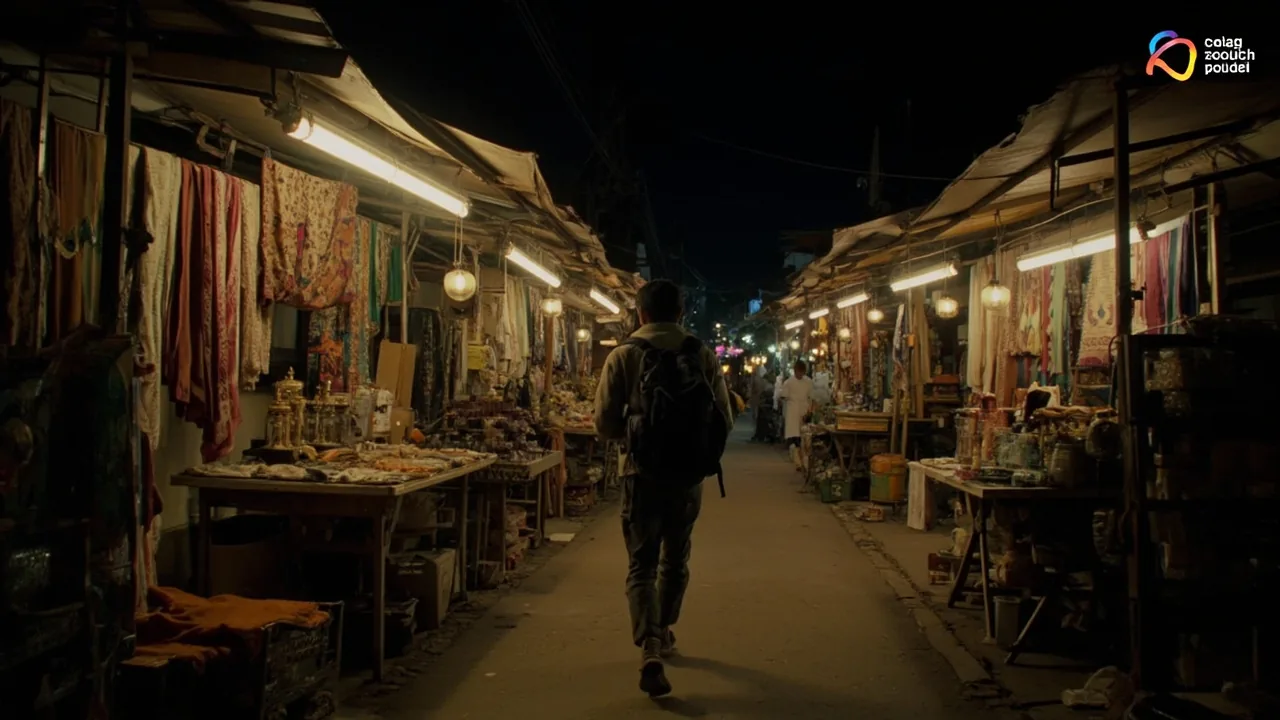
The Luang Prabang night market runs down Sisavangvong Road, from the Royal Palace to the Phou Si hill base, then loops back along a parallel lane lined with food vendors. It kicks off just after sunset (roughly 17:00 from November to February, closer to 18:00 from March to May) and runs until about 22:30. Setup starts around 16:00, so the smart move is to walk through around 17:00 and watch the market take shape, then come back for the main browse after dinner. For more on planning the wider Laos loop, see our Laos 2-week itinerary for Indian backpackers.
The official count sits at around 200 stalls, but in practice you’ll move through them at a steady 30 to 40 per hour. Plan to spend two to three hours if you want to look, longer if you plan to compare textiles across three or four weavers before buying.
The market is fully pedestrian-only from 17:00 onward. Tuk-tuks and cars can’t enter the strip, which is honestly one of the best things about it. You can cross from one side to the other without dodging a single vehicle.
What You’ll Find (And What Most Stalls Are Selling)
If you strip away the photos on Instagram, the Luang Prabang night market is three things:
Textiles and handicrafts. Hmong and Tai Lue weavers, appliqué wall hangings, embroidered table runners, scarves, the standard hemp-bag-with-leather-handles (usually stamped with “Made in Luang Prabang”). Around half the stalls are in this category, and this is where the market genuinely shines. Cooperative stalls that source directly from villages sell better quality at fairer prices than the resellers.
Souvenirs and gift-shop stuff. Bowls, chopsticks, lacquerware, the same Buddha figurines you’ll see in every Southeast Asian market. Most of these aren’t made in Luang Prabang, they’re shipped in from Vientiane, Hanoi, or China. Prices are inflated. Skip.
Clothing. A surprising amount of cheap cotton tops, “boho” trousers, hemp-shorts-with-elastic-waist, and t-shirts with phrased prints like “Same Same But Different.” Most of it is screen-printed and low quality. If you need a basic top it’s fine, but treat it as throwaway. Don’t pay a “handmade” premium here.
There’s also a food section at the far (north) end of the market, near the Phou Si hill base. This is a separate entity from the craft stalls and operates a bit like a night-food-court.
Real 2026 Prices: Clothing, Textiles, Handicrafts
Here is what people pay in July 2026 high season pricing, gathered from current traveller reports.
| Item | Walk-away price (LAK) | First-ask price (LAK) | Bargain to (LAK) | Notes |
|---|---|---|---|---|
| Hmong cross-stitch scarf (cotton, simple pattern) | 40,000 | 100,000 to 150,000 | 50,000 to 70,000 | ”Hmong” is being used loosely; ask how old the weaver is and what thread |
| Tai Lue silk table runner | 150,000 | 300,000 to 500,000 | 180,000 to 250,000 | Real silk is heavy, drapes well; polyester slips with a shine is fake |
| Hmong appliqué wall hanging (50x60 cm) | 200,000 | 400,000 to 600,000 | 250,000 to 350,000 | Hand-stitched takes weeks; price reflects labour |
| Cotton elephant trousers | 50,000 | 80,000 to 100,000 | 50,000 to 60,000 | Most stalls sell exactly the same cut, so shop around |
| Hemp/leather crossbody bag | 80,000 | 150,000 to 200,000 | 90,000 to 120,000 | Check stitching on the strap, common weak point |
| Bamboo beer mug set (4 pc) | 60,000 | 120,000 to 150,000 | 80,000 | Heavier and more durable than Chiang Mai versions |
| Massage / spa / herbal compress ball | 30,000 | 50,000 to 80,000 | 35,000 to 50,000 | Smell before buying; cheap versions use synthetic oils |
| Lacquerware bowl (medium) | 60,000 | 100,000 to 150,000 | 70,000 to 90,000 | Real Luang Prabang lacquer has a deep, layered finish |
| ”Bohemian” cotton top | 60,000 | 80,000 to 100,000 | 60,000 | Skip if you can find similar in Bangkok for less |
| Wooden carved animals | 50,000 | 80,000 to 120,000 | 60,000 | Carving quality varies wildly; look at detail not size |
The “First-ask price” column is the real trap. Vendors here know tourists do comparison pricing across the same road, so they all open at roughly 2x what they expect to close at. The biggest mistake first-timers make is to engage with the first stall that has a nice piece, then pay the first-ask price to “be polite.” Don’t. Walk the whole strip first. The same scarf will be at four stalls; prices will be within 10% of each other; the one with the friendliest vendor is rarely the cheapest.
Food Prices at the Market
The night-market food court is a separate operation from the textile stalls. It opens a bit later in the evening (closer to 18:00) and pulls a local crowd as well as tourists. Quality is genuinely better than most night markets in Thailand or Cambodia, because Lao home cooking travels well and Luang Prabang has competition between vendors.
| Item | Price (LAK) | Notes |
|---|---|---|
| Khao soi / Lao noodle soup | 15,000 to 25,000 | Coconut-based, similar to Northern Thai version |
| Grilled meat skewers (4 pc) | 20,000 | Usually pork or chicken with jeow dip |
| Sai oua / Lao sausage | 15,000 to 20,000 per stick | Herb-heavy, lemony, worth trying |
| Sticky rice basket (small) | 10,000 | Sold by itself as a snack or side |
| Orlam / bitter herb stew | 20,000 | Adventurous, anise-forward, comes with sticky rice |
| Fresh fruit shake (no sugar) | 15,000 to 20,000 | Made to order, not from concentrate |
| Beer Lao (large bottle) | 20,000 to 25,000 | Markets can sell alcohol, don’t carry it into the textile strip |
| Lao coffee (iced, with condensed milk) | 15,000 | Some stalls are better than others; the slow-drip ones cost more |
Two of the better food-stall experiences sit close to the Phosy Market area (which is technically the day market but operates a small evening overlap) and the M&M Restaurant Indian Halal Food spot, which is the right choice if you’ve done three days of Lao food and need dal-chawal. M&M sits a short walk from the main strip.
Bargaining Without Being Awful
Bargaining at Luang Prabang is gentler than in Bangkok or Hanoi. Vendors aren’t used to the cut-throat haggling of Chatuchak or Dong Xuan. Most expect a polite back-and-forth of two or three rounds, not a 50% opening offer.
Here is what works:
Start at 50% of the asking price for textiles and 60% for everything else. So if a scarf opens at ₹432 (~100,000 LAK or ~$4.48), you say ₹216 (~50,000 LAK or ~$2.24), they push back to 80,000, you counter at 60,000, you close somewhere between 60,000 and 70,000. That’s normal here. Don’t go lower than 40% of ask on your first move. It reads as either ignorant or disrespectful, and Luang Prabang vendors remember both.
Buy at least two items if you’re bargaining hard. Wholesale pricing kicks in around three pieces (typically a 10% to 15% drop). If you only want one piece, be honest: “I’ll pay 70,000 for one, 100,000 for two.” The vendor can take it or leave it.
Carry small notes. Most stalls can break ₹216 (~50,000 LAK or ~$2.24) but not always 100,000. The ₹43 (~10,000 LAK or ~$0.45) note is your friend here. Bring a mix of 10s, 20s, 50s. If you only have ₹432 (~100,000 LAK or ~$4.48) notes, you’ll lose bargaining power because the vendor can’t make change easily.
Don’t bargain over food. Food stalls are priced close to cost. There’s no margin to negotiate, and it’s a bit insulting to try.
Smile, walk away slowly. The single best move in any night market: smile, say “I think I’ll look around, maybe come back,” and walk one or two stalls away. There’s a 60% chance the vendor calls you back with a counter. There’s a 40% chance you find the same item cheaper in the next stall.
Use “sa bai dee” (hello) and “khob chai” (thank you) more than English. Vendors visibly soften when you try. The energy of the bargaining changes.
What to Skip
Some stalls are tourist traps in the literal sense. They sell mass-produced imports, mark them up 4x, and rely on tourists who don’t know any better. Specifically:
Anything stamped “Made in Thailand.” A surprising amount of the woodwork and silver-toned jewellery at the Luang Prabang night market is from Chiang Mai or Chiang Rai and routed through here. Prices are 30% to 50% above what you’d pay in Northern Thailand, and the same sellers show up at the Chiang Mai Saturday Walking Street with identical goods.
“Authentic Hmong” textiles under ₹130 (~30,000 LAK or ~$1.34). Real Hmong work involves days of cross-stitch by hand. If a 60cm x 60cm piece is being offered for ₹108 (~25,000 LAK or ~$1.12), it’s machine-embroidered or imported. Don’t pay a handmade premium for machine work.
“Wild” or “ancient” stones and jewellery. Anything claiming to be antique jade, ancient fossil, or “monk-blessed” wood is almost fake. Lao customs laws restrict the export of genuine archaeological material, and you’ll have it confiscated at the airport if it’s real anyway.
The clothing section if you came for crafts. The cotton trousers and “tribal-print” tops at the night market are the same stock you’ll find at any Khao San-area stall. You’re paying for the Luang Prabang location, not the product.
Cheap Buddhist amulets. Even if you wanted one, you’d be buying something mass-produced in a Bangkok factory. Visit a real temple if this is what you came for.
Anything where the vendor won’t let you look closely. If they try to keep the piece wrapped, won’t let you handle it, or rushes you, walk away. The genuine weavers want you to feel the texture, look at the back of the embroidery, and understand what you’re buying.
Payment Methods (And Why LAK Cash Matters)
Most stalls in the Luang Prabang night market are cash only, and Lao kip (LAK) is the main accepted currency. Thai baht might be accepted by a few stalls near the top of the market that get day-trippers from Huay Xai, but it’s at a poor rate and you should never count on it.
What won’t work:
- UPI (PhonePe, Google Pay): no QR infrastructure
- Credit/debit cards: no terminals anywhere in the market
- USD cash: not accepted by any stall, only by larger hotels
- Thai baht: only via a few stalls, bad rate
What will work:
- Lao kip (LAK) in small notes
- A few larger craft stalls near the Royal Palace may accept USD as a courtesy, but the conversion they’ll give is roughly 5% worse than the bank rate
You should arrive with kip. Withdraw from the BCEL or LDB ATM inside the night market entrance area or at any BCEL branch during the day. BCEL has the most reliable ATM presence in Luang Prabang, and most Indian forex cards work cleanly at their ATMs.
If you arrive in Luang Prabang without kip, the airport exchange counter at LPQ gives a fair rate for USD, though much worse for INR. Hit an ATM after arrival if you can.
Daily Budget: What One Market Visit Costs
Budget traveller plan: one scarf, one beer, two food items. Total around ₹389-₹475 (~90,000-110,000 LAK or ~$4.03-$4.92).
Mid-range plan: one textile piece (silk or appliqué), a beer Lao, three food items, small souvenir for someone at home. Total around ₹864-₹1,296 (~200,000-300,000 LAK or ~$8.95-$13.43).
Splurge plan: one high-quality textile or wall hanging, full dinner at the food section, two drinks, gifts. Total around ₹2,160 (~500,000 LAK or ~$22.38) to ₹3,457 (~800,000 LAK or ~$35.81).
A useful mental frame: the market is one of the cheapest things you’ll do on a Laos trip, but it’s also one of the easiest places to overspend by accident. Twelve scarves at “only 30,000 each” still adds up to ₹1,556 (~360,000 LAK or ~$16.11). For a full breakdown of daily costs in the city, see our cost of living in Luang Prabang guide.
Getting Connected (SIM and Data)
The night market itself has good 4G coverage from Unitel and Lao Telecom, and you’ll be able to load maps and use translation apps without issue. If you want to compare prices between stalls by checking what an item costs online (sometimes useful for antiques or branded goods), your existing SIM works fine.
For the daytime Luang Prabang experience, a physical SIM is cheap. For most of the trip through Laos, an eSIM is more convenient, with activation before you fly so you have data the moment you land at LPQ.
Indian Passport Specifics
There are no Indian-specific risks at the Luang Prabang night market. Cash in LAK is the same for everyone. If you’re carrying more than the equivalent of USD 2,000 in cash, declare it on arrival.
Customs officers occasionally check tourists’ bags when leaving Laos through Luang Prabang International Airport (LPQ), looking for genuine antique textiles or large Buddha statues. Most market items are fine to export, but a 1.5m wooden statue may get flagged. Buy small.
For Laos visa specifics, check the latest requirements before you travel. Your bigger decision is route: if you’re overlanding from Thailand, the Thai-Laos Mekong slow boat from Huay Xai connects to Luang Prabang after two days on the river. For a broader read on Southeast Asia route-planning context, see our corridor guide hub.
When NOT to Visit the Market
The market closes completely during the rainy season, typically from late May or early June through September. Vendors dismantle the stalls because heavy rain destroys silk and appliqué. If your trip falls in this window, the day Phosy Market is the closest substitute (open mornings, 06:00 to 14:00).
The market is also at its worst from 17:00 to 18:00 in peak season: vendors are still setting up, the lighting is poor, and you’ll be quoted inflated prices by vendors who haven’t seen enough buyers yet. From 19:00 to 21:00 is the prime window: dark sky, lanterns lit, vendors ready, real atmosphere. After 21:30, vendors start packing up.
If you want to buy textiles seriously, plan for two visits. First pass at 17:30 to scope and photograph, second pass at 19:00 to 20:00 to negotiate. For more on structuring your time in the city, see our 3 days in Luang Prabang itinerary.
FAQ
What’s the best time of night to buy?
Between 19:30 and 21:00. Vendors are in negotiation mode, the lights are good, and the more desperate vendors will meet you at lower prices if you’ve already looked around.
Can I bargain for the food?
No, and you shouldn’t try. Food stalls are already at near-cost pricing. A polite “not today” or a thank-you works fine if you want to back out.
Are these Hmong textiles Hmong?
Most “Hmong” labelled goods at the market are authentically Hmong-made, but some resellers mix in factory-made imports with Hmong-style patterns. Buy from stalls where the vendor can name the village, knows the weaver, or has the cooperative credentials displayed. Real Hmong cooperatives display village names and weaver photos.
Is it safe to walk around with my camera?
Yes. Pickpocketing is rare at the Luang Prabang night market (much rarer than Bangkok or Hanoi). Standard precautions: front-facing money belt, no phone in the back pocket. Cameras are fine.
What if I buy something and the vendor has no change?
Walk to the next stall, swap a ₹432 (~100,000 LAK or ~$4.48) note at a food vendor (almost always have change), come back. Common, normal, no one will think it’s weird.
Can I barter with multiple scarves at once?
Yes. Three to five items of the same type will get you a 15% to 25% discount. This is the fastest way to a fair price.
Should I tip?
Tipping isn’t expected at the night market. If a vendor goes out of their way (helps you ship items, lets you return the next day to swap), a ₹43-₹86 (~10,000-20,000 LAK or ~$0.45-$0.90) tip is appreciated but not required.
Closing: Subodh’s Take
The Luang Prabang night market is one of the few markets in Southeast Asia I’d specifically send someone to, not because it’s the cheapest, but because the cooperative stalls genuinely source from real weavers and the food section has actual Lao home-cooking. The biggest mistake is treating it like Chatuchak, where competition is the prize. Here the prize is the slow, polite conversation with the Hmong woman who took three weeks to make the wall hanging, and that conversation only happens if you walk slowly, don’t bargain hard, and come back twice.
