Pakse to Si Phan Don Bus: Timetable, Cost, and What the 4000 Islands Trip Feels Like
Most blogs treat this as one neat journey: bus, drop-off, boat, island. In practice it has three legs, a stop you didn’t expect, and a return trip that works nothing like the outbound. For related planning, see our guide on Sea Backpacking Hub.
Quick Answers
| What | Answer | Price (INR) |
|---|---|---|
| How long is the Pakse to Don Det bus + boat total? | 4 to 5 hours door-to-door | ₹350 (~80,000 LAK or ~$3.50) |
| What does the bus ticket from Pakse to Nakasang cost? | Around ₹344 (~80,000 LAK or ~$3.58) | ₹350 (~80,000 LAK or ~$3.50) |
| How much is the boat from Nakasang to Don Det? | Around ₹86-₹129 (~20,000-30,000 LAK or ~$0.89-$1.34) | ₹90 (~20,000 LAK or ~$1.00) |
| What time does the first bus leave Pakse for Si Phan Don? | Around 09:00 from the central station | ₹350 (~80,000 LAK or ~$3.50) |
| Can you book the bus from Don Det back to Pakse? | Yes, the guesthouse books it the night before | ₹350 (~80,000 LAK or ~$3.50) |
The Three Legs, Honestly
The corridor from Pakse to Si Phan Don (the 4000 Islands) is one of those trips that looks simple on a map and turns out to have a seam in the middle. You don’t take a single bus to the islands. You take a bus to a junction town called Nakasang, then a short boat to either Don Det or Don Khon. The boat is unavoidable. It is also, honestly, the best part. You may also find How to Get to Luang Prabang useful for this trip.
Total distance is roughly 150 km south of Pakse. The road is sealed the whole way, which it wasn’t always, so the ride is smoother than older guidebooks suggest.
Option 1. Cheapest: Local Bus from Pakse Southern Bus Station
This is what every budget traveller takes and what your guesthouse will arrange if you ask. Head to the southern bus station in central Pakse, a tuk-tuk ride from anywhere in town, and buy a ticket on the next southbound departure. Tickets run about ₹344 (~80,000 LAK or ~$3.58) and you pay on the spot, no booking platform touches this route.
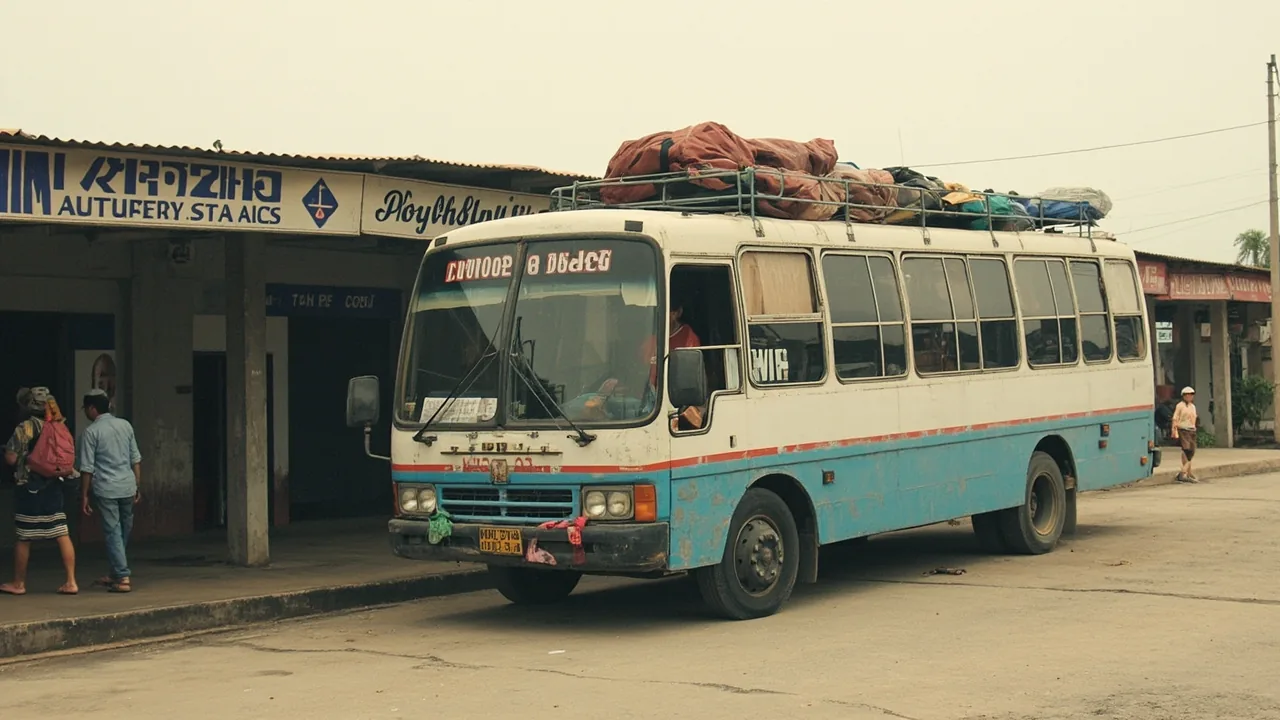
Buses leave roughly every hour from around 09:00 through the early afternoon. The earliest departures give you the most daylight on the islands. The bus is a standard minivan or small coach, sometimes a songthaew-style truck with bench seats. It is not luxurious. It is also not the cramped torture box some online reviews describe. Two and a half hours of sealed road, one or two snack stops, and you roll into Nakasang.
At Nakasang, drivers drop you at the junction by the boat pier. You do not get off at a proper station. You get off at a T-junction with a couple of food stalls and a queue of longtail boats tied up along the bank. Walk fifty metres, find your boat, pay the fare (around ₹86-₹129 (~20,000-30,000 LAK or ~$0.89-$1.34)), and you are fifteen minutes from Don Det.
Total door-to-door from Pakse city centre to a Don Det guesthouse: four to five hours, give or take. The boat driver drops you at whichever pier on Don Det you point at, and your guesthouse is almost within walking distance from there.
Subodh’s Pro Tip: Don’t pre-book through any online aggregator for this leg. The local buses don’t show up on those platforms with accurate times, and the markup is pointless. Walk to the bus station, pay cash, take the next bus.
Option 2. Best Experience: Minivan + Shared Boat Combo, Booked Through Your Guesthouse
If you want the same route with a softer landing, ask your Pakse guesthouse (the place you are staying the night before) to arrange a shared minivan the next morning. The price is similar to the public bus, sometimes ₹431 (~100,000 LAK or ~$4.47), but the vehicle is usually newer and the seats are a touch wider. You still stop at Nakasang, still take the boat.
This is what I recommend for anyone carrying a real backpack, anyone who values not having to navigate the southern bus station, and anyone who wants a confirmed pickup time the night before instead of rolling up and hoping for the next departure.
The boat from Nakasang to Don Det crosses a slow brown stretch of Mekong lined with palm forest. Travellers report the morning light here being one of the better ten-minute stretches on the whole Laos loop.
Subodh’s Pro Tip: Sit on the left side of the minivan heading south. The road opens up to Mekong views twice in the second hour and you get the better half of both.
Option 3. The Return: Don Det (Don Khon) Back to Pakse
This is the part most other guides leave out, and it is the part backpackers Google. The reverse direction works nothing like the outbound.
There is no public bus from Don Det to Pakse. You take a boat back to Nakasang in the morning, and a shared minivan is waiting at the pier. It is the same operator who runs the southbound route, only reversed. Boats from Don Det leave earlier in the morning than the outbound bus from Pakse, and the minivan fills up at Nakasang and departs shortly after the boats land.
Ticket buying for the return works like this: the boat to Nakasang is paid on the spot at the Don Det pier (around ₹86-₹129 (~20,000-30,000 LAK or ~$0.89-$1.34)). The minivan ticket from Nakasang back to Pakse is sold either on the boat itself (a collector walks the length before you dock) or at the Nakasang junction office. Around ₹344-₹431 (~80,000-100,000 LAK or ~$3.58-$4.47). You can also just ask your Don Det guesthouse the night before and they will book the whole package, door-to-door, for around ₹517 (~120,000 LAK or ~$5.36) total. That is the easy option and the one most backpackers use.
Total return time: three to four hours, because you skip the bus station shuffle on the Pakse end and get dropped directly in town.
| Direction | Leg 1 | Leg 2 | Total Time | Total Cost |
|---|---|---|---|---|
| Pakse to Don Det | Bus, 2.5 hrs | Boat, 15-20 min | 4-5 hrs | ₹431-₹560 (~100,000-130,000 LAK or ~$4.47-$5.81) |
| Don Det to Pakse | Boat, 15-20 min | Minivan, 2.5 hrs | 3-4 hrs | ₹431-₹560 (~100,000-130,000 LAK or ~$4.47-$5.81) |
Subodh’s Pro Tip: On the return, ask your guesthouse for a tuk-tuk or drop-off at your next Pakse hotel when you book the boat-and-van combo. They will quote you a small extra (around ₹86 (~20,000 LAK or ~$0.89)) and it saves the awkward Nakasang-to-hotel shuffle on the Pakse end.
The Nakasang Transfer in Detail
Nakasang is a junction town, not a destination. It exists because the road from Pakse ends at the Mekong and the islands are across the water. The “station” is a strip of road with food vendors and a pier. Nothing more.
What happens when you arrive: the bus parks, locals gesture toward the boats, you walk fifty metres, pick a boat, pay the driver (the operator’s guy at the desk), and you cross. It is fast. The whole transfer, from bus arrival to boat departure, takes ten minutes most days. If a boat is filling up because a bus arrived before yours, you wait fifteen minutes for the next one.
Do not pay anyone who approaches you on the bus offering “tickets” before Nakasang. The fare is paid at the pier. Anyone collecting on the bus is overcharging.
Indian Passport Specifics
No border crossing on this corridor. Both endpoints are in Laos, and Pakse is a major VoA entry city. If you arrived in Laos on visa-on-arrival at Pakse airport or the Thai border at Huay Xai / Chong Mek, you are already legal here. Carry your passport, your arrival stamp, and a digital photo of both on your phone. There is no checkpoint at Nakasang, no exit formality for the boat.
Cash: bring enough kip to cover the bus, boat, and a meal at the Nakasang stalls. Cards are not accepted on this corridor. ATMs in Pakse are reliable; ATMs on Don Det work most days but sometimes go offline. Withdraw in Pakse before you leave.
Indian embassy contact for Laos emergencies: the Embassy of India in Vientiane. Save the number before you board the bus south. Standard advice, easy to forget, and genuinely useful if your passport takes a swim in the Mekong.
For full Laos visa context, see laos-visa-extension-overstay-fines-guide and laos-e-visa-application-step-by-step-indians.
When NOT to Take This Route
Wet season, roughly July through September, makes this corridor a worse experience than it needs to be. The road stays open but takes longer, the boat ride gets choppier, and the islands themselves flood in low-lying areas. The famous Li Phi waterfalls on Don Khon side are more dramatic in wet season, but most of Don Det’s beach bars close. If you are choosing when to do this stretch, November through February is the sweet spot.
There is no political or security issue with this route. It is one of the safer corridors on the Laos loop. Standard precautions apply: keep valuables in the daypack on your lap on the bus, watch your bag at the boat pier, and don’t leave phones on the bench seat next to you during snack stops.
For broader Laos route planning, see laos-2-week-itinerary-for-indian-backpackers-route-daily-costs-budget-breakdown.
Where to Stay in Pakse (For the Night Before)
Most travellers spend one night in Pakse before pushing south, especially if they are arriving from Thailand via the Chong Mek border crossing. Two solid backpacker choices in Pakse itself:
| Hostel | Rating | Book |
|---|---|---|
| Sanga Hostel | 9.78 | Check prices |
| Non Pakse One Cup Hostel | 8.58 | Check prices |
| Both are central, both arrange the southbound minivan the next morning, and both are walkable from where the bus back from Nakasang drops you. Sanga Hostel is the higher-rated pick if you want the social backpacker atmosphere. |
What to Eat in Pakse (Before You Leave)
If you are spending the night in Pakse, two spots worth a stop. For a sit-down Italian dinner that punches well above the price, ITALAO Restaurant Pakse is rated 4.9 by travellers and serves proper pasta and wood-fired pizza in a country where you would not expect either. For the Indian-food fix before crossing to the islands, Hathim Indian Restaurant on the 4000 Islands side (rated 4.8) does dal, rice, and the usual North Indian staples at backpacker prices.
Getting Connected
Cell coverage on the Pakse-to-Nakasang road is fine with Lao Telecom or Unitel. Coverage drops to one bar in stretches but rarely disappears. On the islands themselves, Don Det has reasonable 4G at most guesthouses; Don Khon is patchier. The boat transfer has no signal. Bring a Lao SIM from Pakse (Unitel is the usual pick, ₹215 (~50,000 LAK or ~$2.24) for a week of data from any street vendor), or skip the physical SIM entirely and use Get Nomad eSIM which activates before you land and works across Laos and Thailand.
FAQ
How early should I book the bus from Pakse to Don Det? You don’t. Walk up to the southern bus station the morning of, pay cash, take the next departure. First bus around 09:00.
Can I take the bus from Pakse directly to Don Khon instead of Don Det? Yes, but you still transfer at Nakasang. The boat on the Don Khon side is a slightly longer crossing and costs the same.
Is the boat from Nakasang to Don Det safe? Yes. Longtail boats, life jackets usually on board, calm water most of the year. Travellers report no safety issues on this stretch in 2026.
How much cash should I carry for the whole trip from Pakse to Si Phan Don? Around ₹861 (~200,000 LAK or ~$8.94) covers bus, boat, a meal at Nakasang, and the tuk-tuk to the bus station. Anything beyond that is for the islands themselves.
What happens if I miss the last boat from Nakasang? You wait for the next one, or you take a later bus the next morning. There is no overnight option at Nakasang itself. Travellers report this is rarely a problem if you catch a bus before noon.
Can I use UPI anywhere on this corridor? No. Cash only for the bus, boat, and food at Nakasang. Pakse has some shops accepting QR payments but the islands and the road do not.
Subodh’s Take
This is the easiest corridor on the Laos loop to overcomplicate. The three-leg structure looks intimidating on paper, in practice every leg is well-paved, well-signed, and handled by people who do it ten times a day. The Nakasang boat is a fifteen-minute Mekong crossing, not a logistical problem. The reverse journey works fine as long as you book the boat-and-van combo through your Don Det guesthouse the night before instead of trying to piece it together at the pier. The only real mistake is paying anyone on the bus for tickets you should be buying at the pier.
