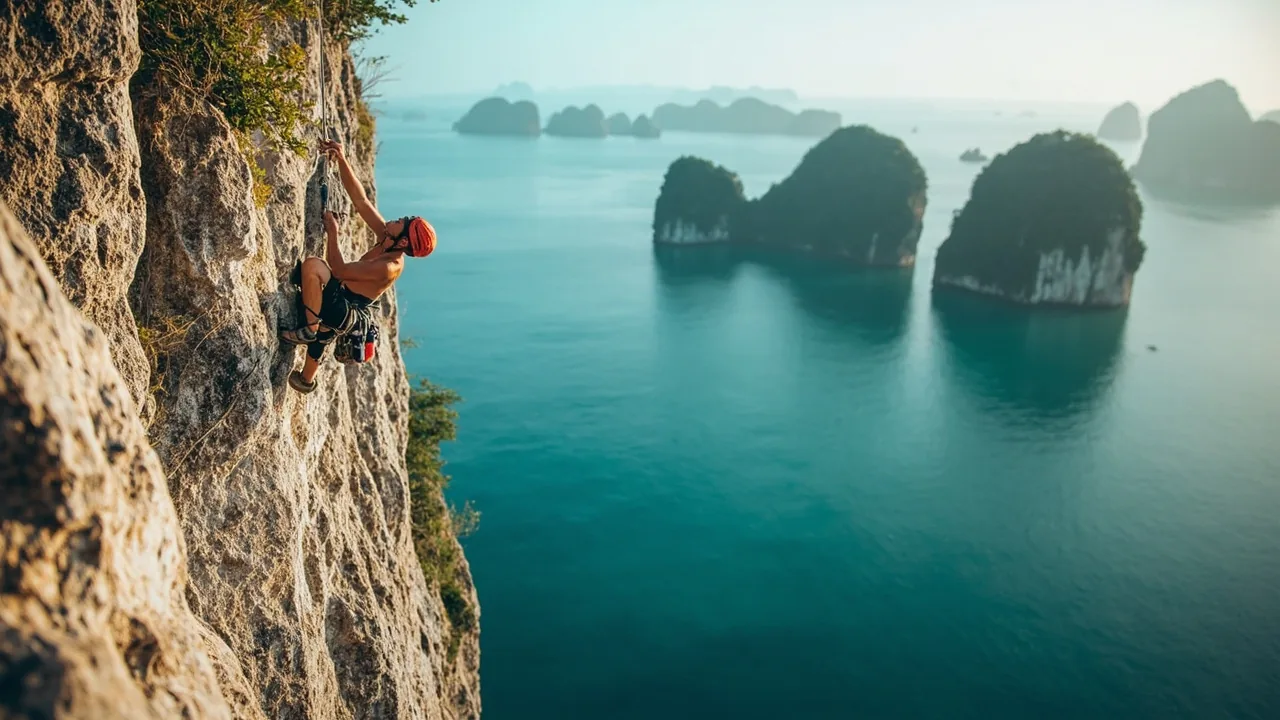
Best Rock Climbing in Southeast Asia: Country Comparison
Verified: 22 July 2026. Prices and visa fees rechecked against official sources.
Thailand (Railay and Tonsai) is the right country for your first Southeast Asia rock climbing sea trip. For related planning, see our guide on Sea Backpacking Hub.
Quick Answers
| What | Answer | Price (INR) |
|---|---|---|
| Cheapest country to climb | Laos (Thakhek, dorms at ₹258 (~60,000 LAK or ~$2.67), guide day ~₹644 (~150,000 LAK or ~$6.69)) | ~₹260 (~60,000 LAK) per dorm night |
| Best beginner limestone | Thailand (Railay, Tonsai, grades 5a to 7a right above the beach) | Day pass ~₹858 (~300 THB or ~$8.90) |
| Best deep-water soloing | Vietnam (Ha Long Bay, DWS on limestone islands) | ~₹5,508 (~1,500,000 VND or ~$57.17) for a half-day boat |
| Visa situation for Indians | Thailand Visa on Arrival, Vietnam eVisa, Cambodia eVisa, Laos eVisa/VoA | Thailand VoA ~₹2,200 (~$22.84) |
| Total trip budget (14 days, all four countries) | Budget ~₹55,000 (~$570.90); comfortable ~₹110,000 (~$1,141.80) | , |
You may also find Southeast Asia on 1 500 Day Country By Country Budget Breakdown useful for this trip.
Quick Comparison Table
| Factor | Thailand | Vietnam | Laos | Cambodia |
|---|---|---|---|---|
| Daily budget (budget) | ~₹1,500 (~$15.57) | ~₹1,200 (~$12.46) | ~₹1,000 (~$10.38) | ~₹1,100 (~$11.42) |
| Visa for Indians | VoA / eVisa (~₹2,200) | eVisa (~₹2,500) | eVisa / VoA (~₹2,300) | eVisa (~₹2,400) |
| Best months | Nov to Mar (dry, cool) | Oct to Apr (avoid Aug monsoons) | Oct to Apr | Nov to Mar |
| Rock type | Limestone towers above turquoise sea | Limestone karst islands, sea-cliff DWS | Limestone karst, inland crags | Sandstone bouldering, limited sport |
| Difficulty range | 5a to 8c+, mostly 6a to 7b | 5a to 8b, world-class DWS | 5c to 8a | V3 to V10 boulder, almost no sport |
| Veg food | Easy, Jay restaurants near Railay | Easy in Hanoi, harder on islands | Limited, mostly in Vang Vieng | Decent in Phnom Penh, thin elsewhere |
| Safety (climbing) | Mature guides, bolted routes, low risk | Good at Ha Long Bay operators, watch weather | Well-bolted in Thakhek, remote elsewhere | Bouldering only, no bolted routes to speak of |
| English spoken | High at climbing areas | Moderate, get a guide | Moderate | High in tourist towns |
| Vibe | Beach, climbing school, party boats | Big-wall and DWS, serious climbing | Quiet crags, cave rivers, group trips | Siem Reap day trips, niche |
| Best for | First-time SEA climbers, families | Experienced climbers chasing DWS | Climbers on a tight budget | Boulderers passing through Angkor |
The next sections break down each country by what it offers a backpacker who climbs. See also: Southeast Asia on 3 000 Day Country By Country Budget Breakdown.
Choose Thailand If…
- You’re new to outdoor climbing and want bolted sport routes you can top-rope after a one-day course. Railay’s “Fire” wall and Tonsai’s “Thaiwand” wall have dozens of routes in the 6a to 7a range above the beach.
- You want a beach holiday with climbing attached. Krabi (where Railay sits) doubles as a scuba and island-hopping destination, so non-climbing partners don’t get bored.
- You need reliable weather in peak season (November through March). Railay and Tonsai are well-documented in guidebooks, with re-bolting programmes running through 2026.
- You want the easiest logistics: direct flights from Delhi, Mumbai, and Bengaluru into Bangkok or Phuket, then a 12-hour bus or a short flight down to Krabi.
Choose Vietnam If…
- You have at least a year of outdoor sport leading under your belt and want deep-water soloing on limestone islands. Ha Long Bay has the highest concentration of DWS routes in the region, with bolted anchors and clear water most of the year.
- You want to climb long multi-pitch routes. The Cat Ba and Ha Long walls include routes up to 300 metres, which the rest of Southeast Asia doesn’t have.
- You’re already planning to backpack Vietnam for other reasons (food, culture, motorbike loops) and want to tack on a climbing week at the end.
Choose Laos If…
- You’re on a tight backpacker budget. Thakhek has bolted sport routes, easy cave-river kayaking between climbs, and dorm beds for under ₹430 (~100,000 LAK or ~$4.46).
- You want a quieter scene. Thailand’s Railay can feel busy in January and February; Thakhek stays mellow even at peak season.
- You’ve heard of “The Loop” (Thakhek to Tha Uthen and back) and want the most scenic multi-day crag approach in Southeast Asia by motorbike.
Choose Cambodia If…
- You’re a boulderer who happens to be passing through Phnom Penh or Siem Reap and want a half-day pad session before Angkor.
- You’re not a climber at all but want to try something. Cambodia has the weakest developed rock of the four; it’s a “while I’m here” stop, not a destination.
Thailand: Pros and Cons
Pros:
- Railay and Tonsai together hold over 700 sport routes across 5a to 8c+, re-bolted through the Climbing Association of Thailand’s ongoing programme.
- Day passes at most Thai climbing gyms run ₹858 (~300 THB or ~$8.90).
- Direct flights from India, world-class medical care in Bangkok if anything goes wrong, and the easiest visa of the four.
- Tonsai is a backpacker hub with dorm beds under ₹1,144 (~400 THB or ~$11.87), so a climbing week costs less than a comparable week in Europe or Vietnam’s better-known areas.
Cons:
- Railay fills up from Christmas through February. Book climbing guides and accommodation 2-3 weeks ahead in January.
- It’s the most expensive of the four countries by a small margin, mostly because Thai beer and resort islands push day costs up.
Vietnam: Pros and Cons
Pros:
- Ha Long Bay’s DWS is unique in Southeast Asia. You paddle to the wall, climb, jump into the sea, repeat.
- Vietnam eVisa is online, takes three working days, and costs about ₹2,500 (~$25.95). No embassy visit needed.
- Hanoi and Sa Pa have indoor gyms for weather days, and Sa Pa’s granite adds a different rock type to the usual limestone.
Cons:
- The climbing is mostly boat-access. You pay ₹5,508 (~1,500,000 VND or ~$57.17) or more for half-day charters, which adds up over a week.
- Ha Long Bay is far from Hanoi (4-hour drive each way). The logistics eat a day each direction.
Laos: Pros and Cons
Pros:
- Thakhek has roughly 250 bolted sport routes, all within a 30 km motorbike loop, with grades from 5c to 8a. Climbers call it “the Thaiwand of Laos” because the rock is similar but the scene is much smaller.
- Cost is the lowest of the four. Dorm beds around ₹258 (~60,000 LAK or ~$2.67), street-food meals under ₹86 (~20,000 LAK or ~$0.89), beer from ₹43 (~10,000 LAK or ~$0.45) at a climbing hangout.
- Easy to combine with Vang Vieng for the backpacker vibe and river tubing.
Cons:
- Laos visa fees are slightly higher per entry, and the eVisa system is slower than Vietnam’s.
- Remote. If you get hurt at a crag, you’re two hours from the nearest proper hospital in Thakhek town.
Cambodia: Pros and Cons
Pros:
- Sandstone bouldering near Siem Reap, mostly in the V3 to V10 range, is fun for a day.
- Cambodia is the easiest add-on to a Vietnam trip: Phnom Penh to Bangkok by overland, Phnom Penh to Siem Reap by sleeper bus.
Cons:
- Almost no developed sport climbing. If you came for bolted multi-pitch, Cambodia has nothing.
- Climbing infrastructure (pads, guides) is thin. Most boulderers bring their own pads or rent from one shop in Phnom Penh.
Cost Comparison in Local Currency
| Expense | Thailand (THB) | Vietnam (VND) | Laos (LAK) | Cambodia (USD) |
|---|---|---|---|---|
| Dorm bed (avg/night) | 300 to 500 | 200,000 to 400,000 | 50,000 to 80,000 | 8 to 12 |
| Street food meal | 40 to 80 | 25,000 to 50,000 | 15,000 to 25,000 | 2 to 4 |
| Restaurant meal | 150 to 350 | 80,000 to 200,000 | 40,000 to 80,000 | 6 to 15 |
| Local transport (per day) | 100 to 200 | 100,000 to 200,000 | 50,000 to 100,000 | 5 to 10 |
| SIM card (tourist, 7 days) | 299 | 100,000 | 50,000 | 5 |
| Vietnam tourist SIM (7 days) | , | 100,000 | , | , |
| Visa fee | ~₹2,200 (~2,200 THB or ~$22.84) | ~₹2,500 (~$25.95) | ~₹2,300 (~$23.87) equiv | ₹2,890 (~30 USD) |
| Climbing day pass / shoe rental | ₹858 (~300 THB or ~$8.90) | ₹734 (~200,000 VND or ~$7.62) | ₹129 (~30,000 LAK or ~$1.34) | ₹482 (~5 USD) |
| Guide day (1 climber) | ₹7,147 (~2,500 THB or ~$74.19) | ₹11,016 (~3,000,000 VND or ~$114.35) | ₹1,503 (~350,000 LAK or ~$15.60) | ₹5,780 (~60 USD) |
| Beer | 70 to 120 | 25,000 to 50,000 | 15,000 to 25,000 | 1 to 2 |
| 7-day total (budget) | ~₹21,442 (~7,500 THB or ~$222.57) | ~₹20,196 (~5,500,000 VND or ~$209.63) | ~₹10,738 (~2,500,000 LAK or ~$111.46) | ~₹24,085 (~250 USD) |
| 7-day total (comfortable) | ~₹57,178 (~20,000 THB or ~$593.51) | ~₹55,080 (~15,000,000 VND or ~$571.73) | ~₹27,918 (~6,500,000 LAK or ~$289.78) | ~₹48,170 (~500 USD) |
For a 14-day loop covering all four countries, budget travellers land around ₹55,000 (~$570.90) to ₹60,000 (~$622.80) for everything except international flights; comfortable travellers land around ₹110,000 (~$1,141.80) to ₹130,000 (~$1,349.40). Visa fees add another ₹9,400 (~$97.57) to ₹10,000 (~$103.80) on top.
Subodh’s Pro Tip: Book your Railay guide and accommodation 3 weeks ahead if you’re flying in between December 20 and January 5. Tonsai fills up first, Railay second. Travellers report January prices climbing 30% versus November.
Subodh’s Take
For most Indian backpackers reading this, Thailand is the right answer. The flight is shorter, the visa is cheaper, the routes are easier to read on first arrival, and if you break a finger you can be in a proper Bangkok hospital within 24 hours. Railay is where the Southeast Asia climbing scene lives, and a week there teaches you more about outdoor climbing than any YouTube video.
Pick Vietnam if climbing is the main reason for the trip, not an add-on. Ha Long Bay’s deep-water soloing is one of the genuine climbing experiences in the world and worth the trip on its own. Skip Laos unless you’re already going for Vang Vieng or have done Thailand. Skip Cambodia unless you’re a boulderer with your own pad. These last two are side trips, not destinations.
If you want the comparison laid out as a route: Bangkok to Krabi to Hanoi to Sa Pa to Vientiane to Vang Vieng to Thakhek back to Bangkok is the loop most climbers take. Bananarchy’s 30-day trip covers Thailand, Vietnam, Laos, and Cambodia on one fixed-cost itinerary, with Railay and Tonsai scheduled into the second week. If you’ve never been to the region, doing it as a group with the logistics handled is the cheapest way to climb at all four of the crags described above.
Safety Alert: Limestone is sharp. Climbers report finger tendon injuries at Railay and Cat Ba every season. Warm up, tape flappers, and don’t skip rest days. Check your government’s travel advisory at mea.gov.in before booking.
Getting Connected
Thailand’s tourist SIM (AIS TrueMove or dtac) is ₹855 (~299 THB or ~$8.87) for 8 days at the airport, and almost every Thai climbing hostel sells a 7-Eleven version for ~₹800 (~280 THB or ~$8.31). Vietnam’s tourist SIM runs about ₹367 (~100,000 VND or ~$3.81) for 5 GB over 7 days at any Viettel shop; Laos SIMs around ₹215 (~50,000 LAK or ~$2.23) and Cambodia SIMs around ₹482 (~5 USD) for similar 7-day tourist plans. If you’d rather not swap SIMs four times in a month, Get Nomad eSIM covers all four countries on one plan.
Can You Do Both (Or All Four)?
Yes, and most climbers do. The standard 30-day backpacker loop is:
- Days 1-7: Bangkok + travel south to Krabi, climb at Railay and Tonsai
- Days 8-14: Fly to Hanoi, overland to Ha Long Bay, climb DWS for 3 days
- Days 15-21: Sleeper bus to Vientiane, transfer to Vang Vieng, motorbike loop to Thakhek
- Days 22-28: Bus to Phnom Penh, day trip to Angkor, optional bouldering
- Days 29-30: Fly home from Bangkok or Phnom Penh
This shape works because visa runs are infrequent (all four have VoA or eVisa for Indians), transport is overland or by cheap flights, and the climbing seasons overlap from November to March. If you’d rather book a guided multi-country trip than piece it together yourself, compare tour options on GetYourGuide.
FAQ
Is Thailand cheaper than Vietnam for Indian climbers? Roughly the same on a budget (₹1,500 (~$15.57) vs ₹1,200 (~$12.46) per day). Vietnam edges cheaper on dorms and street food; Thailand wins on cheaper SIM cards and visa fees.
Do I need a visa for each country separately? Yes. Thailand VoA is ~₹2,200 (~$22.84), Vietnam eVisa is ~₹2,500 (~$25.95), Laos eVisa/VoA ~₹2,300 (~$23.87), Cambodia eVisa ~₹2,400 (~$24.91). All four combined come to roughly ₹9,400 (~$97.57). Budget this on top of your climbing money.
Which country is safest for solo Indian women climbers? Thailand (Railay, Tonsai) has the largest climbing community and the most English-speaking guides. Vietnam’s Ha Long Bay operators are professional but the boat trips are small-group, so safety depends on the operator.
Can I rent climbing shoes and harnesses at the crag? Yes in Thailand (every climbing hostel at Railay rents shoes for ~₹429 (~150 THB or ~$4.45) and harnesses for ~₹286 (~100 THB or ~$2.97)). Vietnam’s Ha Long Bay operators include gear in their boat price. Laos has gear rentals available in Thakhek town. Cambodia: bring your own pad.
What grade should I climb at to enjoy Southeast Asia? Outdoor sport 6a (French) / 5.10a (YDS) opens up most of Railay and Tonsai’s classic routes. For Ha Long Bay DWS, top-rope confidence at 5c to 6a on real rock is the floor.
How much should I budget for a 14-day climbing trip to all four countries? ₹55,000 (~$570.90) to ₹60,000 (~$622.80) budget, ₹110,000 (~$1,141.80) to ₹130,000 (~$1,349.40) comfortable. Add ₹9,400 (~$97.57) for visas, and ₹18,000 (~$186.84) to ₹25,000 (~$259.50) round-trip flights from India.
