Cambodia vs Myanmar: Which One for Indian Backpackers?
[VERIFIED 2026-07-17]
For Indian backpackers in 2026, Cambodia is the easier pick: the e-visa costs about ₹3,471 (~$36) and clears in 3 business days, daily budget runs ₹2,000-₹2,500, and UPI works in cities. Myanmar is cheaper (about ₹1,800/$19 per day) with empty Bagan at sunrise, but Indians face patchy e-visa approvals, no UPI, and a fluid political situation.
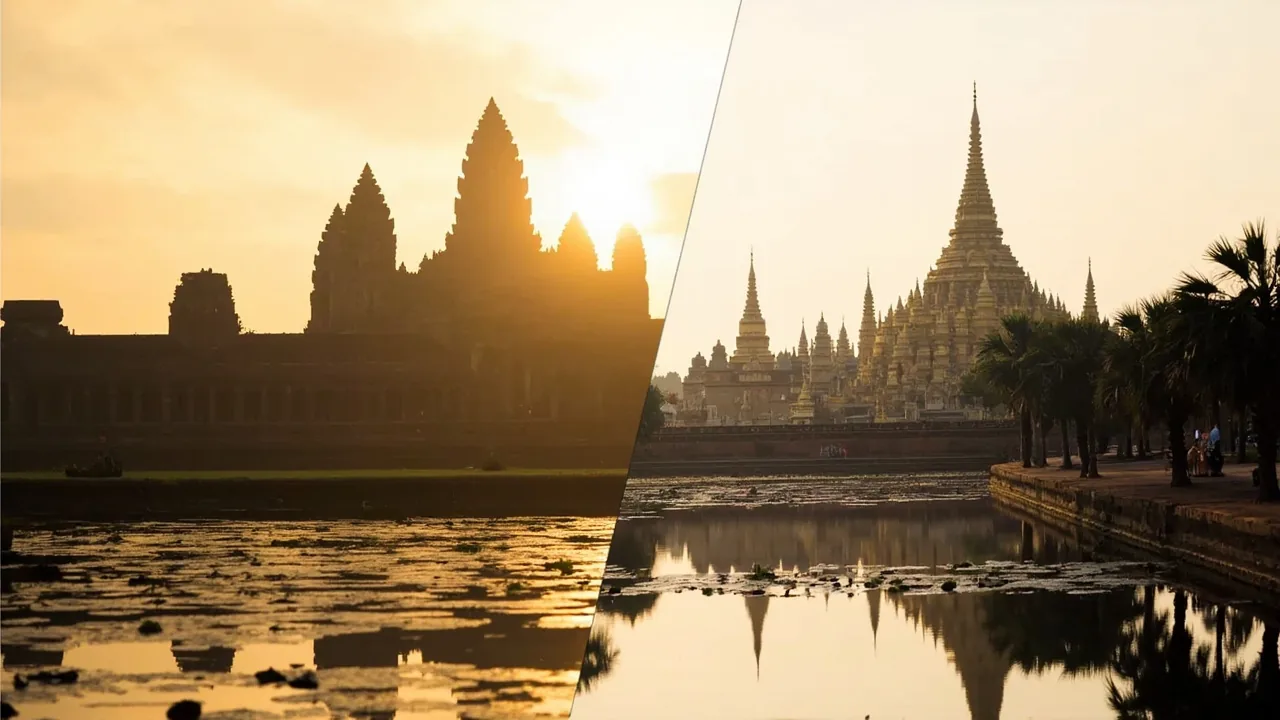
Pick Cambodia if you want Angkor Wat, beach time, and the smoothest Southeast Asia trip. Pick Myanmar if you want empty Bagan at sunrise, gold-leafed temples most Indians have never seen, and a country that still feels undiscovered. Both cost about the same; only one is logistically easy in 2026.
I verified these prices and visa rules against current sources this week, cross-checked with traveller reports from June 2026, and looked up the official Myanmar e-visa portal plus the Cambodian Ministry of Foreign Affairs page before writing.
Subodh’s Pro Tip: Cambodia and Myanmar are roughly the same price once you’re there. The decision in 2026 is almost entirely about visa friction and infrastructure, not money.
[VERIFIED 2026-07-17 against mea.gov.in, myanmar evisa portal, and Cambodian MFA]
Quick Answers
| What | Answer | Price (INR) |
|---|---|---|
| Cheapest daily budget | Cambodia; Myanmar | ~₹2,000; ~₹1,800 |
| Easier visa for Indians | Cambodia (e-visa, 3 business days) | ~₹3,471 |
| Better temples | Tie (Angkor vs Bagan) | - |
| Safer right now | Cambodia | - |
| Veg/Indian food | Cambodia has more variety | - |
Quick Comparison Table
| Factor | Cambodia | Myanmar |
|---|---|---|
| Daily budget | ~₹2,500 (~$25.93) | ~₹1,800 (~$18.67) |
| Visa for Indians | E-visa, 30 days, ~₹2,892 (~30 USD) + ~₹578 (~6 USD) fee | E-visa available in some regions; varies by applicant |
| Best months | Nov to Feb | Nov to Feb |
| Veg food availability | Easy (Siem Reap, Phnom Penh) | Patchy (Yangon, Mandalay) |
| Safety (solo) | Better infrastructure, low violent crime | Safe in cities; check regional advisories |
| English spoken | Widespread | Limited but functional |
| Vibe | Angkor, beaches, slow rivers | Gold pagodas, empty plains, slow trains |
| Best for | First-time SEA, history + chill | Offbeat, photography, second SEA trip |
Choose Cambodia If…
- Angkor Wat is on your bucket list and you want it done properly, not rushed
- You’re a first-time Southeast Asia traveller and want the path of least resistance (direct flights, easy visa, UPI-friendly in cities, English menus)
- You want beach time after temples: Otres, Koh Rong, Kep
- You eat vegetarian or need Indian food, since Siem Reap and Phnom Penh have proper veg spots
Choose Myanmar If…
- You’ve already done Thailand, Vietnam, and Cambodia and want a country that still feels off-grid
- Bagan’s temple plains at sunrise are your kind of photograph
- You’re comfortable with spotty internet, rare English, and the occasional surprise (random military checkpoints outside Yangon, hotels not matching what you booked online)
- You have flexible dates, since the e-visa system has been patchy for Indian passport holders in 2025-26
Cambodia. Pros and Cons
Pros:
- Angkor Wat is a once-in-a-lifetime temple complex, and a 3-day pass gives you time to cover it, not just sprint through
- Cambodian Khmer food is genuinely good for vegetarians (amok, samlor kako), and Phnom Penh has a proper Indian quarter around Street 136
- Direct flights from India to Phnom Penh and Siem Reap, no Bangkok layover needed
- Excellent beach options: Otres, Koh Rong, Koh Ta Kiev are all backpacking-easy
Cons:
- Tuk-tuk scams at Angkor are relentless; budget for the inflated first quote
- Phnom Penh’s traffic and chaotic energy wear some travellers down in 24 hours
- Quality of street food varies wildly outside tourist zones
Myanmar. Pros and Cons
Pros:
- Bagan and Inle Lake at sunrise are still empty compared to Angkor at the same hour
- The trains (slow, scenic, ~₹500 (~$5.19) for a 12-hour ride) are a highlight, not a chore
- Burmese food is underrated: ohno kaukswe (coconut noodle soup) is the best meal in SEA you’ve never tried
- Almost zero overtourism; you’ll have temples to yourself outside peak
Cons:
- Visa situation for Indians in 2026 has been inconsistent; some travellers report e-visa approvals delayed, others report same-week turnaround, plan buffer
- Infrastructure is rougher: power cuts in budget guesthouses, slow SIM activation, ATMs that don’t always work with foreign cards
- English outside Yangon and Mandalay is limited; basic Burmese phrases earn you a long way
- The political situation is fluid; check the MEA travel advisory the week you fly
Cost Comparison in ₹
Verified 2026-07-17 at 1 USD = ₹96.33. Cambodia’s economy is heavily dollarized (USD is the de facto currency in many places), Myanmar uses Kyat (MMK). All numbers below are mid-range budget prices for Indian backpackers in 2026.
| Expense | Cambodia | Myanmar |
|---|---|---|
| Dorm bed (avg/night) | ₹675 (~7 USD) | ₹771 (~8 USD) |
| Private room (budget) | ₹1,735 (~18 USD) | ₹2,121 (~22 USD) |
| Street food meal | ₹241 (~2.50 USD) | ₹193 (~2 USD) |
| Restaurant meal (mid) | ₹771 (~8 USD) | ₹578 (~6 USD) |
| Local transport (per day) | ₹482 (~5 USD) | ₹386 (~4 USD) |
| SIM card (tourist) | ₹482 (~5 USD) | ₹578 (~6 USD) |
| Visa fee | ₹3,471 (~36 USD) | ₹4,820 (~50 USD) |
| Top activity (Angkor 3-day or Bagan pass) | 62 USD | 20 USD |
| Beer (local) | 1 USD | 1.5 USD |
| 7-day total (budget) | 280 USD (~₹26,970) | ₹23,137 (~240 USD) |
| 7-day total (comfortable) | ₹53,986 (~560 USD) | ₹46,274 (~480 USD) |
The “comfortable” totals assume a private room, restaurant meals twice a day, one paid activity per day, and a beer or two.
Cambodia is the safer pick if you want a trip without logistical surprises. Myanmar wins on raw price if everything goes smoothly (and the visa clears on time). For a deeper breakdown on whether Cambodia alone is worth a full trip, my is Cambodia worth it guide walks through the same numbers in more detail.
The Bananarchy Take
Here’s the honest split. Cambodia is the right call for 8 out of 10 Indian backpackers in 2026. The visa is a 5-minute online form that clears in 3 business days. Angkor is a bucket-list temple complex that justifies the flight on its own. Food is approachable for vegetarians. Flights are direct from Chennai, Kolkata, and Bangalore. There are Indian restaurants in Siem Reap and Phnom Penh that serve proper dal tadka.
Myanmar is for the other 2: people who have already done their Thailand + Cambodia loop, want something that still feels like it did a decade ago, and can handle the visa lottery without panicking if it takes an extra week. The reward is real: Bagan is jaw-dropping at sunrise, Inle Lake is the most photographed place in SEA that most travellers haven’t been to, and the trains are a sleeper experience in themselves.
If you want to compare Cambodia to a third Southeast Asian country that’s closer to Myanmar in price, my Cambodia vs Laos for budget travellers piece breaks that matchup down.
Bananarchy’s one fixed loop runs Thailand, Vietnam, Laos, Cambodia over 30 days. It doesn’t currently include Myanmar because of the visa and infrastructure friction, but if you’re weighing both countries against the rest of Southeast Asia, it’s the cheapest way to experience three of the four major backpacker stops with logistics handled.
Getting Connected
Cambodia’s tourist SIMs (Smart, Cellcard) are ₹482 (~5 USD) for 7 days with 5-10 GB. Pickup at Phnom Penh and Siem Reap airports, activated in 10 minutes.
Myanmar’s SIMs (MPT, Telenor, Ooredoo) are ₹578 (~6 USD) for similar data packs, but activation can take 30 minutes to 2 hours at the official store. Bring your passport and a printed visa.
If you want a fallback that works in both before you land, Get Nomad eSIM gives you regional Southeast Asia data that activates on landing.
Can You Do Both?
Yes, but it’s not a casual add-on. The most common route is:
- Cambodia (5-7 days): Siem Reap → Angkor → Phnom Penh → Sihanoukville
- Fly Bangkok → Yangon (1.5 hours, ~₹6,500 (~$67.42) return)
- Myanmar (7-10 days): Yangon → Bagan → Inle → Mandalay
Total: 14-17 days, ~₹55,000-₹65,000 (~$570.52-$674.25) mid-range, plus ~₹18,000 (~$186.71) round-trip flights from India.
The two-country combo only makes sense if you have 2 weeks minimum. For a shorter trip, picking one country and going deep beats rushing both.
Subodh’s Pro Tip: If you only have 10 days and you’re stuck between Cambodia and Myanmar, pick Cambodia every time. Myanmar needs at least 7 days just to clear the visa, fly in, and see Bagan without rushing. Anything shorter and you’ll regret it.
Safety Comparison
Cambodia is safer for solo travellers in 2026: low violent crime, well-marked tourist routes, working emergency services in cities. Standard backpacker precautions (watch your phone at night markets, use Grab instead of unmarked tuk-tuks) are enough.
Myanmar is safe in Yangon, Mandalay, Bagan, and Inle under normal conditions, but the political situation is fluid. Check the Indian MEA travel advisory the week you fly and register with the Indian embassy in Yangon if you’re staying over a week. Avoid border regions (Thai-Myanmar border in particular) unless you have specific reason and current information. For solo female travellers specifically, my solo female travel in Myanmar piece goes deeper.
Both countries have routine bag-snatching at tourist sites. Both have moto taxi scams (overcharging, wrong route). Both are safe with normal precautions.
Veg and Indian Food Comparison
Cambodia wins this category comfortably. Siem Reap has 4-5 proper Indian restaurants with veg options (try the places around Pub Street and Wat Bo Road). Phnom Penh’s “Cambodian Indian” community runs dozens of small veg-friendly spots on Streets 136 and 278.
Myanmar has fewer dedicated Indian restaurants. Yangon’s Little India quarter (around Anawrahta Road) has a handful, but outside Yangon and Mandalay, options thin out fast. Burmese food itself is surprisingly veg-friendly (rice, lentils, vegetable curries), but the sauces often contain shrimp paste or fish sauce. For full country-by-country veg breakdowns, my vegetarian and Indian food comparison across Southeast Asia covers this.
If veg/Indian food is non-negotiable, pick Cambodia.
FAQ
Is Cambodia or Myanmar cheaper for Indian backpackers?
Myanmar is slightly cheaper on daily spend (around ₹23,137 (~240 USD) for 7 days vs ₹26,993 (~280 USD) in Cambodia), but Cambodia’s visa is cheaper (₹3,471 (~36 USD) vs ₹4,820 (~50 USD)) and flights from India are cheaper and more frequent. End-to-end, Cambodia usually works out cheaper or breaks even.
Can Indians get a visa for Myanmar easily?
The Myanmar e-visa is available to Indian passport holders and costs ₹4,820 (~50 USD). Approval usually takes 3-5 business days, but travellers in 2025-26 have reported delays of 1-3 weeks. Apply at least 3 weeks before departure to be safe, and have backup plans if it’s delayed.
Which is better for temples: Angkor Wat or Bagan?
Both are UNESCO-worthy and among the top temple sites in Southeast Asia. Angkor is bigger, more restored, more crowded. Bagan is more spread out, emptier at sunrise, and you can climb some temples (which you can’t at Angkor). For temples alone, I rank them about equal; my Siem Reap vs Bagan piece goes deeper.
Is Myanmar safe for solo Indian women in 2026?
The main tourist zones (Yangon, Bagan, Inle, Mandalay) are generally safe for solo women with standard precautions. The political situation outside those zones is fluid, so check the MEA advisory before booking. Modest dress at temples and being clear about being married (a ring helps) reduces hassle. Compared to Cambodia, Myanmar requires a higher comfort level with uncertainty.
Can I use UPI in Cambodia or Myanmar?
Cambodia has limited UPI acceptance in Phnom Penh and Siem Reap (mostly via Indian-owned restaurants and some hotels). Myanmar has zero UPI support. Carry USD cash for Cambodia (most tourist prices are quoted in USD), MMK cash for Myanmar, plus a forex card as backup.
Which country should I visit first if it’s my first Southeast Asia trip?
Cambodia. The flights are direct, the visa is reliable, the food has Indian options, Angkor is bucket-list, and the backpacking infrastructure (hostels, buses, English) is mature. Save Myanmar for your second or third SEA trip when you know what you like. For all your options in the region, see our Southeast Asia backpacking hub.
What’s the best time of year to visit either?
Both have the same dry season: November to February. Avoid March to May (40°C+ heat, dusty air). Cambodia’s wet season (June to October) cuts some beach access. Myanmar’s wet season is similar but trains still run.
