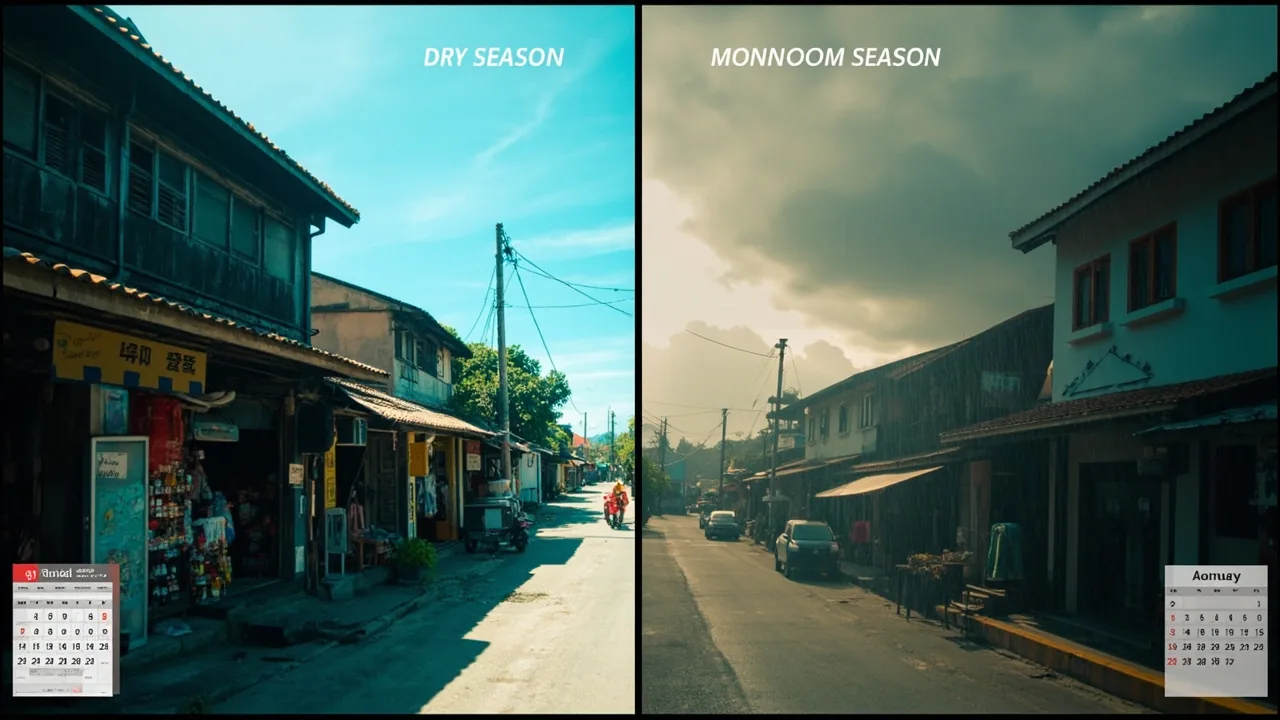
Dry Season vs Monsoon Season in Southeast Asia: When to Go and What to Expect
The bottom line. Dry season in Southeast Asia runs November to March across mainland Thailand, Laos, Cambodia, and Vietnam — reliable beach days, blue skies, and the classic postcard version. Want lower prices, fewer tourists, and dramatic skies? The green season (May to October) delivers the same trip at 20-30% less.
Most Indian backpackers plan their Southeast Asia trip around Indian holidays, which works beautifully. December-January is peak dry season everywhere except eastern Indonesia. May-June overlaps with the Indian summer break and lands right at the start of the green season, when prices drop and the rains are still light. October is the cheapest month across the region, but it sits inside typhoon season for Vietnam and the Philippines, so plan around it.
Quick Answers
| What | Answer | Price (INR) |
|---|---|---|
| Dry season across mainland SEA | November to March | — |
| Cheapest month across SEA | October (low shoulder) | — |
| Wettest month across SEA | August-September (mainland), January-February (east coast) | — |
| Rainy season still ok for travel? | Yes, mainland SEA sees showers, not all-day rain | — |
| Best month for Indians to visit | December to February (dry + cool + Indian school holiday) | — |
Quick Comparison Table
| Factor | Dry Season (Nov-Mar) | Monsoon/Green Season (May-Oct) |
|---|---|---|
| Daily budget (₹) | ₹2,800 (~$29.04) to ₹3,500 (~$36.31) | ₹2,000 (~$20.75) to ₹2,800 (~$29.04) |
| Rain pattern | Almost none, blue skies | Daily 1-3 hour downpours, then sun |
| Crowds | High (Nov-Feb peak) | Low to medium |
| Prices | Peak season, 20-30% higher | Off-peak, 20-30% lower |
| Beach quality | Best (calm water, no red flags) | Variable (choppy water, red flag days) |
| Photographers pick | Clear skies, golden hour is clean | Dramatic clouds, lush green rice terraces |
| Island ferry reliability | High | Lower (Phuket, Koh Tao, Gili T all see cancellations) |
| Veg food availability | Same year-round | Same year-round |
| Best for | First-timers, beach lovers, families | Budget travellers, photographers, repeat visitors |
| Worst for | Anyone on a tight budget who hates crowds | Anyone whose only goal is perfect beach weather |
Dry Season in Southeast Asia: Month by Month
The dry season definition in Southeast Asia is different from what most Indians learned in school. In India, the “dry season” usually means winter (October-March in the north). In tropical Southeast Asia, “dry season” means the months when the southwest or northeast monsoon has pulled moisture away from that specific region. The timing flips depending on which side of the Thai-Malay peninsula you’re on. Our backpacking hub for Southeast Asia covers country-by-country details if you want to drill deeper.
Mainland SEA: Thailand, Laos, Cambodia, Vietnam (Nov-Mar)
The cool dry season runs November to February. Daytime highs sit around 28-32°C, nights drop to 18-22°C in northern Thailand, Laos, and northern Vietnam (Sapa can hit 8°C in December). March is hot and dry, often above 35°C in Bangkok, Yangon, and Phnom Penh, with smoke season starting in northern Thailand from agricultural burning.
This is the version of Southeast Asia you see in movies. Angkor Wat at sunrise with clear skies. Halong Bay on a glass-calm day. The Mekong between Huay Xai and Luang Prabang. It is also peak season, which means Bangkok hostels fill up around Christmas and New Year, Koh Tao dorms book out 3-4 weeks ahead for January, and Vang Vieng prices nearly double. If you want the full country-by-country breakdown, check our Southeast Asia backpacking hub.
Maritime SEA: Bali, Malaysia, East Coast (Apr-Sep)
Here’s where it flips. While Thailand is drying out, Bali, Lombok, the Gili Islands, and Malaysia’s east coast (Perhentian, Tioman) are entering their own dry season, which runs April to September. If you time it right, you can chain both dry seasons into one trip: Vietnam and Thailand in December, then Bali in May.
This pattern is driven by the south Asian monsoon system. Between November and March, the northeast monsoon dumps rain on the east coast of Malaysia, Borneo, and eastern Indonesia. Between May and September, it reverses and the southwest monsoon hits the Andaman side (Phuket, Krabi, Koh Lanta) while leaving the Gulf side and Bali mostly dry. For more on how this affects each country individually, see our Southeast Asia backpacking hub.
Monsoon/Green Season in Southeast Asia: What to Expect
The travel industry calls it the “green season” for a reason. The rain comes in heavy afternoon bursts that last 1-3 hours, then the sun comes back and everything looks more saturated and alive. Rice terraces in Sapa and Bali go electric green. Waterfalls in Laos and northern Thailand hit peak flow. Temperatures stay warm (28-33°C) and humidity spikes to 80-90%.
What you sacrifice:
- Beach days become hit-or-miss, especially on the Andaman coast and the east coast of Bali
- Ferries to Koh Tao, Koh Phangan, Koh Lanta, and the Gili Islands get cancelled when the swell is up
- Temples lose some of their golden-hour magic under flat cloud cover
- Typhoons roll through Vietnam and the Philippines between July and October
What you gain:
- Prices drop 20-30% on hostels, tours, and internal flights
- Crowds thin out, so you get Angkor Wat almost alone at 6 AM in August
- Lushness that the dry season can’t match, Sapa in September is unreal
- Reliable islands like Koh Lanta (west coast has rain shadow), Phu Quoc (dry in Aug-Sep), and Koh Samui (dry in Feb-Apr) work as wet-season substitutes. Island guides live in our Southeast Asia backpacking hub.
Subodh’s Pro Tip: If you have flexibility, target late October or early November. The rains are tailing off in mainland SEA, prices haven’t spiked yet for the dry season rush, and the air is clean after the burning season ends.
Cost Comparison in ₹
| Expense | Dry Season (Nov-Mar) | Monsoon/Green Season (May-Oct) |
|---|---|---|
| Dorm bed (avg/night) | ₹600 (~$6.22) to ₹1,200 (~$12.45) | ₹450 (~$4.67) to ₹900 (~$9.34) |
| Street food meal | ₹172 (~60 THB or ~$1.79) | ₹144 (~50 THB or ~$1.49) |
| Restaurant meal | ₹718 (~250 THB or ~$7.45) | ₹574 (~200 THB or ~$5.96) |
| Local transport (per day) | ₹400 (~$4.15) to ₹600 (~$6.22) | ₹400 (~$4.15) to ₹600 (~$6.22) |
| SIM card (tourist, 8 days) | ₹500 (~$5.19) to ₹700 (~$7.26) | ₹500 (~$5.19) to ₹700 (~$7.26) |
| Top activity (e.g. Angkor pass) | ₹3,567 (~37 USD) | ₹3,567 (~37 USD) |
| Beer | ₹230 (~80 THB or ~$2.38) | ₹172 (~60 THB or ~$1.79) |
| 7-day total (budget) | ₹22,000 (~$228.21) to ₹28,000 (~$290.45) | ₹16,000 (~$165.97) to ₹20,000 (~$207.46) |
| 7-day total (comfortable) | ₹40,000 (~$414.92) to ₹55,000 (~$570.52) | ₹30,000 (~$311.19) to ₹40,000 (~$414.92) |
Safety Alert: Check the MEA travel advisory page before booking. Vietnam’s central coast and the Philippines see real typhoon disruption between August and October, with the kind of flooding and flight cancellations that can wreck a 7-day trip. Don’t plan a tight itinerary through Da Nang or Hanoi in September without backup flights.
Choose Dry Season If…
- You’re a first-time Southeast Asia visitor who wants the textbook version. Angkor Wat at sunrise, Phi Phi without rain, Sapa terraces with a clear view of Fansipan.
- Your trip is 7-10 days and beach-heavy. Short trips can’t absorb a typhoon or a 3-day ferry cancellation. The Gulf islands (Koh Tao, Koh Phangan, Koh Samui) are most reliable December to March.
- You’re travelling with parents or someone who’s never backpacked. Cooler nights in December and January (18-22°C) make Chiang Mai and Hanoi comfortable for older travellers who wilt in April heat.
- You need reliable connectivity for work. Rain doesn’t usually knock out Wi-Fi, but typhoon-season power outages in central Vietnam and the Philippines can last 24-48 hours.
Choose Monsoon/Green Season If…
- Budget is your top priority. A 7-day budget trip costs roughly ₹16,000 (~$165.97) to ₹20,000 (~$207.46) in green season vs ₹22,000 (~$228.21) to ₹28,000 (~$290.45) in dry. That’s a difference of ₹4,000 (~$41.49) to ₹6,000 (~$62.24) across the same itinerary.
- You want to photograph Southeast Asia at its most photogenic. Sapa terraces, Bali rice fields, and Kuang Si Falls in Luang Prabang all peak during the wet months.
- You’ve already done the standard loop and want something quieter. Halong Bay in October has a fraction of the boats of December. Pai in July has the same vibe without the Christmas crowds.
- You can handle schedule slippage. A 14-day itinerary has room for a rained-out day or a rescheduled ferry. A 5-day itinerary does not.
Dry Season. Pros and Cons
Pros:
- Reliable beach weather across the Gulf of Thailand, southern Vietnam, and Bali
- Calm water for diving around Koh Tao and the Gili Islands
- Cool nights in northern Thailand, Laos, and northern Vietnam (Dec-Feb)
- All ferries, flights, and overland routes running on schedule
- Christmas and New Year trips work without monsoon disruption
Cons:
- Peak prices on hostels, tours, and internal flights (20-30% higher than green season)
- Crowds at major sites (Angkor, Phi Phi, Halong Bay) especially Dec 20 - Jan 5
- March burning season in northern Thailand (Chiang Mai often hits hazardous AQI)
- Less photogenic than the green season if you like dramatic skies
Monsoon/Green Season. Pros and Cons
Pros:
- 20-30% cheaper across hostels, tours, and flights
- Almost no crowds at the major sites after August
- Lush, saturated green that photographers love
- Lower humidity in some regions (the rain cools things down)
Cons:
- Daily downpours, usually afternoons, that can wreck outdoor plans
- Ferry cancellations to Andaman islands (Phuket, Koh Lanta) and Gili Islands
- Typhoon risk in Vietnam (Aug-Oct) and Philippines (Jun-Nov)
- Some beach destinations (Phuket, Koh Chang east side, east Bali) genuinely suffer in the wet months
The Bananarchy Take
The honest answer is that dry season wins for most first-time Indian travellers, not because monsoon is bad, but because the risk profile of a ruined ferry day or a typhoon-flooded Ha Giang loop is higher when you only have 7-10 days and this is your one shot. Green season wins for repeat visitors, photographers, budget-conscious backpackers, and anyone with 14+ days who can absorb a couple of rain days.
There’s also a clever middle path: travel in early November or late March, the shoulder windows. The rains have tapered off (in the case of November) or haven’t started in earnest (late March), but the December-January peak crowds haven’t arrived yet. Prices are 10-15% below peak, not the 20-30% of full green season, but the schedule reliability is closer to dry season.
If you’re weighing this against a different decision (like Vietnam vs Thailand), the timing question interacts with it: Thailand in green season is more forgiving than Vietnam in green season because Thailand doesn’t get typhoons. Browse all comparison guides in our Southeast Asia backpacking hub.
Getting Connected
Connectivity is the same year-round. Thai AIS, Vietnamese Viettel, and Cambodian Cellcard all sell 8-day tourist SIMs for ₹859 (~299 THB or ~$8.91). Coverage drops during heavy storms (cell towers get knocked out), but for normal green-season rain, both AIS and Viettel hold up fine. If you don’t want to swap SIMs at each border, Get Nomad eSIM covers all of mainland SEA on one data plan.
Can You Do Both?
Yes, and the smart move is to chain dry seasons. Start in Vietnam and Thailand in December (peak dry), then move to Bali in May (start of Bali’s dry season). The leg between Phuket and Bali involves a flight (cheapest via Kuala Lumpur or Singapore), but the overlap in dry weather across both halves of the trip is worth the connection cost.
A 30-day split like that covers roughly:
- 14 days Thailand/Vietnam (Dec-Jan)
- 3 days transit (Thailand to Bali via KL/Singapore)
- 13 days Bali, Lombok, Gili Islands (May, dry season starting)
Budget for the combined trip: ₹80,000 (~$829.84) to ₹110,000 (~$1,141.04) excluding international flights.
FAQ
Is dry season the same as winter in India?
No. India’s dry season (Oct-Mar) overlaps with mainland Southeast Asia’s dry season, which is the same thing driven by the northeast monsoon pulling moisture south. The temperature is different though: SEA stays warm (25-32°C) while northern India cools to 5-15°C.
Which month is wettest in Southeast Asia?
August and September for mainland SEA (Thailand, Laos, Cambodia, Vietnam), driven by the southwest monsoon. January and February are the wettest on Malaysia’s east coast and eastern Indonesia.
Can I visit Bali in monsoon season?
Yes. Bali’s rainy season (Nov-Mar) brings heavy afternoon showers but plenty of sun. The east coast (Sanur, Nusa Dua) stays drier than the west coast (Canggu, Tanah Lot). It’s also Bali’s low season, so prices drop 30-40%.
Is December or May better for Indians?
December to February is the sweet spot. It overlaps with Indian school winter break, lines up with mainland SEA’s peak dry season, and the temperatures are comfortable. May-June works but you’ll hit the start of monsoon in some regions.
What about typhoon season in Vietnam?
Central Vietnam (Hue, Da Nang, Hoi An) is most exposed August to October. Northern Vietnam (Hanoi, Halong Bay) gets hit less often but still sees tropical storms. The south (Ho Chi Minh, Mekong Delta) is mostly shielded.
Are tours and activities cheaper in green season?
Yes, 20-30% on most tours. Diving around Koh Tao drops from ₹7,179 (~2,500 THB or ~$74.47) to ₹5,169 (~1,800 THB or ~$53.62) for a 2-dive trip. Halong Bay cruises drop from ₹14,461 (~150 USD) to ₹8,676 (~90 USD) for an overnight boat. Some operators close entirely (especially on Phuket and Koh Lanta), so check ahead.
