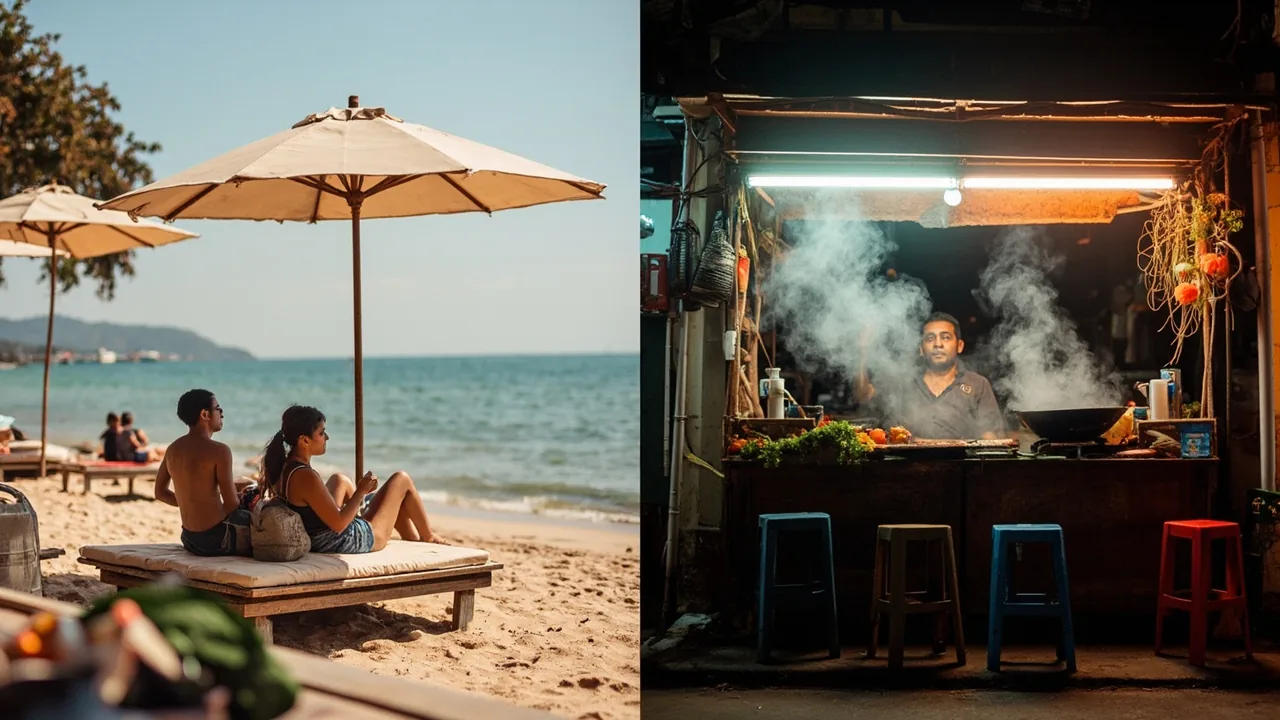
Bali vs SE Asia Trail: Why the Trail Wins
For Indian backpackers in 2026, Bali vs Thailand comes down to this: Bali wins on ease and Indian food. If you want a real Southeast Asia trip costing half as much across four countries, the Thailand-Vietnam-Laos-Cambodia trail wins, and it is not close. Planning the wider region? Our Southeast Asia backpacking hub covers the full multi-country route.
The Bali bubble has gotten expensive and crowded in ways most Instagram posts do not show. Here is the honest side-by-side.
Quick Answers
| What | Answer | Price (INR) |
|---|---|---|
| Cheapest daily budget (Bali) | Around ₹2,800/day outside Canggu/Seminyak | ₹2,800 (~530,189 IDR or ~$29) |
| Cheapest daily budget (SE Asia trail) | Around ₹1,800/day in Thailand/Vietnam | ₹1,800 (~627 THB or ~$19) |
| Visa cost for Indians (Bali) | eVOA on arrival | ₹4,800 (~1,000,000 IDR or ~$50) |
| Visa cost for Indians (Thailand) | Visa-free until further notice | ₹0 |
| Visa cost for Indians (Vietnam) | e-visa single/multiple entry | ₹2,400 (~646,486 VND or ~$25) |
| Nightlife comparison | Bali beach clubs vs Bangkok/Koh Phangan/Sapa/Vang Vieng | Both strong, Bali costlier |
| Best months to visit | May to September | November to March for Vietnam, November to April for the rest |
| Indian veg food availability | Easy in Bali, easy across mainland SE Asia | Bali slightly weaker on pure veg |
Quick Comparison Table
| Factor | Bali | Thailand-Vietnam Trail |
|---|---|---|
| Daily budget (₹) | ₹2,800 (~$29.02) to ₹5,500 (~$57.01) | ₹1,800 (~$18.66) to ₹3,200 (~$33.17) |
| Visa for Indians | eVOA ₹4,800 (~$49.75) | Mostly free or ₹2,400 (~$24.88) |
| Best months | May to September | November to March for Vietnam, November to April for the rest |
| Veg food availability | Good (Jay and Indian restaurants everywhere) | Better (dedicated veg restaurants in every backpacker town) |
| Safety (solo) | safe, well-trodden | safe on the main trail, slightly rougher in border areas |
| English spoken | Strong in tourist zones, weak in villages | Strong in tourist zones, weak in villages, same pattern |
| Vibe | Tropical, surf, party, influencer-dense | Varied: temples, mountains, rivers, scooters, street food |
| Best for | First-timer who wants one base, lifestyle traveller, content creator | Backpacker who wants range, overland lover, value-seeker |
Choose Bali If…
- You want one base for two weeks and do not feel like moving cities every three days. Canggu, Ubud, and Uluwatu each have their own ecosystem, and you can settle in.
- You want Indian food as a guaranteed daily option, not a hunt. Bali has dedicated Jay restaurants and Indian kitchens in every tourist hub.
- You want the surf-and-sunsets-in-one-day package without internal flights. The Bukit peninsula delivers this straight out of Seminyak.
- You want predictable infrastructure: Bolt, Grab, Gojek, Western clinics, and English-speaking staff at every hostel desk.
Choose the Mainland SE Asia Trail If…
- You want four countries on one trip without four flights. The Chiang Mai to Luang Prabang to Hanoi route runs on sleeper trains and tourist buses, no flying required.
- You want to spend less per day and travel longer. Verified 2026-07-18 at 1 INR = 0.349 THB and 1 INR = 271.52 VND: a dorm bed in Bangkok or Hanoi is around ₹1,005 (~350 THB or ~$10.43), less than half of Canggu’s going rate.
- You want the actual Southeast Asia experience most first-timers came for: night markets, mountain treks, sleeper buses, riverside towns, and street food cooked two metres from your face.
- You want to come back having earned something. Bali gives you the same experience every trip. The trail gives you a different one each time.
Bali. Pros and Cons
Pros:
- One airport in, one airport out, no border runs. Ngurah Rai is well signed in English and Grab drivers are used to Indian travellers.
- Indian food coverage is the strongest in Southeast Asia. Pure veg Jay restaurants in Canggu, Ubud, and Uluwatu. Multiple Gujarati thali spots.
- The Bali bubble is genuinely comforting for a first-timer. English, rupiah prices written on most menus, Grab works, hospitals are Western-standard.
Cons:
- It is more expensive than the mainland for almost every line item. A dorm bed in Canggu is around ₹964 (~180,000 IDR or ~$10), where the same bed in Bangkok is around ₹1,005 (~350 THB or ~$10.43).
- Internal transport drains time and money. Ubud to Canggu is two hours minimum by car or scooter, around ₹1,072 (~200,000 IDR or ~$11.12) one way.
- The “hidden Bali” hype is mostly sold out. The waterfalls and rice terraces have queues. If you want the Bali of 2018, you will be disappointed.
- Burnout is common. After seven days the same beach clubs, brunch spots, and sunset angles repeat themselves.
SE Asia Trail. Pros and Cons
Pros:
- Cheaper on almost every line item, end to end. Verified above: dorm beds, street food, local transport, beer, all lower on the mainland.
- Four countries in one trip without flying. Chiang Mai to Hanoi via Luang Prabang is a clean overland route, sleeper trains the whole way.
- The variety is unbeatable. Mountains in Sapa, rivers in Luang Prabang, beaches on Koh Phangan or Koh Rong, cities in Hanoi and Bangkok, all on one trip.
- Indian traveller infrastructure has matured. Indian restaurants in Bangkok and Hanoi are reliable; Phnom Penh and Vientiane have a smaller and less consistent selection, and pure veg on request is not always available.
Cons:
- You will move cities more often. Six to eight stops in a 30-day trail is normal, so it is not the trip for someone who hates packing.
- Border runs add friction. The Chiang Mai to Mae Sai to Huay Xai to Luang Prabang route requires two border crossings with passport checks and fees.
- The Thai baht is strong right now. A beer in Bangkok (around ₹230 (~80 THB or ~$2.38)) is not as cheap as it used to be, even if still cheap by Indian standards.
- Domestic flight networks in Laos and Cambodia are thin. If you choose to fly, you fly with Lao Airlines or Cambodia Angkor Air, not VietJet or AirAsia.
Cost Comparison in ₹
| Expense | Bali (₹) | SE Asia Trail (₹) |
|---|---|---|
| Dorm bed (avg/night) | ₹950 (~$9.85) | ₹800 (~$8.29) |
| Street food meal | ₹160 (~$1.66) | ₹100 (~$1.04) |
| Restaurant meal | ₹530 (~$5.49) | ₹350 (~$3.63) |
| Local transport (per day) | ₹430 (~$4.46) | ₹280 (~$2.90) |
| SIM card (tourist) | ₹300 (~$3.11) | ₹280 (~$2.90) |
| Visa fee | ₹4,800 (~$49.75) | ₹2,400 (~$24.88) |
| Top activity (e.g. Day trip) | ₹1,900 (~$19.69) | ₹1,400 (~$14.51) |
| Beer | ₹190 (~$1.97) | ₹110 (~$1.14) |
| 7-day total (budget) | ₹15,400 (~$159.62) | ₹9,800 (~$101.57) |
| 7-day total (comfortable) | ₹36,600 | ₹21,700 |
For one couple, exchange rate 1 IDR = 0.0053 INR, 1 THB = 2.87 INR, 1 VND = 0.0037 INR. These are realistic middle-of-the-road numbers.
The Bananarchy Take
Bali is the right choice for one kind of Indian traveller: someone who wants a low-friction two-week reset, depends on Indian food, and is happy paying 1.5x to 2x for predictability. That is a real user, and the decision is honest.
The trail is the right choice for everyone else. If you have 21 to 30 days, want to see three or four countries, and care about value per rupee, the mainland loop wins on every axis that matters: cost, variety, depth of experience, and the feeling of having gone somewhere. Bali gives you a holiday. The trail gives you a trip.
Bananarchy’s one fixed loop runs Thailand-Vietnam-Laos-Cambodia, not Bali. That is a positioning choice, not a value judgement. For the right traveller, Bali is still excellent. Most Indian backpackers want more than one beach town and a yoga class, and that is exactly what the trail delivers.
If you want the cheapest, fullest mainland loop without planning logistics yourself, see dates on the Bananarchy trip. For independent planners, the Thailand vs Indonesia 2026 piece covers broader cost comparisons. Travellers picking a Bali base first should read which side of Bali is best before booking.
Getting Connected
Indonesia, Thailand, and Vietnam all sell tourist SIMs at the airport for around ₹1,607 (~300,000 IDR or ~$16.67) in Bali and ₹859 (~299 THB or ~$8.91) in Thailand. Coverage is solid in tourist towns on all three. The faster setup is an eSIM before you fly. Get Nomad eSIM lets you land connected, skip the airport kiosk queue, and switch countries on the same data plan.
Can You Do Both?
Yes, but most Indian backpackers skip it for budget reasons. A cheap version is Bali plus Bangkok plus Hanoi over 21 days: four days in Canggu, four nights in Bangkok, two nights in Pai, then Hanoi, Ha Long, Hoi An, and Ho Chi Minh City for the remaining ten days. Land in Denpasar, fly domestic to Bangkok via Kuala Lumpur or Singapore (around ₹14,000 (~$145.11) round trip if booked three weeks out), then loop Vietnam overland and fly home from HCMC.
The total cost is around ₹85,000 (~$881) to ₹95,000 (~$984.64) for 21 days including the Bali-Ngurah Rai to Bangkok flight. That is more than the trail alone but cheaper than two separate trips once you count foregone international flights.
A Bali plus Philippines plus Vietnam build is also doable but eats more days. If you want the cheapest combined play, Bali plus Thailand plus Vietnam is the right order: Bali first (shortest beach break), then the slower Southeast Asia mainland loop second. The reverse, mainland first then Bali to wind down, works equally well if you prefer the slower section at the front.
For connections between specific cities, the overland vs flying Southeast Asia guide covers sleeper bus versus flight trade-offs in detail, and the sleeper bus vs train comparison breaks down overnight options on the mainland.
FAQ
Is Bali cheaper than Thailand for Indians in 2026? No. Daily costs in Bali are 1.4x to 2x higher than Thailand or Vietnam for almost every category. Dorm beds, street food, beer, and transport all cost more.
Which has better nightlife, Bali or Thailand? Both are strong. Bali has beach clubs in Canggu and Seminyak, while Thailand has Bangkok’s Soi Rambuttri and Khao San Road, Koh Phangan full-moon parties, and Pai’s late-night bars. Bali is more planned and expensive, Thailand is more chaotic and cheaper.
Can I get a visa for Bali and Thailand on the same Indian trip? Yes. Indonesia gives an eVOA on arrival or via the online portal. Thailand is visa-free for Indian passport holders until further notice. Vietnam needs an e-visa applied for in advance. Apply at least 10 working days before departure.
Which is safer for solo Indian women, Bali or mainland SE Asia? Both are safe on the main backpacker trail. Bali has stronger healthcare and English-speaking hospitals, but Thai cities like Bangkok and Chiang Mai also have international-standard clinics. Avoid late-night scooter rides on either side; that is the consistent risk factor.
Is Bali good for vegetarian Indian travellers? Yes, the best in Southeast Asia after Thailand. Jay restaurants and Indian veg options are denser in Canggu and Ubud than anywhere else in the region outside Bangkok. Mainland SE Asia is also strong now, just slightly less consistent village by village.
How many days do I need for the Bali plus mainland loop? Realistically 21 days minimum. Two days are lost to Bali-Bangkok transit, leaving 19 days for the mainland loop. Any shorter and you are sprinting. 25 to 30 days is the comfortable duration.
Which is better in July-August 2026? Bali’s July-August weather can be mixed, with showers on parts of the island. The mainland trail is generally at its drier stretch in central and northern Thailand, Cambodia, and Vietnam during these months. If your dates are fixed to July-August 2026, weigh both options.
Subodh’s Line
Bali is a holiday. The Thailand-Vietnam-Laos-Cambodia trail is a trip. If you can only do one, pick the one that will change how you see travel.
