Baguio Temple Etiquette Guide: Cultural Rules for Visiting Buddhist & Taoist Temples in the Philippines
Cross-checked against traveller reports from June 2026 and the official Philippine tourism guidance for religious sites. Prices and entry rules verified as of mid-2026. Planning the wider region? Our Southeast Asia backpacking hub covers the full multi-country route.
The short version: remove your shoes before entering any worship hall, cover your shoulders and knees, never point your feet at a Buddha image or altar, and ask before photographing monks or rituals. Getting any of these wrong won’t get you arrested, but it will mark you as a tourist who didn’t bother to learn, and the temple caretakers notice.
Baguio sits at 1,500 metres in the Cordillera mountains of northern Luzon, and its religious sites are a mix of Filipino Catholic heritage, Chinese-Filipino Taoist temples, and a small but visible Buddhist community. The temples here follow the same core etiquette as temples across East and Southeast Asia, with a few local wrinkles unique to Baguio’s mountain-town culture. This guide covers what an Indian backpacker needs to know before walking through the door, and pairs well with our broader Philippines safety guide for Indian tourists.
Quick Answers
| What | Answer | Price (INR) |
|---|---|---|
| Entry fee | Most temples are free; some request a small donation | ₱20-50 suggested donation |
| Dress code | Shoulders and knees covered | , |
| Shoes | Remove before entering worship halls | , |
| Photography | Usually allowed outside; ask before photographing rituals or monks | , |
| Best time to visit | Early morning (6-8 AM) or late afternoon (4-5 PM) | , |
| Quiet hours | Avoid loud conversation inside worship halls | , |
What Is Temple Etiquette?
Temple etiquette is the set of unspoken rules that govern behaviour at Buddhist and Taoist religious sites: how you dress, where you walk, how you stand, what you touch, and how you interact with worshippers and clergy. These rules exist because temples are active places of worship, not museums. The goal isn’t to test visitors on religious trivia; it’s to show respect for the people praying there and the objects they hold sacred.
For Indian visitors, much of this will feel familiar from Hindu and Jain temple traditions: removing footwear, covering the head in some traditions, not touching sacred objects, maintaining silence. The specifics differ, but the underlying logic is the same: act like a guest in someone else’s home, not a tourist at a photo op. If you’ve visited temples in Malaysia before, our Melaka temple etiquette guide covers similar ground.
Step-by-Step: How to Visit a Baguio Temple Respectfully
1. Dress the Part Before You Leave the Hotel
Pack or wear a light cover-up. Baguio’s mountain weather stays cool year-round (15-25°C), so this is easy: long pants or a long skirt, a t-shirt with sleeves, and closed shoes you can slip off easily. Flip-flops work for removal but offer no protection on stone steps. Travellers report that some smaller Taoist temples in Baguio’s Session Road area have turned away visitors in tank tops and shorts, especially during festival days.
If you forget, some temple entrances sell cheap shawls or have loaner sarongs. Don’t rely on this. Bring your own.
2. Arrive at the Right Time
Early morning (6-8 AM) and late afternoon (4-5 PM) are the best windows. Mornings are when locals come to pray and make offerings; the air is cooler, the incense is fresh, and you’ll see the temple in use rather than empty. Late afternoon is quieter and good for photography (with permission).
Avoid major Buddhist and Taoist festival days if you want a calm visit. The Chinese New Year period (late January or early February) brings heavy crowds to Baguio’s Taoist temples; Lunar ghost month (usually August) is solemn and observation-focused, not a tourist moment. Many of the same scam-awareness principles from our Vietnam travel mistakes guide apply during these crowded festival days.
3. Remove Your Shoes at the Threshold
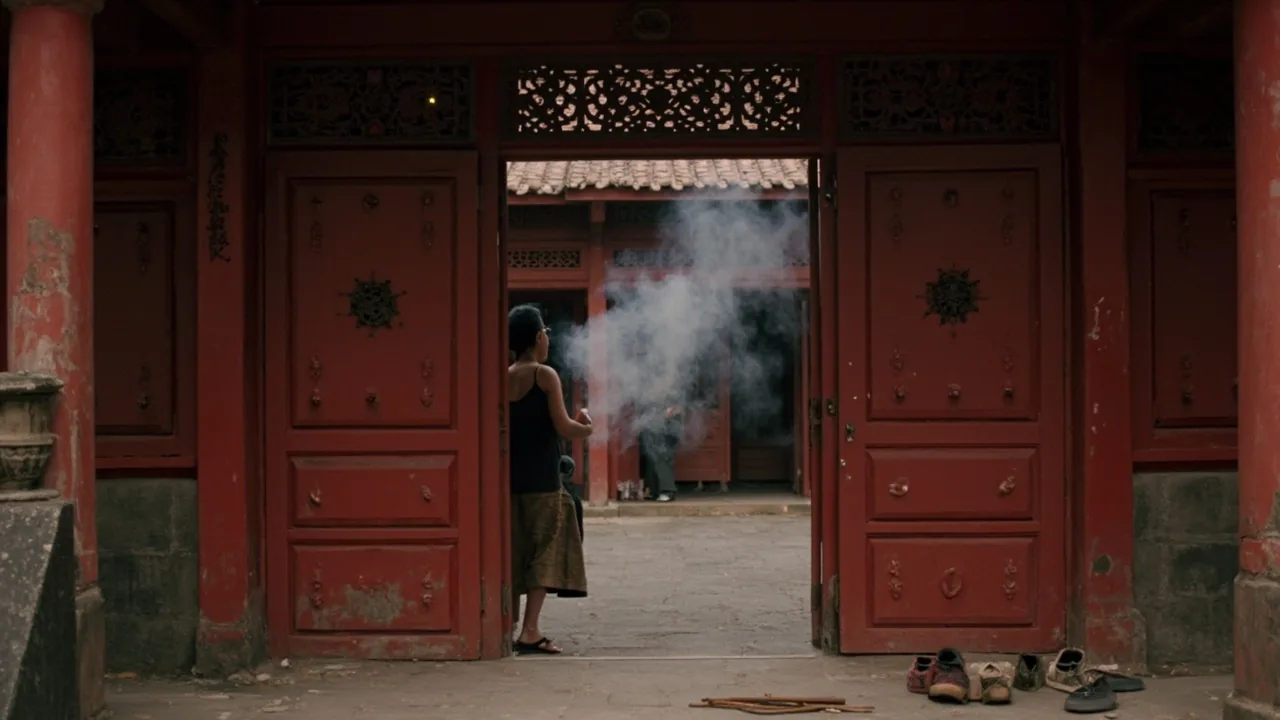
Every temple has a clear demarcation: a step up, a threshold, or a row of shoes outside the door. This is where you stop. Place your shoes neatly with the toes pointing toward the door (so you can step into them when leaving), not scattered across the entrance.
Travellers report that the most common faux pas from foreign visitors is walking three steps into a worship hall wearing shoes before being stopped. Don’t be that person. Pause at the threshold, look down, and check whether others have removed their footwear.
4. Move Through the Space Quietly
Once inside:
- Walk slowly and keep your voice low. If you’re travelling with friends, save the conversation for outside.
- Don’t touch statues, altars, incense burners, or offerings. Even leaning on a pillar can be a problem if it’s part of the structure.
- Never point your feet at a Buddha image, altar, or monk. In Buddhist and Taoist tradition, feet are the lowest, dirtiest part of the body. If you sit on the floor (which is rare in Baguio’s temples; most have pews or standing room only), sit cross-legged or with your feet tucked behind you.
- Don’t turn your back to the main altar when taking a photo. Step to the side instead.
5. Know What to Do With Incense and Offerings
Many Baguio temples have incense coils or sticks burning near the entrance. The custom is:
- Take at most one or three sticks (odd numbers are traditional).
- Light them from the communal flame, not a lighter if possible.
- Bow slightly before placing them in the burner.
- Let them burn down naturally. Don’t blow them out; this is considered rude.
If you want to make a small offering (fruit, flowers, a candle), place it on the altar or in the designated tray. Don’t eat any food that’s been laid out as an offering; it’s sacred until the ceremony removes it.
6. Photograph Thoughtfully
Outside the temple and in courtyards, photography is almost always fine. Inside the worship hall:
- Look for signs. Some temples explicitly prohibit interior photography.
- When in doubt, ask the caretaker. A quick “Can I take photos inside?” in English usually gets a clear answer.
- Never use flash during a prayer or ritual.
- Don’t photograph monks or worshippers without permission. A smile and a gesture toward your camera is the universal ask.
7. Interact With Monks and Caretakers
If a monk or temple volunteer approaches you, a slight bow with hands together (similar to a Thai wai or Indian namaste) is a respectful greeting. Don’t initiate physical contact, don’t hand them anything with your left hand if you’re offering something, and don’t ask probing questions about their personal practice.
A common question from Indian visitors: “Can I meditate here?” The answer is usually yes if the temple is open to visitors and not mid-ceremony. Sit quietly, face the altar or a wall, and keep sessions short (10-15 minutes). Don’t lie down, and don’t treat the space like a yoga studio.
Common Mistakes Indians Make
Mistake 1: Treating the Temple Like a Tourist Attraction, Not a Place of Worship
What people do wrong: Walking in loudly, posing for selfies at the altar, touching statues for photos. What happens: Caretakers ask you to leave, or worshippers move away from you. You miss the actual experience of the place. How to avoid it: Spend the first five minutes just standing quietly. Watch how locals move. Follow their lead.
Mistake 2: Wearing Revealing Clothing Because Baguio Is Cool
What people do wrong: Assuming the cool mountain weather means shorts and tank tops are fine. What happens: Some temples will turn you away, especially during festivals. How to avoid it: Default to covered shoulders and knees. Baguio’s temperature makes this easy.
Mistake 3: Bringing Food or Drinks Inside
What people do wrong: Walking in with a bottle of water or a snack from a street vendor. What happens: You’ll be asked to leave them at the door. In some temples, eating near sacred objects is considered a serious breach. How to avoid it: Finish your snack before entering. Water bottles should stay with your shoes at the entrance.
Mistake 4: Lighting Incense Without Knowing the Custom
What people do wrong: Grabbing a handful of incense sticks, lighting them carelessly, blowing them out. What happens: It’s a small but visible breach. Locals notice. How to avoid it: One or three sticks, light from the communal flame, bow, place, let them burn.
Mistake 5: Assuming Indian and Buddhist Customs Are Identical
What people do wrong: Assuming what works in a Hindu temple works here. Removing shoes is the same, but head covering isn’t required in most Buddhist and Taoist temples. Sitting on the floor is rarely done. Touching statues is forbidden. What happens: You look awkward or, worse, disrespectful. How to avoid it: Read this guide, watch a YouTube video of temple visits beforehand, and observe before acting.
What Most Guides Don’t Tell You
Buddhist and Taoist Temples in Baguio Are Not the Same
Baguio has both Buddhist (often Thai, Chinese Mahayana, or Filipino Buddhist) and Taoist (Chinese-Filipino folk religion) temples. The etiquette overlaps but isn’t identical:
- Buddhist temples tend to be quieter, more meditative. Photography inside is more often restricted. Monks may be present.
- Taoist temples are more colourful, often with ornate roofs, red lanterns, and ancestor tablets. Incense and offerings are more prominent. Photography is usually more relaxed.
If you’re unsure which type you’re entering, look at the altar: a single Buddha statue suggests Buddhist; ancestor tablets, multiple deities, and fortune sticks suggest Taoist.
The Lourdes Grotto and Mirador Are Catholic, Not Buddhist
Two of Baguio’s most famous religious sites, Our Lady of Lourdes Grotto and Mirador Heritage and Eco-Spirituality Park, are Catholic. See Our Lady of Lourdes Grotto tours on GetYourGuide and See Mirador Heritage and Eco-Spirituality Park tours on GetYourGuide are spiritual sites but follow Catholic etiquette: quiet reverence, modest dress, and no specific Buddhist/Taoist customs like incense offering. If you’re using this guide for those sites, the dress code and shoe rules still apply, but the incense and altar protocols do not.
Festival Days Change Everything
During Chinese New Year, Lunar New Year festivities, and specific Buddhist holy days (Vesak in May, for example), temples are packed and the rules tighten. Loud behaviour, flash photography, and casual dress are more likely to get you turned away. Check the lunar calendar before your trip if you’re visiting in January, February, or August.
Connectivity in Baguio Is Patchy
Temples are often in older parts of the city or up hillside steps. Local SIM cards work fine in central Baguio, but temple sites can have weak signal. If you rely on your phone for translation or maps, get a local SIM or eSIM before you go. Get Nomad eSIM works across the Philippines and activates before you land.
For more on staying connected across Southeast Asia, see Indian SIM roaming in Southeast Asia.
What to Eat Nearby (Veg-Friendly Options in Baguio)
After a temple visit, you’ll want something warm. Baguio’s mountain food scene leans toward Filipino comfort food and hotpot, with a few veg-friendly spots:
- Tea House (rating 4.9): Quaint tea house offering a variety of teas and light bites. Good for a quiet post-temple reflection with vegetarian-friendly options.
- Canto (rating 4.3): Fusion restaurant in Baguio known for its creative takes on Asian dishes, particularly the umami-rich truffle sisig and refreshing calamansi sorbet. Some veg options; ask about vegetarian preparations.
- Tong Yang, SM City Baguio (rating 4.8): A popular hotpot restaurant with a variety of options. Hotpot is the most veg-friendly format: build your own broth and load up on vegetables, tofu, and noodles.
For Indian vegetarian food specifically, Baguio has a small Indian community. Ask your hostel staff or search “Indian restaurant” on Google Maps; you’ll usually find 2-3 options within Session Road.
Safety and Travel Insurance
Baguio is one of the safer cities in the Philippines for Indian travellers, but temple sites involve uneven stone steps, hillside paths, and weather that can change fast. Wear shoes with grip, don’t visit remote temples alone at dusk, and keep your valuables secure (temple courtyards can be busy).
For broader safety context in the Philippines, see Philippines Safety Guide for Indian Tourists.
FAQ
Do I need to cover my head in Buddhist or Taoist temples in Baguio?
No. Head covering is not required in most Buddhist and Taoist temples in Baguio, unlike some Hindu, Sikh, or Jain traditions you may know from India. Shoulders and knees covered is the rule; the head is fine.
Can I take photos inside the temple?
Outside and in courtyards, usually yes. Inside the worship hall, it depends on the temple. Look for signs or ask the caretaker. Never use flash during rituals or prayers.
What should I do with my shoes?
Remove them at the threshold and place them neatly with toes pointing toward the door. Most temples have a designated shoe area; some provide plastic bags if the ground is wet.
Is there an entry fee?
Most temples in Baguio are free. Some have donation boxes near the entrance; ₱20-50 (roughly ₹30-75) is a reasonable offering if you take photos or spend time inside. Donation is optional, not a ticket.
Can I meditate or sit quietly inside the temple?
Yes, if the temple is open to visitors and not mid-ceremony. Sit cross-legged or on a pew, face the altar or a wall, and keep your session short. Don’t lie down, and don’t treat the space as a photo backdrop.
What’s the difference between Buddhist and Taoist temples in Baguio?
Buddhist temples are usually quieter, with a single Buddha image as the focal point. Taoist temples are more colourful, with ancestor tablets, multiple deities, fortune sticks, and heavy incense use. Etiquette overlaps, but Taoist temples are generally more relaxed about interior photography.
Are Buddhist and Taoist temples safe for solo Indian travellers?
Yes. Baguio’s temple community is welcoming to foreign visitors. Basic precautions apply: visit during daylight, keep valuables secure, and dress modestly. Travellers report that monks and caretakers are usually happy to answer respectful questions.
Subodh’s Take
Temple etiquette isn’t about memorizing rules. It’s about slowing down enough to notice that you’re a guest in a sacred space. The specific rules (shoes off, shoulders covered, no flash) are easy. The harder part is the mindset: put the phone away, watch how locals move, and let the place be what it is instead of a backdrop for your photos. Get that right, and the rest follows.
