Melaka Temple Etiquette for Indians: A Practical Guide
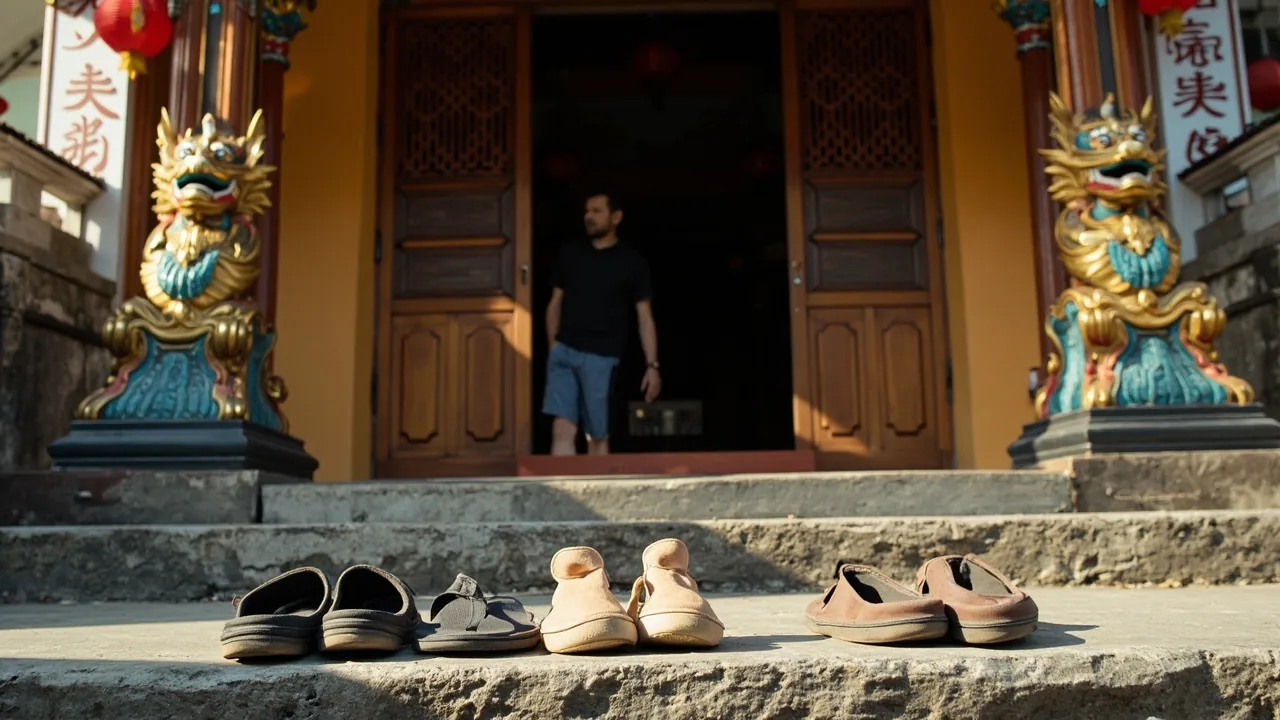
Melaka temple etiquette comes down to three rules: cover your shoulders and knees, remove your shoes before stepping onto any tiled or raised platform, and ask before photographing people at prayer. Indian visitors who follow these basics are welcome at every heritage temple in the old city, including the Hindu ones. For related planning, see our guides on Sea Backpacking Hub and Malaysia Evisa Rejected Reasons Reapply Refund.
This guide covers the dress code, footwear rules, and behavior norms Indian travelers should follow at Hindu, Buddhist, and Chinese temples in Melaka, with specific notes for Sri Poyyatha Vinayagar Moorthi, Cheng Hoon Teng, and the other heritage sites along Jonker Street.
Quick Answers
| What | Answer | Price (INR) |
|---|---|---|
| Main dress rule | Cover shoulders and knees | , |
| Footwear | Remove at the entrance, expect a rack or pile | , |
| Head covering | Not required for visitors | , |
| Smoking | Not allowed inside temple compounds | , |
| Photography | Allowed outside, restricted inside prayer halls | , |
| Sarong rental | Most temples provide free wraps if you need one | , |
| Best time to visit | Early morning, 9 to 11 AM, before tour buses arrive | , |
| Donation | Optional, ₹118-₹236 (~5-10 MYR or ~$1.22-$2.45) is typical | , |
| Total trip budget (3 days) | , | ~₹15,000 |
Exchange rate at time of writing: 1 MYR ≈ ₹23.59, so 10 MYR ≈ ₹236.
What Is Melaka Temple Etiquette?
Melaka temple etiquette is the set of dress, footwear, and behavior rules that apply across the city’s Hindu, Buddhist, and Chinese temples. The city’s heritage zone is a UNESCO site where these rules overlap: a single street can have a 17th-century Chinese temple, an 18th-century Hindu temple, and a 19th-century mosque within 100 metres of each other. The customs are similar to what you’d find in Tamil Nadu or Singapore, but with a Malaysian Muslim context that adds some specific rules, like removing shoes outside the temple gate, not just inside, and avoiding photography during prayer time.
Indian travelers who grew up visiting temples in India will already know 80 percent of what to do. The remaining 20 percent is what this guide covers.
The Five Core Rules
These apply at every temple in Melaka, regardless of religion.
1. Cover Your Shoulders and Knees
This is the rule Indian visitors get wrong most often. Shorts, sleeveless tops, crop tops, and knee-length skirts all get you turned away or handed a sarong at the entrance. For men, a t-shirt and full-length trousers work. For women, a kurta with leggings, or any top with sleeves plus a long skirt or pants, works fine.
Most temples keep a stack of plain sarongs near the entrance. They’re free to borrow and you return them on the way out. Sri Poyyatha Vinayagar Moorthi and Cheng Hoon Teng both do this. Travellers report the sarongs at smaller Chinese temples can be well-worn, so bringing your own light cotton scarf is a reasonable backup.
2. Remove Your Shoes at the Entrance
Look for a shoe rack, a tiled platform, or a row of slippers just outside the door. Don’t walk onto any raised, tiled, or painted surface in your shoes. In some temples, the rule extends to the inner courtyard, not just the prayer hall.
Temple floors are usually cool tile in the morning, but they heat up by midday. If you’re barefoot across hot stone, walk quickly or stay on shaded paths. Travellers with foot issues should bring a pair of thin cotton socks; some temples allow them, some don’t. When in doubt, go barefoot.
3. Don’t Point Your Feet at the Deities or Images
This applies at Hindu and Buddhist temples. When you sit on the floor, tuck your legs under you or sit cross-legged. Never stretch your legs out toward the main shrine, a Buddha image, or a row of statues. The same goes for pointing with your finger: use your whole hand, palm down, when gesturing toward a deity.
4. Ask Before Photographing People, Statues, and Prayer
Most Melaka temples allow outdoor photography freely. Inside the prayer hall, signs usually make the rule clear. Sri Poyyatha Vinayagar Moorthi allows photos in the courtyard but asks visitors not to photograph the inner sanctum during a puja. Cheng Hoon Teng allows photos for personal use but bans flash and tripods.
If a worshipper is praying, don’t walk into the frame. Step back, wait, or move around. The same applies to elderly visitors who may be mid-bow or mid-prostration.
5. No Smoking, No Alcohol, No Loud Phone Calls
Temple compounds are non-smoking zones. So is most of the heritage street, since the buildings are 200 to 300 years old. Alcohol on the breath is a quick way to be asked to leave a Hindu temple. Phone calls should be taken outside the gate, on silent.
Temple-Specific Etiquette
Sri Poyyatha Vinayagar Moorthi (Hindu)
This is the oldest functioning Hindu temple in Malaysia, founded in 1783. It’s a Tamil temple, so the customs are the same as a temple in Tamil Nadu. A few specifics Indian visitors should know:
- The main deity is Ganesha, with a smaller shrine to a Thai Buddha image that’s been part of the temple since its founding.
- Offerings of fruit and flowers are placed by worshippers at the entrance. As a visitor, you don’t need to bring anything. If you want to participate, a small coconut or a marigold garland from a stall outside costs ₹71-₹118 (~3-5 MYR or ~$0.73-$1.22).
- The temple runs a daily puja at around 8 AM and again at 6 PM. Visitors are welcome to watch quietly from the side; don’t walk across the front of the shrine during the bell-ringing.
- Footwear goes off at the outer gate, not just at the inner door. The marble corridor between the gate and the sanctum is sacred.
Cheng Hoon Teng (Chinese Buddhist / Taoist)
Cheng Hoon Teng is the oldest functioning Chinese temple in Malaysia, dating to 1645. The etiquette is a mix of Buddhist, Taoist, and local Chinese-Malaysian custom. Indian visitors will notice a few differences from a Hindu temple:
- Three main altars are dedicated to Kuan Yin (Goddess of Mercy), Tua Pek (a long-life deity), and a Taoist ancestral figure. Bow slightly at each altar as you walk past; no need to kneel unless you want to.
- Incense coils hang from the ceiling. Lighting incense is optional. If you do, three sticks, lit from an existing candle, and placed upright in the urn.
- The temple is built on a slope. The courtyard has multiple levels, each with its own set of shoes-off rules. Watch for painted tile edges; those mark the boundary.
- The temple runs a fortune-telling service using moon blocks. You’ll see locals kneeling and tossing two crescent-shaped wooden pieces. Don’t touch the blocks or the urn; this is for worshippers only.
Kampung Kling Mosque
Not a temple, but right next to Sri Poyyatha Vinayagar Moorthi on Jalan Tukang Emas. Indian visitors with a headscarf already in their bag can usually walk in during off-prayer hours. The mosque is open to non-Muslim visitors from 9 AM to 12:30 PM and 2:30 PM to 4 PM, except during Friday prayers. Robes are provided at the entrance. Hindu visitors shouldn’t feel out of place: the mosque’s architecture is influenced by Hindu temple design, with a stepped pyramidal roof instead of a dome.
Common Mistakes Indians Make
Wearing shorts because “it’s hot”. You’ll get handed a sarong. The temple staff don’t mind, but you’ll spend the visit holding up a wrap. Wear trousers or bring a long scarf from India.
Leaving shoes on the inner prayer hall tiles. Outer racks are for temple-wide shoes. If you walk past the rack and into a tiled corridor, you’ve gone too far. Watch the floor: carpet or mat = shoes off, plain courtyard tile = shoes on (usually).
Bringing leather items into a Hindu temple. Leather belts, leather wallets, and leather bags are technically considered impure in many Hindu traditions. Most Melaka temples don’t enforce this strictly, but if you’re visiting during a major puja, leave the leather belt at the hostel.
Asking the temple priest questions during a ritual. The priest is busy. Watch first, ask after. If you want a guided explanation, most temples have an English-speaking volunteer on weekend mornings. Cheng Hoon Teng and Sri Poyyatha Vinayagar Moorthi both run informal English tours on Saturday around 10 AM.
Treating the temples as a photo set, not a worship site. The heritage zone sees heavy tourist traffic. Visitors who pose, laugh loudly, or take selfies with the deities are a known issue. Walk in quietly, take your photo from outside the prayer hall, and move on.
What Most Guides Don’t Tell You
The dress code is enforced more strictly on weekends and during festivals. During Thaipusam, the Tamil month of Thai (January to February), and Chinese New Year (late January or February), the temples draw large local crowds and the rules are observed more strictly. Weekday mornings are quieter and the staff are more relaxed.
There’s a difference between “temple open to visitors” and “temple open for worship”. Some smaller shrines on Jonker Street are closed to non-worshippers except during a narrow window. A sign will usually say “Open for prayer only” or “Closed during puja”. If you see a locked iron gate with incense smoke rising from inside, that’s a private prayer session. Come back later.
Donations aren’t required, but they’re appreciated. A ₹118-₹236 (~5-10 MYR or ~$1.22-$2.45) note in the donation box covers the cost of incense and upkeep. Larger donations get you a name plaque, but that’s more for regulars than for a backpacker passing through.
The temples are physically close together, so you can visit three in 90 minutes. Sri Poyyatha Vinayagar Moorthi, Cheng Hoon Teng, and Kampung Kling Mosque are all within a 2-minute walk on Jalan Tukang Emas. Plan a temple-cluster morning, with a coffee break at a Jonker Street café between visits.
Step-by-Step: A Temple Morning in Melaka
Here’s how a typical Indian visitor’s morning works.
- 9:00 AM, arrive at Sri Poyyatha Vinayagar Moorthi. Shoes off at the outer gate. Pick up a sarong if you’re wearing shorts. Walk clockwise around the main shrine. Bow at the entrance, then proceed.
- 9:30 AM, cross the street to Kampung Kling Mosque. Robe provided at the entrance for non-Muslims. Women should cover their head with the scarf you brought. Photography allowed in the courtyard, not inside.
- 10:00 AM, walk to Cheng Hoon Teng. Shoes off at the main entrance. Light incense if you want to, three sticks, place them upright in the urn. Walk through all three altars. Donation box near the exit.
- 10:30 AM, coffee at a Jonker Street café. Order a kopi or teh tarik. Rehydrate before the next stop.
- 11:00 AM, optional: The Harmony Street side temples. A few smaller Taoist shrines along Jalan Tukang Emas are worth a quick look. Some are closed except during specific hours; check the signs.
This whole loop costs nothing beyond coffee. If you donate ₹236 (~10 MYR or ~$2.45) at each temple, that’s ₹707 (~30 MYR or ~$7.34) for the morning.
How Much Does a Melaka Temple Trip Cost?
| Expense | Amount | Notes |
|---|---|---|
| Sarong rental | Free | Most temples provide |
| Donation per temple | ₹118-₹236 (~5-10 MYR or ~$1.22-$2.45) | Optional but appreciated |
| Coffee between visits | ₹141-₹236 (~6-10 MYR or ~$1.47-$2.45) | Kopitiam prices |
| Walking tour guide (optional) | ₹1,178 (~50 MYR or ~$12.23) | 2-hour heritage walk |
| Half-day cultural tour (GetYourGuide) | ~₹1,885-₹2,827 (~80-120 MYR or ~$19.57-$29.35) | Includes van and guide |
For a broader budget on your Melaka trip, see the Malaysian Ringgit to Indian Rupee daily budget guide. And before you fly, double-check your Malaysia visa application status and payment site safety so you’re not scrambling at the airport.
If you want a structured, English-language guided walk through Melaka’s heritage temples with a local guide who can explain the syncretism between Hindu, Buddhist, and Malay-Muslim traditions in the old city, Check Melaka heritage temple tours on GetYourGuide.
Getting Connected
You don’t strictly need a SIM for a Melaka temple visit, since the heritage zone is compact. But if you’re staying longer, Malaysian telcos Hotlink and Celcom both have tourist SIMs at Melaka Sentral bus terminal and KLIA airport. For an eSIM that activates before you land, see Get Nomad eSIM. For SIM rules across Southeast Asia, the SIM card registration rules by country guide covers what Indian backpackers need to know.
FAQ
Are Melaka’s Hindu temples similar to temples in Tamil Nadu?
Yes. Sri Poyyatha Vinayagar Moorthi follows the same Agama traditions as a Tamil temple in Chennai or Madurai. The architecture, puja schedule, and dress code are identical.
Can I wear a sari or salwar kameez inside the temple?
Absolutely. Both are ideal. A sari covers shoulders, knees, and most of the head if you drape the pallu over your head, which is welcome at most Hindu temples. A salwar kameez works the same way.
Do I need to remove my bindi before entering a Buddhist temple?
No. Bindis and sindoor are personal religious markers, not impediments to visiting a Buddhist or Chinese temple. No Melaka temple has a policy on this.
Is it okay to bring prasad from an Indian temple in Malaysia?
Yes, but it’s not common practice. If you have leftover prasad from a puja at home, you can offer it at any Hindu shrine. Most visitors just buy a coconut or marigold garland at the entrance.
Are the temples crowded?
Weekday mornings, no. Weekend mornings and festival days, yes. Thaipusam and Chinese New Year draw hundreds of local worshippers. If you want quiet, arrive at 9 AM sharp on a Tuesday or Wednesday.
Can non-Hindus enter Sri Poyyatha Vinayagar Moorthi?
Yes. The temple welcomes visitors of all backgrounds. The only rule is the dress code and removing your shoes.
Are there any temples I should avoid?
No temple in Melaka’s heritage zone is off-limits to respectful visitors. The only places with restricted access are private prayer halls during a puja. If you see a closed door with incense smoke, that’s the sign.
Subodh’s Take
Melaka’s temple etiquette is forgiving if you show up with the right intent: cover your shoulders and knees, take your shoes off at the right line, and treat the place like a place of worship, not a photo backdrop. Indian travelers who grew up in Tamil Nadu or Kerala will feel at home here within five minutes. For everyone else, this guide plus one slow morning walk through the heritage zone is all you need.
