Bamboo Island Cambodia Entry Fee in 2026: What You’ll Pay (No Tourist Trap Math)
Bamboo Island sits about 400 metres off the southern tip of Koh Rong Samloem, a 20-minute longtail ride from Saracen Bay. The bamboo entry fee structure has more small print than a tuk-tuk driver’s taxi licence: foreigner ticket, kid rules, drone permits, camping surcharges, and the USD-versus-riel math that nobody bothers to explain. Planning the wider region? Our Southeast Asia backpacking hub covers the full multi-country route.
Subodh’s Pro Tip: The island is managed by the Sihanoukville provincial tourism office, not a private operator. The fee is officially fixed in USD, and the riel price is just the FX mirror. If someone at the dock quotes you a wildly different number, they’re not the official collector.
Quick Answers
| What | Answer | Price (INR) |
|---|---|---|
| Foreigner adult entry fee | ₹482 (~5 USD) per person, mandatory for all non-Cambodian visitors | ₹480 (~$4.98) |
| Cambodian adult entry fee | ₹48 (~2,000 KHR or ~$0.49) per person (locals pay less) | ₹48 (~$0.50) |
| Children under 6 | Free, no ticket issued | ₹0 |
| Children 6 to 12 | Half price, ₹241 (~2.50 USD) | ₹240 (~$2.49) |
| Drone filming permit | ₹1,928 (~20 USD) per drone, paid at the Saracen Bay ranger station | ₹1,925 (~$19.95) |
| Overnight camping surcharge | ₹482 (~5 USD) per person per night, on top of entry fee | ₹480 (~$4.98) |
| Glass-bottom boat snorkel (optional) | ₹482 (~5 USD) per person, separate from entry | ₹480 (~$4.98) |
The Official Entry Fee: What the Sign Says
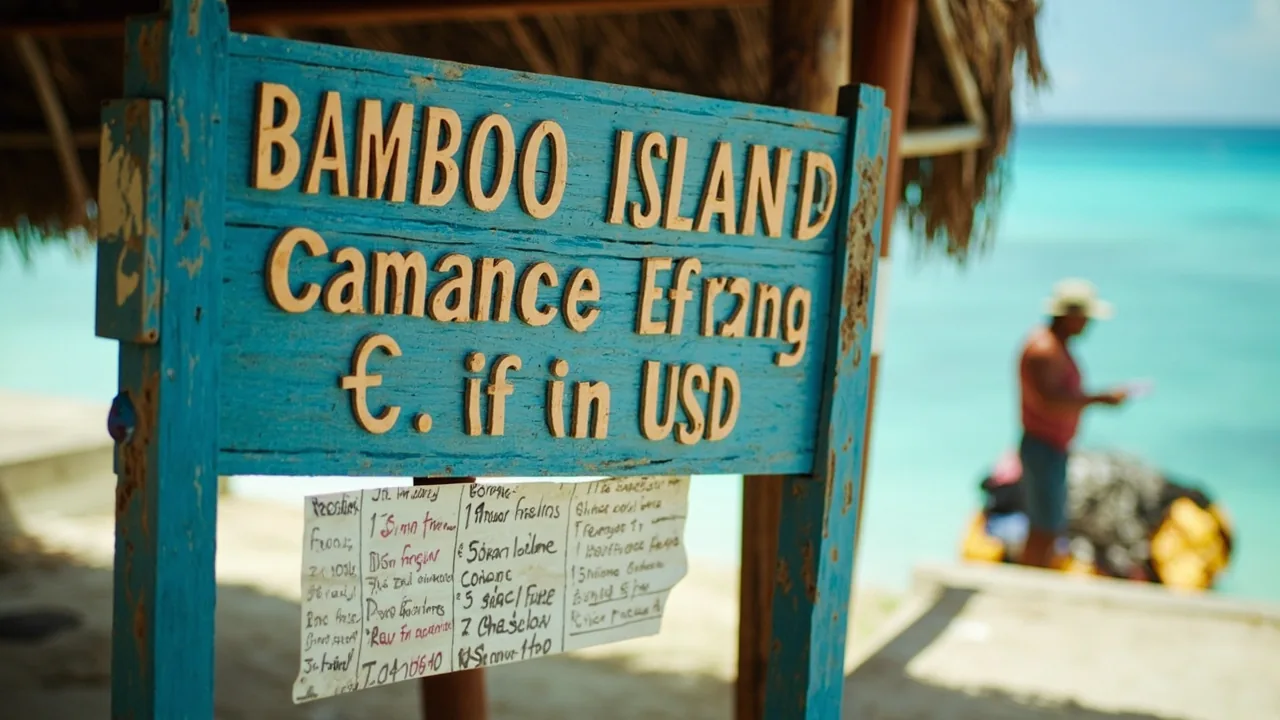
Walk off the longtail onto the white sand, and there is a small wooden ranger hut on the eastern shore. The sign is hand-painted in Khmer, English, and Mandarin, and the foreigner rate is the same for Indians, Brits, Germans, and everyone else who doesn’t hold a Cambodian passport.
The current foreigner entry fee is ₹482 (~5 USD) per person, paid once per visit regardless of how many hours you stay. The same ticket covers the whole island, including the small beach on the western side, the snorkel reef about 80 metres out from the main jetty, and the short walking trail through the casuarina pines at the northern tip. There is no second charge for “different beaches” and there is no “snorkel zone access fee.” If anyone tries to charge you a second time on the same day, you are likely being scammed, which is why every traveller should skim the Cambodia scams and safety guide for tourists before the dock.
Subodh’s Pro Tip: The ticket is a small paper stub. Keep it in your phone case or wrapped in your waterproof pouch. There is one checkpoint on the walking trail back to the main beach where rangers ask to see it. If you’ve lost it, the official policy is to reissue for free, but a tout will try to charge you again. Walk back to the hut and ask.
Payment is in USD cash or Cambodian riel notes, and change is given in riel. At the current rate (1 USD = ₹96.3294), 5 USD is roughly ₹480. Most Indian backpackers pay with a clean, untorn US dollar bill. Travellers report that small riel notes (under ₹24 (~1,000 KHR or ~$0.25)) are usually accepted for tips to the boat crew, but the official entry fee counter wants USD or large riel notes only. Don’t try to pay ₹477 (~20,000 KHR or ~$4.95) and call it ₹482 (~5 USD), the counter rate they offer is bad. Pay in USD, get your change in riel.
What the Money Pays For
The ₹482 (~5 USD) foreigner entry fee is split three ways according to the provincial tourism budget that funds the island’s upkeep:
- Park maintenance and trail clearing (about ₹145 (~1.50 USD)): covers the wooden walkway repair, the freshwater shower behind the ranger hut, and the weekly beach cleaning crew.
- Rubbish disposal and toilet upkeep (about ₹193 (~2 USD)): this is the big one. Bamboo Island has no road access, so every bin bag has to go back to the mainland by boat. The ₹193 (~2 USD) per visitor covers the barge fuel and the landfill fees in Sihanoukville.
- Ranger salaries and reef monitoring (about ₹145 (~1.50 USD)): pays the three full-time rangers who rotate shifts, plus the basic coral-bleaching surveys they do every quarter.
Safety Alert: The toilets on Bamboo Island are basic pit latrines with a hand-pump well next to them. They are cleaned twice a day but not sterilised. Bring your own hand sanitiser, wet wipes, and a small bottle of water for brushing teeth if you are camping overnight. Do not drink the well water, even after boiling, the mineral content is high enough to upset most stomachs.
The Fine Print Most Blog Posts Miss
Drone Filming Permit
If you are flying a drone for personal content, the fee is ₹1,928 (~20 USD) per drone, paid at the Saracen Bay ranger station before you board the longtail to Bamboo Island. Travellers report that this is non-negotiable, and the rangers at Bamboo Island itself have a list of paid permits. If you fly without paying, the fine on the spot is ₹4,820 (~50 USD) and your drone gets held until you pay.
For commercial shoots (branded content, tourism videos for clients), the fee jumps to ₹4,820 (~50 USD) and you need a written permit from the Sihanoukville provincial office, not just the ranger station. The vast majority of Indian backpackers fall into the personal-use category, so ₹1,928 (~20 USD) is the number to budget for.
Overnight Camping Surcharge
Day visitors leave by 5 PM when the last longtail pulls back to Saracen Bay. If you want to camp under the stars, there is a ₹482 (~5 USD) per person per night camping surcharge on top of the entry fee, paid at the ranger hut. This covers the fire pit area, the basic ground mat hire, and the overnight security patrol.
Camping is only allowed in the designated zone behind the casuarina pines, not anywhere you fancy on the beach. Tents are not provided, bring your own or rent one from your hostel in Saracen Bay for about ₹482 (~5 USD) per night.
Snorkel Gear Rental
The reef on the eastern side of the island is the main draw, and the ranger station rents basic mask-and-fins sets for ₹289 (~3 USD) per day. A glass-bottom boat tour, run by a local Saracen Bay operator, costs ₹482 (~5 USD) per person for a 30-minute loop around the reef. This is separate from the entry fee, but it is run by licensed operators, not rangers, so you pay the boat guy directly.
How to Spot Fake “Extra Charges” by Boat Touts
This is the part that costs Indian backpackers the most. Travellers report three common patterns at the Saracen Bay jetty:
The “reef access fee” scam: A longtail tout tells you the ₹482 (~5 USD) entry ticket does not cover the snorkel reef and you need to pay another ₹289 (~3 USD). The truth: the entry ticket covers the whole island including reef access. The “reef access fee” is the tout’s commission, and it goes straight into his pocket, not the ranger fund. Walk past him and pay the ranger hut directly.
The “drone declaration” scam: Someone at the dock says you need to register your drone with them for ₹964 (~10 USD) before you fly. The real permit is ₹1,928 (~20 USD) and is paid at the Saracen Bay ranger station, not at the dock. The ₹964 (~10 USD) “registration” is fake and gives you no legal cover if a real ranger checks.
The “kids are half price with a different form” trick: Some touts quote a “special family rate” of ₹771 (~8 USD) for two adults and one child. The official policy is two adults at ₹482 (~5 USD) each plus a child under 6 free, which is ₹964 (~10 USD). The tout is shorting you by claiming a non-existent discount. Ask to see the printed price list on the ranger hut wall if anyone tries this.
Cheapest Way to Pay: USD Cash vs Riel vs Card
USD cash wins, every time. Here is the math at the current rate of 1 USD = ₹96.3294:
- 5 USD cash at the ranger hut: ₹480 equivalent, no commission.
- ₹477 (~20,000 KHR or ~$4.95) note: the counter will accept it, but the rate they offer is usually 3,800 KHR per 1 USD instead of the market 4,050 KHR, so you lose about ₹29 (~0.30 USD) per note. Over a few days of fees, that adds up.
- Credit or debit card: not accepted at the ranger hut. The card terminals are only in the bigger Sihanoukville hotels. Bring USD cash from Phnom Penh or Siem Reap before you head to the coast.
Subodh’s Pro Tip: Withdraw USD from an ABA Bank ATM in Sihanoukville city before you take the ferry to Koh Rong Samloem. The ATM dispenses ₹9,640 (~100 USD) notes, which are accepted everywhere, while smaller denominations get refused at some stalls. Split your cash between two places on your body, never carry the full trip budget in one wallet.
What to Do If You Get Overcharged
- Stay calm and ask for the printed price list. Every ranger hut has a laminated A4 sheet on the wall with the official fees in three languages. If the tout’s number is different, point to the sheet.
- Ask for a receipt. The official entry stub has a serial number and the date. If you don’t get one, you didn’t pay the official fee.
- Walk to the ranger station in Saracen Bay (15 minutes from the Bamboo Island drop-off point) and explain. The station manager speaks basic English and can refund or reissue.
- Photograph the tout and the boat registration number. Travellers report that posting a clear photo with the boat number on the r/KohRong subreddit often leads to community warnings about that operator.
Getting There Without Getting Scammed
The cheapest legal route from the Cambodian mainland to Bamboo Island is:
Phnom Penh to Sihanoukville: bus, ₹675 (~7 USD), 4 to 5 hours. Book the Phnom Penh to Sihanoukville bus on 12go.
Sihanoukville to Saracen Bay (Koh Rong Samloem): speed ferry, ₹1,735 (~18 USD) return, 45 minutes each way. Book the Sihanoukville to Koh Rong Samloem ferry on 12go. The ferry ticket includes a ₹193 (~2 USD) “island development fee” that the ferry operator collects on behalf of the provincial tourism office, this is legitimate and shows up on your ticket receipt.
Saracen Bay to Bamboo Island: longtail boat, ₹482 (~5 USD) per person each way, paid directly to the boat operator at the jetty. There is no fixed schedule, boats leave when 4 to 6 passengers have gathered. If a tout quotes you ₹964 (~10 USD) for the same trip, haggle back to 5 or wait for the next boat.
For a full breakdown of every ferry and bus option, see the Koh Rong Samloem travel guide and the Cambodia scams and safety guide for tourists.
Where to Stay (If You’re Camping on Bamboo Island or Coming Back for the Day)
Most Indian backpackers base themselves in Saracen Bay and day-trip to Bamboo Island. The two hostels below are the best-rated on Koh Rong Samloem for solo backpackers and groups, both have free cancellation and real reviews from other Indian travellers.
| Hostel | Rating | Dorm Bed (USD) | Vibe | Book |
|---|---|---|---|---|
| Onederz Koh Rong Sanloem | 9.24 | ₹1,157 (~12 USD) | Big social hostel, beachfront bar, daily boat to Bamboo Island from the jetty | Check prices |
| CocoHuts Cambodia | 8.84 | ₹964 (~10 USD) | Quieter, family-run, sunset hammocks, 5 min walk to the jetty | Check prices |
| If you do camp overnight on Bamboo Island, the Onederz front desk rents two-person tents for ₹482 (~5 USD) per night and they handle the ₹482 (~5 USD) camping surcharge payment on your behalf so you don’t have to find the ranger hut in the dark. |
For the full Cambodia hostel list, see the one-week Cambodia backpacker itinerary.
What to Eat After Paying Your Entry Fee
There are no restaurants on Bamboo Island itself, only a small drink stand run by the rangers selling water and canned beer. Most backpackers bring a packed lunch from their hostel in Saracen Bay or grab a meal at one of these spots on the way back:
- NOMAD Restaurant and Bar on the Saracen Bay main strip: the spicy coconut curry is ₹578 (~6 USD) and the portions are honest. Good for vegetarian options, the kitchen will do a veg version of most Khmer dishes.
- The sky café koh Rong: a chill café with views of the bay, strong Wi-Fi, and a ₹386 (~4 USD) vegetarian breakfast set that includes fresh fruit and Khmer coffee.
- Lee hour restaurant: local Cambodian eatery, the amok fish is ₹482 (~5 USD) and the rice is unlimited. Travellers report the kitchen is happy to make any dish vegetarian if you ask.
- CASA MIA PIZZERIA KOH RONG: a taste of Italy on the island, wood-fired pizza from ₹675 (~7 USD). The margherita is reliable and the kitchen handles a cheese-only no-tomato version for picky eaters.
- ណាក់ណាក់ស៑ុប&Pizza24h: late-night Khmer soup and pizza, open till 2 AM when the boats come back from any bioluminescence trips.
For a deeper dive on Cambodian food costs across the country, see the cost of food in Cambodia per day breakdown.
Common Mistakes Indian Backpackers Make at the Dock
- Assuming the kid is automatically free because they’re under 6: the age cutoff is strict. A 5-year-old is free, a 6-year-old pays ₹241 (~2.50 USD), and a 12-year-old pays the full ₹482 (~5 USD). The rangers do not round down for “almost 6.” Bring the passport if the age is borderline.
- Paying the tout in riel because “USD is too expensive to break”: you will lose about 5% on the FX. Better to break a ₹9,640 (~100 USD) note at the ABA Bank in Sihanoukville before the ferry.
- Leaving the entry stub on the boat: the rangers will ask for it again on the walking trail, and you will have to walk back to the hut to get a replacement, costing you 30 minutes of beach time.
- Flying the drone without a permit because “it’s just a quick shot for Instagram”: the on-the-spot fine is ₹4,820 (~50 USD), ten times the permit fee. Pay the ₹1,928 (~20 USD) first.
- Trusting the “all-inclusive day tour” sold on the hostel noticeboard: these bundle the longtail, lunch, and a snorkel stop at a different reef for ₹2,410 (~25 USD). The math works out to about ₹482 (~5 USD) more than doing it yourself, but the reef they visit is usually a worse spot than Bamboo Island. The hostel gets a ₹482 (~5 USD) commission, the tout gets ₹482 (~5 USD), you get an inferior experience.
FAQ
Is the entry fee ₹482 (~5 USD) or does it change by season?
Travellers report it has been ₹482 (~5 USD) for foreigners since 2023, with no seasonal variation. The provincial tourism office reviews the fee every two years and the next review is scheduled for late 2027. If a tout quotes you a different number, ask for the date stamp on the printed price list.
Can I pay the entry fee in Indian rupees or via UPI?
No. The ranger hut only accepts USD cash or large KHR notes. UPI is not accepted anywhere on Koh Rong Samloem. Bring USD from a Phnom Penh or Siem Reap ATM before you head south.
Do I need to pay the entry fee if I’m just dropping anchor for a kayak break?
Yes, if your feet touch the sand. Travellers report the rangers count kayaks on the beach and the captain has to walk up and buy a ticket for each passenger. There is no “passing through” exemption.
Is the drone fee the same for a toy drone under 250g?
Yes, the ₹1,928 (~20 USD) permit applies to any drone that can record video, regardless of weight class. A sub-250g drone still needs the permit. A drone that cannot record (a toy quadcopter with no camera) does not need the permit.
Can I camp overnight if I have a Cambodian friend who is a local?
The camping surcharge is per person, not per foreign visitor. If you camp with a local friend, they pay ₹482 (~5 USD) for the camping surcharge and you pay ₹482 (~5 USD) for the entry fee plus ₹482 (~5 USD) for the camping surcharge, total ₹1,446 (~15 USD). The local rate does not stack with the foreigner rate for tourists.
Is there a discount for large groups?
Only for school groups with a pre-booked provincial tourism letter, not for backpacker groups. A group of 10 Indian friends pays ₹4,820 (~50 USD), full stop. No bulk discount, no “group rate” exists in the official policy.
What happens if I lose the paper entry stub?
Walk back to the ranger hut at the eastern jetty. The rangers can reissue a replacement stub for free if you remember the approximate time you arrived and the boat operator’s name. They keep a logbook.
Subodh’s Take
Bamboo Island is one of the few places in Southeast Asia where the “tourist trap” anxiety is mostly in your head. The fee is published, the rangers are reasonable, and the scams are at the dock, not the island itself. Show up with clean USD, keep your stub, and you’ll have a flawless day. The bigger mistake most Indian backpackers make is over-planning it, the island is small, the water is clear, and the only thing you need to bring is reef-safe sunscreen.
