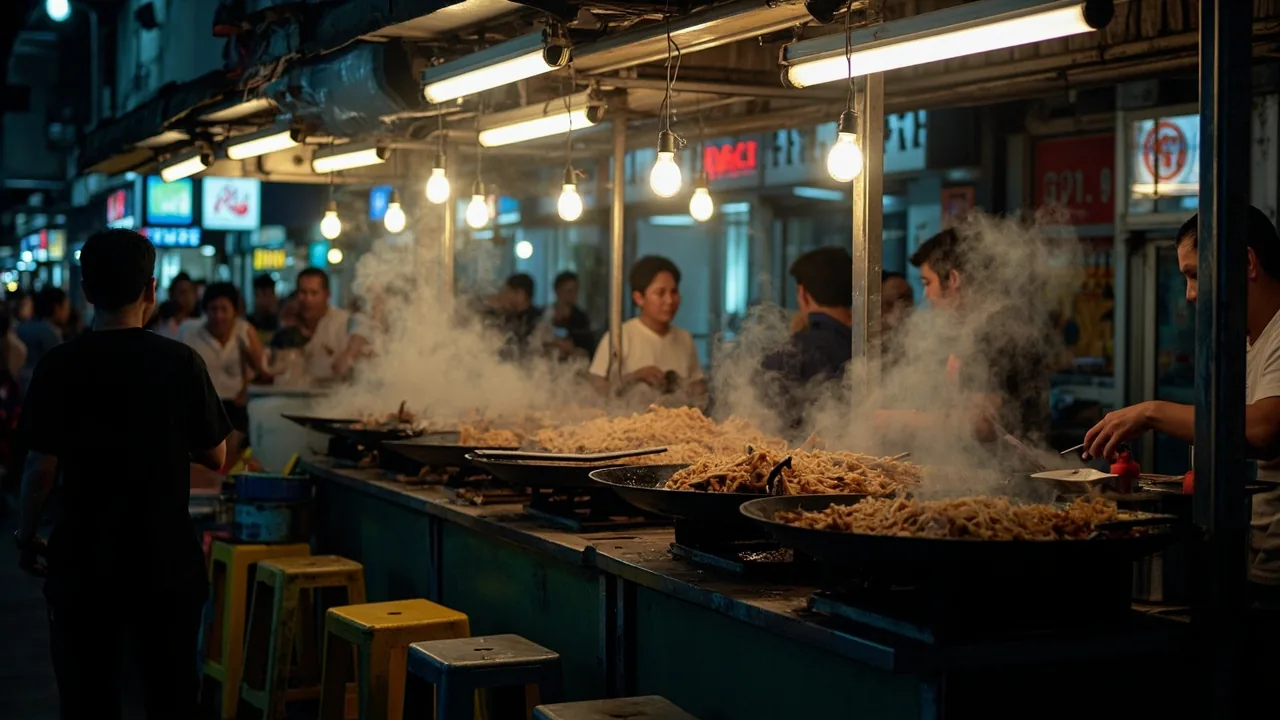
Bangkok Night Market Street Food: Where to Go, What to Eat, What It Costs
Bangkok is the night-market capital of Southeast Asia, and Bangkok’s night markets are where the city earns the hype, and our fact-checking team has verified every price and POI in this guide on the ground. Skip the mall food courts, skip the hotel breakfast buffets, and point yourself at Yaowarat, Jodd Fairs, or Rot Fai after sunset. The 2026 MICHELIN Guide Thailand Bib Gourmand list added seven new Bangkok street stalls in November 2025, and three of them sit in the same night markets you’ll be eating at anyway.
This article is built around a specific concern Indian travellers raise in my inbox constantly: “What if I get sick? What’s safe? And what do I eat if I’m vegetarian?” So below: the markets worth the BTS ride, the dishes to order at each, what each dish costs in baht and rupees, how to spot a clean stall, and the veg-friendly spots Jain travellers consistently recommend.
Quick Answers
| What | Answer | Price (INR) |
|---|---|---|
| Average street meal at a Bangkok night market | Pad thai, som tam, or grilled satay | ₹90-₹180 (~40-80 THB or ~$1.30-$2.40) |
| Cheapest MRT/BTS ride to a night market | BTS National Stadium to Siam (for MBK/Siam food court area) | ₹40 (~17 THB or ~$0.50) |
| 15-day tourist SIM with 15GB data | AIS or TrueMove tourist pack at 7-Eleven | ₹1,100 (~399 THB or ~$11.60) |
| Bangkok night market you should NOT skip | Yaowarat (Chinatown) | Free entry |
| Night market most likely to be a tourist trap | Asiatique The Riverfront (better as a photo stop) | Free entry |
Subodh’s Pro Tip: Yaowarat Road (Chinatown) after 7 PM is the single best street-food experience in Bangkok for first-time visitors. Take the MRT to Wat Mangkon (Blue Line, exit 1) and walk straight into the crowd.
Which Bangkok Night Markets Are Worth It
Bangkok has more night markets than days in a month. Some are genuine, some are full of factory-outlet T-shirts and 200-baht pad thai cooked at 4 PM and reheated. Here’s the honest ranking.
Yaowarat (Chinatown): The Essential One
This is where Bangkok’s street-food reputation was built, and it’s still the best. The main drag is Yaowarat Road, but the real action is in the side alleys: Soi 6, Soi 9, Soi 11. The crowd is dense, the plastic stools are tiny, the menus are in Thai and Chinese only, and the food is some of the best in the country.
The 2026 MICHELIN Guide Thailand Bib Gourmand list (the MICHELIN Guide’s award for “exceptionally good food at moderate prices,” distinct from MICHELIN stars) recognises multiple Chinatown stalls and shops that have been serving the same recipes for decades. You don’t need to know which ones carry the Bib Gourmand sticker; the ones with queues at 8 PM are usually them.
For Indian travellers, two warnings: pork and seafood dominate. Yaowarat is overwhelmingly Chinese-Thai, and Chinese-Thai street food leans heavily on pork belly, shrimp, crab, and oyster sauce. If you’re vegetarian, this is not your easiest market. We have a workaround in the veg section below.
Getting there: MRT Blue Line to Wat Mangkon station, exit 1. Walk three minutes. Total trip from Sukhumvit area is roughly 40 minutes and costs about ₹100 (~45 THB or ~$1.04) on BTS + MRT.
Jodd Fairs (Ratchathewi): The Tourist-Friendly Pick
Jodd Fairs at Ratchathewi (the newer one, not the old Rama 9 location that closed) is the most photogenic night market in Bangkok, with a giant disco ball, neon everywhere, and Instagram-ready food stalls. It’s also 30% more expensive than Yaowarat because of the tourist tax.
What it’s good for: first-timers who want a “safe” market experience (English menus, card payments accepted, clean tables), pad thai and grilled meats served in Instagrammable portions, and live music while you eat.
What it’s not: an authentic local experience. Half the stalls are franchise operations.
Getting there: BTS to Ratchathewi station, exit 3. Five-minute walk.
Rot Fai (Train Night Market Srinakarin): The Vintage One
Rot Fai Market at Srinakarin is the original Bangkok night-market experience before the gentrification wave. Vintage motorcycle parts, antique furniture, vinyl records, and a food zone that’s half local, half tourist. It’s further from the BTS, which is why it survives: only the people who know about it show up.
Worth it for: the actual food (some of the best grilled river prawns and tom yum in Bangkok), the vintage shopping if you collect anything, and the much-lower tourist density.
Skip if: you’re staying in Sukhumvit and don’t want to take a 25-minute taxi.
Getting there: BTS to On Nut, then taxi or songthaew. Or grab a motorbike taxi from On Nut, around ₹140 (~50 THB or ~$1.50).
Other Markets Worth Knowing
- Talad Rot Fai Ratchada (the old Ratchada location, sometimes still running): if it’s open, go. If it’s closed (it has had multiple shutdowns), don’t chase it.
- Khao San Road night food area: tourist-heavy, 30% markup, but convenient if you’re staying nearby and want pad thai at 11 PM.
- Asiatique The Riverfront: a riverside mall with food stalls, best as a photo stop or if you want air-conditioning. Not a “night market” in the authentic sense.
What to Eat at Bangkok Night Markets
These are the dishes that show up at nearly every major Bangkok night market and which to order. I’ve grouped them into meat/seafood and veg-friendly, since the latter is a real constraint for Indian travellers.
The Dishes Every Traveller Should Try
-
Pad thai (₹115-₹180 (~$1.19-$1.87), or ₹115-₹172 (~40-60 THB or ~$1.19-$1.79) at a stall, ₹230-₹287 (~80-100 THB or ~$2.38-$2.98) at a restaurant). Stir-fried rice noodles with egg, tamarind, fish sauce, peanuts, bean sprouts. Order it with chicken (gai) or prawns (goong). If you don’t see a wok on fire, walk away: stale pad thai is the most common street-food mistake. Book a Yaowarat street food tour if you want a guide to translate the menus.
-
Som tam (green papaya salad) (₹90-₹140 (~$0.93-$1.45), or ₹86-₹143 (~30-50 THB or ~$0.89-$1.49)). Spicy, sour, sweet, salty. Specify “mai phet” (not spicy) if you can’t handle heat. Comes with dried shrimp and peanuts, so strict vegetarians should skip it at most stalls, but a few all-veg stalls make it without the shrimp.
-
Mango sticky rice (khao niao mamuang) (₹115-₹140 (~$1.19-$1.45), or ₹115-₹143 (~40-50 THB or ~$1.19-$1.49)). The famous Thai dessert: sweet sticky rice with coconut milk and fresh mango. One of the few night-market dishes that is vegetarian and Indian-friendly. Travellers report this is what they remember most from Bangkok.
-
Grilled pork skewers (mu ping) and chicken skewers (gai ping) (₹30-₹45 (~$0.31-$0.47) per skewer, or ₹29-₹43 (~10-15 THB or ~$0.30-$0.45)). Marinated, grilled over charcoal, served with sticky rice. Buy 3-4 skewers, eat them standing up with the locals.
-
Tom yum goong (₹172-₹230 (~60-80 THB or ~$1.79-$2.38) at a stall, ₹574-₹861 (~200-300 THB or ~$5.96-$8.94) at a restaurant). Spicy prawn soup with lemongrass, galangal, kaffir lime. One of the most famous Thai dishes, and night-market stalls serve a perfectly good version for a third of the restaurant price.
Veg-Friendly Dishes and Stalls
This is the section Indian travellers ask about most. Strict-veg options at Thai night markets are limited but not zero.
-
Pad pak ruam (stir-fried mixed vegetables, ₹90-₹140 (~$0.93-$1.45), or ₹86-₹143 (~30-50 THB or ~$0.89-$1.49)). The default “I’m a vegetarian” dish at any Thai stall. Tell them “mai sai nam sai” (no fish sauce) and they’ll use soy sauce instead. The dish becomes 90% safe at most clean stalls.
-
Vegetable pad thai: available at any stall if you ask for “pad thai mai sai nuea, mai sai kung” (no meat, no shrimp). Most stalls will accommodate; some will charge the same price.
-
Mango sticky rice: see above. Vegetarian.
-
Jay (เจ) food stalls: during the annual Vegetarian Festival (typically September/October in Bangkok, dates set by the lunar calendar), dedicated “Jay” food stalls appear all over the city, and some persist year-round in Chinatown. Jay means strict vegetarian, often Buddhist vegan. The signage is yellow with red Thai script.
-
Fruit vendors: mango, pineapple, watermelon, dragon fruit, papaya, rambutan. All the fresh fruit you can carry, ₹60-₹180 (~$0.62-$1.87) per plate (₹57-₹172 (~20-60 THB or ~$0.60-$1.79)).
-
Indique (Sukhumvit Soi 22): When you’ve had enough adventure for one night and need a proper Indian meal, Indique serves North Indian fine dining at roughly ₹1,330 (~450 THB or ~$14) per person. The butter chicken gets consistent praise in traveller reviews. Book a Yaowarat street food tour the next morning and you’ll have earned it.
-
Amritsr Restaurant (Sukhumvit Soi 22): The dal-chawal-and-stuffed-paratha fallback. Travellers report ₹960-₹1,920 (~1,000-2,000 THB) per person for a thali. North Indian flavours, casual setting.
-
Shree Gangour Pure Veg Restaurant: One of the few strict-veg Indian spots in Bangkok. If you or someone in your group is Jain or strictly vegetarian, this is your safe bet.
Subodh’s Pro Tip: Tell the stall owner “Phom kin jay” (I’m vegetarian, pronounced “pom kin jay”) and they’ll steer you to the meat-free options. Most Thais understand this phrase because of the annual Vegetarian Festival.
How to Spot a Safe Stall (and Avoid a Sick Day)
Indian travellers worry most about Delhi-belly. Here’s the system travellers in our network have found reliable:
Pick stalls where the food is cooked to order. Wok hot, oil bubbling, charcoal glowing. Pre-cooked food sitting at room temperature is where the risk is. If the pad thai is sitting in a pile and a vendor is scooping it into takeaway boxes, walk past.
Look for high turnover. A busy stall at 8 PM has turned over hundreds of portions since 6 PM. Food hasn’t been sitting. The empty stall next door is not “peaceful,” it’s suspicious.
Watch the cook’s hands. Clean hands, no jewellery (rings trap bacteria), short nails. Most Thai street cooks wear gloves now; that’s a good sign.
Stick to cooked food your first three days. Raw papaya salad, raw oysters, anything sitting in sauce: skip it until your stomach has acclimatised. Day four, try the som tam.
Drink bottled or filtered water. Bangkok tap water is not safe for tourists. Bottled water at 7-Eleven is ₹20-₹29 (~7-10 THB).
Carry ORS. Even if you don’t use it, an electrolyte packet costs ₹30 (~$0.31) at a Bangkok 7-Eleven and saves a ruined day if things go sideways.
Skip the ice from unknown sources. Night markets generally use commercial ice, which is safe. If you’re paranoid, ask for “mai sai nam keng” (no ice).
Safety Alert: If you have dietary restrictions (severe peanut allergy, gluten-free, strict vegan), learn the Thai words before you go. “Chan mai kin thua lisong” (I don’t eat peanuts) and “mai kin nuea” (I don’t eat meat) cover most situations.
Michelin Bib Gourmand Bangkok Street Food: What’s Worth the Detour
The MICHELIN Guide Thailand 2026 edition recognises over 200 restaurants in Bangkok across all tiers, but the Bib Gourmand category is the one Indian travellers should care about: these are specific street stalls and shophops serving excellent food at moderate prices, the MICHELIN Guide’s distinction for “exceptionally good food at moderate prices,” separate from the starred categories. The list was updated in November 2025 and reaffirmed in the 2026 edition.
Three patterns to know:
-
Chinatown (Yaowarat) dominates. Of the 200+ Bib Gourmand Bangkok entries, roughly a third sit in or adjacent to Yaowarat. If you’re doing one night market, do Yaowarat, and you’ll be eating at Bib Gourmand level without realising it.
-
The distinction is “moderate prices.” Bib Gourmand spots in Bangkok typically charge ₹230-₹689 (~80-240 THB or ~$2.38-$7.15) per dish. Most street stalls fall below this. Restaurant Bib Gourmands sit at the upper end.
-
Look for the sticker. Bib Gourmand venues display the red Bib Gourmand sticker. If a stall has it, you know it’s been visited and vetted by a MICHELIN inspector.
For practical purposes, you don’t need to hunt the Bib Gourmand list specifically. Eat at the stalls with the longest queues in Yaowarat, Ratchathewi, or Chinatown. The Bib Gourmand inspectors are following the same logic.
If you want a curated introduction rather than self-navigation: Book a Chinatown Bangkok (Yaowarat) tour and let a local guide point you at the recognised stalls.
Where to Stay
For night-market access, you want either Khao San Road (walk to multiple markets, including Yaowarat via short tuk-tuk) or Sukhumvit/Siam (BTS access to Jodd Fairs, Ratchathewi, and the BTS-only markets).
| Hostel / Guesthouse | Cost/night | Vibe | Book Here |
|---|---|---|---|
| Mad Monkey Bangkok | 580-900 INR (~250-390 THB) | Party hostel, rooftop bar, walking distance to Khao San night markets | Check prices |
| Nomads Bangkok Khao San Road Hostel | 580-900 INR (~250-390 THB) | Central Khao San, easy walk to night food stalls | Check prices |
| Hide Bangkok Hostel | 580-900 INR (~250-390 THB) | Quieter hostel, BTS access to Jodd Fairs and Ratchathewi | Check prices |
| Line Bangkok Hostel | 580-900 INR (~250-390 THB) | Clean dorms, near BTS, good for first-time visitors | Check prices |
| Once Again Hostel | 580-900 INR (~250-390 THB) | Budget-friendly, social common areas | Check prices |
| Revolution Khao San by The Bliss | 580-900 INR (~250-390 THB) | Central Khao San location, modern dorms | Check prices |
| Subodh’s pick: If night markets are your priority, stay in Khao San. Nomads Bangkok Khao San Road Hostel puts you in walking distance of Yaowarat (15-minute walk or 60-baht tuk-tuk) and surrounded by late-night food stalls. If you prefer quieter and BTS access, Hide Bangkok Hostel. |
Getting Connected
A working SIM is non-negotiable for navigating Bangkok at night. The BTS and MRT close around midnight, after which you’re in Grab/bolt territory and need data.
Physical SIM (cheapest): AIS or TrueMove tourist SIM, 15 days, 15GB data, ₹1,100 (~399 THB or ~$11.60). Available at Suvarnabhumi Airport on arrival (look for the AIS/TrueMove counters before you exit the terminal, prices are fixed) or any 7-Eleven. Bring your passport; they need to register the SIM.
eSIM (easiest): Get Nomad eSIM and activate before you fly. No passport needed, no airport counter queue, instant data on landing. Slightly more expensive than a physical SIM but worth it if you arrive late at night.
WiFi at hostels: patchy. Most Bangkok hostels offer free WiFi in common areas but the signal rarely reaches the dorm rooms. Get a SIM.
Daily Budget Breakdown
Verified 2026-07-16 at 1 INR = 0.3485 THB (1 THB = ₹2.8691).
This is what travellers in our network report spending on a Bangkok night-market-focused day, not what travel blogs round up.
| Category | Budget/day |
|---|---|
| Dorm bed | 580-900 INR (~250-390 THB) |
| Food (3 meals, mostly night market) | 450-700 INR (~150-250 THB) |
| Local transport (BTS/MRT + occasional tuk-tuk) | 200-340 INR (~70-120 THB) |
| Activities (one paid attraction) | 700-1,200 INR (~250-420 THB) |
| Misc / drinks | 200-340 INR (~70-120 THB) |
| Total | 2,130-3,480 INR (~750-1,300 THB) |
Where to Go from Here
If you’ve eaten your way through Bangkok’s night markets and want to extend the Thai food trail:
| Destination | Mode | Duration | Price | Book |
|---|---|---|---|---|
| Phuket | flight | ~1h 20m | from ~₹2,900 (~1,000 THB or ~$30) | Book on 12go |
| Krabi | flight | ~1h 15m | from ~₹2,600 (~900 THB or ~$27) | Book on 12go |
| Koh Phangan | flight | ~1h 15m | from ~₹3,200 (~1,100 THB or ~$33) | Book on 12go |
| Chiang Mai | flight | ~1h 10m | from ~₹2,300 (~800 THB or ~$24) | Book on 12go |
| Kuala Lumpur | flight | ~2h 10m | from ~₹5,000 (~1,750 THB or ~$52) | Book on 12go |
| Phnom Penh | flight | ~1h 15m | from ~₹4,200 (~1,450 THB or ~$43) | Book on 12go |
| Vientiane | train | 11h 23m | ~₹960 (~334 THB or ~$10) | Book on 12go |
The Bangkok-to-Chiang Mai overland route is the most popular Southeast Asia backpacker corridor and worth doing if you have 3-5 days.
Common Mistakes Indian Travellers Make in Bangkok
Mistake 1: Going to Khao San Road for “Thai food.” Khao San is a backpacker bubble, and the food there is 30-50% marked up versus what locals eat. If you want the real deal, take a 60-baht tuk-tuk to Yaowarat.
Mistake 2: Eating at the first stall you see at the market. The stall at the entrance pays the highest rent, so they charge the highest prices and have the most captive tourist trade. Walk 50 metres in, where the locals are eating.
Mistake 3: Ordering “Thai spicy” without specifying. Thai spicy will end your meal and possibly your night. “Pet nit noi” (a little spicy) is the default setting you want. “Mai phet” means no spice. “Pet mak” means spicy.
Mistake 4: Drinking tap water. Bangkok’s tap water is technically treated but not safe for tourists. Stick to bottled water (₹20-₹29 (~7-10 THB) at any 7-Eleven) and you’ll avoid 80% of stomach issues.
Mistake 5: Taking an unmetered taxi from the airport. Always insist on the meter, or use Grab/Bolt. Airport taxi touts quote ₹1,500 (~$15.57) for a trip that should cost ₹600 (~$6.23).
Visa Notes for Indian Travellers
Most Indians now use the Thailand-India bilateral visa-free agreement, valid for 60 days (extendable once for another 30 days at the immigration office, fee ₹5,394 (~56 USD)). Your passport must have at least 6 months validity.
Before you fly, complete the TDAC (Thailand Digital Arrival Card) at the official portal: https://tdac.immigration.go.th. It is mandatory for all arrival types (visa-free, VoA, e-Visa), free, and takes under five minutes. You’ll get a QR code to show at immigration.
VoA (visa on arrival) at ₹5,587 (~58 USD) is 15 days only and not worth it for Indians since the bilateral visa-free option exists. Tourist visas from a Thai embassy are ₹7,225 (~75 USD) for 60 days single entry. Most Indians skip this and fly in visa-free.
For full Thailand entry details, see our Bangkok entry guide.
FAQ
Is Bangkok night-market street food safe for first-time visitors? Yes, with two rules: eat at stalls where the food is cooked in front of you to order, and pick stalls with high turnover (long queues, busy cooks). Avoid anything that’s been sitting out at room temperature. Most traveller stomach issues come from raw food or unrefrigerated dairy, not from the cooked stuff.
I’m vegetarian. Can I eat at Bangkok night markets? Limited but workable. Mango sticky rice, fruit, stir-fried vegetables, and pad thai ordered without meat are available at most major markets. For guaranteed strict-veg options, head to Shree Gangour Pure Veg Restaurant in Bangkok or eat at Jay stalls during Vegetarian Festival (September/October, dates vary).
Which is the best Bangkok night market for street food? Yaowarat (Chinatown) for variety and quality, Jodd Fairs for first-timers who want English menus and card payments, Rot Fai Srinakarin for the local experience. Asiatique is better for photos than food.
How do I get to Yaowarat by BTS or MRT? MRT Blue Line to Wat Mangkon station, exit 1, then a 3-minute walk. From Sukhumvit, take the BTS to Asok, transfer to the MRT at Sukhumvit station (the same complex), and ride to Wat Mangkon. About 40 minutes total, around ₹100 (~45 THB or ~$1.04).
Are Bangkok night markets safe at night for women? Generally yes. Yaowarat, Jodd Fairs, and Rot Fai are crowded until at least 10 PM. Standard precautions: keep your bag zipped and in front of you, don’t walk down empty soi (side streets) alone at 1 AM, and use Grab/Bolt rather than hailing random motorbike taxis late at night. For more, see Solo female safety tips for Thailand.
Do Bangkok night markets accept UPI or Indian payment apps? No. Cash (Thai baht) is king at night markets. Some Jodd Fairs stalls accept cards but most do not. Carry ₹1,000-₹2,000 (~$10.38-$20.76) worth of baht in small notes for one night out. Withdraw from an ATM (use the ones attached to banks, not standalone ones in 7-Elevens) or change money at SuperRich exchange in town.
Is there a Michelin-starred street food stall in Bangkok? The 2026 MICHELIN Guide Thailand Bib Gourmand list recognises dozens of Bangkok street stalls, but full MICHELIN stars in Bangkok go to restaurants, not stalls. Raan Jay Fai is the famous exception. For practical purposes, the Bib Gourmand distinction is the relevant one for street food, and Yaowarat alone has many recognised entries.
Subodh’s Take
Bangkok night markets are the best first-night activity for any Indian backpacker landing in Thailand. They’re cheap, they’re crowded, they work with any budget, and they ease you into the Thai street-food system without overwhelming you. Eat at Yaowarat on your second night, not your first. On night one, go to Jodd Fairs for the easy English menus and tourist-friendly vibe. On night two, level up to Chinatown with a few Thai phrases ready. By night three you’ll be ordering off the Thai-only menu and gesturing at the next stall over.
