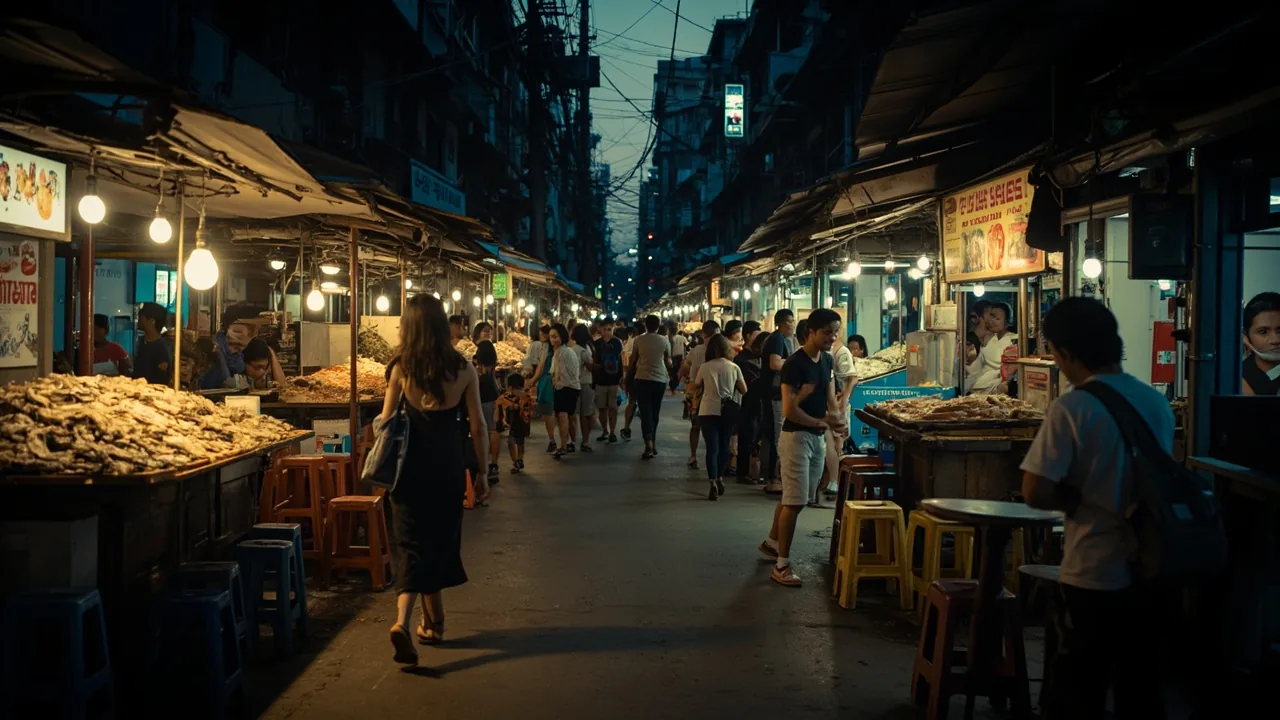
Bangkok’s Best Sea-Foodie Night Markets: A Bangkok Food Guide for Indian Travelers
The most famous night market in Bangkok for food is Yaowarat (Chinatown), followed by Pratunam (for shopping plus snacks) and the train markets (for the spectacle). Yaowarat wins on pure food density: a few hundred metres of street, 200+ stalls, open roughly 5 PM to 1 AM, and almost everything you point at is edible. Most Bangkok night markets run from around 5 PM to midnight, with Yaowarat going latest. Planning the wider region? Our Southeast Asia backpacking hub covers the full multi-country route.
This guide ranks the four markets Indian backpackers use, gives you the opening hours for each, tells you which one is worth a detour, and flags the stalls that work for vegetarians.
Quick Answers
| What | Answer | Price (INR) |
|---|---|---|
| Most famous night market in Bangkok | Yaowarat (Chinatown) | , |
| Best for shopping + street food | Pratunam / Platinum Fashion Mall area | , |
| Best for the “experience” photo | Rot Fai (train market) | , |
| Typical night market hours | 5 PM to midnight (Yaowarat runs to 1 AM) | , |
| Average meal at a stall | ₹172-₹431 (~60-150 THB or ~$1.79-$4.47) | 60 to 150 |
| Seafood plate at Yaowarat | ₹718-₹1,723 (~250-600 THB or ~$7.45-$17.87) | 250 to 600 |
| Going rate for a tuk-tuk from Khao San | ₹431 (~150 THB or ~$4.47) | 150 |
| Metro/BTS from Sukhumvit to Yaowarat | ₹115-₹144 (~40-50 THB or ~$1.19-$1.49) | 40 to 50 |
| Best strict-veg Indian fallback | Shree Gangour / Indique | , |
The Bangkok Night Markets, Ranked for Indian Travelers
1. Yaowarat (Chinatown), the seafood street at night in Bangkok
Yaowarat is the answer most Thai locals will give you if you ask where to eat at night. The main drag is a few hundred metres of road that closes to traffic around dusk and fills with hawker stalls on both sides, plus shophouses upstairs that have been running for generations.
What to eat:
- Guay tiew kua gai (charred chicken noodles) at T&K Seafood. A bowl runs ₹172-₹287 (~60-100 THB or ~$1.79-$2.98).
- Hoy tod (oyster omelette) at any of the oyster stalls near the intersection of Yaowarat and Charoen Krung. About ₹431-₹718 (~150-250 THB or ~$4.47-$7.45) for a small pan.
- Hoi kraeng (grilled shellfish, mussels and clams with garlic and peppercorn). The big plates run ₹718-₹1,723 (~250-600 THB or ~$7.45-$17.87) and feed two.
- Khao mun gai tod (crispy fried chicken with rice) at any of the rice-and-chicken stalls, ₹230-₹345 (~80-120 THB or ~$2.38-$3.57).
- Mango sticky rice for dessert. ₹230-₹345 (~80-120 THB or ~$2.38-$3.57). The version with warm coconut cream poured tableside is the move.
- Bird’s nest soup if you’re feeling fancy. Skip it.
Vegetarian reality check: Yaowarat is a meat-and-seafood street. Strict veg travellers will struggle here. The stalls have separate veg sections (jay means vegan/vegetarian in Thai), and you can point at the vegetables and tofu in soy sauce on most stir-fry grills, but it’s not the place to be choosy. Bring snacks or eat at Shree Gangour before you go.
Hours: roughly 5 PM to 1 AM. Sunday through Wednesday is quieter; Thursday through Saturday is a shoulder-to-shoulder crush.
How to get there: MRT to Wat Mangkon (Sam Yaek) station, exit 2. You’ll pop up about 100 metres from the action. From Sukhumvit it’s two trains and 40 minutes.
You can also book a guided Chinatown food walk if you’d rather have someone translate the menu for you.
2. Pratunam + Platinum Fashion Mall area, the shopping night market
Pratunam is technically a wholesale garment market by day and a shopping-and-snack zone by night. The night market element is a stretch of stalls around Baiyoke Tower and the Indra Square pedestrian mall, plus the Platinum Fashion Mall which stays open until around 8 or 9 PM (the food stalls around it run later).
What it’s good for:
- Cheap clothes, knock-off sneakers, phone cases. Bargain hard: start at 40% of the asking price and walk away once if they don’t come down.
- Snacks: grilled squid on a stick, banana roti (Indian-influenced fried bread with condensed milk, ₹115-₹230 (~40-80 THB or ~$1.19-$2.38)), coconut ice cream in a coconut shell (₹144-₹230 (~50-80 THB or ~$1.49-$2.38)), fresh fruit smoothies (₹115-₹201 (~40-70 THB or ~$1.19-$2.09)).
What it’s not good for: serious Thai food. This is snack territory.
Hours: 6 PM to around midnight. The mall closes earlier; the surrounding stalls go later.
How to get there: BTS to Chit Lom, walk 10 minutes. Or BTS to Ratchathewi, exit the back side.
3. Rot Fai (the train markets), the photo night market
There are two: Srinakarin Rot Fai and the original Ratchada Rot Fai. Ratchada (next to the Esplanade mall, MRT Huai Khwang) is more tourist-friendly and easier to reach.
Rot Fai is more about the vibe than the food. Antiques, vintage clothes, vinyl, weird taxidermy, plus a beer garden and a half-decent food court. The food is fine but not the main draw.
Hours: Thursday to Sunday, 5 PM to midnight.
How to get there: MRT to Huai Khwang, exit 3, walk 5 minutes.
4. Chatuchak Weekend Market, daytime, but worth knowing
Chatuchak is technically a day market (around 9 AM to 6 PM on Saturdays and Sundays), but a lot of the surrounding area runs stalls into the evening, and there’s a smaller Friday-night night market section near the Or Tor Kor side. If your schedule is already full on weekday nights, the Saturday Chatuchak + Saturday night Chatuchak area combo is solid.
Why it makes this list: Indian travellers who can only plan a Bangkok weekend trip ask which market is “the big one.” Chatuchak is it for shopping. Don’t expect the food intensity of Yaowarat, but the coconut ice cream and the pad thai are solid.
Step-by-Step: A Bangkok Night-Market Evening Plan
If you’ve got one night, do this:
- Eat early dinner at 6 PM at an Indian restaurant. Seriously. Get your dal-chawal fix at Shree Gangour or Indique first. You’ll thank me when you’re elbowing through Yaowarat two hours later and don’t have to worry about finding veg food.
- MRT to Wat Mangkon (Sam Yaek) at 7:30 PM. The crowds peak around 8 to 10 PM; arriving on the early side lets you walk without being pushed.
- Walk the length of Yaowarat twice. Once up the east side, once down the west side. Each side has its own famous stalls.
- Pick one seafood stall and commit. The prices are similar across them, so just pick the one with the shortest line of locals. Point at the live prawns or the clams; they’ll quote you by weight.
- Skip the bird’s nest and shark fin. Overpriced, often mislabelled, and not what you’re here for.
- Mango sticky rice at the end of the night. It tastes better as a second dessert, walk it off, then come back.
- MRT or taxi back. Do not tuk-tuk. From Yaowarat back to Sukhumvit is ₹431-₹574 (~150-200 THB or ~$4.47-$5.96) by Grab. Tuk-tuks will quote you ₹1,149 (~400 THB or ~$11.91) and the tuk-tuk scams around Chinatown are a known thing.
Total spend for one person, eating a full seafood dinner with two drinks: ₹1,723-₹3,446 (~600-1,200 THB or ~$17.87-$35.74).
Bangkok Night Market Time. Hours Cheat Sheet
| Market | Days | Hours | Best for |
|---|---|---|---|
| Yaowarat (Chinatown) | Daily | 5 PM to 1 AM | Food |
| Pratunam night stalls | Daily | 6 PM to midnight | Shopping + snacks |
| Rot Fai Ratchada | Thu to Sun | 5 PM to midnight | Vibe + photos |
| Chatuchak Weekend | Sat and Sun | 9 AM to 6 PM (some stalls later) | Shopping + daytime food |
If you’re in Bangkok only on weekday nights, Yaowarat is the one.
What to Eat at Bangkok Night Markets. A Vegetarian-Friendly Walkthrough
This is the section Indian travellers need. Most Thai street food is fish sauce, oyster sauce, or shrimp paste. Almost every stir-fry has anchovies in the base. You cannot always order “no fish sauce” and have the stall understand it.
Strict-veg strategy:
- Learn two words: “jay” (เจ) means vegetarian/vegan, “mai sai nam pla” (ไม่ใส่น้ำปลา) means no fish sauce. Say both.
- Look for the yellow flags with red writing. Stalls displaying these are explicitly vegetarian. They’re scattered around Yaowarat but not on every corner.
- Eat at one of the Indian places first as your real meal, then walk the markets with a coconut ice cream in hand and a couple of grilled bananas in your stomach. That’s the move most Indian travellers settle into by night two.
- Indique for fine-dining Indian. About ₹1,350 (~14 USD) per person, butter chicken is the bestseller, sit-down with air conditioning. Worth it for one night if you’ve been eating pad thai for a week.
- Amritsr Restaurant Sukhumvit Soi 22 for North Indian. Stuffed parathas are the signature, casual, ₹2,872-₹5,743 (~1,000-2,000 THB or ~$29.79-$59.57) per person.
- Shree Gangour for pure veg. The name says it.
Non-veg / everything-goes strategy:
- Guay tiew kua gai (charred chicken noodles)
- Pad kra pao moo (basil pork with fried egg)
- Hoy tod (oyster omelette)
- Hoi kraeng (grilled shellfish)
- Khao mun gai tod (crispy chicken with rice)
- Moo ping (grilled pork skewers, ₹29-₹57 (~10-20 THB or ~$0.30-$0.60) each)
- Grilled river prawns at the seafood stalls (ask for the price per 100g before they cook, not after)
- Mango sticky rice
- Kluay tod (fried bananas)
Common Mistakes Indians Make at Bangkok Night Markets
-
Trusting the first price on a seafood stall. Vendors at Yaowarat will quote you per piece for prawns and clams if you let them. Always ask “tao rai?” (how much?) for the whole plate before you say yes. Travellers report being charged ₹5,743 (~2,000 THB or ~$59.57) for prawns they assumed were ₹1,723 (~600 THB or ~$17.87).
-
Going to Yaowarat on a Friday night expecting to walk through it. Friday and Saturday, 9 to 11 PM, it is genuinely shoulder-to-shoulder. If you have a choice, go on a Tuesday or Wednesday.
-
Trusting tuk-tuk drivers who offer to “take you to the night market, only 20 baht.” This is the classic Bangkok tuk-tuk scam. You’ll end up at a tailor shop or a gem stall. Walk to the BTS, take the MRT. It costs ₹115 (~40 THB or ~$1.19) and you go where you intended.
-
Buying bird’s nest soup or shark fin. Both are overpriced tourist traps in Bangkok’s night market area. Genuine bird’s nest costs 10,000+ THB per bowl at proper Chinese-medicine shops, not ₹1,436 (~500 THB or ~$14.89) on the street. What you’ll get at ₹1,436 (~500 THB or ~$14.89) is sugar water.
-
Drinking the tap water in fruit shakes. The fruit is fine. The ice from street vendors in central Bangkok is generally fine. The “fresh fruit shake” from a push-cart that hasn’t been washed in a week is a gamble. Stick to stalls with running water.
-
Walking through the market eating, then sitting down at a “tourist seafood” restaurant near the entrance. These places mark the menu in English, charge 3x the local rate, and the food is no better than the stall food. Eat where the locals are sitting on plastic stools.
What Most Guides Don’t Tell You
The Yaowarat side streets are where the best food is. The main road gets all the tourists. The side alleys (Soi Texas, Soi Phadungdao, Soi Worachak) have the old-school stalls that the tourist guides don’t list. Walk one block off the main drag and you’ll see what the Bangkok locals eat at night.
Most “Bangkok night market” lists on travel blogs are written by people who visited one market and called it a day. The reality is Bangkok has dozens of small neighbourhood markets (Talad Rot Fai, Talad Phlu, the Khlong Lat Mayom floating market) that tourists never see. If you’ve got a second night, ask your hostel staff which market is on in your neighbourhood that week.
The seafood is not “cheap” the way it was five years ago. A plate of grilled prawns at Yaowarat in 2026 runs ₹1,149-₹2,297 (~400-800 THB or ~$11.91-$23.83) for a portion that feeds two. Compare that to a pad thai at ₹172 (~60 THB or ~$1.79). Bangkok has gotten more expensive across the board, and the seafood stalls are no longer the bargain they once were.
The Rot Fai Ratchada market has been sold and partially relocated. Several of the original vintage stalls have moved. Check the current operator’s Facebook page before you go if a specific stall is on your list.
FAQ
What is the most famous night market in Bangkok?
Yaowarat (Chinatown). It’s the answer 9 out of 10 Thai locals will give, and the answer in any food blog written by someone who has been to more than one Bangkok market.
What time do Bangkok night markets open?
Most open around 5 PM and close between midnight and 1 AM. Yaowarat runs latest. The day markets like Chatuchak open around 9 AM and are not night markets.
Which is better, Pratunam or Chatuchak?
Different markets for different purposes. Pratunam is for clothing and quick snacks, open every evening. Chatuchak is for everything (clothes, plants, antiques, ceramics, food), but only Saturday and Sunday, and only during the day. If you want to shop, go to Chatuchak on Saturday. If you want to shop AND eat, do Chatuchak Saturday afternoon plus Yaowarat Saturday night.
Is Bangkok safe at night for Indian travelers?
Yes, in the tourist areas (Yaowarat, Pratunam, Sukhumvit, Silom, Khao San) you’ll be fine. Standard precautions: keep your phone in your front pocket in the crowds at Yaowarat, don’t flash cash at the gem stalls, and use Grab instead of hailing a tuk-tuk for anything longer than 2 km. For current advisories before you fly, check the Indian Ministry of External Affairs travel page at mea.gov.in.
What is the best street at night in Bangkok?
Yaowarat Road between Charoen Krung and the Wat Traimit area. About 800 metres of food stalls, all open at the same time. Walking the full stretch, eating as you go, takes two to three hours.
Can I use UPI in Bangkok night markets?
Some larger restaurants and malls accept UPI through Indian bank tie-ups (HDFC, ICICI, Axis). Street stalls are cash-only. Carry Thai baht, in small notes. ₹287 (~100 THB or ~$2.98) and ₹1,436 (~500 THB or ~$14.89) notes are the most useful sizes at night markets. For forex, see the carry-money-india-abroad guide.
Is there vegetarian Indian food at Bangkok night markets?
Not really, which is why this guide covers the Indian restaurants in the vegetarian-friendly section above. Eat Indian first, then go to the market for snacks and the experience.
Connectivity: SIM and eSIM
You’ll want Google Maps running in Bangkok at night. Bangkok’s street numbering is genuinely hard, and the markets are easier to navigate with the pin dropped. Buy a SIM at the airport (AIS or TrueMove, 8-day tourist SIM around ₹859 (~299 THB or ~$8.91)) or skip the queue with an eSIM from Nomad that activates before you fly.
Daily Budget Reality
For one person, one Bangkok night out at the markets:
- Transport (MRT return): ₹230-₹287 (~80-100 THB or ~$2.38-$2.98)
- Seafood dinner at a Yaowarat stall: ₹1,149-₹2,297 (~400-800 THB or ~$11.91-$23.83)
- One drink: ₹172-₹431 (~60-150 THB or ~$1.79-$4.47)
- Mango sticky rice: ₹230-₹345 (~80-120 THB or ~$2.38-$3.57)
- Buffer for “one more thing”: 200 THB
Total: 820-1,370 THB. At current rates (1 THB ≈ ₹2.87), that’s about ₹2,350 to ₹3,930.
For a fuller Bangkok daily budget breakdown, see the main guide, and check the average daily spend in Thailand for context.
Subodh’s Take
Yaowarat is the answer. Every other night market in Bangkok is good, but none of them are Yaowarat. Go on a Tuesday, eat the seafood, skip the bird’s nest, take the MRT home. That’s the whole Bangkok night-market game, and you don’t need a tour guide to play it. If you want a second night, add Rot Fai Ratchada for the photos, but the food is the Chinatown street, full stop.