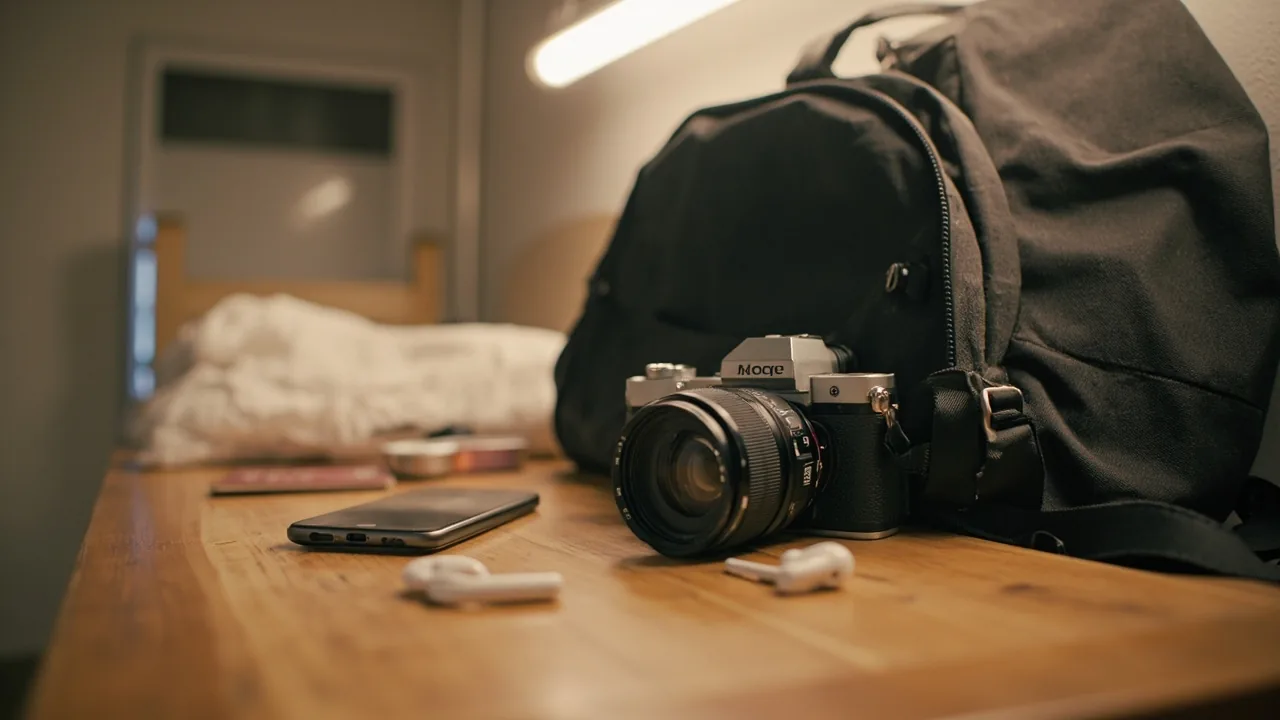
Best Cameras for Southeast Asia Travel: 2026 Gear Guide for Indian Backpackers
If you’ve spent ten minutes scrolling Instagram reels set in Pai or Hoi An, you’ve already felt the gear envy. The honest truth: most of that footage was shot on a phone, and the best camera for travel India backpackers can carry is the one that doesn’t slow them down on a sleeper bus. This guide is built around real conditions on the ground across Southeast Asia: monsoon humidity that fogs lenses, beach sand that kills ports, tuk-tuk rides that shake every frame, and night markets where autofocus either locks or fails. For related planning, see our guides on Sea Backpacking Hub and Airtel International Roaming Thailand Plans Review.
Quick Answers
| What | Answer | Price (INR) |
|---|---|---|
| Best camera overall for SEA backpackers | Smartphone you already own (iPhone 13+/Samsung S22+/Pixel 7+) | ₹0 (already have it) |
| Best dedicated camera under ₹50,000 (~$517.98) | Sony ZV-1 or Canon G7X III (used) | ₹38,000 (~$393.66) to ₹48,000 (~$497.26) |
| Best action camera for beaches/scooters | GoPro Hero 12 (or Hero 11 if on sale) | ₹30,000 (~$310.79) to ₹35,000 (~$362.59) |
| Best vlogging/handheld setup | DJI Osmo Pocket 3 | ₹48,000 (~$497.26) to ₹52,000 (~$538.70) |
| Tripod budget | Manfrotto Befree or lightweight GorillaPod | ₹3,000 (~$31.08) to ₹6,500 |
Quick frame for budget thinking: 1 USD = ₹96.5289 right now, so a ₹50,000 camera is roughly ₹50,195 (~520 USD). Most cameras here are cheaper to buy in Bangkok’s Pantip Plaza or Singapore’s Sim Lim Square than in India, after factoring GST, but warranty and after-sales service often tilt the decision back home.
Why The “Best Camera” Question Is Mostly Wrong
The right question isn’t “what’s the best camera for travel India shoppers.” It’s “what’s the best camera for the way I shoot.” A solo traveller doing 14 countries in 6 months has different needs from a content creator running a reel business. SEA is also a specific test: heat, dust, monsoon rain, low light in temple interiors, bright harsh sun on the beaches of Koh Tao or Phu Quoc, plus the constant threat of theft from open scooter bags.
Three real conditions shape every gear decision in this region:
- Humidity and dust. Lenses fog going from air-con hostels to 35°C streets. Sensor dust from scooter rides is a quiet killer. Weather-sealed bodies help; cheap kit lenses with extending barrels don’t.
- Weight on a sleeper bus. A 1.2 kg mirrorless with two lenses plus a tripod, gimbal, and laptop is a 6 kg carry burden. Most backpackers hit the wall at day 6 and stop carrying the second lens.
- Theft risk in tourist zones. Khao San, Pub Street, and Walking Street hostels all have stories. The camera that gets stolen is the obvious one. A small G7X in a pocket disappears less often than a Sony A7C with a 24-70 hanging off your neck.
The Three Tiers Of Camera Choice For SEA
Tier 1: Your Smartphone (Zero Extra Gear)
This is the answer for 70% of you. Phones since 2021 shoot 4K video, RAW photos, have computational night mode, and slip in a pocket. For solo travellers posting reels, making memories, or building any kind of casual social presence, a phone is enough.
What works:
- iPhone 13 and newer for video, especially Cinematic Mode and Action Mode.
- Samsung S22+ and newer for the 10x optical on the Ultra trims.
- Pixel 7+ for night photography that embarrasses point-and-shoots.
What a phone won’t do well:
- Long zoom (concert-style shots at Doi Suthep from the viewpoint).
- Shallow depth-of-field portraits with creamy bokeh.
- Low-light video without grain in dim temples.
The practical move for most Indian backpackers heading to SEA: spend your camera budget on accessories for the phone. A DJI OM series gimbal (₹8,000 (~$82.88) to ₹12,000 (~$124.32)), a clip-on wide/macro lens (₹2,000 (~$20.72)), a small tripod (₹1,500 (~$15.54)), and a solid case. Total spend under ₹20,000 (~$207.19) and you’re set for 90% of trip content.
Tier 2: Premium Compact (The Sweet Spot For Most Backpackers)
If you want noticeably better photos than a phone, but refuse to carry a camera bag, this is the tier. Premium 1-inch sensor compacts fit in a jeans pocket and outperform every phone in low light.
Top three picks for 2026:
- Sony ZV-1 / ZV-1 II, the vlogging king. Flip screen, great mic, 1-inch sensor, fast autofocus. Used ZV-1s hover around ₹30,000 (~$310.79), new ZV-1 II around ₹48,000 (~$497.26). Best for solo travellers who talk to the camera.
- Canon G7X III, the influencer favourite. Same 1-inch sensor class, slightly better JPEG colours out of camera, less video frills. Used market in India is flooded at ₹35,000 (~$362.59) to ₹42,000 (~$435.10).
- Ricoh GR III / GR IIIx, the street photographer’s pick. APS-C sensor in a pocketable body. No video chops, but photos from this thing punch two tiers above its weight. ₹55,000 (~$569.78) to ₹70,000 (~$725.17) new, ₹40,000 (~$414.38) used.
Subodh’s Pro Tip: Buy these used from India itself, not from SEA. Bangkok’s camera market is great but you don’t have a warranty address, and the moment you cross back through Indian customs, you’ll get hit with customs duty anyway if it’s not on your person at arrival. Used prices on OLX or from Cloudynest in Bangalore are 30% cheaper than SEA grey market after you add the 18% GST differential.
Tier 3: Mirrorless or Action Camera (For Specific Missions)
Pick this tier only if your shooting mission is clear.
Mirrorless (Sony A6700, Fujifilm X-S20, Canon R50) is for someone who wants to learn photography seriously, plans to print, or shoots in RAW for editing. The trade-off is weight: a body plus 18-135mm plus a 35mm f/1.8 plus a tripod is 2 kg minimum. By day 9 in Luang Prabang, you’ll leave the tripod at the hostel.
Action cameras (GoPro Hero 12, DJI Action 4, Insta360 X4) make sense for specific cases: scooter rides in Ha Giang, diving in Koh Tao, surfing in Siargao, POV trekking. The 360 cams in particular shine for travel because you reframe later in software, so a single mount on a helmet gives you every angle.
DJI Osmo Pocket 3 sits in its own category: a gimbal-stabilised camera with a 1-inch sensor. Vloggers swear by it. The catch is that the gimbal head attracts attention in tourist areas, and the small accessories ecosystem means losing the charging case (₹4,000 (~$41.44) to replace) ends the trip’s filming.
| Type | Best For | Weight | Price Range |
|---|---|---|---|
| Smartphone + gimbal | Most backpackers, solo travellers | ~250g total | ₹8,000 (~$82.88) to ₹15,000 (~$155.39) |
| Premium compact (ZV-1, G7X, GR) | Better-than-phone without bulk | 300g | ₹30,000 (~$310.79) to ₹55,000 (~$569.78) |
| Mirrorless + 2 lenses | Serious photo learning | 1.2 to 1.8 kg | ₹120,000 (~$1,243.15) to ₹200,000 (~$2,071.92) |
| Action cam (GoPro/DJI) | Adventure POV, diving | 150g | ₹28,000 (~$290.07) to ₹45,000 (~$466.18) |
| Pocket gimbal (Pocket 3) | Vlogging, smooth walking shots | 180g | ₹48,000 (~$497.26) to ₹52,000 (~$538.70) |
What To Buy In India Before You Fly
Sourcing matters because you’ll either overpay in SEA or get stung by customs on the way back.
Bought cheaper in India:
- Any phone (after GST the price is competitive).
- Mirrorless bodies under ₹150,000 (~$1,553.94).
- Tripods, gimbals, memory cards, cleaning kits.
- UV/CPL filters from Indian brands like Marumi or Hoya via Amazon India.
cheaper in SEA (mostly Bangkok’s Pantip Plaza or Singapore):
- High-end mirrorless lenses (24-70 f/2.8, 70-200 f/2.8).
- Used pro gear from camera shops in Bangkok’s MBK or Pantip.
- GoPro bundles and DJI products.
The customs rule you must know: anything over ₹50,000 declared value, used for less than a year, brought back into India is duty-taxed on the depreciated value at 38.4% (15% BCD + IGST). A friend brought a ₹1.4 lakh lens back from Bangkok and got a ₹46,000 (~$476.54) duty bill at Mumbai customs. The math doesn’t work. Buy expensive gear in India, or accept the duty hit as a cost.
For power banks and electronics that go with the camera, see our best power banks for Southeast Asia travel 2026 buyer guide and the electronics guide for SEA travel.
Lens Picks If You Go Mirrorless
One body, two lenses is the cap. Anything more and the backpack weight story breaks.
For Sony E-mount (A6700, A7C II):
- Sony 18-135mm f/3.5-5.6 OSS as the do-everything walkaround.
- Sony 35mm f/1.8 OSS for low light and portraits.
For Fujifilm X-mount (X-S20, X-T50):
- Fujifilm 18-135mm f/3.5-5.6 WR.
- Fujifilm 23mm f/2 or 35mm f/2 for street.
For Canon RF-mount (R50, R8):
- Canon RF-S 18-150mm.
- Canon RF 35mm f/1.8 IS Macro.
Notice the pattern: one weather-sealed zoom (rain matters in monsoon SEA, June to October), one fast prime. Skip the 70-200mm telephoto entirely. The weight isn’t worth the shots.
Storage, Batteries, And The Small Stuff That Matters
Most travellers underestimate how fast storage eats on a 14-day trip.
Memory cards:
- Minimum two cards, never one. A corrupted card in Bangkok with no backup is heartbreak.
- 128 GB V30 UHS-I cards from SanDisk or Lexar run ₹1,200 (~$12.43) to ₹1,800 (~$18.65).
- 256 GB cards ₹2,500 (~$25.90) to ₹4,000 (~$41.44).
- For 4K video, V60/V90 cards are required; budget ₹4,500 (~$46.62) to ₹8,000 (~$82.88) per card.
Batteries:
- One spare minimum, two spares if mirrorless.
- Buy genuine. Third-party batteries die in humidity and bulge. Sony NP-FZ100 is ₹4,500 (~$46.62) to ₹6,500 (~$67.34) per battery. Pack three total (one in camera, two spares) for a mirrorless trip.
Cleaning kit:
- Rocket blower (₹400 (~$4.14)), sensor swabs if you own a mirrorless (₹800 (~$8.29) for a pack of 10), microfibre cloth (₹200 (~$2.07)).
- Skip lens cleaning fluid in carry-on; it’s a liquid the airport will confiscate.
Adapters, Chargers, And Power
SEA uses three plug types you’ll hit:
- Thailand and Cambodia: Type A, B, and C (the flat two-pin or round two-pin). Most Indian chargers with Type C plug work without an adapter.
- Vietnam: Type A, C, and G (the British three-pin). You’ll need an adapter for any G socket.
- Laos: Same as Vietnam mostly.
Universal adapters from India (₹500 (~$5.18) to ₹1,500 (~$15.54)) work fine. Don’t buy the cheap ₹200 (~$2.07) ones from Bangkok night markets; the grounding is poor and you’ll fry a charger in the monsoon humidity. Our SEA plug adapter guide has the country-by-country breakdown.
Insurance, Theft, And The Hard Truth
Cameras get stolen on the Pai loop. They get stolen at Full Moon Party. They get stolen in Hanoi hostels. This is not paranoia, it’s traveller consensus. A few rules:
- Get travel insurance that covers gear. Get SafetyWing travel insurance covers Indian travelers from ~$62/month (~₹5,900). It does NOT cover standard camera gear theft by default; you need an add-on or a separate rider through your home insurance.
- Declare at the airport on the way out of India. If you bought a ₹1.2 lakh mirrorless before flying, fill out the baggage declaration form at immigration. On return, having a paper trail saves the duty argument.
- Carry the camera on you, not in checked luggage. Baggage handlers in Bangkok and Mumbai both have sticky fingers. Use a low-key sling like the Peak Design Everyday Sling (₹11,000 (~$113.96) to ₹14,000 (~$145.03)) rather than a camera-bag-flashing messenger bag.
Selling Or Bringing Back: The Customs Question
If you buy a camera in SEA (say, a GoPro bundle in Bangkok) and bring it back, declare it. The customs officer has discretion on whether to charge duty. Personal-use items under ₹50,000 declared value usually pass through without duty, but cameras are flagged because they are high-theft items and customs knows it.
If you bought something genuinely used in SEA and it’s scratched and old, the depreciation makes the duty reasonable. If you walked into Pantip and bought a sealed box of the latest Sony body, expect the duty.
Safety Alert: The MEA India travel advisory page at mea.gov.in has the current advisories for Thailand, Vietnam, Laos, and Cambodia. Check it before you fly, especially around monsoon season for any border-region updates.
FAQ
Should I buy a camera in India or in SEA?
Buy the body in India for warranty. Buy lenses and accessories in Bangkok’s Pantip if the deal is 25%+ cheaper than Indian MRP. Always declare on return; duty-free allowance is for personal effects not new purchases.
Is a GoPro worth it for a backpacker trip?
Yes, but only if you’ll do adventure stuff: scooters, diving, treks, water. If your trip is hostels, cafes, and temples, the GoPro stays in the bag. A pocketable phone gimbal is more useful for 80% of travellers.
Do I need a drone in SEA?
Drone rules vary wildly. Thailand requires registration for any drone over 250g. Vietnam bans drones in many areas. Cambodia is loose. Laos is strict near borders. If you bring a Mini 4K (sub-250g) you skip registration in most countries, but check current local rules because fines are steep.
What’s the best vlogging camera under ₹50,000 (~$517.98) for solo travel?
Sony ZV-1 II new at ₹48,000 (~$497.26), or ZV-1 used at ₹30,000 (~$310.79). The flip screen, mic input, and 1-inch sensor make solo framing trivial.
Should I bring a tripod?
A GorillaPod 5K (₹5,500 (~$56.98)) for phone or small cameras. Skip full-size tripods unless you’re shooting long exposure night scenes or are a serious landscape photographer. The weight on the sleeper bus isn’t worth the occasional long-exposure shot.
What’s the best camera for night market photography?
Sony ZV-1, Ricoh GR III, or Fujifilm X-S20 with a fast prime. The 1-inch and APS-C sensors handle tungsten/LED mixed lighting far better than phone sensors, which turn dim market stalls into grain mush.
Is it worth buying a full-frame camera for travel?
For 95% of backpackers, no. The weight and cost outweigh the sensor size benefit. APS-C (Fujifilm, Sony A6xxx series, Canon R50) gives 90% of the image quality at 60% of the weight and price.
If your camera is heavier than your laptop, you’ll stop using it by day 7. Match the gear to how you shoot, not the reel you imagine you’ll make.
