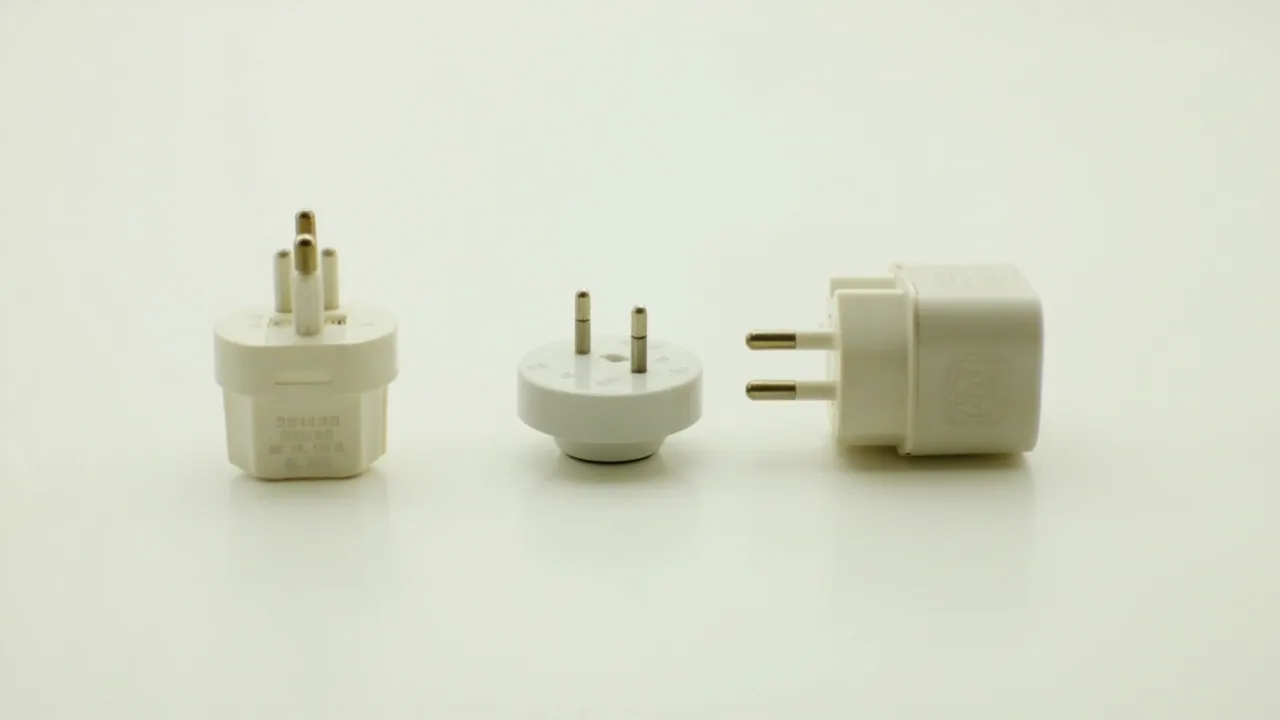
Southeast Asia Plug & Adapter Guide for Indian Travelers: What Plugs Each Country Uses
Your Indian phone charger has round pins. Half of Southeast Asia uses flat pins. This Southeast Asia adapter guide covers which socket type each country uses and whether your Indian plugs will physically fit. For related planning, see our guide on Sea Backpacking Hub.
A universal adapter rated for 250V and 10A works across all eight Southeast Asia countries on this list. Avoid the cheapest ₹200 (~$2.08) unbranded jobs, they overheat on sustained loads like laptop chargers overnight.
Quick Answers
| What | Answer | Price (INR) |
|---|---|---|
| Will my Indian 3-pin charger work in Thailand? | No, Indian Type D/M has thicker pins than Thai sockets. You need an adapter. | ₹800 (~$8.30) |
| What plug type does Vietnam use? | Type A, C, and D (mixed). Indian Type C fits most sockets, Type D rarely fits. | ₹800 (~$8.30) |
| Do I need a different adapter for Bali/Indonesia? | No, same Type C/F as India works. | ₹800 (~$8.30) |
| Will Indian Type M plug fit in Malaysia or Singapore? | Yes, Type G (British 3-pin) is standard. Indian Type M fits with effort but loose. | ₹800 (~$8.30) |
| Can I use my Indian hair dryer / kettle without a converter? | No, India’s 230V/50Hz matches SEA voltage, but high-wattage devices need a converter if the adapter doesn’t support the load. | ₹800 (~$8.30) |
One ₹800 (~$8.30) universal adapter rated for 250V/10A covers all eight countries on this list. Cheaper ₹200-₹400 (~$2.08-$4.15) adapters overheat on sustained loads like laptop chargers overnight. Pay once, cry once.
Why Indian Plugs Don’t Fit Most Southeast Asian Sockets
India uses three plug types depending on the device:
- Type C (2 round pins, 4mm): phone chargers, laptop bricks, camera batteries. This is the EU-style “Europlug” and it’s the most common Indian charger pin shape.
- Type D (3 large round pins in a triangle): older appliances, heavy-duty plugs. Old laptop chargers sometimes have these.
- Type M (3 large round pins, South African style): high-power devices like AC units, geysers. Rare in luggage.
The problem: Type D and Type M have thick 7mm pins. Most Southeast Asian sockets are designed for Type A (2 flat pins) or Type C (2 thin 4mm round pins). A Type D plug physically cannot enter a Type A or Type C socket. A Type C plug (your phone charger) fits into almost any Type C, E, F, or hybrid socket worldwide.
So the rule of thumb: if your Indian charger has 2 round pins (Type C), it fits most of Southeast Asia with no adapter. If it has 3 round pins (Type D or M), you need an adapter everywhere.
What Plug Type Each Southeast Asia Country Uses
| Country | Plug Types Used | Indian Type C Fit? | Indian Type D/M Fit? | Voltage / Frequency |
|---|---|---|---|---|
| Thailand | A, B, C, F | Yes | No | 230V / 50Hz |
| Vietnam | A, C, D (mixed) | Yes | Sometimes (loose) | 220V / 50Hz |
| Laos | A, B, C, E, F | Yes | No | 230V / 50Hz |
| Cambodia | A, C, G (mixed) | Yes | No | 230V / 50Hz |
| Indonesia (Bali) | C, F | Yes | No | 230V / 50Hz |
| Malaysia | G (British 3-pin) | No (need adapter) | Loose fit possible | 240V / 50Hz |
| Singapore | G (British 3-pin) | No (need adapter) | Loose fit possible | 230V / 50Hz |
| Philippines | A, B, C | Yes | No | 220V / 60Hz |
Thailand: A, B, C, F
Thailand uses a chaotic mix. Most modern sockets (hotels, hostels, cafes) accept Type A (flat 2-pin), Type B (flat 3-pin), Type C (round 2-pin), and Type F (Schuko, round 2-pin with side grounding clips). Indian Type C phone chargers fit fine. Indian Type D laptop chargers do not fit. Older buildings in Chiang Mai and Pai sometimes have only Type A/B sockets, which won’t accept any Indian plug at all without an adapter.
Vietnam: A, C, D
Vietnam is the weird one. Newer hotels use Type A and C (flat + round), but older buildings and many homestays still have Type D sockets (the same 3-round-pin configuration as India, but with slightly thinner pins). Vietnamese Type D sockets often loosely accept Indian Type D plugs. It works, but the connection feels wobbly. Most backpackers carry a universal adapter and stop worrying.
Laos: A, B, C, E, F
Laos uses a similar mix to Thailand. Type C fits. Type D does not. Vientiane hostels tend to have newer sockets, while rural guesthouses sometimes have only Type A.
Cambodia: A, C, G
Phnom Penh and Siem Reap hostels mostly use Type A and C, same as Thailand. A few older hotels have British Type G (the chunky 3-rectangular-pin socket). Your Indian Type C charger works in 90% of cases. The remaining 10% will leave you hunting for an adapter at a guesthouse front desk. For more on Cambodia’s power situation, see our Cambodia wifi, VPN, and power outage guide.
Indonesia (Bali, Jakarta, Lombok): C, F
This is the easiest country on the list for Indian travelers. Bali uses Type C and F, identical to India’s most common socket. Your Indian Type C phone charger fits directly into any Indonesian socket with no adapter. Indonesian sockets are also 230V/50Hz, identical to India. No converter needed for dual-voltage devices (anything with a brick-style charger, which covers most modern electronics).
Malaysia: G (British 3-pin)
Malaysia uses British Type G exclusively. Three rectangular pins in a triangle. Indian Type C phone chargers do not fit. Indian Type D/M plugs do not fit. You need an adapter. Every Malaysian convenience store (7-Eleven, KK Mart) sells universal adapters for ₹353-₹589 (~15-25 MYR or ~$3.67-$6.11). Kuala Lumpur airport has them for ₹707 (~30 MYR or ~$7.34) in arrivals.
Singapore: G (British 3-pin)
Same as Malaysia. Type G sockets everywhere. Changi Airport has universal adapters at the 7-Eleven in each terminal for ₹1,119-₹1,865 (~15-25 SGD or ~$11.61-$19.36). Indian Type C chargers do not fit without an adapter.
Philippines: A, B, C
Manila, Cebu, Palawan use Type A and B (North American flat-pin style), with some Type C sockets. Indian Type C fits the Type C sockets. Type A sockets won’t accept any Indian plug. Filipino malls and airports sell universal adapters for 150–300 PHP (₹236–₹472).
Adapter vs. Converter: What You Need
Adapter changes the plug shape so your Indian device physically fits the foreign socket. It does not change electricity.
Converter changes the voltage (220V → 110V or vice versa).
India runs 230V / 50Hz. Southeast Asia runs 220–240V / 50Hz (Philippines is 220V / 60Hz). Your Indian phone charger, laptop brick, and camera battery are all rated 100–240V / 50–60Hz. They handle the full voltage range. You do not need a converter for any modern electronics with a brick or wall-wart charger.
You only need a converter if you’re plugging in a high-wattage Indian device that runs only on 230V (like an Indian hair dryer, electric kettle, or immersion rod). These will work in Southeast Asia voltage-wise (220–240V is close enough that they won’t fry), but the adapter plug won’t fit and the wattage draw can overheat cheap adapters. Travellers report that Indian hair dryers trip hostel breakers when used with flimsy adapters.
For 99% of Indian backpackers carrying phones, laptops, cameras, and power banks: one good universal adapter is all you need. No converter.
The One Adapter To Buy
What to look for in a universal adapter:
- Type: Universal adapter with retractable pins (US, UK, EU, AU)
- Rating: 250V / 10A minimum (some cheap ones are 6A, they overheat)
- USB ports: At least 2 USB-A or 1 USB-C PD so you can charge phone + power bank from one socket
- Surge protection: Optional but useful in Vietnam and Cambodia where voltage spikes happen
- Price: ₹700-₹1,200 (~$7.27-$12.46) in India (Amazon, Croma, Reliance Digital). ₹300-₹500 (~$3.11-$5.19) if you buy at a 7-Eleven in Bangkok or Singapore.
Generic universal adapters from Amazon India work fine. Avoid the ₹150 (~$1.56) unbranded ones with no surge protection, they fail within a month.
Subodh’s Pro Tip: Buy your universal adapter in India before flying. Airport shops in Bangkok and Singapore charge 2–3× the Indian price for the same product. A ₹800 (~$8.30) adapter in India becomes ₹1,800-₹2,400 (~$18.68-$24.91) at Changi or Suvarnabhumi.
Power Bank Rules for Indian Travelers
This is the other half of the electronics equation that gets backpackers stopped at airport security:
- Under 100Wh (roughly 20,000 mAh at 3.7V): Allowed in cabin baggage on all Indian and Southeast Asian airlines. No airline approval needed.
- 100–160Wh (20,000–43,000 mAh): Allowed but requires airline approval. Call your airline 48 hours before flying.
- Over 160Wh: Banned from cabin baggage on every airline on this list.
Most Indian travelers carry 10,000–20,000 mAh power banks from Mi, Ambrane, or Realme. These fall under the 100Wh limit and fly without issues. Pack the power bank in your cabin bag, not checked luggage. Lithium batteries in checked bags get flagged and confiscated.
For deeper power bank buying advice, the best power banks for Southeast Asia travel 2026 buyer’s guide breaks down capacity, weight, and airline rules.
Multi-Country Trips: One Adapter, Eight Countries
If you’re doing a Thailand. Vietnam. Cambodia. Laos loop (the standard SEA backpacker route), one universal adapter covers all four. Malaysia and Singapore require the same adapter (Type G), so no swap needed. Bali and the Philippines use Type C/F, which your adapter handles.
What you pack:
- 1 × universal adapter (₹800 (~$8.30)) in main bag
- 1 × backup universal adapter (₹300-₹500 (~$3.11-$5.19)) in daypack, in case the main one fails or gets left at a hostel
- 2 × USB-C cables (one short for power bank, one long for hostel beds)
- 1 × multi-port USB wall charger if you’re travelling with a friend
That’s it. No country-specific adapters needed.
What to Do If You Forget Your Adapter
Forgot to pack one? Every country on this list has you covered:
- Vietnam: Mobile phone shops, minimarts in tourist areas. ₹184-₹551 (~50,000-150,000 VND or ~$1.91-$5.72).
- Cambodia: Guesthouse front desks often lend adapters. Phnom Penh markets sell them for ₹193-₹482 (~2-5 USD).
- Indonesia: Indomaret, Alfamart, Circle K. ₹161-₹430 (~30,000-80,000 IDR or ~$1.68-$4.47).
- Malaysia: 7-Eleven, KK Mart. ₹353-₹707 (~15-30 MYR or ~$3.67-$7.34).
- Singapore: 7-Eleven in Changi. ₹1,119-₹1,865 (~15-25 SGD or ~$11.61-$19.36).
- Philippines: Mall electronics shops. 150–400 PHP (₹236-₹629 (~$2.45-$6.53)).
The price markup over India is real but not catastrophic. If you forgot yours, the bigger risk is buying a junky adapter that overheats your laptop brick overnight. If you have to buy one abroad, spend a little extra for a branded one.
For more on electronics sourcing and pricing across the region, electronics guide for Southeast Asia travel: what to bring from India covers chargers, cables, and device compatibility.
Voltage and Frequency Cheat Sheet
| Country | Voltage | Frequency | Indian Device OK? |
|---|---|---|---|
| Thailand | 230V | 50Hz | Yes |
| Vietnam | 220V | 50Hz | Yes |
| Laos | 230V | 50Hz | Yes |
| Cambodia | 230V | 50Hz | Yes |
| Indonesia | 230V | 50Hz | Yes |
| Malaysia | 240V | 50Hz | Yes |
| Singapore | 230V | 50Hz | Yes |
| Philippines | 220V | 60Hz | Yes (60Hz vs 50Hz matters for motors, not electronics) |
Your Indian phone charger, laptop, camera battery, power bank, e-reader, wireless earbuds case, and any device with a switching power supply will work fine across all eight countries. The 10V difference (220V vs 230V vs 240V) is within tolerance for every modern electronic charger. You only need to worry if you’re plugging in a 50Hz-only motor device (old Indian clocks, some fans) into a 60Hz country like the Philippines; the motor will run slightly fast but won’t burn out for short-term use.
SIM and eSIM Note (Plug This In Before You Travel)
Chargers are only useful if your phone has data to show you a converter app. Most backpackers sort their SIM at the airport on arrival, but if you want connectivity the moment you land, an eSIM is the cleanest option. Get Nomad eSIM activates before you fly, works across Thailand, Vietnam, Cambodia, and Indonesia on a single plan, and saves the airport SIM-counter queue. For country-specific physical SIM guides, the Vietnam SIM card for Indian travelers comparison and our Indonesia and Malaysia SIM guides walk through the airport-counter options in detail.
Common Mistakes Indian Travelers Make with Adapters
- Buying the cheapest unbranded adapter from a Bangkok night market. Travellers report these overheating within days. If it smells like burning plastic, unplug immediately.
- Assuming Type C fits everywhere. It fits Thailand, Vietnam, Laos, Cambodia, Indonesia, the Philippines. It does not fit Malaysia or Singapore. You need the UK-pin mode for those two.
- Packing a voltage converter for no reason. Your phone and laptop are dual-voltage. The converter just adds weight.
- Forgetting the adapter at a hostel checkout. This happens constantly. Keep your adapter in your daypack, not your main bag, so it travels with you on every hostel move.
- Plugging a high-wattage Indian hair dryer into a cheap adapter. Hair dryers pull 1,500–2,000W. Most universal adapters are rated 1,500W max sustained. Use the hostel’s hair dryer if they have one, or buy a local one for ₹858 (~300 THB or ~$8.90) at a Thai convenience store.
Subodh’s Take
The adapter question has a simple answer: buy one ₹800 (~$8.30) universal adapter rated 250V/10A in India before flying, pack a ₹300 (~$3.11) backup in your daypack, and stop overthinking it. Voltage matches, your phone and laptop are dual-voltage, and the only countries that genuinely require swapping the pin mode are Malaysia and Singapore. Everything else takes your Indian Type C charger as-is. The traveller who packs five adapters is the same one who forgot to charge their power bank the night before a 14-hour sleeper bus. Pack light, plug smart, and spend the saved weight on souvenirs.
Where to Stay
Most hostels and guesthouses across Southeast Asia have universal sockets in common areas, but your room might only have one or two outlets. Book accommodation with good charging facilities through our fixed-cost backpacking trip, and we pick hostels with bedside sockets and USB ports so you’re not fighting for outlet space.
FAQ
Do I need a different adapter for each Southeast Asian country?
No. One universal adapter with US, UK, EU, and AU pin modes covers all eight countries on this list. The only mode swap is Malaysia and Singapore, which need the UK 3-rectangular-pin setting.
Will my Indian laptop charger work in Thailand, Vietnam, and Bali?
Yes. Indian laptop chargers are dual-voltage (100–240V, 50–60Hz) and use Type C or Type D plugs. Type C fits Thailand, Vietnam, Bali, Laos, Cambodia with no adapter. Type D needs an adapter in all of them.
Can I charge my Indian phone directly in a Malaysian socket?
No. Malaysia uses Type G (British 3 rectangular pins). Your Indian Type C charger has 2 round pins and won’t fit. You need an adapter in UK-pin mode or a USB charging cable plugged into a laptop.
What’s the difference between an adapter and a converter?
An adapter changes the plug shape so it fits the socket. A converter changes the voltage (220V to 110V). Indian travelers do not need a converter because India and Southeast Asia both run 220–240V. You only need an adapter.
Are power banks allowed in cabin baggage on flights to Southeast Asia?
Yes, power banks under 100Wh (roughly 20,000 mAh) are allowed in cabin baggage on all Indian and Southeast Asian airlines without airline approval. Power banks are banned from checked luggage.
Can I buy a universal adapter at Bangkok airport if I forget mine?
Yes. 7-Eleven at Suvarnabhumi and Don Mueang sell universal adapters for ₹715-₹1,144 (~250-400 THB or ~$7.42-$11.87). The airport electronics shops in Phnom Penh, Ho Chi Minh City, and Bali also stock them. Expect to pay 2–3× the Indian price.
Will my Indian immersion rod or electric kettle work in Vietnam or Thailand?
Voltage-wise yes (220–230V is close enough), but the plug won’t fit any socket. You need an adapter rated for the kettle’s wattage (usually 1,500–2,000W), and most universal adapters are only rated 1,500W sustained. Safer option: buy a local kettle at any minimart for ₹572-₹1,144 (~200-400 THB or ~$5.94-$11.87).
