Best Solo Activities in Thailand: Cooking Class in Chiang Mai, Koh Tao Diving, Ethical Elephant Sanctuaries & Songkran 2026
Thailand is the easiest first solo trip for an Indian backpacker. Activities here are built around groups, English is everywhere on the trail, and four signature experiences solve the “what do I do alone” problem on their own.
Quick Answers
| What | Answer | Price (INR) |
|---|---|---|
| Chiang Mai cooking class (half day, market visit + 4 dishes) | Yes, the single best solo-mixer activity in Thailand | ₹1,500-2,500 (~523-872 THB or ~$16-26) |
| Koh Tao Open Water diving (3-4 days, certification) | Worth it if you’re here 5+ days; not a day-trip | ₹14,000-18,000 (~4,880-6,275 THB or ~$145-187) |
| Ethical elephant sanctuary (full day, no riding) | Mae Sa / Chang Chill / Elephant Nature Park-tier only | ₹2,200-3,500 (~767-1,220 THB or ~$23-36) |
| Songkran 2026 dates | April 13-15 nationwide, Chiang Mai extends to ~April 19-21 | Free to roam; water-gun ~₹230 (~80 THB or ~$2.38) |
| Thailand visa-free for Indians (2026) | Yes, 60 days, bilateral, TDAC mandatory before boarding | Free (extension ~₹5,395 (~$55.96)) |
The Solo Travel Vibe on the Thailand Trail
The Thailand section of the Banana Pancake Trail runs Chiang Mai → Pai → Mae Hong Son on the north end, and Bangkok → Koh Phangan → Koh Tao → Krabi on the south end. Every hostel along it runs the same playbook: a common kitchen with 4-6pm beer hours, a “what are you doing tomorrow” whiteboard, and staff who have been doing this since they were 19.
Indian solo travellers fit in faster here than anywhere else in Southeast Asia. There are usually 2-3 other Indians in every Bangkok or Chiang Mai dorm in peak season, but because most hostels are also 50% European and Australian, you end up eating pad thai with a Finnish couple by hour three. You don’t have to seek out social situations: the activities themselves (cooking class, dive boat, elephant sanctuary, Songkran) put you in a group within minutes.
Chiang Mai Cooking Class: The Best Solo-Mixer in Thailand
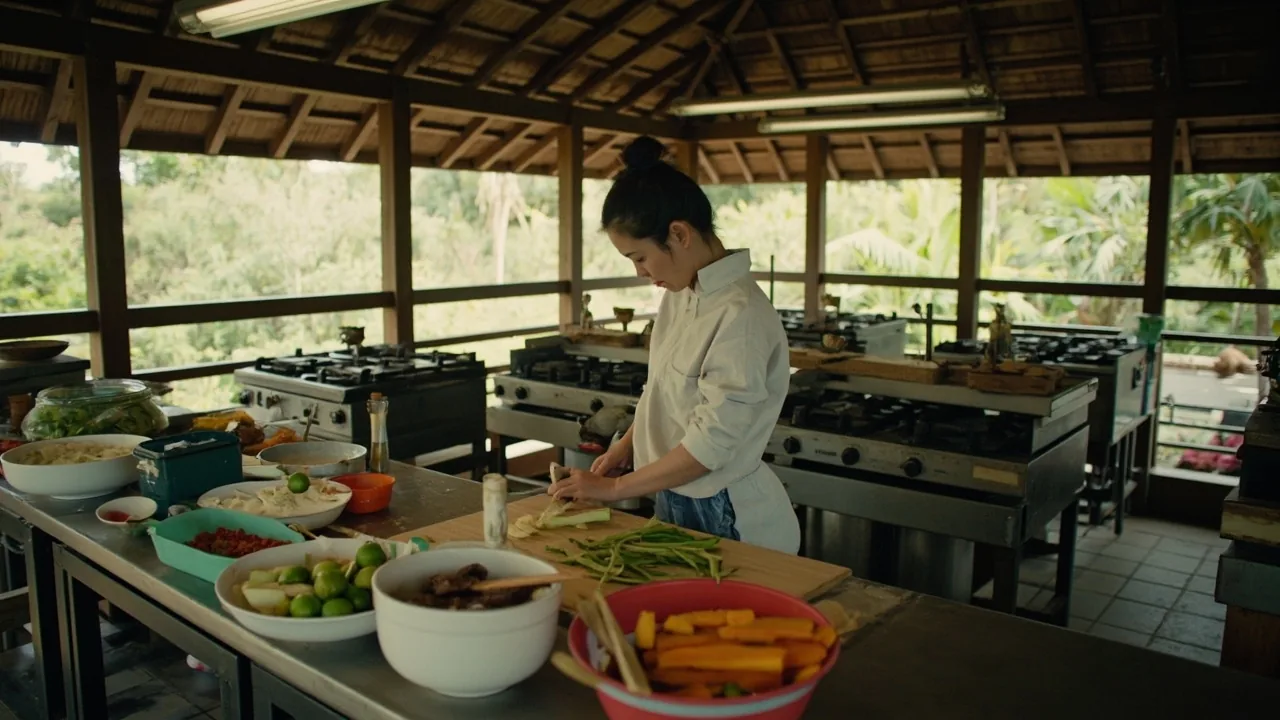
A Chiang Mai cooking class is the closest thing Thailand has to a guaranteed friend-making machine. You arrive alone, you meet 8-12 people at the morning market run (the class picks you up at your hostel around 8:30am), you pick herbs you’ve never seen before, and by lunch you’re eating tom yum you cooked yourself alongside people you’ll see in every other hostel for the next two weeks.
The trick is picking the right one. The market-tour-plus-cook format (most operators in the ₹2,297-₹3,446 (~800-1,200 THB or ~$23.83-$35.74) range) runs 5-6 hours and includes the hotel pickup, market visit, 4-5 dishes you cook, and a recipe booklet. The cheaper “cook only” classes skip the market and feel transactional.
Look for classes with a minimum of about 8 and maximum of about 14 students per session: smaller groups don’t have the social energy, larger ones become a factory. Half-day classes (8:30am-1:30pm) leave your afternoon open. Full-evening classes are rarer and worth the extra cost if you want more time with the group.
For dietary flexibility: most Chiang Mai cooking schools have separate veg-only stations, dedicated woks for the vegetarian students, and full vegan adaptations of standard Thai dishes. If you’re Jains, message the school in advance about no-onion-no-garlic and they will adapt. Halal meat is rarely a feature at cooking schools; check individually.
Ethical Elephant Sanctuaries: How to Pick Without Getting Scammed
Thailand has hundreds of places advertising “sanctuary.” About 90% of them still offer elephant riding, perform shows, or keep elephants chained at night. The 10% that don’t are the ones worth your money and your day.
Subodh’s Pro Tip: Walk past any “sanctuary” that lets visitors ride or bathe elephants. Genuine sanctuaries observe the elephants and don’t interrupt them. The elephants walk; you watch. If a place offers direct contact (bathing, feeding by hand), that’s a yellow flag: contact is allowed only when the elephants initiate, and only at observer-tier sanctuaries like Elephant Nature Park.
What an ethical sanctuary looks like in 2026:
| Signal | Good | Bad |
|---|---|---|
| Size | Herd of 5-30+ elephants | 2-3 elephants total |
| Time with elephants | Observe at distance, walk alongside on their route | Riding, bathing, photo-op |
| Sessions/day | One group per herd, limited hours | Multiple back-to-back groups |
| Source | Rescued from logging/tourism camps, vet history available | Sourcing unclear, no vet staff on-site |
| Price | ₹7,179-₹10,050 (~2,500-3,500 THB or ~$74.47-$104.25) full-day including transport | Under ₹4,307 (~1,500 THB or ~$44.68) |
Three sanctuaries Indians repeatedly book, all reachable as a half-day trip from Chiang Mai with hostel pickup included:
- Mae Sa Elephant Home: smaller herd, observation-heavy, full-day with ethical feeding prep
- Chang Chill: rescue-focused, no riding, no bathing, hands-off observation only
- Elephant Nature Park (Lek Chailert’s original): the reference standard for ethical elephant tourism in Chiang Mai
Full-day tours including return transfer from Chiang Mai run ₹6,317-₹10,050 (~2,200-3,500 THB or ~$65.53-$104.25) at genuine sanctuaries, around ₹7,753 (~2,700 THB or ~$80.42) at the most reputable ones. If a tour costs under ₹4,307 (~1,500 THB or ~$44.68) or is sold as a Klook/GetYourGuide “deal,” the elephants are still working.
Koh Tao Diving: Worth It If You Stay 5+ Days
Koh Tao is one of the cheapest places in the world to get scuba-certified, and the reason is cynical: the island built its economy on certification factories. There are over 50 dive schools in Sairee village, and the bad ones churn students.
PADI Open Water certification runs 3-4 days: 2 days of confined water + theory, 2 days of open-water boat dives, total 4 dives. Fun Dives (no certification, must already be certified) are ₹2,872-₹4,020 (~1,000-1,400 THB or ~$29.79-$41.70) per 2-tank dive.
Whether Koh Tao diving is worth it depends entirely on how long you’re staying:
- 5+ days on the island: yes, Open Water is genuinely worth it. The certification is lifetime-valid worldwide, the underwater visibility around Koh Tao is 15-25m, and most schools have strict 4-student-per-instructor ratios at the reputable end.
- Less than 5 days: do a Discover Scuba Diving (DSD) intro instead. One day, 1 confined dive + 1 open dive, no certification. ₹10,050-₹12,922 (~3,500-4,500 THB or ~$104.25-$134.04).
- Already certified: book Fun Dives. Buoyancy check + 2 boat dives = ₹5,169-₹7,179 (~1,800-2,500 THB or ~$53.62-$74.47) at most shops.
How to pick a school without picking a factory:
- Maximum 4 students per instructor on every water session (this is the PADI/Ideal Dive Centre tier)
- Own boats, not third-party boat rental
- Modern equipment (rental BCDs and regulators less than 5 years old)
- No “guarantee you’ll pass” promises; genuine instructors fail students who aren’t ready
Two class-of-the-island picks Indian travellers keep coming back to (both with Indian-friendly vegetarian meal options on the boat):
- Ban’s Diving Resort: large, well-organized, Indian-friendly meal options, Sairee location
- Crystal Dive: smaller group caps, Koh Tao’s longest-running PADI 5-Star centre
Safety Alert: Koh Tao diving has had isolated operator negligence issues over the years. Before booking, message the school directly, ask about the student:instructor ratio for your specific dates, and verify their certification status on the PADI or SSI public registry. The Thai Department of Marine and Coastal Resources also lists approved operators.
Songkran Solo: April 13-15, 2026
Songkran is the Thai New Year, celebrated by throwing water at every human being in range. For a solo traveller, it’s the single best social situation of the year: you walk out of your hostel at 9am and you’re drenched, handed a water gun, and pulled into a group within 90 seconds. No introduction required. The water does the socializing.
Dates for 2026:
- Nationwide: April 13-15
- Bangkok (Silom, Khao San): April 13-15, with the biggest crowd on Khao San Road
- Chiang Mai: extends to roughly April 19-21 (the old city moat becomes the world’s largest water fight)
- Phuket: stays a coastal water festival through the week
Solo-specific Songkran notes:
- Bag protection: any electronics (phone, wallet, power bank) go in a sealed dry bag. Most hostels sell these at the front desk for ₹287-₹431 (~100-150 THB or ~$2.98-$4.47), or a 7-Eleven ziplock-and-cling-wrap hack works in a pinch.
- Clothes: wear stuff you don’t mind getting soaked in front of strangers. Quick-dry shorts > denim. White T-shirts go transparent within 10 minutes.
- Water gun price: ₹230-₹431 (~80-150 THB or ~$2.38-$4.47) on Khao San, ₹144 (~50 THB or ~$1.49) at a 7-Eleven in Chiang Mai. Refills are free at any street stand selling ice.
- Accommodation booking: book 4-6 weeks ahead. Phuket, Koh Phangan, Chiang Mai Old City all fill by mid-March for any April dates.
- Connecting with other solos: most Chiang Mai hostels run a Songkran-week pre-party on April 12 and a wet-T-shirt volleyball tournament on April 14. Attend at least one; it’s the cheapest group activity on the calendar.
Safety Alert: Songkran sees a sharp rise in drink-driving accidents every year. The Thai Ministry of Public Health data is consistent on this. If you’re drinking, use Grab/Bolt, not motorbike taxis, and walk where possible. Khao San Road is the worst offender: don’t expect sobriety at 2am on April 14.
How to Meet Other Solo Travellers (The General Skill)
The four activities above solve the “I’m alone” problem, but a few general skills make Thailand solo travel even easier:
- Stay in social dorms. A 6-8 bed dorm with a common kitchen is where you meet people. A 16-bed “pod” hostel or a private room keeps you alone. Chiang Mai dorm beds run ₹689-₹1,005 (~240-350 THB or ~$7.15-$10.43), Koh Tao dorm beds ₹861-₹1,436 (~300-500 THB or ~$8.94-$14.89).
- Join the free walking tour. Almost every Bangkok, Chiang Mai, and Pai hostel runs one. Two hours, 8-15 people, no cost, and the guide usually takes everyone to lunch afterwards (the place they go to gets a commission, but you’ll get a discount).
- Use the hostel whiteboard. Most social hostels still have one. “Going to [place] tomorrow, message me” = your meeting board.
- Group dinners, not solo dinners. If you’re eating alone at 7pm at a street stall, you’re missing the social layer. Hostel common dinners at 7pm are how every long-traveller you meet found their first friend.
Safety for Solo Travellers in Thailand
Thailand is one of the safest countries in Southeast Asia for solo travellers, with two real exceptions: motorbike accidents and Songkran drinking. Keep your phone charged, your bag zipped in crowded markets, and your motorbike helmet on if you rent. Use Grab/Bolt over street taxis in Bangkok; in Chiang Mai, red songthaews are fine for short hops.
For female travellers specifically, Thailand stays in the “high comfort” tier for solo Indian women; the same general rules of avoiding isolated beaches after dark, using hostel lockers, and trusting your instinct on street taxi offers apply here.
Getting Connected (SIM/eSIM)
Stay reachable. Pick up a TrueMove or AIS tourist SIM at Suvarnabhumi / Chiang Mai airport arrivals (every carrier has a booth in the international terminal). The 15-day tourist SIM with 15GB is the standard pick. Both physical SIM and eSIM work in Thailand; the physical SIM has wider rural-island coverage, the eSIM is faster to set up if you don’t want to find a kiosk after a 6-hour flight.
Get Nomad eSIM as a backup or primary option.
Budget stays from the time you collect it: AIS 15-day SIM is ₹1,146 (~399 THB or ~$11.88), TrueMove equivalent is ₹1,146 (~399 THB or ~$11.88).
Common Solo Mistakes Indians Make
- Booking a private room from day one. Private rooms isolate you. Stay in dorms for the first week; upgrade to private only if you need space for work calls.
- Skipping the hostel common kitchen or dining table for breakfast. The 8am hostel breakfast (almost always free or ₹172-₹287 (~60-100 THB or ~$1.79-$2.98)) is the most reliable social moment of the day.
- Staying only with Indian groups. The hostel is full of Europeans, Australians, and Latin Americans. Switch tables, ask where they’re going next, trade itineraries.
- Over-packing a 60-litre bag. Solo travel depends on you being able to carry your own bag across a bus station at midnight. A 45L pack + a small daypack is the correct size.
- Treating Songkran as a passport-only trip. Thailand has a 60-day visa-free entry for Indian passport holders in 2026. You can land April 10 and use Songkran as the start of a 50-day trip up and down the country instead of flying home.
FAQ
Is Thailand safe for solo female Indian travellers? Yes, Thailand is one of the easiest first solo trips for Indian women. The main risk categories are motorbike accidents and Songkran drinking, both managed by using Grab/Bolt and pacing yourself. Standard urban rules apply: cover up at temples, don’t walk alone on empty beaches after midnight.
Will I get bored travelling alone in Thailand? No. Thailand’s hostel density and activity culture make solo travel more social than travelling with a partner. Cooking classes, dive boats, elephant sanctuary vans, and Songkran groups put you in a crowd within hours of leaving your dorm.
How do I handle my bags when I need the bathroom on a bus or train? Pack a small sling bag (waist pouch, 3-5L) for passport, phone, cash, and a credit card. Leave your main backpack locked at the bus station’s left-luggage counter (₹144-₹287 (~50-100 THB or ~$1.49-$2.98) for a day) or in the bus hold. Never leave anything visible in a roadside restroom.
Do I need a visa for Thailand as an Indian in 2026? No, Indians are on the bilateral 60-day visa-free agreement. You do need the TDAC digital arrival card (free, https://tdac.immigration.go.th) completed before boarding. Visa-on-arrival is a 15-day option but rarely useful when visa-free gives you 60.
Is Koh Tao diving worth the time? Yes if you’re staying 5+ days on the island (full Open Water cert). For shorter stays, the Discover Scuba Diving intro dive is the better pick. Already-certified divers should book Fun Dives (₹2,872-₹4,020 (~1,000-1,400 THB or ~$29.79-$41.70) per 2-tank boat dive).
What is the best month to visit Thailand solo? November to February is peak season with the best weather (cool, dry). March-April is hot but offers Songkran. May-October is monsoon but cheaper; the Gulf coast (Koh Tao, Koh Phangan) stays diveable through this period.
Subodh’s Take
You don’t need a partner, a group, or a fixed plan to enjoy Thailand. The four activities above (cooking class, sanctuary, dive, Songkran) will hand you a social group inside the first day in each. Pick one of them per city and the rest takes care of itself. Travel light, stay in dorms for the first week, and book the elephant sanctuary that doesn’t let you ride.
