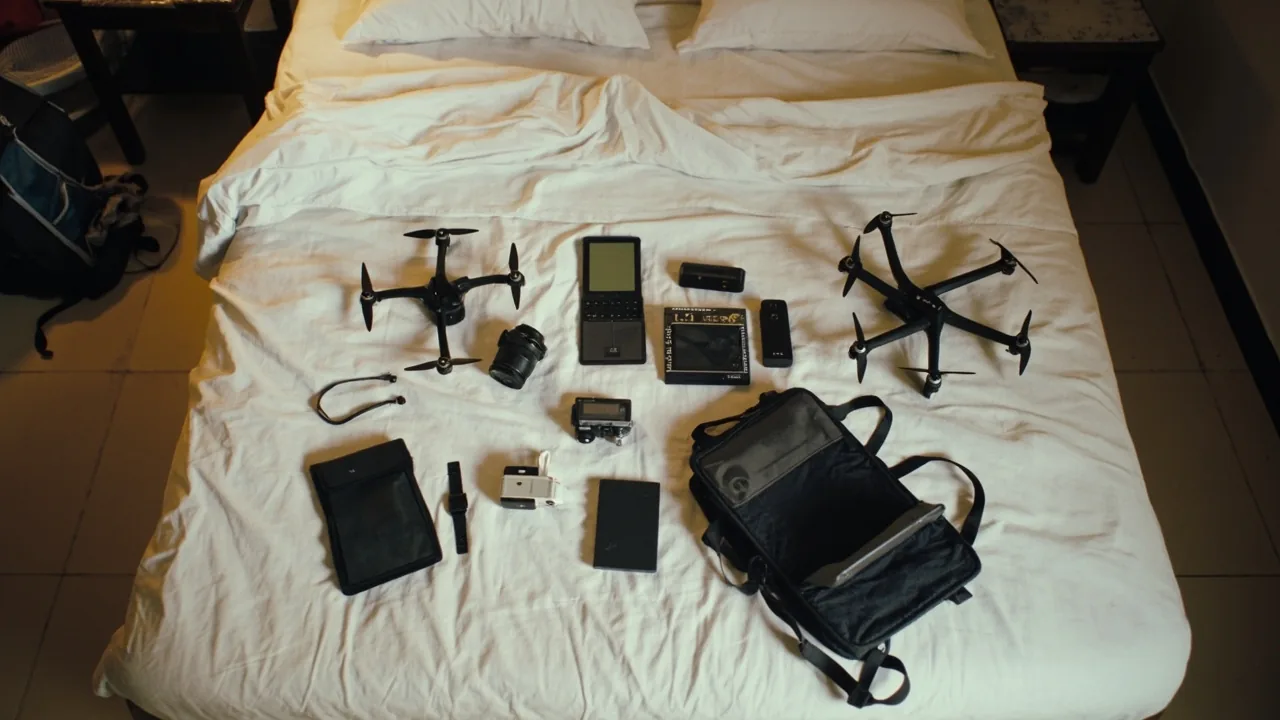
Best Travel Gadgets for Laos: Camera, Drone, Power Bank, Kindle & Waterproof Cases
Packing light is the golden rule of backpacking Southeast Asia, and Laos tests it harder than most neighbours. A Vientiane tuk-tuk to the Mekong sunset, a slow boat from Huay Xai to Luang Prabang, a motorbike loop out of Vang Vieng, a river-tubing day where your phone genuinely ends up in the water; each of those days wants different gear, and the country rewards travellers who thought about it before flying out of Delhi. You only need a 40 to 50 litre backpack and a tight electronics kit; everything else, from sarongs to rain ponchos, can be bought in Vientiane or Luang Prabang for a few dollars if you forget. For related planning, see our guides on Sea Backpacking Hub and Vpn Internet Apps Laos Backpacking.
This is the gear I would pack for three weeks in Laos in 2026: cameras, drone rules, e-readers, power banks, phone cases, and the clothing choices that handle both sticky monsoon humidity and temple dress codes without a separate wardrobe. You may also find What to Pack for Laos the Backpacker S Checklist useful for this trip.
Quick Answers
| What | Answer | Price (INR) |
|---|---|---|
| Best camera for Laos backpacking? | A pocketable mirrorless (Sony ZV-E10 or Fujifilm X-T30 II) for Laos’s soft golden light and temple interiors. | ₹60,000 (~5,200 LAK or ~$620) |
| Do I need to register a drone in Laos? | Yes, drones above 250g require registration with Lao CAA. A DJI Mini 4 Pro (sub-249g) avoids most paperwork. | ₹85,000 (~7,400 LAK or ~$880) |
| Power bank limit on flights to Laos? | Cabin baggage only, under 100Wh (roughly 27,000 mAh at 3.7V). Anything bigger gets confiscated. | ₹1,500 (~130 LAK or ~$15) |
| Kindle or iPad for slow boat to Luang Prabang? | Kindle Paperwhite, it lasts two weeks on a charge and survives the slow boat’s wet deck. | ₹13,000 (~1,100 LAK or ~$135) |
| Is a waterproof phone case necessary in Laos? | Yes for tubing at Vang Vieng and boat days; a ₹86 (~20,000 LAK or ~$0.89) dry bag works as well as a ₹1,500 (~$15.57) case. | ₹300 (~25 LAK or ~$3) |
The Camera Question
Laos is one of the underrated photography countries in Southeast Asia. The morning alms round in Luang Prabang has soft, directional light and monks in saffron against sandstone walls; Kuang Si Falls shoots through canopy; the Mekong at sunset in Vientiane goes orange-pink for twenty minutes. You want something that handles low light (temple interiors are dark, motorbike rides at dusk aren’t) and is small enough to carry on a 12-hour slow boat. See also: Luang Prabang Weather By Month.
A pocketable mirrorless is the sweet spot. Sony ZV-E10 with the kit lens runs around ₹22 (~5,200 LAK or ~$0.23) new in India and weighs 343 grams. Fujifilm X-T30 II runs similar money and gives you Fuji’s film simulations, which look great straight out of camera for the orange-robe shots. Both handle 1080p video if you want reel footage.
If mirrorless is too much, an iPhone 15/16 Pro does nearly everything and is already in your pocket. Skip the dedicated action cam unless you’re committed to the waterfalls or the Vang Vieng lagoon rope swings. Phone footage is fine, and the simpler kit means one less thing to charge.
For audio (morning market calls, monk chants, slow boat chatter), a small lav mic plugged into your phone is the move. RØDE Wireless Micro runs about ₹3 (~700 LAK or ~$0.03) and is the most forgiving piece of gear in my pack.
Drone Rules in Laos (Sub-249g vs the Real World)
This is the most-asked question and the answer has two layers.
The legal layer. Laos requires drone registration through the Lao Civil Aviation Authority (Lao CAA) for any UAS above 250 grams. The DJI Mini 4 Pro weighs 249 grams with the standard battery, which puts it right at the threshold and exempt from most registration paperwork in many jurisdictions, including Laos’s current guidelines. Anything heavier, a DJI Air 3, Mavic, etc., needs to be registered, with permits potentially required for flights near temples, government buildings, or the airport perimeter in Vientiane (Wattay) and Luang Prabang (LPQ).
The practical layer. Even with a sub-249g Mini, you will get asked questions at Wattay airport if you fly in central Vientiane, and temple authorities at Wat Xieng Thong in Luang Prabang don’t love drones overhead during alms round. Travellers report that flying at Kuang Si Falls, on rural stretches of the Mekong, or over the Nam Song valley at golden hour is fine; flying over monks, pagodas, or markets is not.
Pack: drone, three batteries (cold mornings and humid afternoons both chew battery), ND filter set (8/16/64) for the golden hour shots over the Mekong, and a small hardshell case. Do not pack a drone to fly at Wat Phou in Champasak without checking current site rules on the day; that site has become stricter about photography gear in the last two years.
Subodh’s Pro Tip: If you don’t already own a drone, this is not the trip to buy one. A Mini 4 Pro combo runs about ₹32 (~7,400 LAK or ~$0.33) in India. The slow boat, the falls, and the tubing day give you better stories for the same money spent on a Laos cooking class or a night at the Mandarin Mekong in Luang Prabang.
Kindle vs iPad for the Slow Boat
The slow boat from Huay Xai to Luang Prabang takes two days, with an overnight stop in Pak Beng. There is no Wi-Fi on the boat, charging points are limited (one shared socket for the lower deck, often not working), and you will be sitting for six to seven hours each day looking at the Mekong. This is the single longest reading window of any Southeast Asia overland route.
Kindle Paperwhite wins this category. It weighs 205 grams, lasts up to 10 weeks of casual reading on a charge, and is genuinely waterproof (IPX8), so if the boat deck gets splashed or your bag tips at the Pak Beng homestay, the device survives. A 16GB model is around ₹5 (~1,100 LAK or ~$0.05) in India and holds thousands of books. Pre-load four or five before you leave Delhi, since Amazon’s Kindle Store is region-restricted in many cases and you cannot reliably download new books from Laos.
iPad is fine if you also want to edit photos, watch downloaded Netflix on the bus from Vang Vieng to Vientiane, or take notes. But it’s another device to charge daily, another thing to keep dry in monsoon season (June to September), and another ₹40,000 (~$415.20) to ₹15-₹30 (~3,500-7,000 LAK or ~$0.16-$0.31) of glass to worry about on a motorbike. For pure reading, Kindle. For everything else, iPad, but bring a sleeve.
Power Bank Rules (The Boring Part That Matters)
Two limits, both strict:
- Under 100Wh for cabin baggage on all flights to/from Laos. 100Wh equals roughly 27,000 mAh at 3.7V. The 20,000 mAh Anker PowerCore, the most common backpacker pick, is 74Wh, fully legal.
- No power banks in checked baggage, ever. They go in your carry-on only, and you may be asked to pull them out at security.
Travellers report that Indian airport security on the Vientiane route has been checking labels more carefully in 2025 and 2026, so make sure your power bank has its Wh rating printed on the body. If yours only shows mAh, multiply by 3.7V then divide by 1000 to get Wh (20,000 mAh × 3.7V = 74,000 mWh = 74Wh). Bigger than 100Wh and you’re either leaving it behind or shipping it.
Pack: one 20,000 mAh power bank, one short USB-C to USB-C cable, one USB-C to Lightning (if you still run an older iPhone). Skip the multi-port brick; you don’t need it, and it’s another thing to forget at a guesthouse.
Waterproof Cases and the Tubing Question
Vang Vieng’s river tubing is the single highest-risk activity for your phone in any Laos itinerary. You sit in a tractor-tyre tube, you float the Nam Song, you stop at bars along the river. You fall in. Everyone falls in. Phones in pockets die at the first bar.
Three options, ranked by what Indian backpackers pack:
- A ₹1,500 (~$15.57) to ₹2,500 (~$25.95) universal waterproof phone pouch with lanyard (₹107 (~25,000 LAK or ~$1.11) or ~₹289 (~3 USD) to ₹2,408 (~25 USD)). Works for phones up to 7 inches. Touchscreen still works through the plastic. This is the right answer 90% of the time.
- A proper 10,000 mm dry bag (₹4 (~1,000 LAK or ~$0.04) or ~₹963 (~10 USD)). Bigger, holds phone + keys + wallet, easy to find in Vientiane’s Talat Sao morning market or any Luang Prabang outdoor shop. Slightly more cumbersome to use while in the tube.
- A dedicated phone case with IP68 rating (like the Lifeproof or similar). Great protection, but adds bulk and costs ₹3,000 (~$31.14) to ₹1-₹2 (~260-520 LAK or ~$0.01-$0.02).
What you need depends on how much water exposure you expect. For pure tubing, option 1 is fine. For multi-day Mekong trips or rainy-season motorbike loops, option 2.
Travel Routers and Connectivity
Most backpackers skip the travel router because their phone hotspot works. In Laos, the case for a small router is stronger than in Thailand or Vietnam: SIM signal at guesthouses in rural areas (Nong Khiaw, Muang Ngoi, the 4,000 Islands) drops to 3G or EDGE, and sharing your phone’s flaky connection across a laptop and a Kindle eats battery. A GL.iNet Mango or Slate AX runs about ₹2-₹3 (~350-700 LAK or ~$0.02-$0.03) and lets you plug in an Ethernet cable at the rare hotel that has it.
For SIM, the cheapest option in Southeast Asia is the Unitel tourist SIM at ₹107 (~25,000 LAK or ~$1.11) for 15GB of data, available at Unitel shops in Vientiane, Luang Prabang, and Pakse, and at Wattay airport after customs. It’s the best value in the region and worth buying at the airport even if you plan to shop around in town.
If you’d rather skip the airport queue, Get Nomad eSIM works on Lao networks and activates the moment you land. Either way, skip the roaming pack from Jio or Airtel; it costs four to six times more than a local SIM.
For more on this, the Laos SIM card guide has the current data plans and where to buy.
Electronics & Tech Setup Checklist
- Universal travel adapter: Laos uses Type A, B, C, E, and F sockets. A single adapter with all five works; a multi-port USB brick saves you from fighting over the one socket at a guesthouse. Standard Indian three-pin plugs almost never fit directly, and Lao sockets can be loose even with an adapter.
- Three USB-C cables, one USB-C to Lightning (if needed), one short 30cm cable for power bank use.
- 20,000 mAh power bank (under 100Wh), labelled.
- Kindle or iPad, pre-loaded.
- Camera body, one versatile lens (18-50mm or 23mm prime), two SD cards, one card case. Don’t pack a laptop charger if you can charge the laptop off the power bank’s USB-C PD port.
- A tiny voltage tester (₹1 (~200 LAK or ~$0.01) or ~₹193 (~2 USD) in any Lao electronics shop), because rural guesthouses sometimes have miswired sockets that fry phone chargers. This is a real thing, not paranoia.
- Offline maps downloaded in Google Maps and Maps.me for Vientiane, Vang Vieng, Luang Prabang, Nong Khiaw, and the 4,000 Islands. Cell signal drops to nothing in the rural stretches.
Cultural Dress Codes (Temples vs Tubing)
Laos is conservative on temple grounds, and the rules apply to tourists strictly. Shoulders and knees must be covered at Wat Xieng Thong, Wat That Luang, Wat Phou, and any working monastery you happen to walk into during morning alms round.
Pack:
- One light cotton long-sleeve shirt or linen overshirt for temple days.
- Quick-dry travel trousers or long skirt. Jeans work but are slow to dry after the tubing incident and weigh a kilo.
- A ₹5 (~1,200 LAK or ~$0.05) cotton sarong from Talat Sao or the Luang Prabang night market. Doubles as a towel, a pillow on the slow boat, and a temple cover-up. Best multi-use item in the bag.
For the actual hot days (March to May is 38°C in Vientiane), pack two quick-dry synthetic tees, two pairs of running shorts or lightweight travel shorts, and one pair of breathable linen trousers for evenings. Synthetic dries in 30 minutes when you wash it in the sink; cotton stays damp for four hours and mildews in your backpack by day three. This is the single most common backpacker mistake in monsoon Laos.
Footwear: one pair of running shoes or trail shoes for the Kuang Si walk and the Phousi Hill climb in Luang Prabang, plus one pair of durable sandals (Tevas, Chacos, or the cheap local knockoffs from any Vientiane market) for everything else. Sandals are also fine for the tubing day; just don’t wear your good ones.
Common Packing Mistakes Indians Make
- Packing jeans. They’re heavy, slow to dry, and useless in 90% humidity. Travellers report jeans staying damp for 24+ hours in monsoon season. Two pairs of quick-dry trousers cover every situation a pair of jeans would.
- Bringing a hardshell suitcase. Sleeper buses from Vientiane to Luang Prabang have steep steps and small luggage holds. You’ll be the person dragging a suitcase across a wet bus station floor at midnight. A 40 to 50L backpack is the right answer.
- Overpacking toiletries. 7-Eleven, Circle K, and local marts in Vientiane and Luang Prabang stock everything: shampoo, soap, sunscreen, mosquito repellent. The one exception is sunscreen, which is two to three times the Indian price in Laos. Bring one tube from Delhi.
- Forgetting the power bank Wh label. Without it, Indian airport security may make you dump it. Test at home: if it doesn’t say 100Wh or less, it doesn’t fly.
- Buying a fancy “waterproof” phone case that isn’t waterproof. A ₹300 (~$3.11) pouch from a Vientiane market is more reliable than a ₹5,000 (~$51.90) Amazon “IP68” case that hasn’t been pressure-tested. Test yours in the sink before you trust it on the Nam Song.
Trail Laundry & Daily Logistics
Most guesthouses and hostels in Laos offer laundry by the kilogram, typically ₹43-₹86 (~10,000-20,000 LAK or ~$0.45-$0.89) per kg, returned same day. Pack enough clothes for five to six days, do laundry mid-trip, repeat. This is also why synthetics win: you can wash a quick-dry tee in the hostel bathroom sink at 9 PM and wear it the next morning.
For toiletries you genuinely forgot (toothpaste, contact lens solution, deodorant), the minimarts in Vientiane and Luang Prabang are well-stocked and cheap. Sunscreen is the one exception. Bring it from India.
Subodh’s Take
Three weeks in Laos is one of the best itineraries in Southeast Asia for slow travel, and the gear list is short on purpose. A pocketable mirrorless, a sub-249g drone if you already own one, a Kindle for the slow boat, a 20,000 mAh power bank under 100Wh, a ₹1,500 (~$15.57) waterproof pouch for the tubing, and a universal adapter. Add two quick-dry trousers, two synthetic tees, one linen overshirt, and one sarong. That bag will weigh under nine kilograms, fit in any sleeper bus luggage rack, and get you through every temple, fall, river, and bus ride from Vientiane to the 4,000 Islands without a single gear regret.
FAQ
Can I bring a power bank on flights from India to Laos? Yes, in cabin baggage only, under 100Wh (around 27,000 mAh at 3.7V). Anything bigger gets confiscated at Indian airport security, not in Laos. Check the Indian airport power bank rules for the current checklist.
Do I need to register a DJI Mini 4 Pro in Laos? At 249g, it’s right at the threshold. Current Lao CAA guidance is light on sub-250g paperwork, but you still cannot fly over temples, alms rounds, or government buildings. Heavier drones (Air 3, Mavic) need formal registration.
Is a Kindle better than an iPad on the slow boat? For pure reading, yes. The Paperwhite lasts 10 weeks on a charge, weighs 205g, and is genuinely waterproof. The iPad lasts a day, needs a charger, and isn’t rated for the boat deck splash zone. If you also want to edit photos or watch Netflix on buses, bring both.
Should I pack a rain poncho for monsoon Laos (June to September)? Yes, a cheap ₹21 (~5,000 LAK or ~$0.22) poncho from any Vientiane market is fine. Skip the fancy ₹2,000 (~$20.76) one from India. The local ones work, and you can leave them behind when you cross into Thailand.
Can I buy a SIM card at Wattay International Airport in Vientiane? Yes, Unitel has a counter after customs. ₹107 (~25,000 LAK or ~$1.11) for 15GB, valid 15 days. It’s the cheapest tourist SIM in Southeast Asia and faster than going into town to shop around.
What should I wear to temples in Luang Prabang? Shoulders and knees covered. A cotton sarong (₹4-₹9 (~1,000-2,000 LAK or ~$0.04-$0.09) or ~₹96 (~1 USD) to ₹193 (~2 USD) from the night market) handles both the dress code and doubles as a beach towel and slow-boat pillow. Pack one light long-sleeve shirt for temple days.
Is Laos safe for backpackers in 2026? Generally yes. Standard precautions: use Grab or official tuk-tuks at night in Vientiane, watch your phone on the Nam Song tubing day, and check your government’s official travel advisory (MEA’s Laos page is the right starting point) before departure. For health coverage, Get SafetyWing travel insurance, covers Indian travelers from ~$62/month (~₹5,900). Includes COVID, trip interruption, and medical evacuation across Southeast Asia.
