Chiang Mai Cooking Class Cost: What Indians Pay in 2026
Chiang Mai runs more cooking schools per square kilometre than almost anywhere else in Southeast Asia, and many Indians book one on day two of a trip because it answers two problems at once: you’ll eat well for the next week from stuff you learned to cook, and the school’s market walk explains the herbs you’ve been staring at in bowls. Prices range from around ₹2,297 for a basic half-day to ₹10,050 for a private session.
Quick Answers
| What | Answer | Price (INR) |
|---|---|---|
| Cheapest group class, half day, no market | Around ₹2,297 (~800 THB or ~$23.83) | ₹2,297 |
| Standard market + cook, full day, group | ₹3,446-₹4,307 (~1,200-1,500 THB or ~$35.74-$44.68) | ₹3,446 |
| Premier school with market tour (Mama Noi, Basil) | ₹4,307-₹6,317 (~1,500-2,200 THB or ~$44.68-$65.53) | ₹4,307 |
| Private class, 1 to 2 people | ₹7,179-₹10,050 (~2,500-3,500 THB or ~$74.47-$104.25) | ₹7,179 |
| Vegetarian or vegan class surcharge | ₹0-₹861 (~0-300 THB or ~$0-$8.94) | ₹0 |
Use a forex card with no forex markup to pay for the class itself (every Thai school has a card machine) and you’ll save the 1 to 3 percent you lose on cash exchange.
The Schools Indians Most Often End Up At
Most backpackers in Chiang Mai book one of these four. Each has its own flavour, in a literal sense. What you pay depends on whether the market tour is included, how many dishes you cook, and whether the class is shared.
Mama Noi Cookery School
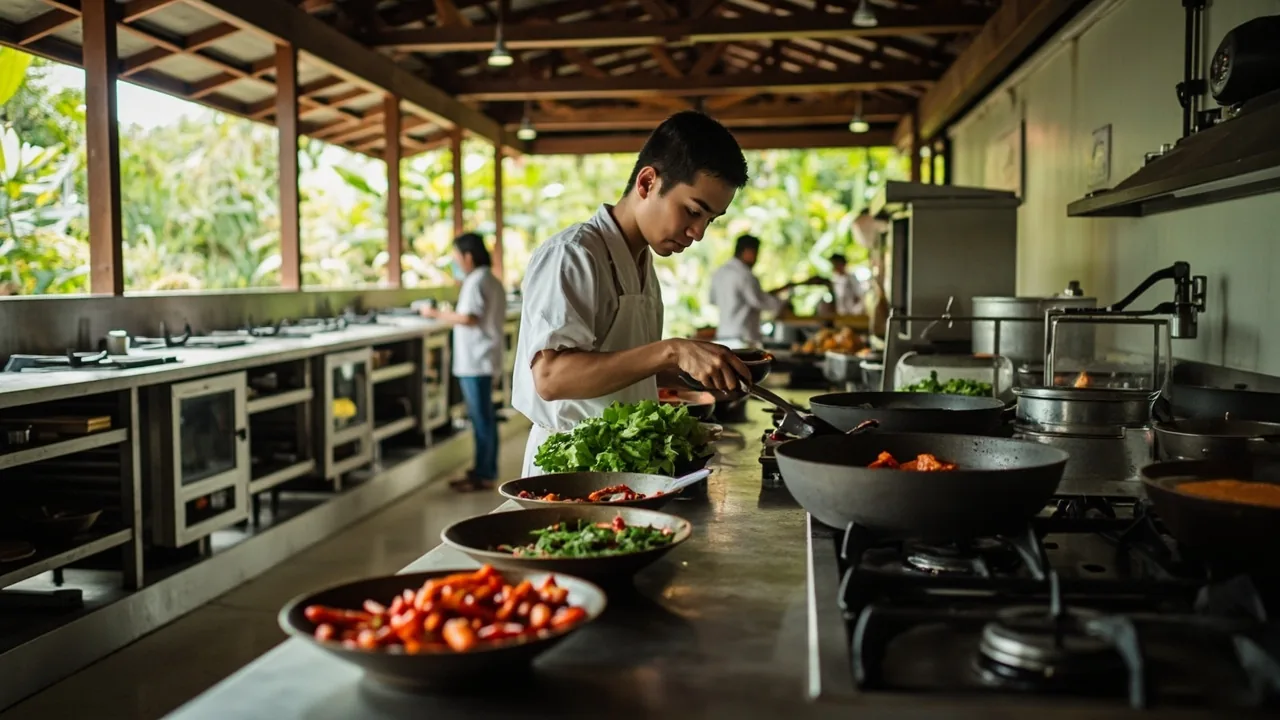
The headline name in Chiang Mai cooking classes, known for a structured market tour (around 30 minutes at a local market to see galangal, kaffir lime, lemongrass) then a hands-on cooking block where you cook 4 to 6 dishes from a menu of about 25. Group size usually runs 6 to 12 people. Standard full-day market + cook sits at ₹4,307 (~1,500 THB or ~$44.68), half-day at ₹3,446 (~1,200 THB or ~$35.74). The school is set in a garden compound just south of the old city with cooking stations in open-sided salas.
Basil’s Thai Cooking School
A more intimate operation, capped at around 8 students per session, with a focus on hands-on instruction. The ₹4,307 (~1,500 THB or ~$44.68) price buys the market tour plus the cooking plus a printed recipe book to take home (handy for reproducing khao soi back in a Bandra kitchen). The garden setting in a residential soi is what does it.
Baan Thai Cookery School
The budget option, sitting closer to ₹2,297-₹2,872 (~800-1,000 THB or ~$23.83-$29.79) for a half-day without a market tour, ₹2,872-₹3,733 (~1,000-1,300 THB or ~$29.79-$38.72) with one. The compound is bigger and runs multiple sessions a day so you can pick a morning slot and still make it to Doi Suthep by 3 pm. The cooks here are teachers by trade, so the explanations are slower and clearer, which matters when you don’t already know what galangal looks like next to ginger.
Galangal Cooking School
A newer, smaller studio run by a younger generation of Chiang Mai cooks who lean into Northern Thai dishes. The som tam and laab modules are stronger here than at the older schools. Pricing is around ₹2,872-₹3,446 (~1,000-1,200 THB or ~$29.79-$35.74) for a half-day, ₹4,020-₹4,594 (~1,400-1,600 THB or ~$41.70-$47.66) for a market-plus full-day. Class sizes of 4 to 6.
For a broader Chiang Mai city guide and food scene overview, the cooking class sits as a day-three recommendation, after the first two days of temple-hopping. If you’re building a vegetarian-first itinerary, see also vegetarian food in Thailand: what to eat, where to eat, how to ask.
What’s Included at Each Price
The price spread across Chiang Mai is mostly a question of three things: market tour, number of dishes, and group size. Here’s how it breaks down at the four schools above.
- ₹2,297-₹2,872 (~800-1,000 THB or ~$23.83-$29.79): Half-day, no market visit, group of 8 to 12, you cook 3 to 4 dishes. Plain instructions, printed recipe, water and tea. No lunch unless stated.
- ₹3,446-₹4,307 (~1,200-1,500 THB or ~$35.74-$44.68): Full-day or extended half-day, market tour included, group of 6 to 10, you cook 4 to 6 dishes. Lunch of what you’ve made is included at premium schools, otherwise just the cooking. Recipe booklet at the upper end.
- ₹4,307-₹6,317 (~1,500-2,200 THB or ~$44.68-$65.53): Full-day with hotel pickup in old city, market tour, individual cooking station rather than paired, 5 to 6 dishes. Some schools include a fruit carving demo or a Thai dessert specialty at this tier.
- ₹7,179-₹10,050 (~2,500-3,500 THB or ~$74.47-$104.25): Private class for 1 to 2 people. The teacher slows down for you, lets you pick which dishes to learn, and can lean harder into Indian-friendly spice levels since it’s just you.
For a snapshot of how these slots sit within a Thai trip budget overall, Thailand food cost per day: a backpacker’s daily breakdown shows what you should be paying for normal meals before and after the class.
What Indians Specifically Ask For
Three requests come up in every Indian group’s class booking, and the good schools know how to handle them.
Spice level adjustment. Thai chillies (prik kee nu, the small pointy ones) are not on the same heat scale as the Byadgi or Guntur chillies most Indians are used to. Ask the teacher to split the curry paste between two bowls: one with the full Thai amount, one with half. You can add paste to the milder half if you want more heat. Most teachers at Mama Noi, Basil’s, and Baan Thai will do this without being asked if you mention it at the start.
Vegetarian or vegan menu. Every school above has a separate veg menu which swaps fish sauce for soy sauce (and shrimp paste for, usually, fermented soybean paste). The surcharge at premium schools is ₹0-₹861 (~0-300 THB or ~$0-$8.94). At budget schools, no surcharge, but you may have to ask in advance.
Jain-friendly (no onion, no garlic). This is the one that takes more work. Northern Thai curries lean heavily on garlic, shallots, and a thick paste in the mortar. Tell them in the booking email and most schools can adjust 2 or 3 of their dishes to a Jain-friendly form. Don’t expect all 6 to convert cleanly. The schools that handle this best with no last-minute stress are Mama Noi and Basil’s, in that order.
Paying: Cash, Card, Forex
Every school accepts both Thai cash and Visa/Mastercard. The card machine rate is typically a couple of baht per 100 worse than the rate you got from your forex card in India, so the math is roughly: pay in baht on the card vs. Pay in baht in cash from a Wise/NIOMO/IndusInd forex card. The smart move is to bring the class fee out of an ATM in baht from a forex card that refunds ATM fees (the IndusInd Tiger and Niyo SBM cards both do), then pay cash in baht to the school. Saves a small but real amount.
If you’re trying to keep trip-wide costs tight, factor the class into your daily Chiang Mai budget. Most Indians on a backpacker pace will treat a ₹4,307 (~1,500 THB or ~$44.68) class as one full day’s food and activity budget, which is fair.
Where You’ll Eat What You Cooked
You’ll cook khao soi (green curry, or pad thai) and you’ll want to eat it again the same week, but cheaper than at at a tourist restaurant. Three places from the Chiang Mai shortlist that handle those dishes well:
- Mr. KAI Restaurant in the Nimman area does a modern khao soi with a coconut-cream finish that’s almost a different dish. Use this as your comparison point for what “advanced” looks like.
- Han Teung Chiangmai near the night market does a strong green curry and a serviceable pad thai at local prices.
For Indian fallback on the night you don’t want Northern Thai, Kanchan Indian Food (a small pure-veg family place) and Yummy India near the night bazaar (their pani puri at ₹287-₹459 (~100-160 THB or ~$2.98-$4.77) per plate is a popular order) keep both groups and solo Indian travellers fed.
For a more structured look at these spots and others across the city, see the broader Chiang Mai city guide.
What Cooking Class Day Looks Like
Rough timing, since this is the most common question after cost.
- 8:30 am: Hotel pickup (only at premium schools and only in the old city or nearby Nimman)
- 9:00 am: Arrive at the school, herbal welcome drink, introduce ingredients at the prep station
- 9:30 am: Walk to the local market with the teacher, 20 to 30 minutes, identify the ten herbs you’ll use
- 10:30 am: Back at the school, start cooking, first curry paste in the mortar
- 12:30 pm: Eat what you cooked for lunch, served buffet-style
- 1:30 pm: Cooking resumes for the dessert and a fifth or sixth dish
- 2:30 pm: Sit down for tea, recipe booklet, certificate (Mama Noi gives a real one), goodbyes
- 3:00 pm: Drop-off at hotel
If you’re booking the half-day option, the market tour is cut and you arrive at 11 am for two hours of cooking and a late lunch. Cheaper, but you miss the part Indians tend to find most useful (the herb identification).
Mistakes Indians Make When Booking
Book through a third-party aggregator for the convenience. This usually adds ₹574-₹1,149 (~200-400 THB or ~$5.96-$11.91) over the school’s direct rate and locks you into a specific time slot. Walk into any school the day before and book for the next morning.
Pick the cheapest school expecting the same herbs. The ₹2,297 (~800 THB or ~$23.83) half-day at Baan Thai is genuinely good value, but you’ll learn 3 dishes versus 5 at Mama Noi, and the market walk is shorter. If your goal is to cook at home for friends in Mumbai, the extra ₹2,010 (~700 THB or ~$20.85) at a premium school is worth it for the recipe booklet and the deeper explanations.
Assume the recipes will translate to Indian kitchens. Kaffir lime leaves, galangal, and Thai basil are all hard to source in India outside of speciality stores. A few you can sub (lemon zest for kaffir lime rind, ginger for galangal), but the result is a 70 percent version of the dish. Worth knowing before the class.
Forget to confirm the veg menu in writing. Schools occasionally forget the no-shrimp-paste swap if it’s only mentioned over the phone. Email the booking with “vegetarian, no fish sauce, no shrimp paste” in the message body, and you’ll get a confirmation reply that protects you on the day.
FAQ
Do the schools cater to Jain dietary rules (no onion, no garlic)?
Yes, the bigger ones (Mama Noi, Basil’s) handle this cleanly if you email in advance. Expect 2 to 3 of the dishes on the menu to be Jain-convertible rather than all of them.
Can I pay in Indian rupees?
No. Pay in Thai baht, either cash from an ATM withdrawal on a forex card or by card directly at the school. The day’s forex rate applies, not a special tourist rate.
Is the market tour safe for vegetarians?
Yes. The market walk is observational (you see herbs, paste, produce), no samples of meat. You will see whole chickens and pork being cut, which is unusual for some travellers but no safety concern.
Should I book before arriving in Chiang Mai or after?
After is fine for group classes in low season (April to October). In high season (November to February), book 2 to 3 days ahead because the morning slots fill, especially at Mama Noi and Basil’s.
What if I have dietary restrictions beyond vegetarian?
Email the school before arrival. Gluten-free and nut-free are both straightforward. Diabetic menu adjustments require more lead time and most schools will only do this for private bookings.
Do I get to keep the recipes?
Premium schools give you a printed recipe booklet. Budget schools give you handwritten notes or a single printed page per dish. Take photos during the cooking in case the printed version is thin.
