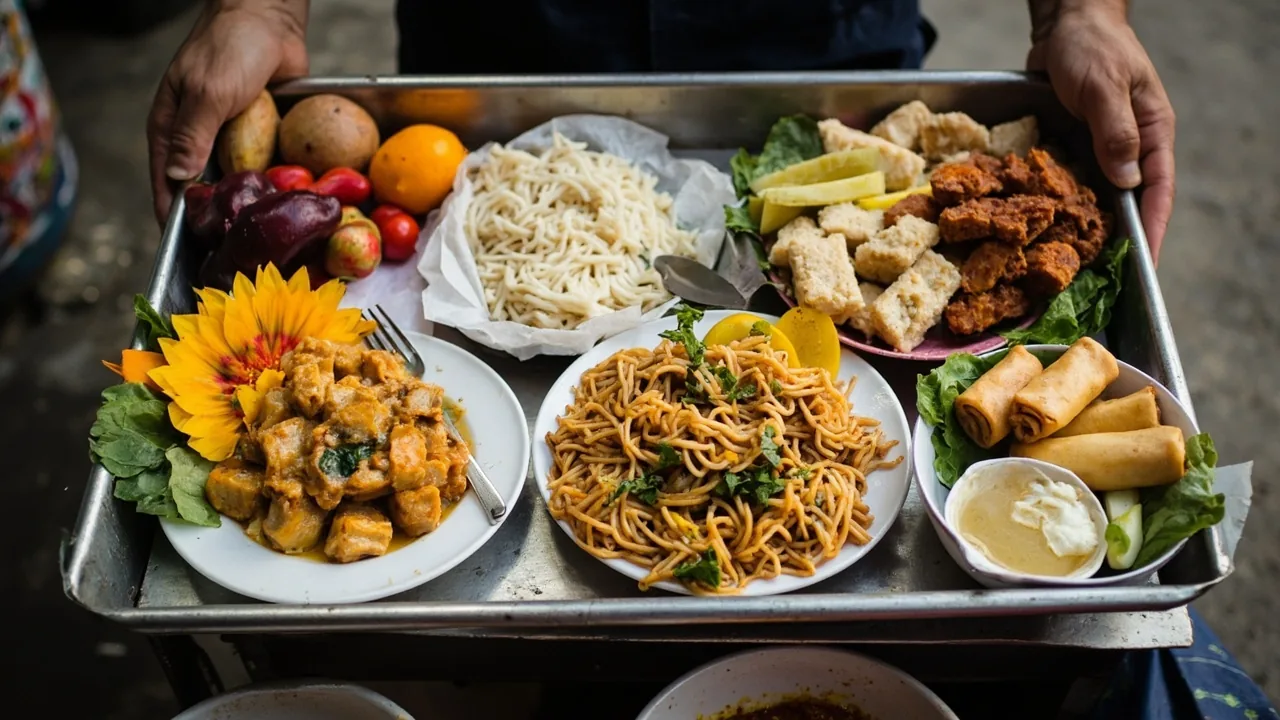
Thailand Vegan Food Tour: Where to Eat Plant-Based in Bangkok, Chiang Mai & Phuket
Thailand is one of the easiest countries in Southeast Asia to eat plant-based, but only if you know the system. The word you need is Jay (เจ), the yellow flag with red text that marks vegan stalls during the annual Tesagan Gin Jay festival (also called the Vegetarian Festival or Nine Emperor Gods Festival), and the handful of restaurant clusters that make Bangkok, Chiang Mai, and Phuket genuinely livable for Indian vegans and vegetarians. At current rates (1 THB = ₹2.87), a bowl of plant-based Pad Thai at 60 THB costs ₹172 (~$1.79), a fresh coconut at ₹114 (~40 THB or ~$1.19) costs ₹115 (~$1.19), and a full vegan set at a dedicated Jay restaurant runs ₹286-₹515 (~100-180 THB or ~$2.97-$5.34). This guide covers where to eat, what to order, and how to read the festival yellow flags when the calendar turns. For related planning, see our guide on Sea Backpacking Hub.
Subodh’s Pro Tip: The single most useful thing any plant-based traveller can do in Thailand is learn to read the Jay (เจ) sign. A yellow background with red Chinese-style characters means the stall or restaurant is serving vegan food for the festival period, and during the Nine Emperor Gods Festival in late September/October, that yellow flag is everywhere from Bangkok’s Chinatown to Phuket’s old town. Outside festival season, look for permanent Jay restaurants rather than relying on festival stalls.
Quick Answers
| What | Answer | Price (INR) |
|---|---|---|
| Magic word for vegan food | Jay (เจ), yellow flag with red text | 0 THB |
| Average Pad Thai Jay at a street stall | Stir-fried noodles, no egg, no fish sauce | ₹172 (~60 THB or ~$1.78) |
| Average plant-based green curry with rice | Coconut curry, tofu or veg only | ₹229-₹343 (~80-120 THB or ~$2.37-$3.56) |
| Bangkok vegan food tour (group, 3-4 hours) | Chinatown + Jay stalls, guide-led | ₹3,431-₹7,147 (~1,200-2,500 THB or ~$35.61-$74.19) |
| Tesagan Gin Jay festival dates | Late September / early October, 9 days | 0 THB |
The Local Culinary Landscape
Thailand is a Buddhist country and vegetarianism has real cultural roots, but the everyday Thai kitchen leans hard on fish sauce (น้ำปลา nam pla), shrimp paste (กะปิ kapi), oyster sauce, lard, and chicken stock as background flavour. Almost every stir-fry, soup, and curry starts with one of these. Calling a dish “veg” in Thailand without specifying usually means “vegetable, but seasoned with fish sauce and chicken broth.” It does not mean what an Indian vegetarian means.
The two systems that work:
- Jay (เจ) during festival season and at permanent Jay restaurants. Jay means strictly vegan and traditionally excludes onion, garlic, and certain other aromatic vegetables. For Jains this is the safest label in Thailand.
- “Mang Sa Wirat” (มังสวิรัติ) for permanent “ovo-lacto vegetarian” restaurants, mostly in tourist zones, where eggs and dairy are fine but meat is out.
Outside these two systems, every dish needs to be ordered with a fish-sauce-substitute request. Most street stalls will say yes to soy sauce instead of fish sauce if you point and ask. Indian travellers report that 7-Eleven sandwiches and packaged food in Thailand are not a fallback for veg, they are usually mayonnaise-and-ham or fish-based.
For broader Thai veg context across the country, the Thailand vegetarian survival guide covers phrases and ordering tactics that work in any Thai city.
Key Phrases in Local Script
Print this section, screenshot it, or save it offline. Hand the phone to the cook.
| English Phrase | What It Means | Local Script | Pronunciation |
|---|---|---|---|
| I am vegan (no meat, fish, egg, dairy) | Strict plant-based | ฉันกินเจ | chin kin jay |
| No fish sauce | Substitute soy or salt | ไม่ใส่น้ำปลา | mai sai nam pla |
| No shrimp paste | Important in curries and stir-fries | ไม่ใส่กะปิ | mai sai kapi |
| No egg | For Pad Thai etc. | ไม่ใส่ไข่ | mai sai khai |
| No oyster sauce | Common in morning glory, mushrooms | ไม่ใส่น้ำมันหอย | mai sai nam man hoy |
| No meat, no seafood | Belt and braces | ไม่ใส่เนื้อสัตว์ ไม่ใส่อาหารทะเล | mai sai nuea sat, mai sai ahan talay |
| No onion, no garlic | For Jains and strict Jay | ไม่ใส่หัวหอม ไม่ใส่กระเทียม | mai sai hua hom, mai sai kratiam |
| Is this Jay / vegan? | Pointing at a dish | อันนี้เจไหม | an nee jay mai |
| Only vegetables, no broth | Important for soups | ผักอย่างเดียว ไม่ใส่น้ำซุป | phak yang diao, mai sai nam sup |
These eight phrases cover roughly 95% of ordering situations. The “is this Jay?” question is the single most useful, because it outsources the whole translation problem to the cook.
Where to Eat Plant-Based: Bangkok, Chiang Mai & Phuket
This is the section the rest of the article builds toward. Three cities, three different food personalities, all of them workable for plant-based travellers.
Bangkok: Jay Restaurants and Chinatown Stalls
Bangkok has the deepest plant-based infrastructure in Thailand, mostly because of Tesagan Gin Jay (เทศกาลกินเจ), the Nine Emperor Gods Vegetarian Festival celebrated annually in Chinatown (Yaowarat). Outside festival week there are still permanent Jay restaurants, Indian restaurants with vegan sections, and a growing vegan cafe scene.
Two booking options worth knowing about, both heavily searched by Indian travellers planning plant-based Bangkok trips:
- Bangkok group vegan food tour: Most operators run 3-4 hour Chinatown walks with English-speaking guides who handle the fish-sauce language barrier and walk you through 8-12 tastings. Group tours typically run ₹3,431-₹7,147 (~1,200-2,500 THB or ~$35.61-$74.19) per person including the food.
- Private guided vegan street food walk: Same idea, one guide for your group, deeper on dietary requirements and Jain-friendly ordering. Usually ₹7,147-₹12,865 (~2,500-4,500 THB or ~$74.19-$133.54) for 2-4 guests, prices double around festival week.
For bookable guided options across the country, browse Thailand food tours on GetYourGuide to see what’s running during your dates. Festival-week tours sell out weeks ahead, so book early if you’re targeting late September or early October.
Local Thai spots to know in Bangkok:
- Aonchorn Thai restaurant ออนชอน ราชดำเนิน (4.9): A local Thai restaurant on Ratchadamnoen with authentic flavours and cosy vibes, the kind of place Bangkokians eat at. Order the green curry with tofu (no fish sauce) at around ₹343 (~120 THB or ~$3.56).
- Jim Thompson, A Thai Restaurant (4.8): Authentic Thai cuisine in a charming, traditional setting, the kind of spot worth one dress-up dinner when family is travelling with you. Set menus run ₹2,287-₹4,288 (~800-1,500 THB or ~$23.74-$44.51), with vegan options on request.
Indian / vegan-friendly fallback in Bangkok:
When you’ve been eating Jay rice for four days straight and need a proper dal or masala dosa, the Indian restaurants in Bangkok guide covers the diaspora spots across Silom, Sukhumvit, and Phra Khanong. Most have a marked vegan section and Jain-friendly prep if you call ahead.
Chiang Mai: The Plant-Based Capital
Chiang Mai is the easiest Thai city to eat plant-based. The old city and Nimmanhaemin area are dense with vegetarian restaurants, Jay restaurants, and vegan cafes. The Sunday Walking Street and Saturday Walking Street markets both have permanent vegan sections with yellow Jay flags on every other stall during the autumn festival, and year-round plenty of stalls label dishes “no meat” or “Jay.”
Local Thai spots in Chiang Mai:
- Thai Food Good Taste - Chiang Mai (4.7): Authentic Thai flavours in a cosy setting, a strong khao soy (northern Thai coconut curry noodles) at ₹172-₹229 (~60-80 THB or ~$1.78-$2.37), ask for the vegan version with tofu and no fish sauce.
- Uchi Gastrobar Japanese Food & Sushi (4.7): Not Thai, but useful when the group is split between veg sushi rolls and cooked food. Sushi sets run ₹572-₹1,144 (~200-400 THB or ~$5.94-$11.87), vegan cucumber/avocado rolls available.
Indian / vegan-friendly in Chiang Mai:
- Chai “N” Thai @ Nimman Indian Restaurant (4.9): Best Indian food in Chiang Mai with vegan options, both North and South Indian, near Nimman. Paneer and chana dishes at ₹429-₹715 (~150-250 THB or ~$4.45-$7.42).
- Little Indian kitchen Chiang Mai Night Bazaar (4.9): A cosy, family-run spot in the Night Bazaar with halal-certified, spicy South Indian and vegan-friendly dishes. Idli, dosa, and chana masala around ₹229-₹429 (~80-150 THB or ~$2.37-$4.45).
- Chada Vegetarian Restaurant Chiang Mai (4.8): Cozy vegetarian spot mixing local Thai and Indian dishes, useful when one person wants Pad Thai and another wants palak paneer.
For a deeper dive into plant-based eating in the surrounding mountains, the Chiang Dao vegetarian food guide covers what to eat a few hours north of the city.
Phuket: Old Town and Beach Mix
Phuket’s plant-based scene splits between Phuket Old Town (best for traditional Thai and Peranakan-Baba veg dishes, plus Indian restaurants) and the beach strips (Patong, Kata, Karon, mostly international vegan cafes and smoothie bowls).
Local Thai spots in Phuket:
- Phuket thailand (4.7): A traditional Thai restaurant offering authentic local cuisine, the kind of spot that draws Thai families on weekends. Set menus around ₹572-₹1,144 (~200-400 THB or ~$5.94-$11.87) with vegan options.
- Foodee’s Phuket (4.9): Casual eatery serving Thai and international favourites, useful for groups where some want burgers and others want Pad Thai Jay at ₹229 (~80 THB or ~$2.37).
- Lao Pa Sat Phuket Town (4.8): A traditional market with local food and goods, the best place in Phuket Old Town to graze through multiple stalls in one go. Open in the evenings, vegan vendors cluster near the main entrance.
- The Simple (4.9): Simple, well-executed Thai meals in a casual setting. Curries and stir-fries around ₹229-₹343 (~80-120 THB or ~$2.37-$3.56), easy to veganise.
- Local Canteen Phuket (4.9): Affordable Thai dishes, the budget pick of the bunch at ₹143-₹229 (~50-80 THB or ~$1.48-$2.37) per plate.
Indian / vegan-friendly in Phuket:
- Vrindavan - Indian, Vegetarian Restaurant in Phuket, Thailand (4.9): A serene, upscale venue serving traditional North Indian vegetarian delicacies, including Jain-friendly preparations if you mention it at booking.
- INDIAN Bites Cafe & Vegetarian and Vegan Restaurant (4.9): A health-focused cafe offering South Indian vegetarian and vegan dishes, good thalis and dosas around ₹429-₹715 (~150-250 THB or ~$4.45-$7.42).
- Shree Ganesha 2 Pure Veg & Jain Food (4.9): Family-friendly spot in Phuket offering authentic North Indian vegetarian and Jain cuisine, a reliable fallback for families travelling with elders.
Phuket is also the home of one of the most spectacular Tesagan Gin Jay celebrations in Thailand, see the festival section below.
For the dessert angle that every vegan traveller eventually asks about, the mango sticky rice guide covers where to find plant-based versions (coconut milk + sticky rice + ripe mango, vegan in most places) and what to skip.
Safe Local Street Food Dishes
These are dishes that are either plant-based or one ask away from vegan. All prices in THB, the local currency.
Pad Thai Jay (ผัดไทยเจ), ₹172-₹229 (~60-80 THB or ~$1.78-$2.37). Stir-fried rice noodles with tofu, bean sprouts, peanuts, lime, and chives. Skip the dried shrimp and ask for no egg, no fish sauce, substitute soy. Most street stalls will do this for free.
Som Tam Jay (ส้มตำเจ), ₹114-₹172 (~40-60 THB or ~$1.19-$1.78). Green papaya salad, normally made with fish sauce and dried shrimp. Ask for no fish sauce, no shrimp paste, no crab, add peanuts. Northern Thai versions from Chiang Mai are milder than the Isan original.
Khao Soy Jay (ข้าวซอยเจ), ₹172-₹257 (~60-90 THB or ~$1.78-$2.67). Chiang Mai’s coconut curry noodle soup. The Chiang Mai default is chicken, but most khao soy vendors will make a vegan version with tofu if you order ahead or at a stall that already advertises Jay. Skip the pickled mustard greens and shallots on the side if you’re strict Jain.
Pad Pak Ruam Jay (ผัดผักรวมเจ), ₹143-₹229 (~50-80 THB or ~$1.48-$2.37). Stir-fried mixed vegetables, usually broccoli, cabbage, carrot, and morning glory. No oyster sauce, no fish sauce, soy sauce instead.
Mango Sticky Rice (ข้าวเหนียวมะม่วง), ₹143-₹229 (~50-80 THB or ~$1.48-$2.37). Sweet sticky rice with coconut milk and ripe mango. Vegan, but check: some vendors add egg yolk to the coconut cream for richness. Skip the salted egg yolk topping if it’s offered.
Fresh Fruit, ₹86-₹172 (~30-60 THB or ~$0.89-$1.78) per plate. Mango, pineapple, watermelon, papaya, dragon fruit. Available at every street market, vegan, and a cheap breakfast backup.
Coconut water, ₹86-₹143 (~30-50 THB or ~$0.89-$1.48). Fresh young coconut, cracked open in front of you. One of the cleanest things you can drink in Thailand.
Tesagan Gin Jay: The Vegetarian Festival
Tesagan Gin Jay (เทศกาลกินเจ) translates literally as “Festival of Eating Jay.” It’s a Taoist celebration honouring the Nine Emperor Gods, observed by Thai-Chinese communities, with the largest celebrations in Phuket (especially in Phuket Old Town), Bangkok’s Chinatown (Yaowarat), and parts of Chiang Mai.
The festival typically runs for nine days in late September or early October, tied to the Chinese lunar calendar. During those nine days, devotees go fully vegan (no meat, fish, eggs, dairy, plus no onion, garlic, strong-smelling vegetables, and alcohol). Hundreds of street stalls and restaurants in festival areas switch to fully vegan menus, marked with the yellow flag with red Chinese characters that signals Jay food.
What visitors experience:
- Stalls on every corner of Yaowarat Road in Bangkok, and the central streets of Phuket Old Town, all serving Jay versions of standard Thai dishes: Jay Pad Thai, Jay curries, Jay noodle soups, all at ₹114-₹229 (~40-80 THB or ~$1.19-$2.37).
- Processions through the streets, including the famous Mah Song spirit mediums who pierce their cheeks with metal rods and parade as vessels for the gods. This is sacred to participants and a major spectacle for visitors; bring a camera but do not photograph individuals without asking.
- Large red-and-gold shrines at temple entrances with incense, offerings, and quiet crowds.
- Strict vegan menus even at non-Chinese restaurants in the area, because local Thai Buddhists often observe a milder version of the festival.
Practical tips for visitors:
- Plan accommodation in Phuket Old Town or Bangkok’s Chinatown if you want to walk out of the hotel into the action.
- Yellow Jay flags are the universal signal. If you see one, the food is safe.
- Festival week is one of the cheapest weeks to eat well in Thailand, because stalls compete on price. 40 THB gets you a full plate.
- Respect the processions. They are religious events, not street theatre.
- Bring your own water bottle; the crowds and the incense smoke dehydrate you fast.
For vegan travellers who plan their whole Thai trip around festival week, Phuket is the better choice over Bangkok: smaller crowds, easier logistics, and the Phuket Old Town celebrations are widely considered the most authentic in the country.
Getting Connected
A working data connection is the difference between guessing at a Jay stall and Google Maps-ing one in three seconds. AIS, TrueMove H, and dtac all sell tourist SIMs at Bangkok, Chiang Mai, and Phuket airports, with 7-day and 15-day plans starting at ₹855 (~299 THB or ~$8.87). If you arrive without one, the eSIM alternative lets you skip the airport counter and activate before you land, useful if you’re arriving late or just don’t want to queue. Get Nomad eSIM covers Thailand on most plans and the activation takes about two minutes after install.
Food Safety & Hygiene
Subodh’s Safety Alert: Street food in Thailand is generally safer than its reputation suggests, because high turnover means fresh food and busy stalls are watched by repeat locals. The classic “Delhi belly” causes are undercooked raw meat, ice from unclean water, and food left sitting in the sun. Plant-based eaters have one less risk vector than meat eaters because animal protein is what spoils fastest.
Practical rules:
- Eat at stalls with a queue or with most tables full. Turnover is your friend.
- Skip pre-cut fruit that has been sitting in the open for hours. Buy a whole coconut or a pre-cut piece served straight from the cooler.
- Drink bottled or filtered water, even at mid-range restaurants. A 600ml bottle is ₹20 (~7 THB or ~$0.21) at any 7-Eleven.
- Avoid ice unless you’re sure it came from a clean source. Most restaurants in tourist zones are fine; rural stalls are a calculated risk.
- Wash your hands before eating or carry hand sanitiser. Markets get grimy by hour four.
- Bring oral rehydration salts (ORS). Pharmacies (ร้านขายยา) carry them everywhere, and one sachet in bottled water rescues you faster than anything else after a bad meal.
- Avoid raw or undercooked sprouts, which are common in stir-fries but a common bacterial carrier in tropical heat.
If you do get sick, Thai pharmacies can sell loperamide and oral rehydration without a prescription, and most private hospitals in Bangkok, Chiang Mai, and Phuket have English-speaking staff used to tourist cases.
Common Food Mistakes Indians Make
Mistake 1: Trusting the word “vegetarian” without asking about fish sauce. Thai menus often list a “vegetable” version of a dish that still uses fish sauce, shrimp paste, or chicken stock. “Vegetable Pad Thai” can mean “Pad Thai with tofu but the same fish sauce.” Always ask “no fish sauce” (mai sai nam pla) even when ordering what looks like a veg dish.
Mistake 2: Assuming street vendors understand “no egg” on Pad Thai. Most do, but the egg is often cracked into the wok first and the noodles are added after. A safer ordering tactic is “Pad Thai Jay, no egg” which triggers the full Jay prep. Travellers report that during festival week, ordering Pad Thai Jay anywhere in a Jay-flagged area is faster than arguing substitutions at a non-Jay stall.
Mistake 3: Eating at hotel breakfast buffets without checking labels. International hotel buffets in Thailand often have hidden pork in the congee, fish sauce in the green curry, or shrimp paste in the “vegetable” fried rice. Check the small print cards, or stick to the labelled vegetarian section. The Five-Star Hotel breakfast buffet is where most Delhi-belly cases for Indian travellers originate, not the street stall.
Mistake 4: Confusing “vegetarian Thai food” with “vegan Thai food”. A lot of Thai “vegetarian” cafes serve eggs and dairy freely. For strict vegans, look for the word Jay or check the menu for a separate “vegan” tag.
Mistake 5: Drinking the brown sauce without asking. That dark sauce on the table is usually soy mixed with fish sauce (straight fish sauce). Use it sparingly, or skip it.
Mistake 6: Ordering “curry without meat” and getting chicken anyway. A surprising number of Thai waiters hear “without meat” and substitute chicken. Repeat the request, and add “no chicken, no shrimp, no pork, only vegetables and tofu.” Travellers report that the magic phrase is “gin jay, mai sai nuea sat” (I eat Jay, no animal products).
FAQ
Q: What is the Vegetarian Festival in Thailand and when is it?
The Vegetarian Festival (Tesagan Gin Jay) is an annual nine-day Taoist celebration tied to the Nine Emperor Gods, observed by Thai-Chinese communities. It runs in late September or early October (Chinese lunar calendar, exact dates shift year to year). The biggest celebrations are in Phuket Old Town and Bangkok’s Chinatown (Yaowarat). During the festival, hundreds of stalls and restaurants serve fully vegan food marked with yellow Jay flags, and the streets fill with processions and spirit-medium ceremonies.
Q: Is Bangkok safe for vegan travellers?
Yes, Bangkok is one of the easiest cities in Southeast Asia for vegan travellers year-round. The trick is the Jay label, either at permanent Jay restaurants or during the September/October Vegetarian Festival. Outside festival week, plan on vegan-friendly Indian restaurants, dedicated vegan cafes, and street stalls where you can confidently ask for “no fish sauce, no egg, no oyster sauce.” Guided Chinatown vegan food tours make the first two days trivially easy.
Q: Can I get Jain food (no onion, no garlic) in Thailand?
Yes, but mainly at Indian restaurants in Bangkok, Chiang Mai, Phuket, and the major tourist islands. Strict Jain options at Thai street stalls are limited outside festival week because most Jay recipes still use garlic. During Tesagan Gin Jay, Jay food is by tradition no onion, no garlic, which means it lines up perfectly with Jain requirements. Several Indian restaurants explicitly mark Jain-friendly items on their menus, and Shree Ganesha in Phuket and Vrindavan in Phuket both have Jain prep on request.
Q: Do I need to book a guided Bangkok vegan food tour, or can I DIY?
DIY is fine if you’re comfortable with the Thai phrase set above, or if you’re visiting during festival week when every other stall is Jay-marked. A guided tour is worth it if: it’s your first time in Bangkok, you’re arriving outside festival week, you’re a strict vegan who doesn’t want to negotiate every substitution, or you want the cultural context on Yaowarat’s Taoist traditions. Tours typically run ₹3,431-₹7,147 (~1,200-2,500 THB or ~$35.61-$74.19) per person for a 3-4 hour Chinatown walk.
Q: How much should I budget per day for plant-based food in Thailand?
A comfortable vegan backpacker budget is ₹1,144-₹1,715 (~400-600 THB or ~$11.87-$17.81) per day across Bangkok, Chiang Mai, or Phuket, including one main meal at a casual Jay restaurant (₹229-₹429 (~80-150 THB or ~$2.37-$4.45)), a street meal (₹114-₹229 (~40-80 THB or ~$1.19-$2.37)), snacks and fruit (₹143-₹286 (~50-100 THB or ~$1.48-$2.97)), and drinks. Indian restaurants run higher at ₹429-₹858 (~150-300 THB or ~$4.45-$8.90) per dish. Festival week is cheaper because Jay stalls are abundant and competitive.
Q: What is the best Thai city for vegan food: Bangkok, Chiang Mai, or Phuket?
For density of vegan-only restaurants, Chiang Mai wins. For festival spectacle and variety, Phuket wins during Tesagan Gin Jay. For logistics, year-round options, and Indian restaurant fallback, Bangkok wins. Most plant-based travellers do a Bangkok-Chiang Mai-Phuket loop and eat well at all three.
Q: Is the food at the Vegetarian Festival vegan?
Yes, and stricter than standard vegan: by tradition, festival Jay food is no meat, no fish, no egg, no dairy, no onion, no garlic, no strong-smelling vegetables, no alcohol. Yellow Jay flags indicate a stall observing these rules. Travellers report occasional slip-ups at smaller stalls, so if you’re strict, pick the busiest Jay stall on the street.
Subodh’s Take
Thailand is one of the underrated wins for plant-based Indian travellers, and most people overthink it. Learn Jay, learn mai sai nam pla, screenshot the phrase table above, and the country’s three main cities become trivially navigable. Add the Tesagan Gin Jay festival in late September or early October and you get nine days of cheap, abundant, and culturally rich vegan food. If you’re choosing one festival timing, pick Phuket; if you’re choosing one city, pick Chiang Mai; if you’re choosing one combined experience, do Bangkok + Phuket during festival week.
