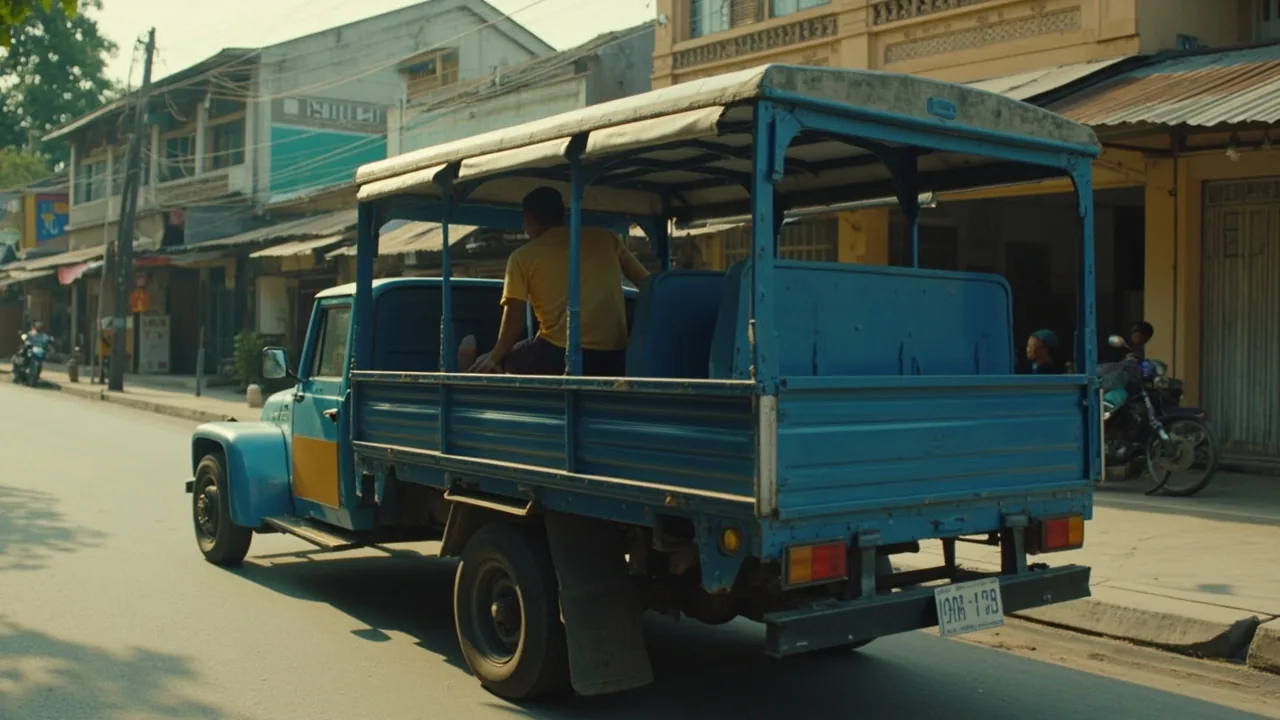
Getting Around Kanchanaburi: Buses, Songthaews & Motorbike Rentals Explained
Kanchanaburi’s public transport is functional, cheap, and genuinely useful for the central town. You can get around without your own wheels, but you should also know when a motorbike rental saves time and money. For related planning, see our guide on getting around Southeast Asia by bus, train, and rental scooter across neighbouring hubs.
Here is the kanchanaburi public transport playbook: what works, what doesn’t, and the one Thai-specific landmine every Indian backpacker hits within 48 hours of arriving, police checkpoints, IDP rules, and what happens when you don’t have the right paperwork.
Quick Answers
| What | Answer | Price (INR) |
|---|---|---|
| Cheapest way to get around central Kanchanaburi | Songthaew (shared red truck) | ₹29 (~10 THB or ~$0.30) |
| Typical songthaew charter for the day | Private hire to Erawan/Hellfire Pass area | ₹2,287-₹3,431 (~800-1,200 THB or ~$23.74-$35.61) |
| Motorbike rental (automatic scooter, 110-125cc) | Per day from most shops in town | ₹575 (~200 THB or ~$2.07) |
| Public bus to Erawan National Park | Minivan from Kanchanaburi bus station | ₹287 (~100 THB or ~$1.04) |
| Police fine for no helmet / no IDP at checkpoint | On-the-spot fine at local station | ₹1,429-₹2,859 (~500-1,000 THB or ~$14.84-$29.68) |
Why Kanchanaburi Works Without a Car
The province is built around one main highway (Route 323) running north-south, and the Thai minivan/songthaew system was designed for exactly this kind of linear geography. Most backpackers overthink the transport here and end up renting a motorbike on day one when a songthaew charter would have cost less, gotten them further, and avoided the IDP hassle.
That said. The falls, the caves, and the best viewpoints are 30+ km from town. Doing those by songthaew means waiting, flagging down trucks, and burning half a day each way. A motorbike cuts Erawan Falls from a 4-hour round trip into a 90-minute ride.
The smart move, and the one I usually recommend: rent a bike for 2-3 days to cover the outer attractions, and use songthaews + walking for the town centre stuff (River Kwai bridge, the night market, the restaurants). Don’t rent for your entire stay unless you’re heading somewhere remote like Khao Poon Camping or 323 camp, which genuinely need two wheels to reach. For the full city overview, see our Kanchanaburi city guide.
Before you even consider renting anything with an engine, the ASEAN driving permit guide is worth reading.
Kanchanaburi Songthaew: How the Red Trucks Work
A songthaew in Kanchanaburi is a pickup truck with two bench seats in the back, usually painted red or yellow, that runs a set route through town. You flag it down like a bus, hop in the back, and pay when you get off. There’s no meter, no app, no fixed schedule. The driver goes when the truck is full or when they decide to leave.
Shared Songthaew (Local Runs)
Within Kanchanaburi town, the songthaews loop along the main road past the bus station, the River Kwai bridge, and most of the guesthouses on the river side of town. Fare is fixed by locals: ₹29 (~10 THB or ~$0.30) per person for any in-town hop. That’s it. No need to ask, no need to negotiate. Pay when you step out.
For backpackers this is the closest thing to a free public bus that Thailand has, and it runs roughly every 10-15 minutes during the day. After 6 pm, service thins out. After 9 pm, you’re walking or flagging down a passing motorbike taxi.
Chartered Songthaew (Day Trips)
This is where songthaews become genuinely useful for Indian travellers. For ₹2,287-₹3,431 (~800-1,200 THB or ~$23.74-$35.61) you can charter the whole truck for a half-day or full-day trip to Erawan Falls, the Krasae Cave, or any of the caves south of town. Split four ways with other backpackers from your hostel, that’s ₹572-₹858 (~200-300 THB or ~$5.94-$8.90) per person for transport that would otherwise cost you a full-day minivan tour at 5x the price.
Tell the driver your pickup time and where you want to go. Most accommodation owners in Kanchanaburi will book this for you at the front desk. Pay at the end of the day, in cash, directly to the driver. Don’t prepay through a “tour agent” who adds a markup for doing nothing.
Kanchanaburi Buses & Minivans to Major Attractions
The Kanchanaburi bus station sits on the north side of town, about 3 km from the River Kwai bridge area. From here you can reach almost every major attraction without a motorbike.
To Erawan National Park
Public minivans leave from the bus station throughout the morning, roughly every 30-45 minutes from 8 am to noon. The ride takes about 90 minutes and drops you at the Erawan park entrance. Last return minivan from Erawan leaves around 4 pm. If you miss it, you’re flagging down a songthaew back to the main highway and praying. It.
Fare: ₹286 (~100 THB or ~$2.97) one way.
To Hellfire Pass (Nam Tok area)
Slower option. Take the local train from Kanchanaburi railway station to Nam Tok, the end of the line. It takes about 3 hours, costs around ₹286 (~100 THB or ~$2.97) for third class, and passes through some genuinely stunning cliff scenery. From Nam Tok station, songthaews run up to the Hellfire Pass Memorial Museum for another ₹286 (~100 THB or ~$2.97). The downside: trains run only 2-3 times a day. Check the schedule at the station before you commit.
The other option is a direct minivan from Kanchanaburi bus station to Hellfire Pass, but these are infrequent and most travellers end up doing it as part of a tour.
To Ayutthaya
This is the leg that makes 12go worth using. Minivans run direct from Kanchanaburi to Ayutthaya (and onward to Bangkok) several times a day. If you’re continuing north or south after Kanchanaburi rather than back to Bangkok, book the Kanchanaburi to Ayutthaya leg on 12go at ₹1,830 (~19 USD), which is roughly what the minivan counter at the bus station charges anyway, with the upside of a confirmed seat and refund if it gets cancelled.
Within Town
The Kanchanaburi local bus system is the songthaew network described above. There’s a separate “town bus” that runs a fixed loop a few times a day, but it’s slower and less frequent. Skip it. Use the songthaew.
Motorbike Rental in Kanchanaburi
Most guesthouses rent bikes, and there are dedicated rental shops along the main road. A 110-125cc automatic scooter (Honda Click, Yamaha Mio, Honda Wave) goes for ₹572-₹858 (~200-300 THB or ~$5.94-$8.90) per day. A bigger 150-160cc semi-automatic or manual scooter runs ₹1,001-₹1,429 (~350-500 THB or ~$10.39-$14.84). A proper 250cc+ motorcycle (think Honda CBR or Kawasaki Versys) starts at ₹2,287 (~800 THB or ~$23.74) and goes up.
The catch with Kanchanaburi rentals specifically: most shops require either a passport copy + cash deposit (₹2,859-₹5,718 (~1,000-2,000 THB or ~$29.68-$59.35)), or just a cash deposit. Few accept just a credit card imprint. Bring cash for the deposit.
Subodh’s Pro Tip: Kanchanaburi rental shops are noticeably more relaxed than Chiang Mai or Pai about checking your license. Don’t take this as a green light. The police checkpoints on Route 323 between Kanchanaburi and Erawan are real, they’re frequent, and they will fine you. The shop owner’s shrug doesn’t transfer to the cop’s clipboard. For a broader look at motorbike rental norms across the region, see our Getting Around Thailand guide.
Do You Need an International Driving Permit?
Legally, yes. Thai law requires a valid IDP with motorcycle endorsement to ride any two-wheeler with an engine above 50cc. Practically, enforcement is patchy, but the checkpoints on the way to Erawan Falls are staffed regularly, and the fine for riding without one is ₹1,429-₹2,859 (~500-1,000 THB or ~$14.84-$29.68).
For Indian travellers, you need the IDP issued by the Regional Transport Authority in India, the one based on the 1949 Geneva Convention (not the 1968 Vienna Convention version). Apply online through Parivahan Sewa before you fly, the process typically takes a few weeks, so don’t leave it to the last minute. The application rules and what counts as a valid motorcycle endorsement vary a lot between Asean countries, so if you’re crossing into other SEA countries on the same trip, our SEA Backpacking Hub covers the full regional overview.
Your Indian car license alone is not valid for motorcycles in Thailand. This is the single most common reason Indian backpackers get fined at checkpoints, and it voids any travel insurance claim if you crash.
Pre-Ride Inspection Checklist
Spend 5 minutes on this before you leave the shop. Photos and video. Time-stamped.
- All existing scratches and dents, photographed from arm’s length
- Both brake levers (front and rear), squeeze test
- Headlight and tail light on
- Indicators working
- Tire tread, no cracks, no exposed threads
- Mirror adjustments
- Helmet with working chin strap (Thai law requires the helmet to be strapped)
If anything is off, point it out to the shop owner and have them mark it on the rental agreement. If they won’t, walk away. There are several rental shops in town. None of them are irreplaceable.
Police Checkpoints on Route 323
The road north to Erawan Falls passes through permanent police checkpoints. They’re set up to catch unlicensed riders and unhelmeted riders, both of which are common violations among backpackers on this exact route.
What happens at a checkpoint:
- They wave you over. Stop. Turn off the engine. Smile.
- They ask for your license (Thai IDP) and passport.
- If you have both, they let you go. Maybe a 30-second conversation about where you’re headed.
- If you don’t have an IDP, they write you a ticket. Fine is ₹1,429-₹2,859 (~500-1,000 THB or ~$14.84-$29.68), paid at the local police station (not to the officer directly). You get a receipt.
- If you don’t have a helmet on, separate fine. Same amount. Same process.
The receipt from a paid fine acts as a waiver for the same offence for the next 3 days. Keep it on the bike.
Safety Alert: Do not, under any circumstances, hand over your actual passport at a checkpoint as “collateral” while the fine is “processed.” They take your passport to the station, you take a songthaew there, you pay, you get the passport back, but this can take hours and some travellers report being asked for “tea money” to speed it up. Pay the fine, get the receipt, walk away with your passport. Always.
Getting Connected (eSIM)
You need data to use Grab/Bolt for late-night songthaew replacements, to check bus schedules, and to navigate the roads to Erawan on a rented motorbike. AIS and TrueMove tourist SIMs are sold at 7-Eleven for ₹855 (~299 THB or ~$8.87) for 8 days with 15 GB. The airport counter charges the same SKU for ₹57 (~20 THB or ~$0.59) more. For a full breakdown of SIM options across Thailand, see our Getting Around Thailand guide.
If you’d rather skip the airport counter, Get Nomad eSIM gives you a Thailand data pack you activate before you fly, no physical SIM swap needed.
Common Mistakes Indian Backpackers Make in Kanchanaburi
Mistake 1: Renting a motorbike for the whole stay because it “feels easier.” You end up paying ₹8,577 (~3,000 THB or ~$89.03) for a bike you use 4 days, get a ₹2,859 (~1,000 THB or ~$29.68) fine at a checkpoint on day 2, and barely use it on day 5 because you’re at the night market 200 metres from your hostel. Charter a songthaew for day trips. Rent the bike only when you need it.
Mistake 2: Leaving your actual passport at a rental shop as “deposit.” Most Kanchanaburi shops accept a cash deposit (₹2,859-₹5,718 (~1,000-2,000 THB or ~$29.68-$59.35)) plus a passport photocopy. Don’t hand over the original passport. If the shop insists on the original, find another shop. There are several of them within walking distance.
Mistake 3: Riding to Erawan Falls in the rain. The road has 4 switchbacks in the last 5 km. Wet roads + inexperienced rider + 125cc scooter = accident. If it’s raining, take the minivan. It’s slower but you’ll arrive in one piece.
Mistake 4: Skipping the Hellfire Pass train. The Bangkok-bound train from Kanchanaburi passes over the original wooden trestle bridge built by POW labour. It’s a 30-minute ride to the next station and back, costs ₹286 (~100 THB or ~$2.97), and is one of the most affecting train rides in Thailand. People skip it because they think “the bridge is the bridge.” It’s not. The ride over it, with the cliffs on either side, is the point.
Mistake 5: Eating only at the guesthouse restaurant. Kanchanaburi has one of the better small-town food scenes in western Thailand, and Indian backpackers who default to their guesthouse for every meal miss out. Pick whatever riverside spots are open when you walk by, ask your songthaew driver for a local rice-and-curry recommendation, and avoid the places with English-only menus aimed at tour groups.
Where to Eat and Stay Between Rides
This is the part most Kanchanaburi guides skip: you’re going to spend half your day waiting for songthaews or filling up the bike, and you need to know which spots are worth stopping at rather than the generic “try local food” filler.
For meals within walking distance of the bridge area, Life Kitchen serves kanom jeen (Thai rice noodle curry) that locals eat, and The Duck House @ Tha Makham does duck noodles with river views for around ₹229 (~80 THB or ~$2.37) a bowl. FOOD HAVEN KANCHANABURI is a solid lunch stop for grilled chicken with sticky rice. For meals out near the attractions, ask your songthaew driver. Most will point you to a specific rice-and-curry spot near Erawan entrance that charges ₹172-₹229 (~60-80 THB or ~$1.78-$2.37) per plate and has been a local staple for years. The catch: those places don’t have English menus, so bring a translation app or point at what the next table is eating.
For an overnight that breaks up the Kanchanaburi-to-Erawan day, the two camping options on the shortlist are worth a look: Khao Poon Camping and 323 Camp are both outside town, both genuinely quiet (no traffic noise, no neighbours), and both offer tent rental plus basic toilets. Either one works as a base for early-morning Erawan visits, before the day-trippers arrive from Bangkok.
Transport at a Glance
| Route | Mode | Duration | Price | Book |
|---|---|---|---|---|
| Kanchanaburi to Erawan Falls | Minivan | 1h 30m | ₹286 (~100 THB or ~$2.97) | Walk-up at bus station |
| Kanchanaburi to Nam Tok / Hellfire Pass | Train | 3h | ~₹286 (~100 THB or ~$2.97) | Walk-up at railway station |
| Kanchanaburi town to River Kwai bridge | Songthaew | 10-15 min | ₹29 (~10 THB or ~$0.30) | Flag down on the road |
| Kanchanaburi to Ayutthaya | Minivan | 2h 30m | ₹1,830 (~19 USD) | Book on 12go |
| Kanchanaburi to any outer attraction (chartered) | Songthaew | Half day | ₹2,287-₹3,431 (~800-1,200 THB or ~$23.74-$35.61) | Ask at guesthouse |
For broader cross-border transport options through Thailand and into Laos or Cambodia, the 12go Kanchanaburi route search shows every minivan, train, and ferry option out of the province.
FX and Daily Costs
Right now, 1 THB = ₹2.8690, so 1 INR ≈ 0.35 THB at time of writing. That math matters because most of what you pay in Kanchanaburi (songthaew fares, bus tickets, motorbike rental) is in Thai baht, and converting mentally through USD is a recipe for overpaying.
A realistic backpacker day in Kanchanaburi on songthaews only, no motorbike rental:
- Songthaew hops in town (4-5 rides): ₹143 (~50 THB or ~$1.48)
- Minivan round trip to Erawan: ₹572 (~200 THB or ~$5.94)
- Three meals at local spots: ₹686 (~240 THB or ~$7.12)
- Entry to Erawan Falls: ₹858 (~300 THB or ~$8.90)
- Total: ₹2,259 (~790 THB or ~$23.44)
Add a one-day motorbike rental (₹715 (~250 THB or ~$7.42)) and the day costs ₹2,974 (~1,040 THB or ~$30.86). Two-day rental for the outer-attractions run is ₹1,429 (~500 THB or ~$14.84), total day cost drops because you’re not paying minivan fares. The crossover point is around day 3 of using motorbike instead of songthaew + minivan.
Subodh’s Take
Here’s the honest version: Kanchanaburi is one of the easier Thai provinces to navigate without a motorbike, and most Indian backpackers rent one on day one because Chiang Mai and Pai trained them to. That’s wasted money here. Rent a bike for 2-3 days when you need it (Erawan, the caves, the campsites), use songthaews for everything else, and save the ₹5,718-₹8,577 (~2,000-3,000 THB or ~$59.35-$89.03) you would have spent on a bike sitting in front of your hostel. For the full Thailand planning picture, see our Thailand travel guide. Get the IDP before you fly. Always.
FAQ
Do I need an IDP to ride a motorbike in Kanchanaburi? Legally, yes. Practically, enforcement is spotty except on Route 323 to Erawan where checkpoints are frequent. Get the IDP from RTA India before you fly. The ₹1,429-₹2,859 (~500-1,000 THB or ~$14.84-$29.68) fine isn’t the real cost, the real cost is the voided travel insurance if you crash without one.
How much does a songthaew cost in Kanchanaburi town? ₹29 (~10 THB or ~$0.30) per person for any in-town shared ride. Pay when you get out. No tipping expected.
Can I charter a songthaew for a full day to Erawan? Yes. ₹2,287-₹3,431 (~800-1,200 THB or ~$23.74-$35.61) for the truck, split 4 ways that’s ₹572-₹858 (~200-300 THB or ~$5.94-$8.90) per person. Cheaper than the minivan tour operators and you set your own schedule.
What’s the cheapest way to get from Kanchanaburi to Bangkok? Train. 3rd class fan-seated train from Kanchanaburi railway station to Bangkok Thonburi station costs around ₹286 (~100 THB or ~$2.97) and takes about 3 hours. The minivan is faster (2 hours) but costs ₹572-₹858 (~200-300 THB or ~$5.94-$8.90) and drops you at the wrong terminal for most travellers.
Is it safe to ride a motorbike from Kanchanaburi to Erawan Falls? The road is paved and well-maintained. The last 5 km has switchbacks that are slippery when wet. Don’t ride in rain, don’t ride at night (no streetlights on the switchbacks), and don’t ride if you’ve never been on a scooter before. The road is forgiving for experienced riders, punishing for first-timers.
Where can I park a rented motorbike overnight safely? Ask your accommodation before you rent. Many places have a locked side area or a CCTV-covered front yard. Park there. Don’t leave the bike on the street overnight, even in quieter parts of town.
- Subodh
