Getting Around Thailand: Transport Options, Costs & Apps for Indian Backpackers
Thailand has one of the easiest transport networks in Southeast Asia, which is exactly why it’s the first stop on most Indian backpacker trips. BTS Skytrains glide above Bangkok traffic, night sleeper buses crawl up to Chiang Mai for a tenth of a flight price, songthaews bounce between temples in the old city, and Grab works almost everywhere there’s a 4G signal. The challenge isn’t access, it’s choosing the right mode without overpaying. This guide covers every option Indian backpackers use, with current 2026 fares in Thai baht and the apps you need on your phone before you board the plane. For related planning, see our guides on Sea Backpacking Hub and Getting Around Ngapali Beach Local Transport Guide for Indian Travellers.
Quick note on money: at the time of writing, 1 THB ≈ ₹2.87. A 100 THB bowl of pad thai runs about ₹287 (~$2.98), and a ₹2,859 (~1,000 THB or ~$29.68) train ticket from Bangkok to Chiang Mai works out to roughly ₹2,870 (~$29.79). You may also find Getting Around Cat Ba Local Transport Guide for Backpackers Buses Taxis More useful for this trip.
Quick Answers
| What | Answer | Price (INR) |
|---|---|---|
| Cheapest Bangkok airport to city option | Airport Rail Link (ARL) Phaya Thai line, 30 min to city centre | ₹129 (~45 THB or ~$1.34) |
| BTS/MRT single trip cost in Bangkok | ₹49-₹177 (~17-62 THB or ~$0.50-$1.84) depending on distance | ₹49-₹177 (~17-62 THB or ~$0.50-$1.84) |
| Overnight sleeper bus Bangkok to Chiang Mai | 11 hours, VIP 24-seat bus, V.I.P. Class | ₹2,287-₹3,431 (~800-1,200 THB or ~$23.74-$35.61) |
| Cheapest way to islands (Koh Samui, Koh Phangan, Koh Tao) | Lomprayah catamaran from Chumphon or Surat Thani | ₹1,715-₹4,002 (~600-1,400 THB or ~$17.81-$41.55) |
| Bangkok tuk-tuk starting price (always negotiate) | Short hop, NEVER get in without agreeing price first | ₹429-₹858 (~150-300 THB or ~$4.45-$8.90) |
| Standard metered taxi flagfall in Bangkok | Plus per-km meter | ₹100 (~35 THB or ~$1.04) |
BTS Skytrain & MRT Metro (Bangkok)
For getting around Bangkok itself, the BTS Skytrain and MRT underground are the only two transit options worth memorising. Bangkok traffic is genuinely punishing: a 6 km trip that takes 15 minutes on the BTS can take 90 minutes in a taxi during evening rush hour. Skipping these for tuk-tuks is a tourist-tax trap.
BTS Skytrain runs two main lines through central Bangkok. The Silom Line covers Silom Road, Sathorn, and the Chao Phraya river crossings at Saphan Taksin. The Sukhumvit Line covers Asok, Phrom Phong, Thong Lor, Ekkamai, Nana, and Siam. Single-trip fares range from ₹49-₹177 (~17-62 THB or ~$0.50-$1.84) depending on distance. Buy a single token at the machine, or load a Rabbit Card with a ₹286 (~100 THB or ~$2.97) refundable deposit for tap-in convenience.
MRT Blue Line runs underground from Bang Sue in the north through Hua Lamphong (for the main train station, currently closed for redevelopment, use Hua Lamphong MRT stop anyway and walk or taxi to replacement), Silom, and down to Huai Khwang. Fares run ₹49-₹129 (~17-45 THB or ~$0.50-$1.34).
For Bangkok airport to city centre, the Airport Rail Link (ARL) runs from Suvarnabhumi (BKK) to Phaya Thai in about 30 minutes flat for ₹129 (~45 THB or ~$1.34). Full breakdown of airport options lives in our BKK airport guide.
Subodh’s Pro Tip: Grab a Rabbit Card (₹286 (~100 THB or ~$2.97) deposit, refundable at any BTS station office) on day one. Fumbling for change at every turnstile eats 5 minutes per ride, and you’ll take 4-5 rides a day.
Songthaews (The Red Truck Taxis)
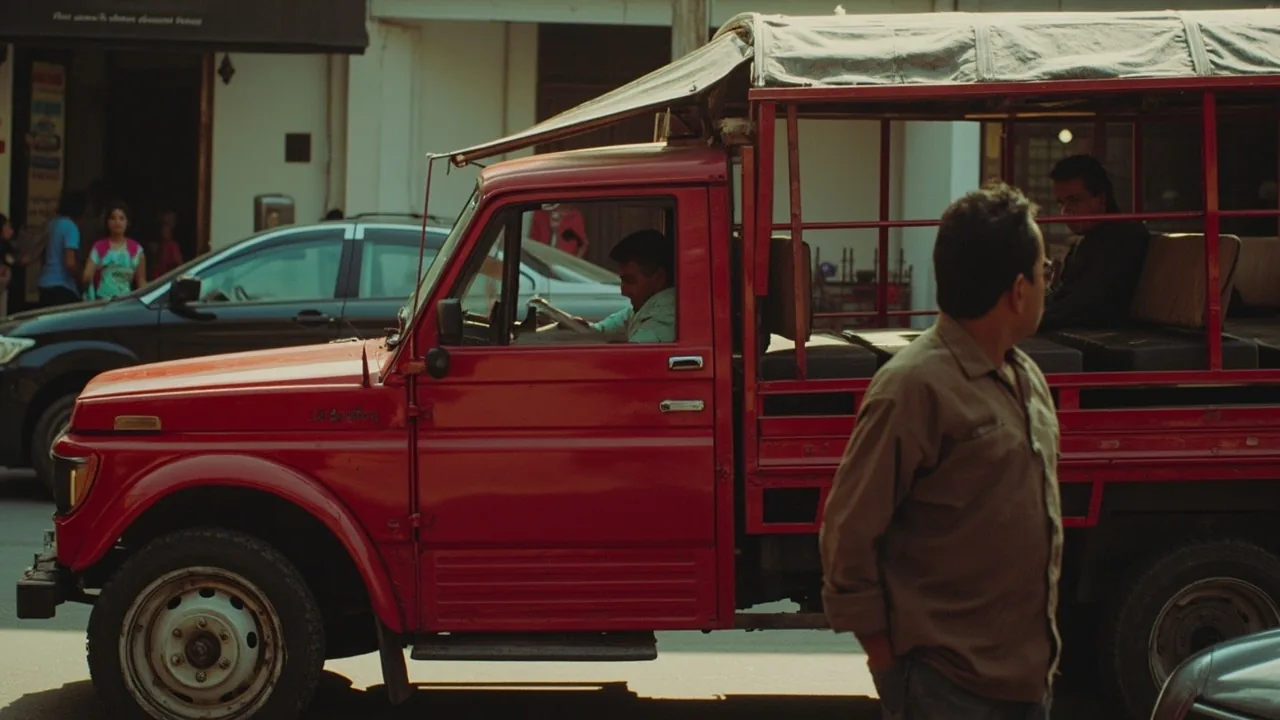
Outside Bangkok, the red songthaew is how Thais get around. Picture a converted pickup truck with two bench seats in the back and a roof. In Chiang Mai, songthaews run set routes inside the old city moat for ₹86 (~30 THB or ~$0.89) per person. In Pai, songthaews connect the town to nearby waterfalls and viewpoints for ₹143-₹286 (~50-100 THB or ~$1.48-$2.97) per person depending on distance. In Krabi town, they run to the weekend market and to Ao Nang beach for ₹172 (~60 THB or ~$1.78).
The unspoken rule: if the songthaew is moving and you’re inside the city limits, hold up your hand. They’ll stop. Pay when you hop out, hand the cash forward to the driver through other passengers. No route map, no schedule. Travellers report this system works because every local knows the fixed loop, and the drivers know the tourists.
Safety Alert: Songthaews don’t have seatbelts and the benches are metal. Hold on tight on rural roads.
Tuk-Tuks (Tourist Tax)
Tuk-tuks are loud, photogenic, and almost always a bad deal compared to metered taxis or Grab. Drivers quote ₹429-₹858 (~150-300 THB or ~$4.45-$8.90) for trips a meter taxi covers for ₹229 (~80 THB or ~$2.37). They also have a well-documented scam of “the Grand Palace is closed today, I’ll take you to a special temple where you get a discount on suits/tuk-tuks/gems.” Ignore all of it.
The one valid use for a tuk-tuk: short scenic hops in Bangkok’s old town around Khao San Road, when you’re paying ₹286 (~100 THB or ~$2.97) for the experience, not the transport. Anywhere else, take a metered taxi or Grab.
Subodh’s Pro Tip: If you do ride a tuk-tuk, agree the price BEFORE you sit down. Once you’re in, the price goes up.
Metered Taxis in Bangkok
Bangkok taxis are cheap by world standards and air-conditioned. Flagfall is ₹100 (~35 THB or ~$1.04), then the meter ticks up roughly ₹17-₹23 (~6-8 THB or ~$0.18-$0.24) per kilometre. A 10 km cross-town trip runs ₹286-₹429 (~100-150 THB or ~$2.97-$4.45). Always insist on the meter (“meter, meter, please”). Drivers will often refuse short hops or claim the meter is broken. Walk away, flag the next one.
Cash is still king. Most taxis do not accept cards. Keep 100 and ₹1,429 (~500 THB or ~$14.84) notes in your wallet.
Grab (and the Bolt Question)
Grab is the dominant ride-hailing app in Thailand and works in Bangkok, Chiang Mai, Phuket, Pattaya, Krabi, and most tourist towns. Set up your account with an Indian Visa/Mastercard before you fly. For taxi bookings, cash payment works everywhere. For GrabCar (private car), card payment goes through the app.
Bolt does operate in Bangkok and Chiang Mai, but driver supply is thin, especially outside peak hours. Default to Grab.
Grab also runs GrabBike in some Thai cities, which is a motorcycle taxi. Useful for solo riders zipping through traffic. Not for luggage.
Subodh’s Pro Tip: Late-night Bangkok, when BTS has shut down at midnight and tuk-tuk drivers smell blood, Grab is your friend. A ₹572 (~200 THB or ~$5.94) meter ride becomes a ₹257 (~90 THB or ~$2.67) Grab with no haggling.
Long-Distance Buses (The Backbone)
The bus network is how 90% of backpackers cross Thailand. Three tiers matter:
Government buses run by The Transport Co. (the green and orange BKS buses). Slower, cheaper, slightly less reliable timing. Bangkok to Chiang Mai government bus: ₹1,715-₹2,573 (~600-900 THB or ~$17.81-$26.71), 11 hours.
VIP 24-seat buses: bigger seats, air-con, USB ports, sometimes a snack. Bangkok to Chiang Mai runs ₹2,287-₹3,431 (~800-1,200 THB or ~$23.74-$35.61). This is the standard backpacker choice. Sombat Tour, Nakhonchai Air, and Greenbus are the main operators.
Sleeper buses: lie-flat beds, 3 across on VIP routes. Bangkok to Phuket runs ₹3,431-₹4,574 (~1,200-1,600 THB or ~$35.61-$47.48), 13 hours. Worth it once, painful twice.
All long-distance routes can be booked on 12go with card payment from India. We use it for our group bookings too. Find rides on 12go.
Trains (Slower but Worth It)
Thai trains are slow but comfortable and scenic. The Bangkok-Chiang Mai overnight sleeper is the classic route: 13 hours, 1st-class AC berth runs ₹4,002-₹5,432 (~1,400-1,900 THB or ~$41.55-$56.38) depending on berth type (upper/lower, air-con/fan). 2nd-class fan sleeper is ₹2,287-₹2,859 (~800-1,000 THB or ~$23.74-$29.68).
For Bangkok to Ayutthaya, the day train from Hua Lamphong (Krung Thep Aphiwat for newer routes) takes 1.5 hours and costs around ₹86 (~30 THB or ~$0.89). Day trips from Bangkok to Kanchanaburi work the same way, see our Hua Lamphong to Ayutthaya train guide for current schedules.
Book trains through 12go or directly at the station. SRT (State Railway of Thailand) sells tickets online at dticket.railway.co.th.
Subodh’s Pro Tip: Train tickets for Bangkok to Chiang Mai often sell out 2-3 days ahead in November-February high season. Book on 12go the moment you know your dates.
Ferries to the Islands
The Thai islands require ferries or speedboats. Main routes:
Bangkok → Koh Samui: Train or bus to Surat Thani, then Lomprayah catamaran to Koh Samui. Total journey 11-12 hours, combined ticket ₹2,287-₹4,002 (~800-1,400 THB or ~$23.74-$41.55). Bus+ferry combo via Lomprayah or Seatran.
Koh Samui → Koh Phangan → Koh Tao: Lomprayah catamarans connect all three in a chain. Samui to Phangan: ₹572 (~200 THB or ~$5.94), 30 min. Phangan to Tao: ₹1,001 (~350 THB or ~$10.39), 1.5 hours. Seatran Discovery does the same routes.
Krabi → Koh Phi Phi → Phuket: Ao Nang to Phi Phi speedboat runs ₹1,287-₹1,858 (~450-650 THB or ~$13.35-$19.29). Phi Phi to Phuket: ₹1,287 (~450 THB or ~$13.35), 1.5 hours.
Koh Lanta (Krabi side): longtail boats and ferries from Krabi’s Chaofa Pier, ₹572-₹1,144 (~200-400 THB or ~$5.94-$11.87).
All ferry routes are on 12go.
Scooter Rentals (With the Standard Warnings)
Scooters open up smaller Thai towns: Pai, Koh Lanta, Koh Phangan, Chiang Mai’s outskirts, Krabi’s beaches. Rental runs ₹572-₹1,144 (~200-400 THB or ~$5.94-$11.87) per day for a Honda Click 125. Long-term weekly rates drop to ₹4,288 (~1,500 THB or ~$44.51).
Three rules every Indian backpacker needs to know:
-
You need a valid motorcycle license. An Indian car license is NOT valid for scooters in Thailand, full stop. The international driving permit (IDP) showing motorcycle category is what police want. Driving without it means a ₹1,429-₹2,859 (~500-1,000 THB or ~$14.84-$29.68) on-the-spot fine at any checkpoint, and any accident invalidates your travel insurance immediately. The IDP costs around ₹5,000 (~$51.90) from RTO in India and takes a few days. Get it before you fly.
-
Photograph the scooter before you ride. Video every scratch, dent, and the odometer. Send the video to yourself on WhatsApp. Rental shops blame riders for every scratch they didn’t see.
-
Don’t leave your passport as collateral. Cash deposit (₹5,718-₹14,295 (~2,000-5,000 THB or ~$59.35-$148.38)) is standard. A passport photocopy + cash deposit is the fair deal. Some shops still ask for the passport. Push back or find another shop.
Helmets are legally required. The rental helmet is usually a thin half-shell; bring your own if you have one.
Songthaew Costs in Specific Thai Cities
| City | Songthaew typical fare | Note |
|---|---|---|
| Chiang Mai (old city) | ₹86-₹143 (~30-50 THB or ~$0.89-$1.48) | Red trucks on fixed loops |
| Chiang Rai (town) | ₹86-₹143 (~30-50 THB or ~$0.89-$1.48) | Smaller system, fewer trucks |
| Pai (rural) | ₹143-₹286 (~50-100 THB or ~$1.48-$2.97) | To waterfalls, viewpoints |
| Krabi town | ₹172 (~60 THB or ~$1.78) | To Ao Nang beach area |
| Phuket (rawai/Chalong) | ₹286-₹572 (~100-200 THB or ~$2.97-$5.94) | Tourist prices higher |
Where to Eat Along the Way
Long bus journeys break at highway rest stops, where the food is decent but unremarkable. In town, the better move is to plan food around stops. A few spots worth knowing:
Chiang Mai old city: Chada Vegetarian Restaurant Chiang Mai does a clean vegetarian menu with local dishes plus Indian-style options, perfect after a songthaew ride around the temples. Pair it with a walk to nearby Nimman, where Chai “N” Thai @ Nimman Indian Restaurant runs north Indian, south Indian, vegan and halal non-veg plates that have kept Indian travellers coming back.
Chiang Rai: Kunda Vegetarian Vegan Burger Cafe Chiang Rai is the move for a quick, filling veg meal between bus arrivals. Vegan burgers, chill setting, and the prices won’t hurt after a 3-hour bus from Chiang Mai.
Southern Thailand (Krabi/Ao Nang/Phi Phi): Beachfront spots like Chacha Beach Café & Restaurant keep things casual with Thai staples and a sea view. Local joints like Krabi Thailand and Gulf of Thailand serve authentic Thai food the way locals eat, no tourist markup. For coffee and a break, Emporio Caffé is a reliable stop.
Bangkok: For a working lunch or dinner near transport hubs, ร้าน พี่ชาย BROTHER serves authentic Thai dishes at honest prices, useful when you’ve got a train to catch in 90 minutes.
Getting Connected
You need 4G for Grab, Bolt, 12go, Google Maps, and translation. Without it, you’re stuck haggling in broken Thai. Two options:
Physical SIM: AIS, dtac, and TrueMove all offer tourist SIMs at Suvarnabhumi airport for ₹855 (~299 THB or ~$8.87). The 7-Eleven version of the same SIM runs about ₹57 (~20 THB or ~$0.59) less if you can wait until you reach town.
eSIM: If your phone supports eSIM, Get Nomad eSIM ships a Thailand data plan before you fly, lands on your phone before landing, no airport SIM queue.
Both work fine. Pick by phone model: eSIM-capable iPhone/Google/Pixel → Nomad. Older phone or dual-SIM preference → physical AIS at 7-Eleven.
Common Transit Mistakes Indians Make
Mistake 1: Riding a scooter on an Indian car license. What happens: police checkpoint, ₹1,429-₹2,859 (~500-1,000 THB or ~$14.84-$29.68) fine, plus any accident is now your financial problem. Fix: get the IDP from RTO before flying, with motorcycle category endorsed.
Mistake 2: Agreeing tuk-tuk prices without asking. What happens: you pay ₹858 (~300 THB or ~$8.90) for a trip that should be ₹229 (~80 THB or ~$2.37), and you still get dropped at the wrong gem shop. Fix: ask the price before sitting. If they won’t use the meter, flag a regular taxi instead.
Mistake 3: Leaving your passport as scooter collateral. What happens: you lose your passport when the shop “loses” it or holds it hostage over a fake damage claim. Fix: cash deposit or photocopy + cash. Walk away if they insist on the original passport.
Mistake 4: Booking the wrong Bangkok train station. What happens: you show up at Hua Lamphong for a 6 AM train and find out your train now leaves from Krung Thep Aphiwat (Bang Sue). Fix: confirm the departure station at booking. Hua Lamphong still runs some routes but not all.
Mistake 5: Not booking sleeper buses in high season. What happens: you arrive at the station, the next bus is full, you wait 8 hours for the next one. Fix: book through 12go 2-3 days ahead for November-February travel.
FAQ
Is Grab or Bolt better in Thailand? Grab. Driver supply is thicker, especially outside Bangkok. Bolt exists in Bangkok and Chiang Mai but you’ll wait longer.
Can I pay Thai taxis with an Indian card? No. Bring cash in small THB notes. Most drivers don’t take ₹2,859 (~1,000 THB or ~$29.68) notes for short hops.
How much is a Bangkok to Phuket sleeper bus? ₹3,431-₹4,574 (~1,200-1,600 THB or ~$35.61-$47.48), 13 hours. VIP class with lie-flat beds. Book on 12go.
Do I need to print my TDAC arrival card? No. The digital QR on your phone is fine. Complete it at tdac.immigration.go.th before you board.
Can I use Indian UPI in Thailand? No. Some shops in Bangkok tourist zones accept UPI through third-party apps, but it’s patchy. Carry Thai cash and use Visa/Mastercard from a forex card.
What’s the cheapest way from Bangkok to Chiang Mai? Government bus, ₹1,715-₹2,573 (~600-900 THB or ~$17.81-$26.71), 11 hours. Or train 2nd-class fan sleeper for ₹2,287-₹2,859 (~800-1,000 THB or ~$23.74-$29.68), 13 hours. Slightly slower than the bus.
Are songthaews safe at night? Within city limits, yes. The risk is rural mountain roads (Pai, Mae Hong Son loops) after dark, where songthaew drivers get tired and the roads have no barriers. Take a minivan instead.
Subodh’s Take
Thailand’s transport network rewards travellers who plan one leg ahead, not zero. Book your Bangkok to Chiang Mai bus on 12go two days before. Download Grab the day you land. Get the BTS Rabbit Card on day two in Bangkok, not day five when you finally give up on tuk-tuks. The backpackers who save real money here aren’t the ones who refuse to spend, they’re the ones who spend on the right thing at the right time: ₹129 (~45 THB or ~$1.34) on the Airport Rail Link instead of ₹2,001 (~700 THB or ~$20.77) on a taxi scam, ₹86 (~30 THB or ~$0.89) on a songthaew through Chiang Mai instead of ₹572 (~200 THB or ~$5.94) on a tuk-tuk tour, ₹3,431 (~1,200 THB or ~$35.61) on a sleeper bus instead of ₹11,436 (~4,000 THB or ~$118.70) on a flight. The system works. Use it.
