Getting Around Manila 2026: Grab, Jeepney, Tricycle Fares & Airport to Intramuros Route
Verified: 2026-07-22
Manila local transport runs on four layers stacked on top of each other, and figuring out which one to use is half the battle for Indian backpackers landing at NAIA. Jeeps are the cheapest, the LRT/MRT is fastest for fixed corridors, Grab handles the door-to-door stuff, and tricycles fill the last-mile gaps in the older districts like Intramuros and Binondo. None of these is a single clean system, so this guide walks you through the four layers, what each one costs in Philippine pesos (1 INR is roughly 0.67 PHP right now, so every 100 PHP is about ₹150 (~$1.56)), where each one breaks down, and exactly how to get from Terminal 3 to a hostel inside the old walled city without getting ripped off. For related planning, see our guide on Sea Backpacking Hub.
For the visa side (Indians get 30 days visa-free, extendable at any Bureau of Immigration office) and the airport arrival walkthrough itself, the Manila NAIA airport guide for Indian travellers covers it. This page picks up from the moment you walk out of arrivals.
Quick Answers
| What | Answer | Price (INR) |
|---|---|---|
| Cheapest way from NAIA Terminal 3 to Intramuros | Public jeep from NAIA Road to Baclaran, then LRT-1 southbound to Central Terminal, then jeep to Intramuros | ₹84-₹185 (~50-110 PHP or ~$0.89-$1.96) total |
| Average Grab fare within central Manila (Malate to Intramuros) | 10-15 min, depending on traffic | ₹253-₹371 (~150-220 PHP or ~$2.67-$3.91) |
| Tricycle fare inside Intramuros / Binondo | Short hop, under 1 km | ₹34-₹84 (~20-50 PHP or ~$0.36-$0.89) |
| Jeepney fare anywhere within Manila city limits | Standard route | ₹22-₹34 (~13-20 PHP or ~$0.23-$0.36) |
| LRT/MRT single-journey ticket | Stored-value beep card or single-journey token | ₹25-₹59 (~15-35 PHP or ~$0.27-$0.62) |
Subodh’s Pro Tip: Install Grab, GCash, and Google Maps before you board your flight to Manila. The airport Wi-Fi is patchy, GCash needs a Philippine mobile number to verify (which you will get from your SIM), and Grab uses Google Maps data to figure out fares.
The Four Layers of Manila Transport
Manila’s transport reads like four different cities glued together. The MRT/LRT is a clean, predictable elevated rail that only covers two corridors. Jeeps are chaos, a beautiful chaos with hand-painted signs and conductors hanging off the back, but chaos. Grab is the same app you used in Bangkok or Ho Chi Minh, with Manila’s notorious traffic baked into the fare. And tricycles are the motorcycles-with-sidecars that roam the side streets and gated districts where jeeps don’t go.
For a backpacker doing the standard Manila loop (NAIA, Intramuros, Binondo, Rizal Park, Mall of Asia, Makati), you will use all four in the same week. The trick is knowing which one suits which leg.
Layer 1: LRT and MRT (the elevated rail)
Two lines, both run by different private concessionaires, both packed. The LRT-1 (yellow line) runs from Baclaran in the south to Monumento in the north, passing through central Manila including the Central Terminal station near Divisoria and the Carriedo station next to Binondo. The MRT-3 (blue line) runs EDSA, the main thoroughfare, from Taft Avenue in Pasay to North Avenue in Quezon City.
For Indian backpackers, the LRT-1 is your friend for getting between Intramuros, Rizal Park, Binondo, and Malate without sitting in traffic. Trains run every 5-10 minutes during peak hours, and a single-journey token is 15-35 PHP depending on distance. A beep card (the reloadable stored-value card) costs 100 PHP for the card itself and saves you the queue at the ticket booth every time.
Subodh’s Pro Tip: Buy a beep card at any LRT/MRT station. Top it up with 200-300 PHP and you are sorted for a week of short hops across the city. The card works on both lines and on most modern city buses too.
Layer 2: Jeepneys (the king of Manila roads)
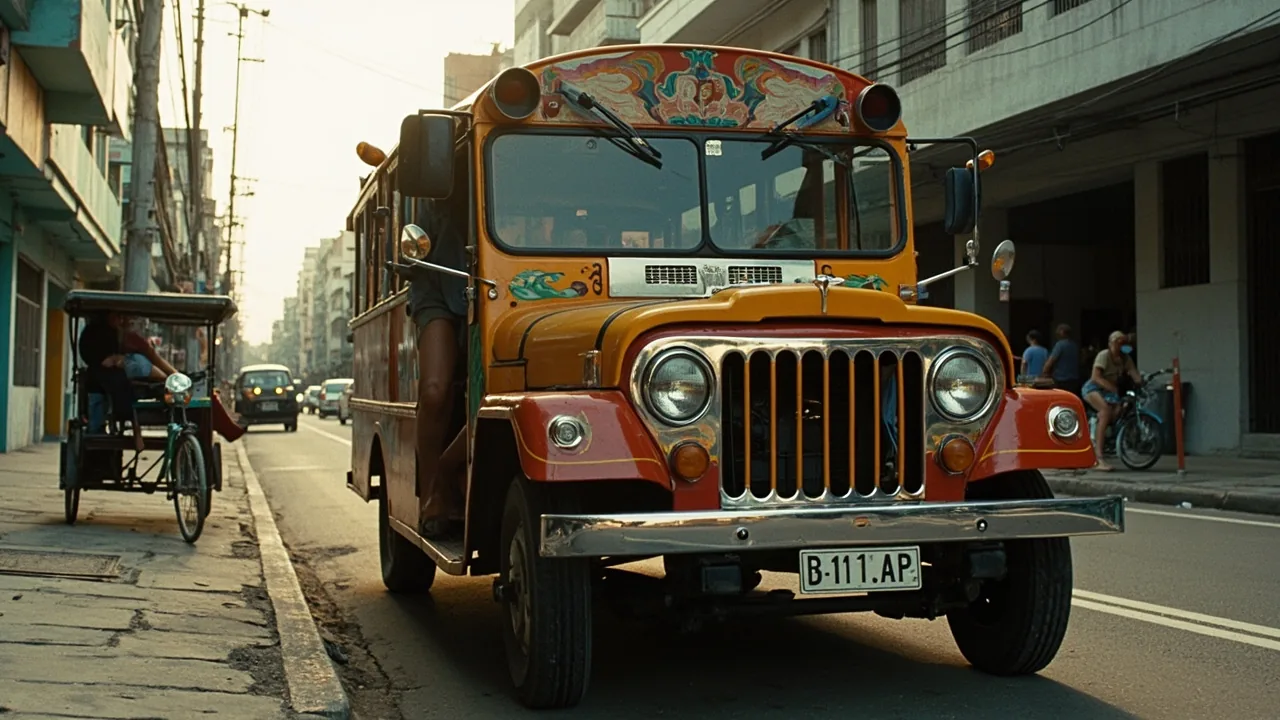
The jeepney is the Philippines’ most recognisable vehicle, a converted US military jeep with two long bench seats and a roof, hand-painted in bright colours with a religious nickname on the windshield (“God is Love,” “Lord Help Us”). Routes are marked on the side panel in Tagalog abbreviations. Fares are 13-20 PHP for any in-city hop, paid in cash directly to the conductor, who sits near the back and shouts destinations as you pass.
For the uninitiated, jeepneys work like this: you flag one down from the curb, hop in from the back, pass your fare forward through other passengers to the conductor, the conductor gives you change, and you say “Para!” (pull the yellow cord above your head) when your stop is coming up. The conductor bangs the roof twice, the driver pulls over, you hop out the back.
Indians who have never been to the Philippines get thrown off by three things. First, jeeps don’t follow timetables, they follow routes. You stand at a stop with the route code painted on a sign, and the next jeep heading that way picks you up. Second, traffic makes them slow. A 5 km ride that should take 10 minutes can take 35 minutes during rush hour. Third, conductors don’t speak Hindi or English, and the route names in central Manila are Tagalog place names. Memorise a few anchors (“Intramuros,” “Baclaran,” “Cubao”) and you will be fine.
The jeepney’s role in your Manila trip is the short-distance layer, the layer between an LRT station and a specific landmark, or the slow scenic loop through Ermita and Paco when you have nothing to do. Forgetting it and using Grab for everything will drain your budget.
Layer 3: Grab (the only app that matters)
Grab is Southeast Asia’s super-app and works the same in Manila as it does in Bangkok or Kuala Lumpur. You open the app, type your destination, watch the fare estimate, confirm, watch a driver accept, and watch the car creep toward you through Manila traffic.
Fares in central Manila are 150-300 PHP for any single trip within the city core (Malate to Intramuros, Makati to BGC, Ermita to Binondo). Surge pricing kicks in during rush hour (7-10 AM and 5-9 PM) and during rainstorms, pushing fares up to 400-500 PHP. Trips to NAIA from central Manila run 250-450 PHP depending on which terminal and how bad the traffic is on NAIAX or Roxas Boulevard.
Grab works well at NAIA. After you clear customs and walk out, open the app at the designated Grab pickup bay (well-signed at all four terminals) and book. Drivers know where to go. Cash payment in PHP works (you do not need a Philippine card), as does card payment through the app.
Subodh’s Pro Tip: Manila has local ride-hailing apps (angkas, JoyRide) that sometimes undercut Grab by 20-30%, especially for motorcycle rides (angkas = motorcycle taxi). Both apps need a Philippine SIM to register. If your budget is tight and you have a local SIM, download Angkas for short hops under 5 km.
Layer 4: Tricycles (the last-mile vehicle)
Tricycles are motorcycles with enclosed sidecars, and they are the only vehicles allowed inside the narrow streets of Intramuros, Binondo’s older lanes, and most gated residential villages. Fares are 20-50 PHP for any short hop inside one of these districts.
Tricycles do not run on a meter. You negotiate the fare before you sit down, or you walk and find another. The standard fare in 2026 for a single hop inside Intramuros (say, from Fort Santiago to Manila Cathedral) is 30-50 PHP per tricycle, which means the fare covers all passengers in one tricycle, not per head. If a driver quotes 100 PHP for two people going 800 metres, walk away.
For longer tricycle rides outside Intramuros (say, to a specific address in Ermita that’s 2 km from the main road), drivers will quote 80-150 PHP. Negotiate, or use Grab instead.
NAIA to Intramuros: The Three Routes Compared
Every Indian backpacker landing at NAIA wants the same thing: the cheapest, fastest, or safest way to reach their hostel in or near Intramuros. Here are the three options, ranked by what matters to most travellers.
Route 1: Grab (fastest, easiest, costs the most)
Walk out of Terminal 3 arrivals, turn left at the exit, follow the signs to the “Ride-Hailing Pickup” bay. Open Grab, enter “Intramuros, Manila” as the destination, confirm. The fare estimate in mid-2026 is 300-450 PHP. The trip takes 30-50 minutes in light traffic, 60-90 minutes during rush hour. There is no negotiating, no language barrier, no risk of being dropped at the wrong gate.
This is the route most Indian travellers should take on arrival, especially after a long flight. Cost is around 350 PHP (~₹525).
Route 2: LRT-1 via Baclaran (cheapest, slowest)
From NAIA Terminal 3, walk to the multi-storey parking building opposite the terminal and catch a jeep or UV Express van heading to Baclaran. Fare is 50-70 PHP. From Baclaran LRT station, take LRT-1 northbound to Central Terminal station. Fare is 30-35 PHP. From Central Terminal, walk to the nearby jeepney terminal and take a jeep bound for Intramuros. Fare is 13-20 PHP.
Total fare: roughly 100 PHP (~₹150), versus 350 PHP for Grab. Total time: 75-100 minutes, with three transfers and a fair amount of walking. This is the route for backpackers who have done Manila before and want to save 250 PHP.
Route 3: Taxi coupon (middle ground)
NAIA has an official taxi coupon desk inside the arrivals hall of every terminal. You pay a fixed fare (around 600-800 PHP) and receive a coupon to hand to a yellow airport taxi at the rank. The fare is fixed, the driver has a receipt, and there is no meter scam.
This is the right route if you have heavy luggage, arrive at an odd hour, or do not want to deal with apps. Cost is around 700 PHP (~₹1,050), versus 350 PHP for Grab. The trade-off is reliability over price.
Local Transport Apps Worth Installing
| App | What it does | Cost |
|---|---|---|
| Grab | Ride-hailing, food delivery, payment | Free, pay per ride |
| Angkas | Motorcycle taxi, cheaper than Grab | Free, pay per ride |
| Google Maps | Navigation, jeepney routing, traffic | Free |
| Sakay.ph | Public transport route planner | Free |
| GCash | E-wallet for cashless payments | Free, needs PH SIM |
Jeepney Routes Every Backpacker Should Know
The Tagalog abbreviations on jeepney route signs are a barrier for first-timers. Here are the ones that matter for the standard Manila backpacker circuit.
- Baclaran-Pasay-Malate-Intramuros: The jeep that runs Roxas Boulevard northbound from Baclaran, through Pasay, past Rizal Park, into Intramuros. Look for “Baclaran-Intramuros” or “Baclaran-Lawton” on the side panel. Flag it down anywhere along Roxas Boulevard.
- Cubao-Project 6-Q Mart: The east-west jeep that crosses Quezon City. Useful if you stay in the Cubao/Quezon City backpacker belt.
- Divisoria-Monumento: The jeep that runs Recto Avenue, useful for getting from Binondo to the LRT-1 stations.
- Pasay Rotunda-EDSA-Taft: The jeep that links the airport area to the MRT-3 Taft station.
When Strikes Hit: Manila Public Transport Strike Reality
Manila sees periodic transport strikes, usually called by jeepney driver associations protesting fuel prices, the government’s jeepney modernisation programme, or fare increases. These strikes can shut down the entire jeepney network for a day or two, and they tend to coincide with major news cycles (check Reddit’s r/phinvest or the local news app before you travel).
During a strike, jeeps disappear from the roads, and the LRT/MRT and Grab see surges. If you land during a strike window, pay for Grab. The LRT/MRT also runs because it is a separate workforce from the jeepney drivers, but stations get packed. Plan for 60-90 minute door-to-door trips.
Bicycle Rental in Manila
Manila is not a bicycle-friendly city, full stop. The roads are hostile to cyclists, there are few dedicated bike lanes outside the newer BGC district, and the air quality in the older parts of the city is rough. But bike rental does exist for the specific case of Intramuros, where the walled city is small enough and traffic-controlled enough to make a slow cycle around the perimeter a genuinely good half-day activity.
In 2026, bike rental shops inside Intramuros charge 50-150 PHP per hour for a basic city bike, 200-400 PHP per hour for a tandem or e-bike. Most hostels near Intramuros can also point you to a rental shop within walking distance. A half-day rental (4 hours) typically costs 250-400 PHP.
Subodh’s Pro Tip: Ride the bike only inside Intramuros and Binondo. Do not take a bike out onto Roxas Boulevard or EDSA. The roads are designed for cars and jeeps, and the trucks do not care about cyclists.
Common Transit Mistakes Indians Make
Mistake 1: Taking an “airport taxi” offered by a stranger inside the terminal. What happens: The tout walks you to a private car, drives you to your hostel, and quotes 1,500 PHP at the destination. How to avoid: Walk to the official Grab bay or the coupon desk. If you must take a regular taxi, queue at the yellow airport taxi rank and demand the meter.
Mistake 2: Hopping on a jeep without knowing the fare structure. What happens: You sit down, the conductor asks for fare, you hand over a 500 PHP note, the conductor gives you back 200 PHP and pockets 287 PHP, claiming the fare is 87 PHP to your destination. How to avoid: Ask “Magkano po?” (“How much?”) before boarding. The standard jeepney fare in 2026 is 13-20 PHP. If the conductor quotes more, hop off.
Mistake 3: Assuming Grab surge will end in 5 minutes. What happens: You watch the fare estimate climb from 200 PHP to 450 PHP and book anyway because you are tired. How to avoid: During rain or rush hour, fares climb fast. If you can wait 20-30 minutes, do so. If not, accept it. Alternatively, switch to LRT/MRT for fixed-corridor trips.
Mistake 4: Using tricycles for long distances. What happens: You hire a tricycle for a 3 km ride outside Intramuros, the driver quotes 200 PHP, you pay. How to avoid: Tricycles are for short hops inside gated districts only. For longer rides, use Grab or jeep.
Mistake 5: Leaving your passport in a rental bike as collateral. What happens: The shop holds your passport “for security,” and now you cannot check into your hostel or fly out without retrieving it. How to avoid: Leave a photocopy plus a 500-1,000 PHP cash deposit. Never leave the actual passport.
Where to Eat Near the Routes (Quick Stops)
You will need to eat between rides. Here are three spots that anchor the Manila transport map, all walkable from major jeep or LRT stops.
For a proper Filipino meal near Rizal Park, Kantina Manila serves sisig and adobo in a rustic setting. Both are worth ordering. The sisig (chopped pork belly with onions and chilies on a sizzling plate) runs 250-400 PHP, the adobo (chicken or pork braised in soy and vinegar) runs 200-350 PHP. Cash only.
For Indian food cravings when you cannot face another plate of rice, Royal Indian Curry House is the closest analogue to a proper North Indian thali you will find in Ermita. Expect to pay 350-600 PHP per person for a full meal with naan, curry, and rice.
For a cheap, fast bite near the LRT-1 Carriedo station in Binondo, Cafe Ilang-Ilang inside the Manila Hotel compound serves Asian and Western dishes at 200-500 PHP. The location near Intramuros makes it a useful reset point mid-sightseeing.
Getting Connected
You need data for Grab, Google Maps, and GCash. Buy a Globe or Smart tourist SIM at the airport counter inside arrivals. A 7-day SIM with 8-12 GB of data runs 300-500 PHP. Bring your passport, the activation takes five minutes. If you prefer an eSIM you can activate before you fly, Get Nomad eSIM has Philippines plans starting at ₹482 (~5 USD) for 1 GB / 7 days.
Safety and Scams to Know
Manila is generally safe for tourists who use common sense, but a few transport-specific scams repeat every year and every tourist falls for at least one.
The padyak scam. A tricycle driver agrees to take you to a destination 3 km away, drops you 800 metres short, and demands full fare. Always agree on the destination and fare before sitting down, and confirm “Sa Intramuros mismo” (“To Intramuros itself”) before you go.
The broken meter. A regular taxi (not Grab, not coupon) claims the meter is broken and quotes a flat fare of 500 PHP for a trip that should cost 200 PHP on the meter. Get out and find another taxi, or use Grab.
The closed jeepney route. A jeep conductor tells you the route you need is suspended due to a strike or road work, then offers to take you to the destination “by private car” for 500 PHP. Always check the jeep’s route sign on the side panel yourself. If it matches your destination, board. If the conductor insists, walk to the main road and flag another jeep.
For broader safety context beyond transport (which districts to avoid at night, dress code for churches, what to do in an earthquake), the Philippine Department of Foreign Affairs posts travel advisories that are worth a quick scan before you go, alongside the Indian Ministry of External Affairs advisory page at mea.gov.in.
Manila Transport: Quick Price Reference
| Transport type | Fare range (PHP) | Best for |
|---|---|---|
| Jeepney (in-city) | 13-20 PHP | Short hops, scenic loops |
| LRT/MRT single journey | 15-35 PHP | Fixed-corridor trips |
| LRT/MRT beep card deposit | 100 PHP | Multi-trip visitors |
| Tricycle (in-district) | 20-50 PHP | Inside Intramuros / Binondo |
| Grab (in-city) | 150-300 PHP | Door-to-door, night travel |
| Grab to NAIA | 250-450 PHP | Airport transfers |
| Airport taxi coupon | 600-800 PHP | Heavy luggage, odd hours |
| Bicycle rental (per hour) | 50-150 PHP | Intramuros only |
Subodh’s Take
Manila’s transport looks chaotic on paper but is one of the easier Southeast Asian capitals to figure out, once you accept that you will use four different modes in a single day. Jeeps and the LRT/MRT handle 80% of trips at almost no cost. Grab covers the door-to-door and the late-night rides. Tricycles fill the last mile inside the walled city. The only real mistake is defaulting to Grab for everything and watching your budget bleed out, or refusing to use Grab at all and getting stuck in the rain without a ride. Mix the four, learn the jeep route signs, and the city opens up.
FAQ
Is Grab available in Manila at night? Yes. Grab operates 24/7 in central Manila. Fares surge after 10 PM and during rainstorms, but drivers are available. Outside central Manila (Quezon City far edges, Parañaque south), wait times stretch to 15-25 minutes.
Can I pay Grab with cash? Yes. Select “Cash” as the payment method when booking. Drivers expect exact change for fares under 200 PHP. For larger fares, handing over a 500 PHP note and getting change is normal.
How much to tip Grab drivers in the Philippines? Tipping is not expected. Round up to the nearest 50 PHP if the driver helped with luggage or took a route that avoided traffic. Most Indian backpackers tip 20-50 PHP per ride, which is appreciated but not required.
Do I need to tip taxi drivers in Manila? No. Taxis in Manila do not expect tips. Round up if you want, but there is no social pressure.
Is Manila safe for public transport at night? The LRT/MRT runs until 10 PM and is reasonably safe during operating hours. Jeeps thin out after 9 PM. Grab is the safest night option. Avoid walking alone in Ermita, Baclaran, and Tondo after 11 PM.
Can tourists rent a bicycle in Manila? Yes, mainly inside Intramuros. Bike rental shops charge 50-150 PHP per hour for city bikes. Do not ride bicycles on major roads like Roxas Boulevard or EDSA, traffic is hostile to cyclists.
What is the Manila public transport card called? The beep card. It is a reloadable stored-value card that works on LRT-1, LRT-2, MRT-3, most city buses, and select modern jeepneys. Buy one at any station for 100 PHP and top up with 200-500 PHP at a time.
For longer-distance trips out of Manila (to Baguio, Sagada, or the beach towns), check the Manila airport to city center guide for bus terminal options, and the Baguio local transport guide for what to expect once you arrive up north.
