How to Meet Locals & Make Friends as a Solo Traveller in Singapore (Even if You’re an Introvert)
Singapore has a reputation for being expensive, clean, and a little… transactional. Travellers worry the city-state is all glass towers and silent MRT rides, that nobody will talk to them, and that four nights there will feel like one long quiet evening in a hotel room. None of that is true. Singapore is one of the easiest cities in Asia to build a social life in for a few days, because the country actively funds hobby clubs, language exchanges, and sports meetups through government-supported platforms like Meetup.com and ActiveSG. The locals are also used to expats and short-term visitors, so showing up alone to a Tuesday-night board-game meetup at a Tiong Bahru café is normal, not weird. The trick is knowing which doors to walk through. For related planning, see our guides on Sea Backpacking Hub and Best Hostels Singapore Solo Backpackers.
This guide covers the practical, India-specific playbook for meeting people in Singapore as a solo traveller, including introvert-friendly paths (no forced small talk required), the Meetup.com and ActiveSG routes most blogs skip, and one or two honest warnings about scams and price traps you’ll want to know about before you book anything. You may also find Where Can I Go for Free in Singapore useful for this trip.
Quick Answers
| What | Answer | Price (INR) |
|---|---|---|
| Is Singapore good for solo social travel? | Yes, especially via Meetup.com hobby groups and ActiveSG sports clubs, both heavily subsidised for residents and visitors. | SGD 0 |
| Cheapest way to meet locals (structured)? | Meetup.com free events, plus ActiveSG pay-per-use sports bookings. | SGD 0 to 15 |
| Pub crawl typical cost? | Hostel-run or independent pub crawls around Clarke Quay / Boat Quay. | ₹2,611 (~35 SGD or ~$27.10) to 60 |
| Best introvert-friendly pick-up spot? | Hawker centres (communal seating, no conversation pressure, easy to leave). | ₹373 (~5 SGD or ~$3.87) to 12 |
| SIM card for staying in touch? | Singtel/M1 tourist SIM, 7 days, ~50GB data, at Changi arrivals. | ₹1,119 (~15 SGD or ~$11.61) |
Subodh’s Pro Tip: Book a 4G SIM at the Changi Airport counter on arrival. Grab, Google Maps, WhatsApp, and Meetup.com all need reliable data the moment you land, and Singapore airport Wi-Fi alone will not cut it once you’re outside Terminal 1. See also: Singapore Travel Tips.
The Solo Travel Vibe in Singapore
Singapore is not the Banana Pancake Trail. There is no single backpacker highway, no ₹674 (~7 USD)-a-night dorm crawl, no shared overnight bus where you end up teaching a German girl Hindi. Singapore is instead a stop: three to five nights for most Indians, tacked on to a Bali trip, a Malaysia stop, or a long-weekend escape from Chennai or Bangalore. That changes the social math.
Because travellers stay short, the people you meet are a mix of (a) other short-stay tourists on overlapping itineraries, (b) expats living in Singapore for two to five years who already have friend groups, and (c) actual Singaporean locals who are curious about visitors but rarely see them, because the city’s tourism skews family and business. The good news is all three groups are reachable in different ways. The bad news is you only have a few days to reach them.
Subodh’s Pro Tip: The mistake most India-origin travellers make is staying in a chain hotel in Geylang or a serviced apartment near Raffles Place. Both are quiet, anonymous, and socially dead. Choose a hostel or a co-living space near Little India, Chinatown, or Tiong Bahru instead. The location matters more than the brand.
How to Meet Other Travellers (Fast, 1 to 3 Days In)
If you only have a short window, focus on the following. These are the lowest-effort, highest-yield channels.
Hostel common rooms and walking tours
A social hostel in Singapore is a faster way to meet people than any app. The dorm scene is small (Singapore has fewer hostels than Bangkok, so the social hostels tend to cluster), and the people who pick hostels over hotels are usually travelling solo by choice, which makes introductions easy.
Free hostel walking tours and communal dinners are the two most reliable icebreakers. Skip the ones marketed as “free” but end in a hard-sell tuk-tuk pitch, those exist in Singapore too, just dressed up. Pick the ones run by the hostel itself, where the guide is also a staff member or a long-term guest.
Pub crawls around Clarke Quay and Boat Quay
Pub crawls work in Singapore, but they’re more structured than in Bangkok or Berlin. Most are run by independent operators or hostel-affiliated groups and follow a fixed route of three to five bars in Clarke Quay or Boat Quay, finishing at a club. Pricing sits around ₹2,611 (~35 SGD or ~$27.10) to 60 per person including a few welcome drinks.
Zaffron Tandoori Restaurant @ Boat Quay is a useful landmark even if you skip the pub crawl, because the riverside stretch is where most crawls converge. If you want a quieter start to the night, eat there first (the Punjabi tandoori menu is solid for vegetarians too) and join the crawl at its third stop.
Meetup.com hobby groups (the underrated channel)
This is where Singapore pulls ahead of every other Southeast Asian city for solo social travel. Meetup.com in Singapore is dense, active, and well-moderated, with recurring groups in board games, hiking, photography, language exchange, expat professionals, women in tech, and dozens more. Most groups are free to attend as a first-timer, with optional cover charges (₹373 (~5 SGD or ~$3.87) to 20) at the door for venue rental or food.
Subodh’s Pro Tip: Search “Singapore expats”, “Singapore hiking”, or “Singapore board games” on Meetup.com a week before you fly. Pick three events on three different days. RSVP to all three. Even if you bail on one, you’ll show up to two, and that’s enough to leave Singapore with real contacts, not just hostel small talk.
The expat population in Singapore means most groups are skewed toward foreigners, but the local Singaporean members are usually the most welcoming to first-timers, because they’re used to onboarding new faces every week. Don’t be shy about messaging the host before you go. A simple “Hi, I’m visiting for 4 nights, is this group friendly to first-timers?” gets a 90% positive response.
ActiveSG sports clubs (the locals’ secret)
ActiveSG is the government-run sports portal. It subsidises pay-per-use access to public swimming pools, badminton courts, football fields, and gyms island-wide. The underrated part is the ActiveSG sports clubs, recurring weekly sessions in everything from basketball to dragon-boating, open to anyone with an ₹746 (~10 SGD or ~$7.74) day pass. These are dominated by actual Singaporeans, not expats, so if you want local friendships (as opposed to traveller friendships), this is the path.
You don’t need to be fit. The whole point is the social mix. Book a slot, show up, and the regulars will integrate you by the second week. For a four-night stay, pick something once-only like a public pool swim or an open gym session, and you’ll still meet a handful of regulars.
Language exchanges and cultural nights
Telegram and WhatsApp groups for “Singapore Language Exchange” and “Singapore Indians” run weekly in-person meetups at bars in Tiong Bahru, Holland Village, and Bugis. These skew 25 to 35, mostly professionals, mostly welcoming to short-term visitors. The format is structured (rotate between English and another language every 20 minutes), so even introverts find it easier than free-form networking.
Subodh’s Pro Tip: For Indian travellers specifically, the “Singapore Indians” and “Singapore Telugu/Tamil/Hindi” groups are gold. Singapore has a 9% Indian-origin population, including permanent residents who’ve been there 20+ years, and they love hosting visiting cousins. One DM asking “any meetups this week?” usually gets three replies.
Hawker centres (the introvert’s social hack)
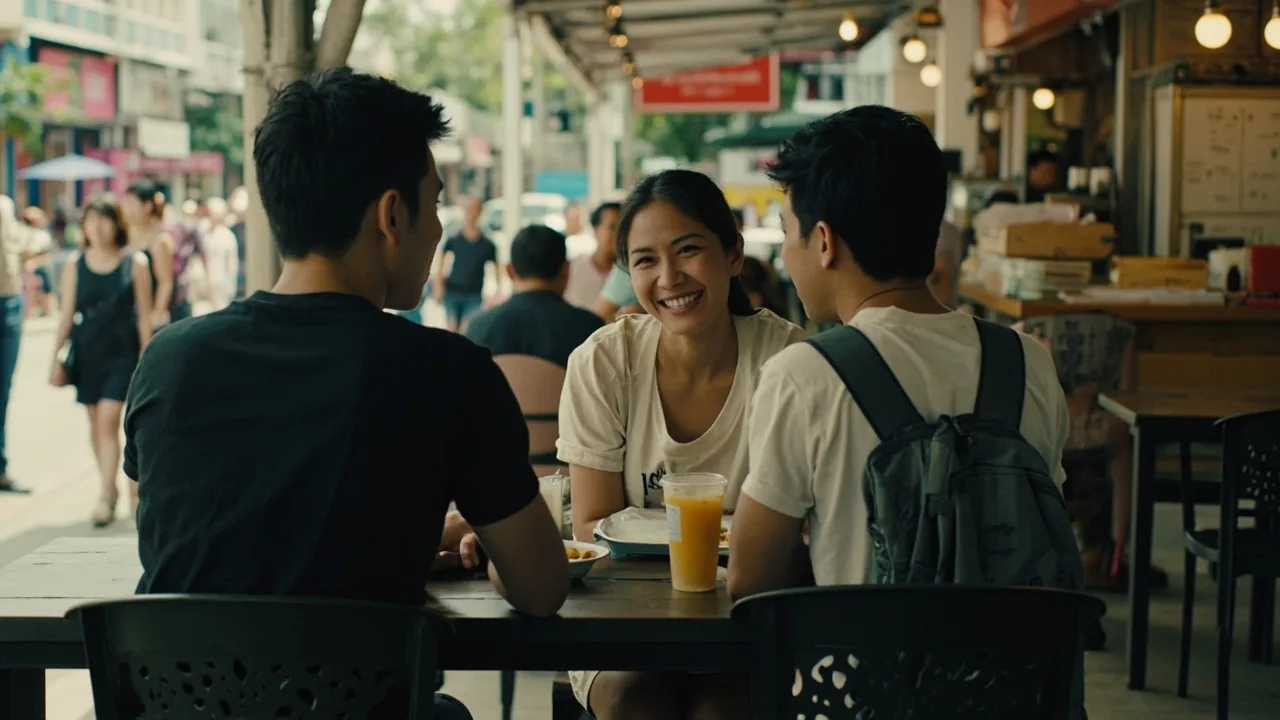
Hawker centres are Singapore’s most underrated social infrastructure. They’re cheap (₹373 (~5 SGD or ~$3.87) to 12 for a full meal), communal-seating (you’ll share a table with strangers unless you hunt for an empty one), and culturally normal for eating alone. Travellers report that more conversations start at a hawker centre table than at any bar in Clarke Quay, because the setting is low-stakes and there’s no expectation of buying drinks or staying long.
Eating solo in Singapore at hawker centres is genuinely one of the easier ways to pass an evening as an introvert. You sit, you eat, someone asks where you’re from, you chat for ten minutes, and then you both move on. No pressure, no follow-up obligation.
Long-Stay Options (If You Have 2+ Weeks)
If you’re in Singapore for a longer stretch (a remote-work month, a course, a family-plus-sightseeing hybrid), the above channels get better with repetition. The real get is showing up to the same event two weeks in a row, because by week three, the regulars remember your name and the dynamic flips from “you being new” to “you being a familiar face”.
Nomadtable and similar dinner clubs run pay-what-you-can multi-course dinners hosted by expats and locals. They pop up on Eventbrite and Instagram and usually charge ₹1,865 (~25 SGD or ~$19.36) to 45 for food and drinks. These are great for first-timers because the format forces mingling.
For co-working spaces, the social layer is real. The bigger spaces run weekly member dinners, board-game nights, and demo sessions. Even if you don’t have a remote-work reason to be there, the day-pass fee (SGD 25 to 40) buys you eight hours of enforced proximity to interesting people. Worth it on a slow Tuesday or Wednesday.
Where to Eat Solo (and Accidentally Make Friends)
Some Singapore restaurants are better than others for solo dining. You don’t need a “singles table”; you just need somewhere with counter seating or communal tables, where eating alone looks normal.
Ming’s Cafe & Pub is a casual spot that works for solo travellers. The “local bites and drinks” framing means the menu is broad enough to graze, and the bar setting means solo seating at the counter isn’t awkward. Order one dish and one drink and you’ll have neighbours in 20 minutes.
Yogiyo Korean restaurant works similarly. Korean BBQ at the counter is genuinely a solo-friendly format because the cooking is the entertainment and you can take your time.
For Indian food, the trio worth knowing:
- Chola Cafe - Biryani House, billed as “Best Biryani in Singapore” by regulars. The Hyderabadi biryani is rich and meaty, the setting is casual, and at lunch on weekdays it’s full of office workers eating alone, which normalises solo dining for you.
- Zaffron Tandoori Restaurant @ Boat Quay is the Punjabi-tandoori pick, with a riverside setting that’s pleasant at sunset. Veg options (paneer tikka, dal makhani) are properly done, not an afterthought.
- Black Pepper Multicuisine Restaurant Singapore is the modern upscale pick. North and South Indian both, with a more polished room. Useful when you want to dress up slightly and eat a longer meal alone without feeling like you’re in a canteen.
For a Japanese detour, Joya Onsen Cafe is a paid-entry onsen-and-cafe experience that works as a solo reset. You pay for the entry, soak, eat, and leave. It’s not a social event, but for an introvert on day four who’s socially exhausted, it’s a useful option to know about.
Les Climats is the French fine-dining pick at the other end of the spectrum. Not a solo-on-a-budget option, but worth noting because the counter seating at the bar is one of the few places in Singapore where eating alone at a “fancy” restaurant feels like the correct choice rather than the awkward one. Treat yourself on the last night if the budget allows.
Subodh’s Pro Tip: Hawker centres first, restaurants second, food courts third. The ₹373 (~5 SGD or ~$3.87) chicken rice at Tiong Bahru Market beats the ₹1,343 (~18 SGD or ~$13.94) version at a chain restaurant every time, and you’ll meet more people.
Safety for Solo Travellers (Especially Women)
Singapore is one of the safest cities in Asia for solo female travel. That said, “safe” doesn’t mean “nothing to think about”, and a few specifics are worth knowing.
Dress code: Singapore is more conservative than Bangkok or Bali in some respects (you’ll see fewer tourists in beachwear outside Sentosa and East Coast Park), but more relaxed than Kuala Lumpur or Chennai. Standard tourist dress is fine everywhere except religious sites (cover shoulders and knees at mosques and certain temples).
Night safety: Walking alone at 11pm in central Singapore (Orchard, Clarke Quay, Tiong Bahru, Bugis) is generally safe. Avoid the Geylang red-light stretch late at night if you’re solo and unfamiliar, the vibe shifts after midnight. Walking alone in Woodlands or Jurong industrial pockets late at night is not advisable, not because of crime but because there’s just nobody around.
Transport: Use Grab for all late-night rides. Street taxis in Singapore are honest by global standards, but they cost the same as Grab and you avoid the cash-handling. Don’t accept rides from unmarked cars at airport exits, this is rare but happens.
Money scams: Singapore has low street-level scam rates compared to Bangkok or Bali. Use bank ATMs inside MRT stations, not standalone machines on the street.
For a deeper breakdown, our solo female travel in Singapore guide goes into area-by-area specifics.
Safety Alert: Singapore is safe by global standards, but always check the current Indian government travel advisory on mea.gov.in before you fly. Regional tensions can shift quickly and the advisory is updated more often than any blog.
Getting Connected
Singapore’s telcos run on top-tier 4G and 5G networks. At Changi Airport, the Singtel and M1 counters sell a 7-day tourist SIM with about 50GB of data for ₹1,119 (~15 SGD or ~$11.61). Walk-in, no registration headache, instant activation. If you’re staying longer than seven days, top up at any 7-Eleven or Cheers convenience store.
If you’d rather skip the airport counter, an eSIM works just as well and activates before you land, which means your Grab and Google Maps work from the moment you exit the gate. Get Nomad eSIM for short-stay Singapore, regional Asia, or multi-country trips across Southeast Asia.
Both physical SIM and eSIM need a passport scan, and most local SIMs require passport registration at purchase. The airport counter handles it in two minutes; eSIM registration is a photo of your passport page.
Common Mistakes Indians Make Solo in Singapore
Mistake 1: Staying in a chain hotel in the CBD. The CBD is dead at night. Hostels and small hotels in Little India, Chinatown, Kampong Glam, and Tiong Bahru have actual foot traffic after 8pm.
Mistake 2: Treating Singapore as a “one big mall” city. The malls are part of it, but the social layer is in hawker centres, neighbourhood kopitiams, and parks. Spend two evenings outside Orchard Road.
Mistake 3: Defaulting to Indian food three meals a day. The Indian food in Singapore is excellent (see the trio above), and you’ll crave it on day three, but if you only eat Indian you’ll only meet other Indians. Branch out for at least one meal a day to break out of the bubble.
Mistake 4: Over-planning the itinerary. Singapore rewards wandering. Two hours in a hawker centre beats a one-hour museum walk in social terms, every time.
Mistake 5: Skipping the free entry-tier apps. Meetup.com, Eventbrite, and the ActiveSG app are all free, all well-populated. If you leave Singapore without opening any of them, you missed the actual social infrastructure.
FAQ
Is Singapore good for solo social travel? Yes, possibly the best in Southeast Asia outside Bangkok. The Meetup.com scene is dense, ActiveSG subsidises sports facilities (residents’ rates are accessible to visitors via day pass), and the hawker-centre culture makes eating alone normal. The catch is that Singapore’s social life lives inside apps and event calendars, not on the street, so you need to look up events in advance rather than wing it.
How do introverts meet people in Singapore? Hawker centres are the introvert’s friend, because communal seating forces low-pressure proximity without conversation obligation. Language-exchange meetups are also introvert-friendly because they have a structured rotation, so you don’t have to come up with topics. ActiveSG sports sessions are similar: the activity gives you something to do, so the talking happens around the activity.
What is the best Meetup.com group for first-timers? For expats and short-stay visitors, “Singapore Newcomers” and “Singapore Hiking” are the two highest-traffic and most welcoming. Both have free RSVP and run multiple events a week. Avoid groups with fewer than 200 members or no events in the last 30 days; they’re usually dormant.
Is there a pub crawl in Singapore? Yes, several. Most run Thursday to Saturday around Clarke Quay and Boat Quay, with prices around ₹2,611 (~35 SGD or ~$27.10) to 60 per person including a few drinks. Hostel-affiliated crawls are the most solo-traveller-friendly because the host knows which bars are accepting of walk-ins and which are door-pickup-only.
How much should I budget for social activities in Singapore? A four-night solo trip with two paid Meetup events, one hawker-heavy day, one restaurant dinner, and one pub crawl will run around ₹18,647 (~250 SGD or ~$193.56) to 400 in social spending, separate from accommodation and transport. Singapore is the most expensive city in Southeast Asia for backpackers, so this adds up faster than Bangkok or Hanoi.
Can I go to ActiveSG sports clubs as a tourist? Yes, but the easiest path is a day pass (around ₹746 (~10 SGD or ~$7.74) to 15) for a single session, which lets you book a court or a pool lane. The recurring clubs require a local-style membership signup, which is free but needs a SingPass or NRIC for residents. Tourists without SingPass can still book most facilities as pay-per-use.
Subodh’s Take
Singapore won’t hand you friends on a plate the way a Thai island hostel will, but if you show up to even one structured event in your first 48 hours, you’ll leave with at least two or three real contacts, and probably one WhatsApp group you’ll message a year later. The infrastructure is there. Use it.
