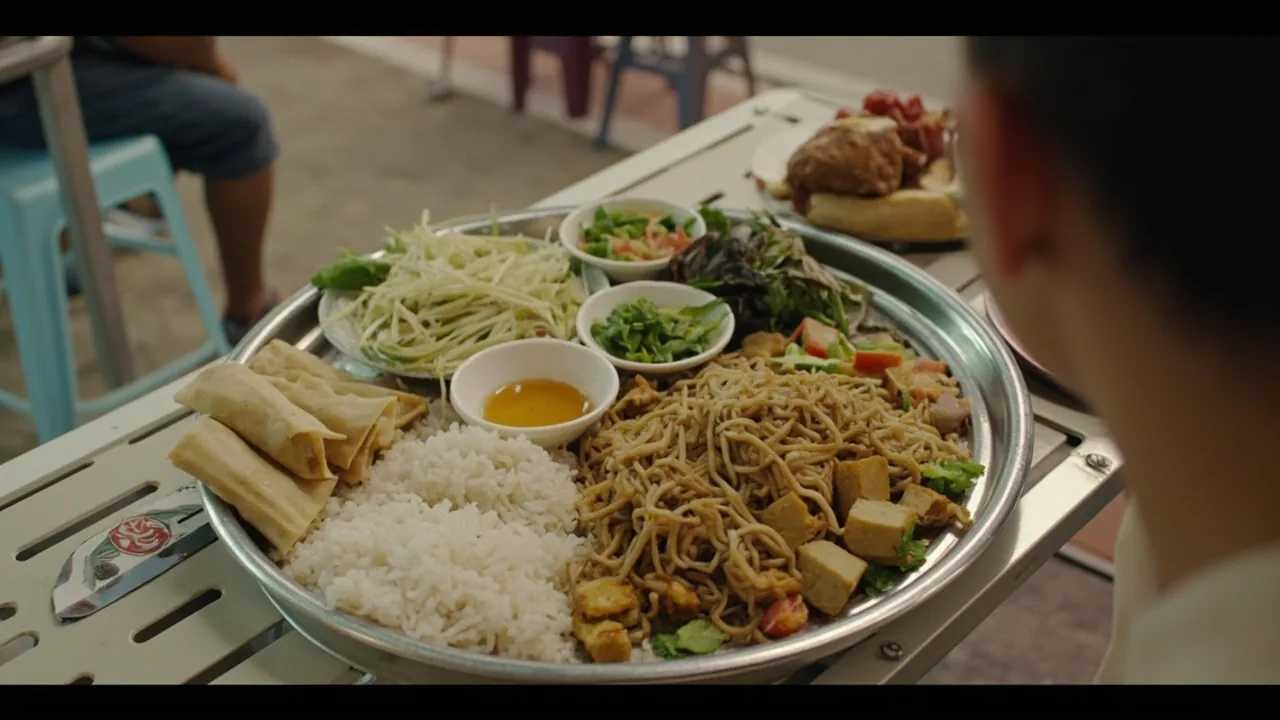
Vegetarian Food in Thailand for Indians: The 2026 Survival Guide
Verified against current Google Maps ratings and traveller reports from June 2026. For related planning, see our guide on Sea Backpacking Hub.
Eating vegetarian food in Thailand for Indians is not the minefield your WhatsApp group says it is. I have run through the phrases, checked which dishes hide fish sauce in the name of “vegetable curry,” and read every review I could find for veg-friendly restaurants in Bangkok, Chiang Mai, Phuket, and Chiang Rai. Here is the full picture: the magic word “Jay,” the hidden ingredients to watch for, the dishes you can eat by default, and the spots that show up over and over in Indian traveller reviews. You may also find Mango Sticky Rice Phuket useful for this trip.
The whole system rests on a single yellow flag with red Thai text, the word “Jay” (เจ), which Thai-Chinese Buddhists use to mark fully plant-based food. Spot the flag, you are safe. Don’t spot the flag, you have to ask. This guide tells you exactly how to ask, what to ask about, and which local dishes you can order without even trying.
Quick Answers
| What | Answer | Price (INR) |
|---|---|---|
| Magic word for vegetarian in Thailand | ”Jay” (เจ) | Free to say |
| Magic word for “no meat, no seafood" | "Gin Jay” (กินเจ) | Free to say |
| Magic word for “no onion, no garlic” (Jain) | “Mai sai horm gratiem” (ไม่ใส่หอมกระเทียม) | Free to say |
| Average Jay street meal (rice + curry + stir-fry) | ₹172 (~60 THB or ~$1.79) | ₹172 (~60 THB or ~$1.79) |
| Average fruit/dessert (mango sticky rice) | ₹143 (~50 THB or ~$1.49) | ₹143 (~50 THB or ~$1.49) |
| Indian thali in Bangkok/Chiang Mai | ₹717-₹1,148 (~250-400 THB or ~$7.45-$11.91) | ₹861 (~300 THB or ~$8.94) |
The Local Culinary Landscape: What “Vegetarian” Means in Thailand
Here is the cultural gap that catches Indians the most. In Thailand, the word “vegetarian” in English on a menu can mean “no red meat”, which still leaves chicken, fish sauce, shrimp paste, eggs, and oyster sauce on the plate. A “vegetable soup” here often has chicken stock. A “vegetable stir-fry” at a normal Thai eatery is almost always cooked in the same wok as meat, or finished with a spoon of oyster sauce or fish sauce for “flavour.”
The fish sauce thing is the real trap. Nam pla (น้ำปลา) is in roughly 70% of savoury Thai dishes. It is in fried rice, pad see ew, most curries, papaya salad, and even some green beans with soybean paste. Shrimp paste (kapi, กะปิ) hides in chili pastles and some curry pastes. Oyster sauce sneaks into morning glory and broccoli dishes. Lard or pork fat turns up in some fried noodles and certain curries in the south.
So a Thai waiter who hears “vegetarian” from an Indian accent will often picture someone who eats chicken and fish. The job of this guide is to make sure you never end up with that assumption on your plate.
The good news: Thailand has a deep, public, visible vegetarian culture. Every October, Tesagan Gin Jay (เทศกาลกินเจ) takes over Chinatown in Bangkok and spreads to Chiang Mai, Phuket, and other cities. Tens of thousands of Thai-Chinese go fully plant-based for nine days. Outside the festival, Jay restaurants, stalls, and the yellow flag system exist year-round, and Bangkok alone has hundreds of them.
The cultural signal you want is the yellow flag with red text reading “เจ” hanging outside a restaurant, stall, or hotel buffet. A Jay place serves food that is vegan and free of the five taboo items in Mahayana-influenced Thai vegetarianism: meat, seafood, eggs, milk, and strong-smelling vegetables (which in this tradition includes onions, garlic, chives, scallions, and leeks). For most Indian vegetarians that is perfect. For Jains it is even more aligned than typical Indian “veg” cooking.
For full safety, lean on Jay-only spots or the Indian restaurant list at the bottom of this guide. For everything in between, you ask the questions in the next section.
Key Phrases in Local Script
Print this table or screenshot it. The Thai script matters because pronunciation alone, with all the tones, can confuse a server. Pointing at the Thai word is the most reliable way to get what you want.
| English Phrase | What It Means | Thai Script | Pronunciation |
|---|---|---|---|
| I eat vegetarian / vegan | ”I am Jay” | กินเจ | ”Gin Jay” |
| No meat | No meat of any kind | ไม่ใส่เนื้อ | ”Mai sai nuea” |
| No seafood | No fish, shrimp, shellfish | ไม่ใส่อาหารทะเล | ”Mai sai a-han ta-lay” |
| No fish sauce | Critical for veg food | ไม่ใส่น้ำปลา | ”Mai sai nam pla” |
| No egg | Important for vegans | ไม่ใส่ไข่ | ”Mai sai khai” |
| No oyster sauce | Watch for in stir-fries | ไม่ใส่น้ำมันหอย | ”Mai sai nam man hoi” |
| No milk / no dairy | For vegan strictness | ไม่ใส่นม | ”Mai sai nom” |
| No onion, no garlic (Jain) | Critical for Jains | ไม่ใส่หอมกระเทียม | ”Mai sai horm gratiem” |
| Is this Jay? | Asking if a dish is plant-based | อาหารเจไหม | ”A-han Jay mai?” |
| I am allergic to peanuts | Common in curries and pad thai | แพ้ถั่ว | ”Pae thua” |
| Spicy OK, but not too spicy | For medium-heat eaters | เผ็ดนิดหน่อย | ”Phet nit noi” |
| Not spicy at all | For sensitive palates | ไม่เผ็ด | ”Mai phet” |
Subodh’s Pro Tip: Carry a screenshot of “Gin Jay” and “Mai sai nam pla” in your phone. When in doubt, show both together. “Gin Jay. Mai sai nam pla” covers 90% of what you need at any Thai street stall.
Safety Alert: If you have a peanut allergy, Thailand is one of the higher-risk countries in Southeast Asia. Peanuts appear whole, ground, in sauces, and in pad thai. Carry an antihistamine or epinephrine auto-injector, and use the “Pae thua” phrase above at every meal.
Safe Local Street Food Dishes
These are Thai dishes that are either plant-based, or become plant-based with a one-line modification. Prices are typical Bangkok and Chiang Mai street-stall rates; island and tourist-zone rates run 30 to 50% higher.
Pad Thai Jay (ผัดไทยเจ)
The classic stir-fried noodle dish, ordered “Jay” style. Rice noodles, tofu, bean sprouts, chives, peanuts, lime, and tamarind. The standard pad thai contains dried shrimp and is finished with a fish-sauce-heavy seasoning. The Jay version skips both. Tell the wok cook “Pad Thai Jay” and you are done. It is the single easiest safe dish to order in Thailand.
- Price: ₹172 (~60 THB or ~$1.79)
- Order it as: “Pad Thai Jay, mai sai nam pla kha” (Pad Thai Jay, no fish sauce please)
- Where: Look for any Bangkok stall with the yellow Jay flag.
Pad Pak Ruam Jay (ผัดผักรวมเจ)
Mixed-vegetable stir-fry, the broccoli-carrot-mushroom-cauliflower medley, in the Jay version. Specify oyster sauce off (oyster sauce is the default seasoning at most woks) and you have a clean, mild stir-fry that pairs with rice.
- Price: ₹172-₹230 (~60-80 THB or ~$1.79-$2.38)
- Order it as: “Pad pak ruam Jay, mai sai nam man hoi” (Mixed veg stir-fry, no oyster sauce)
- Watch for: Some cooks default to oyster sauce and don’t think to flag it. If you see a brown glossy coating on the vegetables, ask before eating.
Som Tam Jay (ส้มตำเจ)
The famous green papaya salad, which is normally loaded with fish sauce, dried shrimp, and crab. The Jay version uses soy sauce or salt instead. The flavour profile changes (less funky, more straightforwardly sour-spicy-sweet), but it is genuinely delicious and one of the best things on a Thai table. You can ask for “mai phet” (not spicy) if you want the tourist version.
- Price: ₹115 (~40 THB or ~$1.19)
- Order it as: “Som Tam Jay, mai sai nam pla, mai sai kung” (Papaya salad Jay, no fish sauce, no shrimp)
Tom Yum Jay (ต้มยำเจ)
The classic hot-and-sour soup, in its plant-based form. The classic tom yum goong (with shrimp) has shrimp paste in the broth base. The Jay version uses mushrooms and soy sauce to mimic the umami. The lemongrass, galangal, kaffir lime, and chili are the same.
- Price: ₹230-₹344 (~80-120 THB or ~$2.38-$3.57)
- Order it as: “Tom yum Jay, mai sai nam pla” (Tom yum Jay, no fish sauce)
Mango Sticky Rice (ข้าวเหนียวมะม่วง)
The dessert that brings everyone to Thailand. Sweet sticky rice, fresh ripe mango, coconut cream drizzled on top. Vegan in nearly every version. The only thing to watch is toppings, and even then it is almost always safe.
- Price: ₹143 (~50 THB or ~$1.49)
- Order it as: “Khao niao mamuang” (it is so common that the name is enough)
Subodh’s Pro Tip: At any Thai street stall, look for two signals before ordering. The first is the yellow Jay flag. The second is a wok that is being used. A busy stall at peak hours means high turnover, which means the food has been cooked recently and is not sitting out. Combined, those two signals are a good proxy for both vegetarian safety and basic food hygiene.
Recommended Vegetarian Restaurants
These are the spots that show up repeatedly in Indian traveller reviews, with a specific veg-friendly angle. Use them as your “I am not gambling today” backup. The Thai-local and Indian-friendly categories are split, because in Thailand those are two genuinely different dining universes.
Thai-Local Vegetarian (Jay) Spots
Kao Man Kai Jay Vegan Food ข้าวมันไก่เจ (rating 4.8) is the kind of place a Bangkok local would text you about. The menu is fully Jay: vegan Thai food in a small, no-frills local setting. Expect rice plates, noodle soups, and stir-fries priced like a street stall even though the setting is sit-down. Typical meal runs ₹172-₹287 (~60-100 THB or ~$1.79-$2.98). The chicken-shaped logo is a Thai pun on “khao man kai” (Hainanese chicken rice), the meat dish the kitchen reimagines in vegan form.
Mama Ann (rating 4.9) is a family-run Thai eatery that is not exclusively Jay but has a strong Jay menu and the kind of home-style Thai cooking that explains why the rating sits where it does. Travellers report ordering Jay curries, stir-fries, and soups with confidence.
Secret Oven (rating 4.9) is a rustic Thai spot with comfort food in the Jay-friendly category. Good for the kind of slow lunch where you order a couple of dishes and a plate of rice and let the kitchen decide.
Aonchorn Thai Restaurant ออนชอน ราชดำเนิน (rating 4.9) sits in the Ratchadamnoen area of Bangkok (the old city) and serves local Thai dishes with the kind of flavour that explains its strong reviews. Ask for the Jay menu when you sit down.
Love Koh Tao (rating 4.9) is a Koh Tao garden restaurant known for massaman curry and seafood platters, but the menu has a clear vegetarian section with curries and stir-fries that translate well. Worth a stop if you are on the island and need a sit-down meal.
Indian and Veg-Fallback Spots
Kanchan Indian Food (Home Made, Pure Veg) (rating 4.8) in Chiang Mai is a family-run Punjabi-vegetarian kitchen. The “home made” promise is real here: the dal, the sabzi, the chapati taste like a North Indian thali from a small-town dhabha. Expect a thali around ₹574-₹803 (~200-280 THB or ~$5.96-$8.34).
Chada Vegetarian Restaurant Chiang Mai (rating 4.8) is a long-running local-vegetarian and Indian-vegetarian spot. Travellers report that it is one of the more reliable places in Chiang Mai to get a proper Indian thali outside Nimmanhaemin. Prices typically sit around ₹430-₹717 (~150-250 THB or ~$4.47-$7.45).
Kunda Vegetarian Vegan Burger Cafe Chiang Rai (rating 4.9) is the Chiang Rai answer to “I am tired of rice.” Burgers, fries, vegan milkshakes. The kind of place you sit in for an hour to escape the heat. Mains around ₹430-₹631 (~150-220 THB or ~$4.47-$6.55).
Chai “N” Thai @ Nimman Indian Restaurant (rating 4.9) in Nimmanhaemin, Chiang Mai, is the all-in-one Indian spot: North Indian, South Indian, vegan, non-veg, halal, gluten-free. Reviewers rate it as the most complete Indian food option in the city. Expect ₹574-₹1,148 (~200-400 THB or ~$5.96-$11.91) per person with rice, dal, and a curry.
Little Indian Kitchen Chiang Mai Night Bazaar (rating 4.9) is the night-bazaar answer to your dal-chawal problem. Halal Indian, vegan-friendly, and explicitly spicy. The night-bazaar setting means you can shop and eat in one stop.
Indique (Bangkok) (rating 4.9) is the upscale pick. Indian fine dining at around ₹3,868 (~1,348 THB or ~$40.15) per person with butter chicken as the signature dish, plus full vegetarian options. The kind of place you book for a special night, not for daily meals.
For a Thai food tour that visits multiple Jay spots in one booking, ask at your hotel or guesthouse for a locally recommended guide.
Food Safety and Hygiene
Travellers report that the most common cause of “Bangkok belly” in Indian visitors is not street food, it is ice in drinks and tap water in salads. Thailand is a country where the food is safer than the water, so use the same caution you would in any Southeast Asian capital.
- Drink only sealed bottled water. A 0.6-litre bottle runs ₹20 (~7 THB or ~$0.21) at 7-Eleven and ₹29-₹43 (~10-15 THB or ~$0.30-$0.45) at a street stall. Avoid ice from unmarked sources; the ice at any reputable restaurant and at 7-Eleven is factory-made with clean water (look for the hollow tube shape, not the solid cloudy cubes).
- Eat at busy stalls with high turnover. A stall with a queue at 7pm is safer than an empty one at 7pm. The food is fresher, the wok is hot, and you can see what other people are eating.
- Skip raw vegetables you didn’t wash yourself. Salads at unmarked stalls can carry the same water risk. A Jay stir-fry where the vegetables hit the wok at 200°C is safer than a green salad at a roadside cart.
- Carry ORS and a probiotic. Pharmacies (Bangkok: Boots, Watsons; elsewhere: local chains) sell ORS sachets for around ₹29-₹86 (~10-30 THB or ~$0.30-$0.89). Travellers report that starting a probiotic two days before arrival noticeably reduces stomach issues.
- Peanut allergy travellers: Carry antihistamines and, if prescribed, an epinephrine auto-injector. Always use the “Pae thua” phrase at every meal. Peanuts show up in pad thai, som tam, massaman curry, and many sauces.
For a deeper dive on the bigger picture (mosquito-borne illness, vaccines, hospitals, insurance), the Thailand health risks guide for Indian travellers covers what to think about before you board the flight.
Getting Connected
A local SIM is cheap and makes food translation, Google Maps, and Grab (the local ride-hailing app) work properly. The two main carriers are AIS and dtac, both of which sell tourist SIMs at the airport and at any 7-Eleven. A 15-day tourist SIM with 30 to 50 GB of data runs around ₹858 (~299 THB or ~$8.91) and is enough to look up a translation, navigate to a Jay restaurant, and message home.
If you would rather skip the airport counter and activate before you land, Get Nomad eSIM lets you buy and install a Thailand data plan in under five minutes from your phone. It connects on landing and is useful for the first 24 hours of translation help while you are still finding the AIS booth.
Common Food Mistakes Indians Make in Thailand
These are the specific failure modes I have heard about from other Indian travellers. Each one is fixable with a small change in what you say at the counter.
- Saying “vegetarian” without “Jay.” The Thai server hears “no red meat” and brings chicken. Switch to “Gin Jay” or “A-han Jay” and the entire kitchen’s preparation rules change.
- Assuming “vegetable soup” is safe. Tom jay is safe; tom yam goong is not. A regular “tom yam” without the “Jay” almost always has shrimp paste in the broth base. Order “Tom yum Jay” specifically.
- Forgetting fish sauce. A green papaya salad with no meat but full of nam pla and dried shrimp is not vegetarian. Always pair “Jay” with “mai sai nam pla” at the savoury end.
- Ordering “mango sticky rice” with extra toppings. The base dessert is vegan. The toppings sometimes are not. Skip the extra “durian sticky rice” or any coconut cream garnishes you cannot identify.
- Trusting the English menu at tourist-zone restaurants. The English menu can be translated from a Thai menu where “vegetable” means “no pork.” Walk-in cooks at non-Jay places still treat English vegetarian as flexible. Stay Jay-specific in your phrasing.
- Underestimating the spice. Thai “mild” is Indian “medium.” If you want a non-spicy dish, say “mai phet” firmly. “Pet nit noi” (a little spicy) is closer to Indian spicy.
For a more detailed dish-by-dish breakdown that pairs with this guide, the vegetarian food in Thailand: what to eat, where to eat, how to ask article expands on this with city-specific recommendations for Bangkok, Chiang Mai, and Phuket.
FAQ
Is Burger King or McDonald’s safe for vegetarians in Thailand?
Yes, both chains have a vegetarian or plant-based option, and their kitchens in Thailand are trained on the Jay item. Burger King’s plant-based Whopper is widely available, and McDonald’s Thailand sells a “McPlant” and a vegetable burger. The fries are typically vegetarian (no animal fat in Thailand) but the hash browns at McDonald’s do contain eggs, so ask. Prices run ₹227-₹456 (~79-159 THB or ~$2.35-$4.74) for a combo meal.
Can I get Jain food (no onion, no garlic) in Thailand?
The Thai Jay tradition itself excludes onion, garlic, chives, scallions, and leeks, so a true Jay restaurant is the closest thing to Jain food you will find outside an Indian restaurant. Use the phrase “mai sai horm gratiem” (no onion, no garlic) at any Thai spot, and rely on the Indian restaurants in the list above for strict-Jain meals. Note that many Indian restaurants in Thailand still use onion and garlic in their North Indian curries, so always ask even at an Indian place.
Is fish sauce in everything?
Not everything, but it is in the majority of savoury Thai dishes. Noodle dishes, fried rice, most stir-fries, papaya salad, and many curries use it. Soups and clear broths sometimes do, sometimes don’t. The only categories where you can relax are: fresh fruit, fried rice or noodles from a confirmed Jay stall, desserts, and Indian restaurants.
What about peanut allergy?
Thailand has a higher rate of peanut exposure than most countries. Peanuts appear whole, ground into sauces, and as garnish on everything from pad thai to som tam to massaman curry. If you have a serious allergy, you need to mention it at every meal (“Pae thua”), carry medication, and consider sticking to Indian restaurants and Jay-only places where the ingredient list is more controlled.
Are Bangkok and Chiang Mai equally good for veg food?
They are equally good but different. Bangkok has more Jay restaurants by sheer volume, more Indian restaurants in tourist zones, and more 24-hour options. Chiang Mai has a stronger small-town vegetarian culture, more Nimmanhaemin-area Indian restaurants, and a more relaxed environment for slow meals. Both cities score well for Indian vegetarians. Phuket and Krabi have a tighter selection but still enough for a 5 to 7-day trip.
What is the daily food budget for a vegetarian Indian traveller?
A reasonable daily food budget in Thailand is ₹1,721-₹2,582 (~600-900 THB or ~$17.87-$26.81) if you mix Jay street food, fruit, and one Indian-restaurant meal. At 1 INR = 0.3485 THB, that comes out to about ₹1,700 to ₹2,600 (~$26.99) a day. Travellers on a tighter backpacker budget can run 400 THB/day (~₹1,148) on Jay stalls and 7-Eleven fruit. A splurge day with a sit-down Indian dinner runs ₹3,443-₹4,304 (~1,200-1,500 THB or ~$35.74-$44.68). For a per-city breakdown, the Thailand food cost per day in Indian rupees article has the numbers.
Subodh’s Take
The reason Indian travellers panic about vegetarian food in Thailand is that they are using the wrong mental model. Thailand is not a country where you have to negotiate every meal; it is a country where the Jay system has done most of the negotiating for you, year-round and at scale. Once you can read the yellow flag and order with “Gin Jay” and “mai sai nam pla,” you get a parallel food universe that runs alongside the meat one, and it is often cheaper and fresher. Spend your first two meals at a confirmed Jay spot or a recommended Indian restaurant, learn the phrases, and the rest of the trip runs itself.
