Kanchanaburi Vegetarian Food Guide: Best Restaurants & What to Eat
Kanchanaburi sits in western Thailand about 130 km from Bangkok. The town has real Thai food everywhere, but the dedicated veg scene is small. What you do find is enough to eat well for a short stop. If you’re still planning your wider route, our Thailand vegan food tour covers plant-based eating across the country, and our Southeast Asia backpacking hub ties the wider route together.
Prices are in THB (Thai Baht) since you’re paying in baht on the ground; 1 THB ≈ ₹2.87.
Quick Answers
| What | Answer | Price (INR) |
|---|---|---|
| Safest word to know for veg food | ”Jay” (เจ), means vegan, no meat, no fish sauce, no egg, often no onion/garlic | Free |
| Average price of a veg stir-fry at a local Thai restaurant | ₹230-₹431 (~80-150 THB) | ₹230-₹430 (~$2.38-$4.46) |
| Price of a fresh fruit shake | ₹115-₹172 (~40-60 THB) | ₹115-₹172 (~$1.19-$1.78) |
| Daily veg food budget (backpacker) | ₹718-₹1,292 (~250-450 THB or ~$7.45-$13.40) | ₹717-₹1,291 (~$7.43-$13.38) |
The Local Culinary Landscape
Kanchanaburi’s everyday food leans on the same Thai foundation you’ll find across the country: stir-fries with holy basil, jasmine rice, coconut-milk curries, and grilled meats at riverside spots. The issue for vegetarians isn’t that veg food doesn’t exist, it’s that the default flavour profile hides animal products in places Indians don’t expect.
Fish sauce (น้ำปลา nam pla) is in roughly 80% of savoury Thai dishes. It’s in pad thai, fried rice, papaya salad, tom yum soup, even the dipping sauce that comes with morning glory. Shrimp paste (กะปิkapi) sits in many curry pastes. Oyster sauce shows up in vegetable stir-fries. Chicken broth is the base of most clear soups unless you specifically ask otherwise. Egg is brushed onto noodles, rice, and even some fried vegetables as a binder.
The local attitude toward vegetarianism is friendly but imprecise. Many Thai people consider seafood “not meat” in casual conversation, and a few older cooks will assume chicken broth is fine for a “vegetarian” because it’s “just flavour.” When you say you’re vegetarian, expect to be asked twice: once with genuine curiosity, once to confirm you mean no fish sauce.
Subodh’s Pro Tip: The yellow flag with red Chinese characters (เจ Jay) is your single best signal in Thailand. Any stall or restaurant flying it is making vegan food with no animal products, often no onion or garlic either. In Kanchanaburi, the Jay offerings rotate, so don’t expect a permanent yellow-flag street market the way you’ll see in Bangkok’s Chinatown. You may need to ask locally where the closest Jay spot is on the day you’re there.
Key Phrases in Local Script
Print this list or screenshot it. Two phrases (the first two below) will handle 95% of your meals in Kanchanaburi.
| English Phrase | What it Means | Local Script | Pronunciation |
|---|---|---|---|
| I am vegetarian (vegan) | The single most useful phrase | ฉันกินเจ | chan kin jay |
| No fish sauce | The hidden-ingredient question | ไม่ใส่น้ำปลา | mai sai nam pla |
| No meat, no seafood | Reinforces Jay with specifics | ไม่ใส่เนื้อ ไม่ใส่อาหารทะเล | mai sai nuea, mai sai ahan taleh |
| No egg | Important for strict veg | ไม่ใส่ไข่ | mai sai khai |
| No onion, no garlic | Essential for Jains | ไม่ใส่หอม ไม่ใส่กระเทียม | mai sai hom, mai sai krathiam |
| Is there shrimp paste in this? | Hidden-ingredient check | มีกะปิไหม | mee ka pi mai |
| Thank you (formal) | Politeness closes the deal | ขอบคุณครับ/ค่ะ | khob khun krap/kha |
The pronunciation column reads phonetically. You’ll be understood even with approximate pronunciation, but locals appreciate the effort.
Safe Local Street Food Dishes
Kanchanaburi’s night market along the river and the smaller stalls near the bus station serve the same Thai staples you’ll find anywhere in the country. The four below are reliably vegetarian when ordered with the right phrase.
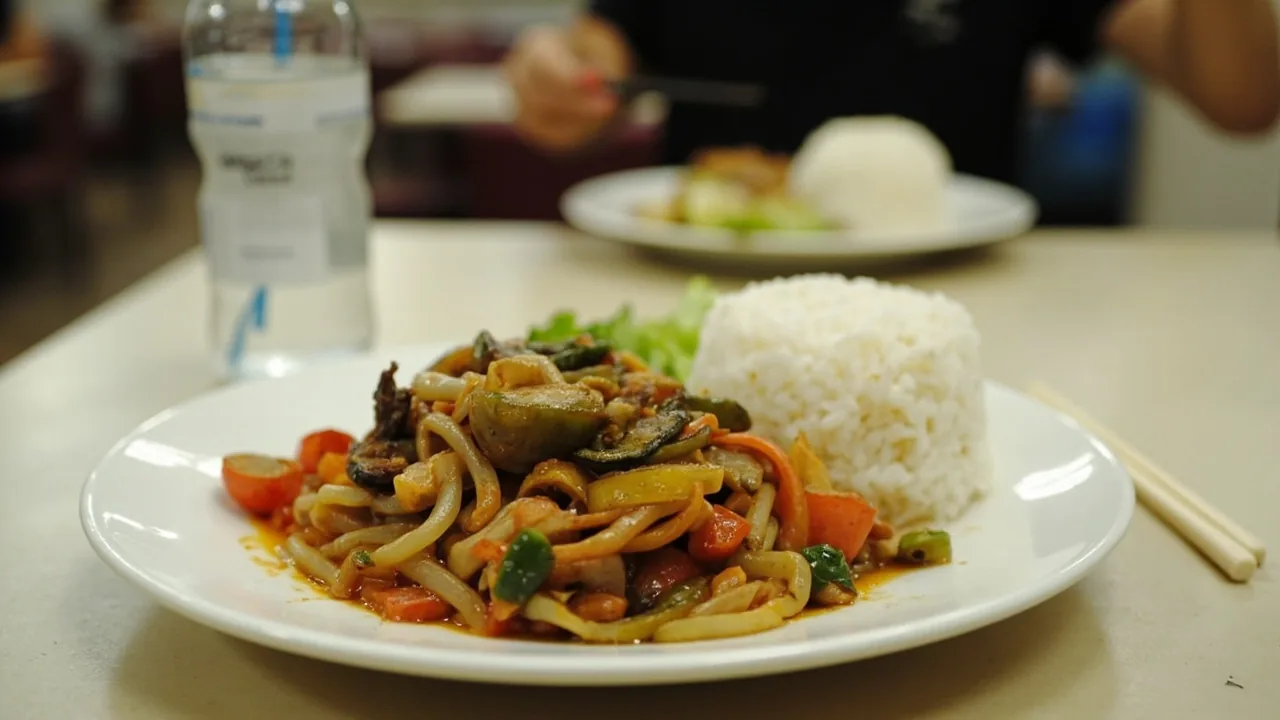
Pad Pak Ruam (ผัดผักรวม) is a mixed-vegetable stir-fry with broccoli, cabbage, carrot, and mushrooms in a light soy or oyster sauce. Specify “no oyster sauce, no fish sauce” and you’ll get a clean soy-and-garlic version. Expect to pay ₹230-₹345 (~80-120 THB) at a casual Thai spot.
Pad See Ew Jay (เส้นใหญ่ผัดซีอิ๊ว เจ) is wide rice noodles with Chinese broccoli in dark sweet soy. Ordering it Jay removes the egg and the fish sauce. Most Thai cooks make this daily, so it’s a low-risk order. Around ₹201-₹287 (~70-100 THB).
Tom Yam Jay (ต้มยำ เจ) is the famous hot-and-sour soup done as a clear vegetable broth with mushrooms, tomato, galangal, and lime. Specify Jay and ask them to confirm no shrimp paste in the paste base. Around ₹287-₹431 (~100-150 THB) for a small pot.
Khao Niao Mamuang (ข้าวเหนียวมะม่วง), mango sticky rice, is the safest dessert in Thailand: glutinous rice, fresh mango, coconut cream, salt. Completely vegetarian and sweet. Expect ₹172-₹287 (~60-100 THB) from any market stall.
Pak Boong Fai Daeng (ผักบุ้งไฟแดง), morning glory stir-fried with garlic and chillies, is common in Kanchanaburi because of the river. Specify no oyster sauce and ask for the garlic version. Around ₹230-₹345 (~80-120 THB).
Safety Alert: Night market stir-fries in tourist towns sometimes default to oyster sauce because the cook assumes Western tourists won’t mind. Always ask. The phrase “mai sai nam pla, mai sai ahan taleh” (no fish sauce, no seafood) is the minimum you need.
Recommended Vegetarian Restaurants
Kanchanaburi doesn’t have a big dedicated vegetarian district. The five places below are the real options. Mix-and-match: Thai for most meals, Indian when you’re homesick.
Mangosteen Garden Restaurant is one option travellers mention for a Thai meal in a garden setting. Order the stir-fried morning glory with garlic (no oyster sauce), a green papaya salad with peanuts (ask for no fish sauce, no dried shrimp), and a plate of jasmine rice. Expect ₹431-₹861 (~150-300 THB) per dish, ₹718-₹1,292 (~250-450 THB) for a full meal. Staff reportedly understand Jay requests.
Salad Factory - โรบินสันไลฟ์สไตล์ กาญจนบุรี sits inside the Robinson Lifestyle mall and is the safest bet in town when you want a guaranteed-veg meal without negotiating ingredients. They build salads and plant-based bowls to order, so you can skip anything you don’t want. Salads run ₹345-₹632 (~120-220 THB), plant-based mains ₹431-₹718 (~150-250 THB). The mall location also means air-conditioning, English menus, and a clean restroom, useful after a long day of sightseeing.
Loft Restaurant & Bar is the move for one slightly fancy night. It’s known for fusion cuisine and a rooftop setting with views over Kanchanaburi, so set expectations accordingly for a mid-range sit-down meal. Non-veg dishes like duck confit appear on the menu, but the kitchen also offers plant-based plates. Plan on ₹861-₹1,723 (~300-600 THB) per person if you’re ordering multiple small plates. Worth it for the view, not necessary every night.
For Indian vegetarian and pure-Jain meals specifically, see the Kanchanaburi Indian restaurants guide, which covers the dedicated Indian spots in town and which ones handle no-onion-no-garlic requests properly.
Food Safety & Hygiene
The standard Southeast Asia rules apply in Kanchanaburi, with one local note: the climate is hot and humid even in the cool season, so food sits out faster than it does in Bangkok.
- Drink bottled or filtered water only. The 7-Eleven on every block sells 0.6 L bottles for ₹20-₹29 (~7-10 THB).
- Eat at stalls with high turnover. If a curry has been sitting on the steam table since breakfast, skip it. The fresh-from-the-wok stir-fry is safer than the pre-cooked one.
- Avoid raw vegetables you didn’t wash yourself, with one exception: the green papaya salad made in front of you is fine because the acid and chilli work as a mild sanitiser.
- Ice from street vendors in central Kanchanaburi is generally factory-made and safe. Outside town, ask if the ice is “nam leng” (pipe water, risky) or “nam thung” (factory ice, safe).
- Carry oral rehydration salts from any Thai pharmacy. A few sachets cost ₹86-₹144 (~30-50 THB) and save a day if your stomach slips.
Getting Connected
A working SIM makes the difference between wandering for an hour looking for a veg spot and just opening Google Maps. Physical SIMs from the major Thai carriers are sold at the airport, convenience stores, and most Kanchanaburi phone shops. A 7-day tourist SIM with 15-30 GB runs ₹571-₹859 (~199-299 THB). Bring your passport for registration. If you’d rather skip the queue, an eSIM activated before you land is a convenient alternative.
Common Food Mistakes Indians Make
Mistake 1: Assuming “vegetable fried rice” is vegetarian. What happens: the cook uses fish sauce instead of salt, brushes the rice with egg, or finishes with oyster sauce. The dish looks safe and tastes fine, and you only realise the mistake later. How to avoid it: always say “Jay” or “mai sai nam pla” before the dish leaves the kitchen, even if the menu photo looks clean.
Mistake 2: Trusting “vegetarian soup.” What happens: tom yum, tom kha, and even clear vegetable soups default to chicken broth or shrimp paste in the base. How to avoid it: order Tom Yam Jay specifically, or ask “wa tee man khae” (what’s the base?) before committing.
Mistake 3: Skipping the “no shrimp paste” question on curries. What happens: green curry, massaman, and panang curries all use a red or green paste with shrimp paste as a standard ingredient. Even after saying Jay, the paste is sometimes pre-made. How to avoid it: ask “mee ka pi mai” (is there shrimp paste?) and request a fresh paste or no paste at all.
Mistake 4: Forgetting about larb and papaya salad. What happens: both dishes traditionally use fish sauce and dried shrimp, and the cook doesn’t think to skip them just because you said no meat. How to avoid it: order “Jay” versions explicitly and confirm dried shrimp is also out.
Mistake 5: Eating only Indian food for the whole trip. What happens: you miss the best part of being in Thailand, which is the Thai food itself, and you end up overspending on a ₹574-₹861 (~200-300 THB) thali when a ₹287 (~100 THB) Thai veg stir-fry would have been better. How to avoid it: mix it up. Two Thai meals a day, one Indian meal when you want comfort food, occasional street-fruit in between.
FAQ
Is there proper Jain food (no onion, no garlic) in Kanchanaburi? Limited. The Indian restaurants in town handle no-onion-no-garlic requests, and a few Jay Thai spots skip onion and garlic by default. See the broader Thailand vegetarian guide for strategies used across the country.
Can I find familiar fast-food fries as a backup? Yes. International chains with localised menus operate in the area. The fries, apple pie, and veggie burger patty at the usual fast-food spots are safe vegetarian options. Not exciting, but useful as a known-quantity meal if your stomach is off.
Is fish sauce in everything? Almost. The exception is anything served with a “Jay” label or a yellow flag. Plain jasmine rice and most desserts are clean. Mango sticky rice, coconut ice cream, fresh fruit, and grilled corn are all safe.
How much should I budget for veg food per day in Kanchanaburi? Backpacker range: ₹718-₹1,292 (~250-450 THB) covers three meals at local Thai spots with one fruit shake. Mid-range: ₹1,292-₹2,010 (~450-700 THB) adds a Salad Factory meal and a fancier dinner. Indian thalis cost more, around ₹574-₹861 (~200-300 THB) per meal.
Do I need to tip? No. Tipping isn’t customary in Thailand at small restaurants and street stalls. Round up the bill or leave small change (₹57-₹144 (~20-50 THB)) at mid-range spots if service was good, but it’s a kind gesture, not an expectation.
Subodh’s Take
Kanchanaburi is a 2-to-3-night stop, not a week-long food pilgrimage, and the vegetarian scene reflects that. You’ll eat Thai food well if you master “kin jay” and “mai sai nam pla” before you sit down. The dedicated veg spots are thin on the ground, but the Thai kitchens that exist are flexible, and the Salad Factory in Robinson mall is your insurance policy for the days you don’t want to negotiate ingredients. Don’t skip the mango sticky rice and don’t skip the morning glory. Both are some of the best in Thailand and both happen to be vegetarian. Travellers heading south after Kanchanaburi often continue into Malaysia, where the regional plant-based scene changes again. Our vegetarian food in Thailand overview explains what to order and how to ask across Thai cities beyond Kanchanaburi.