Laos Transport Guide: How to Get Around (2026)
Laos is Southeast Asia’s slowest, sleepiest country to travel through, and that’s the whole point. Roads are rough, rivers do the heavy lifting, and there’s no metro, no Skytrain, no Grab. This guide covers every realistic option for getting around Laos, what it costs, and how far a transport budget stretches. See our SEA backpacking hub for the full picture.
A quick honest caveat before we start: Laos’s road network is thinner than its neighbours’. The Vientiane to Luang Prabang highway has improved a lot, but branch routes still turn to dust in the wet season. Travellers report that buses break down, ferries get cancelled when the Mekong runs low, and mountain roads between Vang Vieng and Phonsavan close for hours after heavy rain. Plan slack days into your itinerary.
Subodh’s Pro Tip: Download the LOCA Laos app before you arrive. It is the closest thing Laos has to a working rideshare. It works in Vientiane and Luang Prabang for tuk-tuks and songthaews, payment is cash on arrival, and the fare is fixed before you book. Grab and Bolt do not operate in Laos.
Quick Answers
| What | Answer | Price (INR) |
|---|---|---|
| Cheapest intercity option | Local bus (no AC, frequent stops) | ₹430-₹644 (~100,000-150,000 LAK or ~$4.46-$6.69) |
| Best option for Vientiane to Luang Prabang | VIP sleeper bus or short-haul flight | ₹1,074-₹1,718 (~250,000-400,000 LAK or ~$11.15-$17.83) |
| Mekong slow boat Huay Xai to Luang Prabang | 2-day boat, includes Pak Beng overnight | ₹1,074-₹1,331 (~250,000-310,000 LAK or ~$11.15-$13.82) |
| Tuk-tuk within a town (short hop) | Negotiate before getting in | ₹215-₹430 (~50,000-100,000 LAK or ~$2.23-$4.46) |
| Scooter rental per day (Vang Vieng, Vientiane) | Automatic 110-125cc, semi-automatic 110cc manual also common | ₹344-₹644 (~80,000-150,000 LAK or ~$3.57-$6.69) |
| Does Grab work in Laos? | No. Use LOCA Laos in cities, tuk-tuks elsewhere | Free app |
| Is there a metro or train? | No metro. The Laos-China Railway runs Vientiane to Boten (northern border) | ₹859-₹1,718 (~200,000-400,000 LAK or ~$8.92-$17.83) |
| How far does ₹9,634 (~100 USD) stretch on local transport? | Roughly 7-10 days of buses, boats, and tuk-tuks if you mix slow options | ~₹9,634 (~100 USD) |
| App-based rideshares available | LOCA Laos (Vientiane, Luang Prabang only). Grab, Bolt, Gojek: none | Free / pay on arrival |
| Domestic flights | Lao Airlines connects Vientiane, Luang Prabang, Pakse | ₹3,436-₹6,442 (~800,000-1,500,000 LAK or ~$35.67-$66.87) |
The Laos-China Railway: The Newest Option
Let’s start with the elephant in the room because it changes the map. The Laos-China Railway opened in December 2021 and runs from Vientiane in the south to Boten on the Chinese border in the north, with stops in Vang Vieng, Luang Prabang, and several smaller towns. It is fast, air-conditioned, and has cut the Vientiane to Luang Prabang journey from 10-13 bone-shaking bus hours to about 2 hours of smooth track.
Tickets run ₹859-₹1,718 (~200,000-400,000 LAK or ~$8.92-$17.83) depending on class and route, and you can book them at the station, through travel agents in town, or Find rides on 12go for the longer bus and minivan legs the railway doesn’t cover. The catch: the stations sit 10-15 km outside town centres, so you’ll still need a tuk-tuk on either end, which adds ₹215-₹344 (~50,000-80,000 LAK or ~$2.23-$3.57) per ride.
For backpackers doing the classic Vientiane → Vang Vieng → Luang Prabang loop, the railway is the new default. For everywhere south of Vientiane (Pakse, the Bolaven Plateau, the 4,000 Islands), you’re back on buses and boats.
Buses and Minivans
Buses are the workhorse of Laos transport. The system is informal but functional. You buy tickets at the bus station, through your guesthouse, or increasingly online via 12go.
VIP sleeper buses (Vientiane to Luang Prabang, Vientiane to Pakse) are the most comfortable long-distance option. Reclining seats, AC, a blanket, sometimes a snack. Expect to pay ₹1,074-₹1,503 (~250,000-350,000 LAK or ~$11.15-$15.60) for an 8-12 hour ride. The minivan alternatives are faster but rougher, with less luggage space.
Local buses are the budget option. No AC, frequent stops, sometimes a live chicken under your seat. Prices hover around ₹430-₹644 (~100,000-150,000 LAK or ~$4.46-$6.69) for a 6-8 hour route. They’re fine if you’re not in a hurry and you want to see the countryside. They’re a punishment if you have any back issues.
The Vientiane to Vang Vieng and Vientiane to Luang Prabang routes both run multiple times daily. Book a day ahead in high season (November to February). Same-day tickets usually exist but you risk a sold-out VIP bus.
Safety Alert: Night buses in Laos have a bad reputation. Travellers report luggage theft, broken AC, and occasional accidents on mountain passes. If you can afford the sleeper VIP upgrade, take it. If you can’t, daytime buses are safer than overnight ones.
The Mekong Slow Boat
The 2-day slow boat from Huay Xai (on the Thai border) to Luang Prabang is the single most classic Laos travel experience. You board a long wooden boat with bench seating, drift down the Mekong for 7-8 hours, stop overnight in the small town of Pak Beng, then do another 7-8 hours the next day to Luang Prabang.
Cost: ₹1,074-₹1,331 (~250,000-310,000 LAK or ~$11.15-$13.82) including the Pak Beng guesthouse. You can book at the pier in Huay Xai the morning of, or pre-book through your Chiang Khong guesthouse on the Thai side. The boats leave around 11 AM, so cross the border by 9 AM.
The boats are basic. Bring water, snacks, a cushion for the wooden bench, sunscreen, and a warm layer because the afternoon wind on the river gets cold. The Pak Beng overnight is a budget guesthouse, not a hotel. Don’t expect hot water.
Subodh’s Pro Tip: Pay the small extra for a “fast boat” ticket (around ₹1,503 (~350,000 LAK or ~$15.60)) only if you’re pressed for time. The fast boats are louder, more dangerous, and skip the Pak Beng overnight entirely. The slow boat is the whole experience.
Tuk-Tuks and Songthaews Within Town
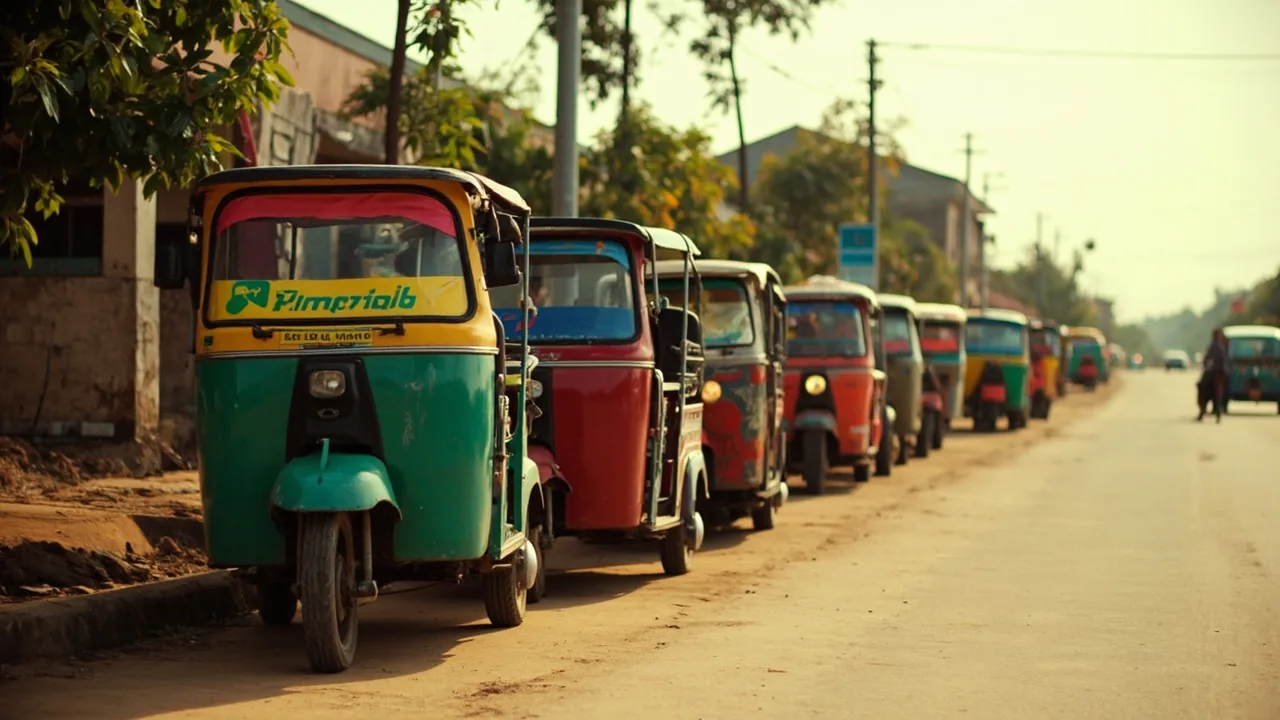
Within towns, your options are tuk-tuks (three-wheeled motorbike taxis, more common in Vientiane and Pakse), songthaews (covered pickup trucks with bench seats, dominant in Luang Prabang and Vang Vieng), and rented scooters.
Tuk-tuks within town: ₹215-₹430 (~50,000-100,000 LAK or ~$2.23-$4.46) per short ride. Always negotiate before you get in. Drivers will quote ₹644 (~150,000 LAK or ~$6.69) to a foreigner and settle for ₹258 (~60,000 LAK or ~$2.67) after a 30-second back-and-forth. Use the LOCA Laos app in Vientiane and Luang Prabang to bypass the negotiation; the fare is fixed.
Songthaews in Luang Prabang and Vang Vieng run set routes for ₹86-₹172 (~20,000-40,000 LAK or ~$0.89-$1.78) per person. Flag one down, tell the driver your destination, and they’ll either nod or shake their head.
Scooter and Motorbike Rental
Scooters are the single most popular way backpackers get around Vang Vieng, Luang Prabang, and the Bolaven Plateau. Rentals run ₹344-₹644 (~80,000-150,000 LAK or ~$3.57-$6.69) per day for an automatic 110-125cc scooter, slightly cheaper for a semi-automatic 110cc.
You do not need a Lao license to rent. Most shops just want your passport (a photocopy) as a deposit. But here’s the catch that matters:
License and Insurance Reality
An Indian car license is not valid for riding a scooter in Laos, and Laos does not issue International Driving Permits in the same way Thailand does. In practice, police checkpoints mostly target riders without helmets, not riders without licenses. But if you have an accident without a valid motorcycle license, your travel insurance will not pay out. Full stop. That’s the real risk.
If you plan to ride, get an International Driving Permit with motorcycle endorsement from the AAI in India before you fly out. It costs around ₹3,000 (~$31.14) and takes a week.
Scooter Rental Checklist
Walk around the bike before you hand over your passport. Photograph every scratch, dent, and scuff from multiple angles on your phone. Check the brakes (squeeze the front brake hard, push the bike forward, it should lock the wheel), check the tires for tread depth and embedded glass, and check that both headlights and tail lights work. Test the horn. Test the indicators. Make sure the helmet strap clicks shut.
If anything is off, point at it and either get it fixed before you take it or go to a different shop. Vang Vieng has 50 rental places within a 1 km radius of the main strip. You don’t need to settle for a dodgy bike.
Common Checkpoint Reality
Police checkpoints exist on the main highways between Vientiane, Vang Vieng, and Luang Prabang. They mostly wave foreigners through. When they do stop you, the most common fine is for not wearing a helmet, and the typical on-the-spot fine is ₹215-₹430 (~50,000-100,000 LAK or ~$2.23-$4.46). Pay it, get a receipt, and you’re legal for the rest of the route. Don’t argue, don’t bribe extra, don’t escalate. The receipt is your waiver for the rest of the trip.
For a deeper dive on Vang Vieng specifically, see the scooter rental guide for Vang Vieng.
Domestic Flights
Lao Airlines flies Vientiane to Luang Prabang (45 minutes), Vientiane to Pakse (90 minutes), and Luang Prabang to Pakse via Vientiane. Prices range from ₹3,436-₹6,442 (~800,000-1,500,000 LAK or ~$35.67-$66.87) one way depending on route and how far ahead you book.
For most backpackers, flights don’t make sense. The slow boat, the railway, and the sleeper buses are part of the experience, and the cost savings are real. But if you’ve got a tight schedule and you want to skip the 12-hour Vientiane to Pakse bus, a flight saves a full day.
How Far Does ₹9,634 (~100 USD) Stretch?
Let’s do the math at the current rate (1 LAK = ₹0.0043, roughly 23,256 LAK per dollar):
A budget backpacker who mixes the cheapest options and isn’t in a rush:
- Day 1: Slow boat Huay Xai to Pak Beng (half-fare, no overnight), say ₹644 (~150,000 LAK or ~$6.69)
- Day 2: Slow boat Pak Beng to Luang Prabang (second half), ₹644 (~150,000 LAK or ~$6.69)
- Day 3: Tuk-tuks around Luang Prabang, ₹859 (~200,000 LAK or ~$8.92) total for 3-4 rides
- Day 4: Train Luang Prabang to Vang Vieng, ₹1,074 (~250,000 LAK or ~$11.15)
- Day 5: Tuk-tuks and rented scooter in Vang Vieng, ₹1,288 (~300,000 LAK or ~$13.37)
- Day 6: Minivan Vang Vieng to Vientiane, ₹644 (~150,000 LAK or ~$6.69)
- Day 7: Songthaews and tuk-tuks in Vientiane, ₹859 (~200,000 LAK or ~$8.92)
Total: ₹6,013 (~1,400,000 LAK or ~$62.42), or roughly ₹5,780 (~60 USD). So ₹9,634 (~100 USD) gives you 7-10 days of moving around Laos on a mix of slow boat, train, minivan, and tuk-tuk. Add scooter rental on top, and you spend more like ₹7,707-₹8,671 (~80-90 USD) for the same period.
Getting Connected
You will need a working SIM to use LOCA Laos, to call tuk-tuk drivers, and to check 12go when your bus is late. The two main operators are Unitel and Lao Telecom. Both sell tourist SIMs at the airport for ₹215-₹430 (~50,000-100,000 LAK or ~$2.23-$4.46) with 5-15 GB of data valid for 7-15 days. Bring your passport. If you’d rather skip the airport counter and activate before you fly, Get Nomad eSIM and have data the moment you land.
Common Transit Mistakes Indians Make
Mistake 1: Assuming Grab works. It does not. Grab, Bolt, and Uber all skip Laos. The only working rideshare is LOCA Laos, and it only covers Vientiane and Luang Prabang. Outside those two cities, you negotiate tuk-tuks in person or through your guesthouse. See our Grab and Bolt alternatives in Laos for the full breakdown.
Mistake 2: Booking the night bus to save a hotel night. The overnight buses save ₹859-₹1,288 (~200,000-300,000 LAK or ~$8.92-$13.37) but cost you a full night of sleep. Travellers report chronic fatigue after two night buses in a row. Mix in day buses and use the railway where it covers your route.
Mistake 3: Leaving your actual passport as scooter rental collateral. Most shops accept a photocopy plus a cash deposit (₹859-₹2,148 (~200,000-500,000 LAK or ~$8.92-$22.29)). Never hand over your physical passport unless the shop is reputable and you’ve got a written receipt. If they insist on the passport, walk to the next shop.
Mistake 4: Riding scooters in Vang Vieng without checking tire tread. The roads out to the blue lagoons and the Tha Nam viewpoint are dirt and gravel. Worn tires on wet dirt send you straight into a ditch. Check the tires before you leave town.
Mistake 5: Not carrying small LAK notes. Tuk-tuk drivers and bus conductors often can’t break ₹430 (~100,000 LAK or ~$4.46) notes. Carry a stack of 10,000 and ₹86 (~20,000 LAK or ~$0.89) notes for small fares and tips. ATMs in Vientiane and Luang Prabang dispense ₹430 (~100,000 LAK or ~$4.46) only.
Internal Connections
If you’re crossing into Laos from Thailand, the border crossing at Nong Khai to Vientiane is the most common route, with buses and trains running frequently across the Friendship Bridge. The Luang Prabang to Vang Vieng route is covered in detail in our transport hub. For getting around Vientiane itself, see our bicycle rental guide.
Safety Alert: Before you travel, check the current Indian government travel advisory at mea.gov.in for Laos, and the Lao government’s own advisory for any region-specific restrictions. Border regions can see periodic tension, and flash flood warnings close mountain roads every wet season.
Where to Eat Along the Way
Food is part of the transport experience in Laos, and every major stop has a real local spot to break the journey. In Luang Prabang, Ma Maison Restaurant serves proper Lao cuisine in a quiet garden setting, and Manda de Laos is the elegant choice if you want a slow lunch with Mekong views. For sunset coffee with Lao coffee-infused cocktails, Breeze Bar By Best cafe sits on a hill overlooking the town and pulls a strong evening crowd.
In Nong Khiaw, SASSYS BAR & RESTAURANT is the easy choice for both food and a cold Beerlao after a day of moving.
Vang Vieng has the most Indian food of any Laos backpacker town. Mandala Restaurant is the most popular, with affordable meals and a social vibe. Jamil Zahid Indian and Pakistani Food is the family-run Pakistani-Indian option for a proper curry fix (₹215-₹430 (~50,000-100,000 LAK or ~$2.23-$4.46) per person), and Vegetarian Food covers strict veg travellers with local vegan dishes.
FAQ
Does Grab or Bolt work in Laos?
No. Neither operates here. The closest equivalent is LOCA Laos, which works in Vientiane and Luang Prabang for tuk-tuks and songthaews. Everywhere else, you negotiate directly or book through your guesthouse.
Can I ride a scooter with an Indian car license?
Legally, no. In practice, Laos does not strictly enforce the IDP rule the way Thailand does. But if you crash without a valid motorcycle license, your travel insurance will deny the claim. Get an International Driving Permit with motorcycle endorsement from AAI before you fly.
How much should I budget per day for transport in Laos?
Backpackers who mix slow boat, train, and local bus spend around ₹644-₹1,074 (~150,000-250,000 LAK or ~$6.69-$11.15) per moving day. Add scooter rental and tuk-tuk hops and you reach ₹1,288-₹1,718 (~300,000-400,000 LAK or ~$13.37-$17.83) per day. A ₹9,634 (~100 USD) transport budget stretches 7-10 days on the slow options.
Is the Laos-China Railway worth it?
Yes, for the Vientiane to Vang Vieng to Luang Prabang leg. It cuts the journey to a fraction of the bus time, the stations are modern, and tickets are reasonably priced. For southern Laos, the railway doesn’t help yet.
Are night buses safe?
Travellers report theft, broken AC, and rough driving. Day buses and VIP sleeper buses are safer. If you take an overnight, lock your bag to the seat frame and keep valuables on your person.
What if my bus breaks down?
It will happen, especially on routes south of Vientiane. Carry water, snacks, and a phone charger. Drivers usually fix minor issues within an hour or flag down a replacement vehicle. Don’t panic, don’t complain, and tip the driver if they sort it out fast.
Subodh’s Take
Laos is the one country in Southeast Asia where the slow option is genuinely the right option. Take the slow boat, take the local bus, take the train where it covers your route, and rent a scooter for the days you want to visit a specific area. Spend the money you save on slow travel on better food and an extra night in the towns you like. The country rewards patience. Don’t fight it.
