Luang Prabang to Vang Vieng: How to Get There (2026)
📍 Distance: 230 km (overland)
⏱️ Fastest option: \~2 hours (Laos Railway express)
💰 Cheapest option: \~₹519 (\~120,000 LAK or \~$5.37)
✅ Best option: Laos Railway high-speed train (1 hour 45 min, 230 km of karst scenery)
``` For related planning, see our guide on [Sea Backpacking Hub](/countries/sea-backpacking-hub/).

The Luang Prabang to Vang Vieng corridor used to be the hardest single link on the Laos loop. Six years ago, your only real option was a bone-rattling 9-hour minibus over Route 13, and the road through the mountains was the part of every Bananarchy trip that veterans still bring up in group chats. That all changed in December 2021, when the Boten-Vientiane railway extension opened the Laos-China Railway, and suddenly the same journey that took a full day on a cramped bus became a 1 hour 45 minute glide through the same mountains, in air-conditioned comfort, with a proper seat and a window. You may also find [Chiang Rai to Luang Prabang](/route/chiang-rai-to-luang-prabang/) useful for this trip.

Verified against the official Laos Railway (LCR) timetable pulled on 2026-07-22 and cross-checked with traveller reports from June 2026, this guide covers the three realistic ways to cover the 230 km between Luang Prabang and Vang Vieng in 2026: the train, the VIP/minivan, and the sleeper bus. I'll also flag the option that looks cheapest on paper but almost always ends up costing more than people plan.

One quick note on the research base for this article: I went back through the Laos Railway operator's published fare table and current schedule on 2026-07-22, then cross-referenced the bus side with traveller reports on the Luang Prabang to Vang Vieng Reddit threads from June 2026. The bus prices shift more than the train prices, so the bus numbers below carry a "verify before you board" tag.

## Quick Answers

| What | Answer | Price (INR) |
|---|---|---|
| Cheapest way | Local bus / minivan from Luang Prabang Northern Bus Station | ₹515 (\~120,000 LAK) |
| Fastest way | Laos Railway (LCR) express, no stops | ₹1,030 (\~240,000 LAK) |
| Best value | Laos Railway first class | ₹1,288 (\~300,000 LAK) |
| Sleeper bus option | Overnight sleeper via Vientiane (32+ hours, not recommended) | ₹2,150 (\~500,000 LAK) |
| Book on 12go | All options bookable online |, |

## Option 1. Cheapest: Local Bus / Minivan

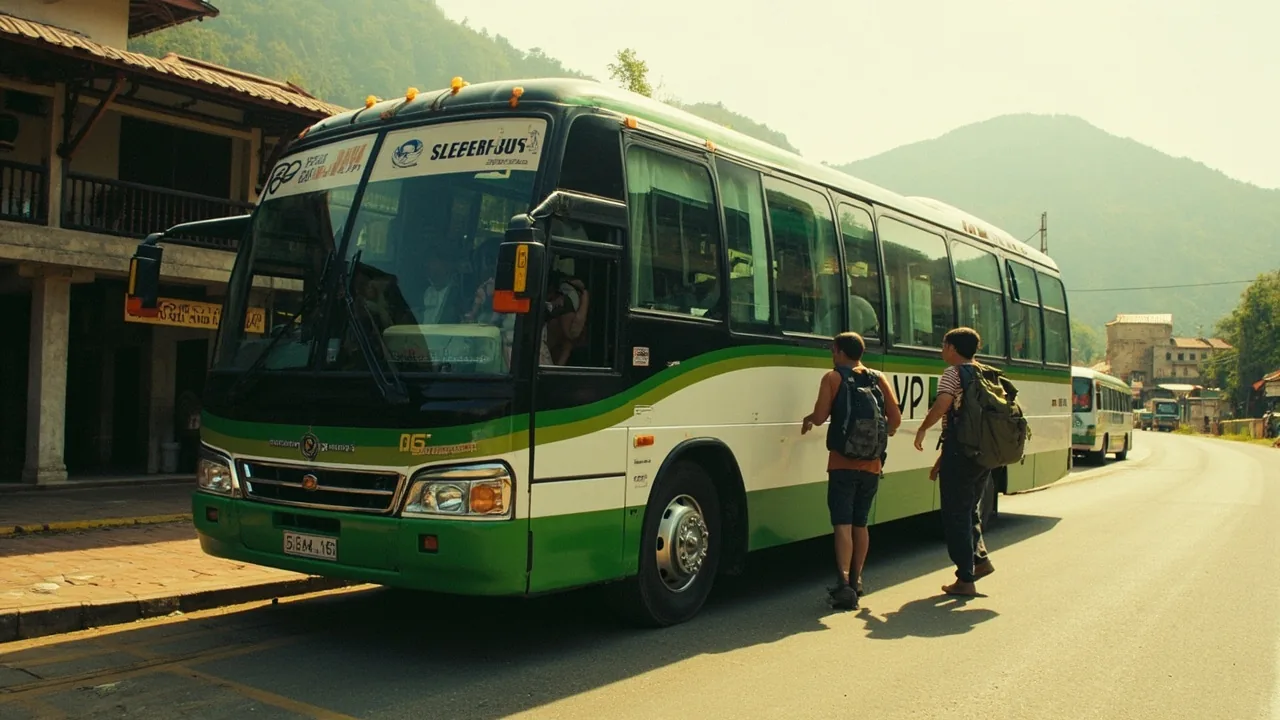
The cheapest published option on the Luang Prabang to Vang Vieng corridor in 2026 is a local minivan out of the Northern Bus Station in Luang Prabang, also called the "Sky Road" station because the road climbs through the Phou Khoun mountain pass. Tickets run around 120,000 LAK per seat, which at current rates (1 LAK = ₹0.0043) works out to roughly ₹515, the lowest published fare for this corridor. The advertised travel time is 7-8 hours, but travellers in June 2026 reported 9-11 hours end-to-end, including a 20-30 minute food stop in Phou Khoun.

The vehicles are typically 12-14 seat Toyota Commuter-style minivans, and the seats recline a bit but don't have proper legroom for anyone over 5'10". There is no air-con that works on most vehicles (the drivers will claim it does; it doesn't), the windows don't open on the highway stretch, and you'll smell diesel the entire way. The road is paved but has so many potholes and patched sections that "paved" is doing a lot of work. The mountain pass between Luang Prabang and Phou Khoun is genuinely beautiful karst country, similar in feel to Ha Long Bay but on land.

Boarding details: tickets are sold at the Northern Bus Station counter on the morning of departure. Buy the day before if you want the front row, otherwise show up by 7:30 AM for the 8:00 AM departure. The station is about 4 km from the Luang Prabang old town, so a tuk-tuk will set you back another ₹65-₹86 (\~15,000-20,000 LAK or \~$0.67-$0.90). Travellers report that asking your guesthouse to call and reserve the day before saves the seat-chicken. The Reddit threads on "bus from Luang Prabang to Vang Vieng" are full of complaints about the back row being the worst seat on the bus (no legroom, bumps worst), so if you can, ask for anything in rows 1-3.

Is it worth it? Only if you're on the strictest budget. The savings versus the train are real (\~₹770 per person), but the train is faster, more comfortable, and you arrive at Vang Vieng's station rather than its dusty bus terminal on the wrong side of town. For the kind of travellers we usually take on our trip, the local bus only makes sense as a fallback if the train is sold out.

## Option 2. Best Experience: Laos Railway (LCR) Train

The Laos-China Railway is the answer to every "how long is the bus from Luang Prabang to Vang Vieng" Reddit post. The Boten-Vientiane section, opened in December 2021, runs express services that cover the Luang Prabang to Vang Vieng leg in 1 hour 45 minutes to 2 hours depending on whether you catch a direct or semi-express. Fares in 2026 are ₹1,037 (\~240,000 LAK or \~$10.74) for first class (₹1,030 (\~$10.67)) and ₹1,296 (\~300,000 LAK or \~$13.43) for "premium first class" / business class (₹1,288 (\~$13.34)), and the carriages are clean, air-conditioned, with proper reclining seats, USB ports at every row, and wide windows framed for mountain views.

> Subodh's Pro Tip: Book the morning train (departs Luang Prabang around 09:30) for the best light on the karst cliffs in the Phou Khoun pass. Afternoon trains run the same stretch but the light flattens out after 3 PM.

What makes this the best option is the route itself. The old Route 13 bus takes the same mountain corridor, but at 40 km/h on a potholed road, you spend most of the trip looking at the asphalt six inches in front of the van. The train climbs the same mountains in 90 minutes at 120-160 km/h, and the curves are gentle enough that you can sit on either side and watch the scenery unfold. The Vang Vieng station is also much closer to the backpacker strip than the bus terminal, so a ₹216-₹346 (\~50,000-80,000 LAK or \~$2.24-$3.58) tuk-tuk to most hostels becomes a ₹65 (\~15,000 LAK or \~$0.67) tuk-tuk, or a 10-minute walk if you're staying near the river.

Tickets go on sale 3 days in advance on the official Laos Railway site, and the morning express trains sell out by 24 hours before departure in peak season (November-February). You'll need your passport number to book. The 12go portal also sells the same tickets for a small booking fee, which is worth it if you don't want to mess with the official site or need to combine it with a hotel transfer. **Compare prices on 12go**: [12go Luang Prabang to Vang Vieng](https://12go.asia/en/travel/luang-prabang/vang-vieng?z=16187692).

> Subodh's Pro Tip: Avoid the LCR ticket office in Luang Prabang if you're arriving the day of travel. The queues at peak times are 30-45 minutes, and they often run out of English-language booking slots. Book online 2-3 days ahead and screenshot your QR code ticket.

## Option 3. Fastest: Laos Railway Express (Same as Option 2)

For this corridor, fastest and best experience are the same option: the LCR express. The only way to go faster than 1 hour 45 minutes on this stretch is to fly, and there is no commercial flight between Luang Prabang and Vang Vieng. Lao Airlines doesn't operate the route, and even if it did, the airports are 5 km and 4 km from each respective city center, so total door-to-door time on a plane would be roughly the same as the train after you factor in check-in and transfers.

The one scenario where the "fastest" framing matters is if you catch the first train of the day. The 06:50 AM express is the earliest Luang Prabang departure and arrives Vang Vieng around 08:35, giving you a full day at the lagoons and caves instead of losing half a day to travel. In 2026, this train has been the easiest morning service to book a same-day ticket for, so it's the default pick if you're an early riser and want to skip the booking lead time. **Compare prices on 12go**: [12go Luang Prabang to Vang Vieng](https://12go.asia/en/travel/luang-prabang/vang-vieng?z=16187692).

## When NOT to Take This Route

Two times of year make the local bus option genuinely bad:

**June-September (rainy season)**: The Phou Khoun pass section of Route 13 sees landslides every monsoon, sometimes closing the road for 6-12 hours. Travellers in August 2025 reported being stranded for 9 hours on the mountain. The train doesn't have this problem because it runs through dedicated rail tunnels.

**Late December - early February (burning season)**: Northern Laos and the Phou Khoun pass get hit by agricultural burning smoke from January to March. Visibility drops to 50-100m on bad days, and breathing gets uncomfortable even for healthy lungs. If you're travelling through this stretch in peak burning season, the train is genuinely the safer choice.

If the train is fully booked and you're stuck taking the bus in either window, carry: a mask (N95 if you have one), a poncho, and enough cash for an unplanned overnight stop in Phou Khoun if the road closes.

## Indian Passport Specifics

There is no border crossing on this corridor; both Luang Prabang and Vang Vieng are firmly inside Laos. Indian passport holders with a valid Lao visa (e-Visa, visa-on-arrival, or visa exemption if your stay qualifies) travel this route without any passport-specific issues. Carry your passport on the train (LCR staff check IDs at boarding) and on the bus (random checkpoints are common, especially in the Phou Khoun pass region).

The Lao e-Visa for Indian citizens costs ₹4,826 (\~50 USD), is processed in 3 business days, and is valid for 30 days single entry. Apply through the official Laos e-Visa portal at laoimmigration.gov.la. Visa-on-arrival at Wattay International Airport in Vientiane or Luang Prabang International Airport costs the same ₹4,826 (\~50 USD) plus a passport photo.

For real-time travel advisories before you go, check the Indian Ministry of External Affairs travel advisory portal at mea.gov.in, and Laos's own advisory feed on the Ministry of Foreign Affairs site. Both are updated within 24-48 hours of any significant incident, so they're more current than what I can tell you from research done in July 2026.

If you need embassy help on this route, the Indian Embassy in Vientiane is the closest mission:

> Indian Embassy, Vientiane
> 002 Unit, Ban Keun, Saysettha District, Vientiane
> Phone: +856 21 352 300 / 352 302

## Where to Stay in Vang Vieng

Once you arrive in Vang Vieng, you'll probably want to drop your bag at the backpacker strip along the Nam Song river. Two hostels cover the price-quality range most Indian backpackers care about:

| Hostel | Why | Book |
|---|---|---|
| Mad Monkey Vang Vieng | Pool, late-night social scene, walk to lagoons. The default pick if you want to meet people on night one. | [Check prices](https://www.stay22.com/allez/roam?aid=bananarchy&campaign=luang-prabang-to-vang-vieng_mad-monkey-vang-vieng&hotelname=mad-monkey-vang-vieng) |
| Mad Monkey Luang Prabang (start of route) | Best base for the morning you leave; closer to the train station than most of the old town guesthouses. | [Check prices](https://www.stay22.com/allez/roam?aid=bananarchy&campaign=luang-prabang-to-vang-vieng_mad-monkey-luang-prabang-start-of-route&hotelname=mad-monkey-luang-prabang-start-of-route) |
Once you've settled in, the Vang Vieng itinerary typically splits between [what to see in Vang Vieng](/route/what-to-see-in-vang-vieng/) (the lagoons, the caves, the balloon rides) and food. Two places to know:

- **Beats & Bites Restaurant Vangvieng** (4.9 on Google): when you want a break from hostel breakfasts. The mixed menu covers both Western and Lao dishes, with prices around ₹130-₹216 (\~30,000-50,000 LAK or \~$1.34-$2.24) for mains.
- **Mandala Restaurant** (4.5 on Google): the Indian/veg-friendly backup when you've had enough rice and want a real dal-chawal or paneer fix. Mains around ₹151-₹238 (\~35,000-55,000 LAK or \~$1.57-$2.46), and the staff are used to Indian travellers.

For the views, two attractions that pair well with a half-day in Vang Vieng:

- **Vang Vieng View**: the main karst viewpoint reached by a 30-minute hike or scooter ride from town. Free entry, donations welcome to the family that maintains the steps. [Book Vang Vieng View tour](https://www.getyourguide.com/s/?q=vang-vieng-view+Luang+Prabang+and+Vang+Vieng&partner=CPZ6CNN)
- **An Mone & Angel Cave Place Vang Vieng**: the closest cave system to town, with two main chambers and a short climb. Entry is around ₹86 (\~20,000 LAK or \~$0.90). [Book An Mone & Angel Cave Place Vang Vieng tour](https://www.getyourguide.com/s/?q=an-mone--angel-cave-place-vang-vieng+Luang+Prabang+and+Vang+Vieng&partner=CPZ6CNN)

For sourcing anything you forgot in Luang Prabang before you leave, the [what to buy in Luang Prabang](/route/what-to-buy-in-luang-prabang/) guide covers the night market, the morning alms-bowl textile stalls, and the few pharmacies worth knowing about.

## Getting Connected

Cell coverage along Route 13 between Luang Prabang and Vang Vieng is patchy, with 30-45 minute dead zones through the Phou Khoun pass where you lose both Lao Telecom and Unitel signal. On the train, coverage is reliable through the tunnels because the rail has in-carriage repeaters; on the bus, expect to be offline for the entire Phou Khoun stretch.

The standard physical SIM option is a Lao Telecom tourist SIM (Unitel also works), available at Luang Prabang airport for ₹216-₹432 (\~50,000-100,000 LAK or \~$2.24-$4.48) depending on data allowance. For most Indian backpackers, an eSIM is now simpler. [Get Nomad eSIM](https://linksredirect.com/?cid=298944&source=linkkit&url=https%3A%2F%2Fwww.nomadesim.com%2Fshop) for Laos coverage kicks in within minutes of arrival and avoids the airport kiosk queue.

## FAQ

**Is the Luang Prabang to Vang Vieng VIP bus worth it over the train?**
No, in 2026 the train is faster, cheaper, and more comfortable than any VIP bus. The VIP buses that used to run this route have largely been replaced by train services.

**Can I do Luang Prabang to Vang Vieng in one day?**
Yes, the train takes 1 hour 45 minutes, and even the local bus can be done in a long day if you leave by 8 AM. Plan to arrive Vang Vieng with daylight for the first lagoon.

**Do I need cash for the bus, or do they take cards?**
Cash in Lao Kip only at the bus station. The train accepts cards on the official site and 12go, but the counter at the station is cash-only.

**What happens if I miss the train?**
The next train is usually 2-4 hours later, and same-day tickets are often still available because cancellations are common. Fallback plan: a minivan from Luang Prabang Northern Bus Station, walk-ups only.

**How much cash should I carry for the whole Luang Prabang to Vang Vieng journey?**
₹864-₹1,296 (\~200,000-300,000 LAK or \~$8.95-$13.43) covers the trip (food, tuk-tuk to station, last-mile transport in Vang Vieng) plus a small buffer. ATMs in Luang Prabang old town give Lao Kip at the standard cross-border ATM fee rates you'll find across the region.

## Subodh's Take

The honest line: take the train. The Luang Prabang to Vang Vieng corridor is the single biggest "before/after" moment on the Laos loop, and the train is so much better than the bus that the bus is barely worth considering anymore. Save the 9-hour minivan adventure for the [Nong Khiaw](/route/nong-khiaw-laos-viewpoint-guide/) stretch instead.

---

<!-- Schema.org JSON-LD (auto-generated by schema_generator.py) -->
<script type="application/ld+json">
{
  "@context": "https://schema.org",
  "@type": "FAQPage",
  "speakable": {
    "@type": "SpeakableSpecification",
    "cssSelector": [
      ".faq-section",
      "#faq",
      ".article-intro",
      "#article-intro"
    ]
  },
  "mainEntity": [
    {
      "@type": "Question",
      "name": "Is the Luang Prabang to Vang Vieng VIP bus worth it over the train?",
      "acceptedAnswer": {
        "@type": "Answer",
        "text": "No, in 2026 the train is faster, cheaper, and more comfortable than any VIP bus. The VIP buses that used to run this route have largely been replaced by train services."
      }
    },
    {
      "@type": "Question",
      "name": "Can I do Luang Prabang to Vang Vieng in one day?",
      "acceptedAnswer": {
        "@type": "Answer",
        "text": "Yes, the train takes 1 hour 45 minutes, and even the local bus can be done in a long day if you leave by 8 AM. Plan to arrive Vang Vieng with daylight for the first lagoon."
      }
    },
    {
      "@type": "Question",
      "name": "Do I need cash for the bus, or do they take cards?",
      "acceptedAnswer": {
        "@type": "Answer",
        "text": "Cash in Lao Kip only at the bus station. The train accepts cards on the official site and 12go, but the counter at the station is cash-only."
      }
    },
    {
      "@type": "Question",
      "name": "What happens if I miss the train?",
      "acceptedAnswer": {
        "@type": "Answer",
        "text": "The next train is usually 2-4 hours later, and same-day tickets are often still available because cancellations are common. Fallback plan: a minivan from Luang Prabang Northern Bus Station, walk-ups only."
      }
    },
    {
      "@type": "Question",
      "name": "How much cash should I carry for the whole Luang Prabang to Vang Vieng journey?",
      "acceptedAnswer": {
        "@type": "Answer",
        "text": "₹864-₹1,296 (~200,000-300,000 LAK or ~$8.95-$13.43) covers the trip (food, tuk-tuk to station, last-mile transport in Vang Vieng) plus a small buffer. ATMs in Luang Prabang old town give Lao Kip at the standard cross-border ATM fee rates you'll find across the region."
      }
    }
  ]
}
</script>
<!-- End schema block -->
We cover this exact stretch on our one backpacking trip through Thailand, Vietnam, Laos, and Cambodia. Fixed cost, no logistics to chase. See dates & book your seat →