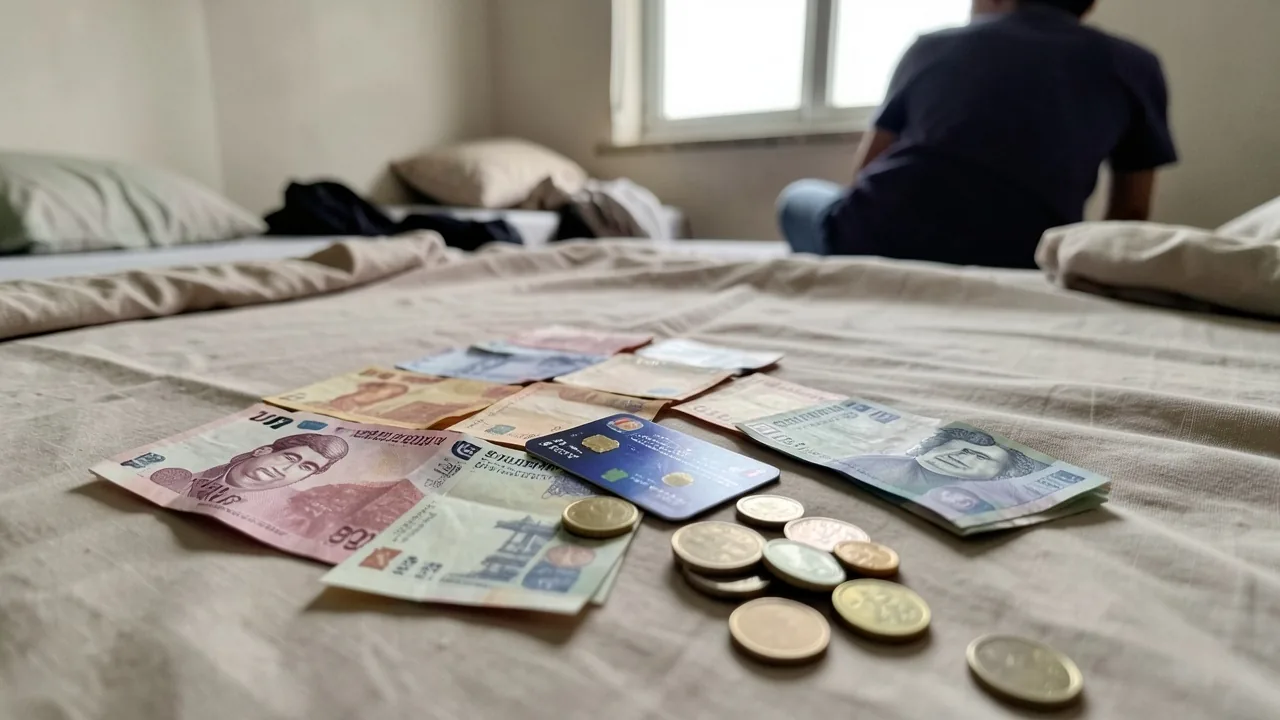
Malaysia Money Guide for Indians 2026: Forex Cards, ATM Fees & UPI/Paytm Explained
Malaysia is one of the easier Southeast Asian countries for Indian travellers on the money front. Cards work in most urban shops, Maybank and CIMB ATMs are everywhere, and the Malaysian ringgit (MYR) is one of the more stable currencies in the region. The trick is avoiding the three usual money leaks: airport exchange counters, DCC at the ATM, and the 20% TCS trap if you load large amounts onto a forex card. For related planning, see our guides on Sea Backpacking Hub and Malaysia Atm Withdrawal Guide for Indian Travelers Limits Fees Charges Explained.
At current rates, 1 MYR = ₹23.59. A 50 MYR meal is ₹1,179, a 10 MYR Grab ride is ₹236 (~$2.45), and a ₹4,712 (~200 MYR or ~$48.91) hostel dorm is ₹4,717 (~$48.96). Running those numbers in your head before you land saves you from guesstimating at the exchange counter. You may also find Indian Rupee to Malaysian Ringgit Exchange Rate useful for this trip.
Quick Answers
| What | Answer | Price (INR) |
|---|---|---|
| Best payment method | Zero-markup debit card (Fi / Niyo) loaded before travel | ₹0 markup, ₹100-₹300 (~$1.04-$3.11) ATM fee |
| Backup method | Cash in MYR exchanged outside India | Varies by counter |
| Worst option | Airport exchange in Malaysia or India | 5%-8% worse than mid-market |
| UPI / Paytm in Malaysia | Not widely accepted | Use card or cash |
| Best ATM network | Maybank / CIMB / Public Bank | Countrywide coverage |
| Currency to choose at ATM | Always MYR (decline DCC) | Saves 3%-7% per transaction |
| Customs cash limit on return | ₹289,017 (~3,000 USD) or equivalent | Includes MYR, USD, INR |
How It Works in Malaysia
Malaysia runs on a hybrid: card-tap in cities (Kuala Lumpur, Penang, Langkawi), cash still dominant in smaller towns, Cameron Highlands, and night markets. Most Malaysian ATMs accept Visa, Mastercard, and Cirrus/Maestro. Indian debit cards work on most of them, but the fees come from three layers stacked on top of each other. See also: Using Indian Atm and Visa Cards in Malaysia Fees Limits Airport Withdrawals Explained.
Layer 1: Your Indian bank. Most Indian banks charge a foreign transaction markup: 1%-3.5% depending on the card. HDFC Infinia, ICICI Emeralde, and Axis Burgundy are 0% on foreign spend. A standard HDFC Millennia charges 3.5%. Niyo and Fi partner banks charge 0% markup on the card itself, but the partner bank may still levy a small cross-currency fee. For related planning, see our guide on Cheapest Sim Card Malaysia.
Layer 2: The Malaysian ATM operator. Maybank charges ₹283 (~12 MYR or ~$2.93) for foreign-issued cards. CIMB charges ₹283 (~12 MYR or ~$2.93). Public Bank charges ₹236 (~10 MYR or ~$2.45). RHB charges ₹283 (~12 MYR or ~$2.93). This is non-negotiable, and it is charged per transaction, not per day.
Layer 3: DCC (Dynamic Currency Conversion). When you withdraw, the ATM asks: “Convert to your home currency?” If you accept, the ATM processor (your card’s network, not the local bank) marks up the rate by 3%-7%. Always decline. Always choose MYR. The mid-market rate your card uses to convert to INR will be better than whatever DCC offers.
So a ₹4,712 (~200 MYR or ~$48.91) ATM withdrawal ends up costing ₹4,712 (~200 MYR or ~$48.91) worth of rupees (at the then-current rate) plus ₹283 (~12 MYR or ~$2.93) ATM fee (₹283 (~$2.94)) plus your bank’s markup. On a Fi card that’s 0% markup, so the total cost is just the ₹283 (~12 MYR or ~$2.93) ATM fee (~₹283). On a standard HDFC debit card, add 3.5% markup (~₹1,654) on the ₹4,712 (~200 MYR or ~$48.91) itself, plus ATM fee. Always choose the 0% markup card.
Comparison of Popular Options
| Tool | Markup | ATM Fee (MYR) | Daily Limit | Best For | Verdict |
|---|---|---|---|---|---|
| Fi Debit Card (Federal Bank) | 0% | ₹283 (~12 MYR or ~$2.93) per txn | ₹50,000/day | Frequent ATMs, urban spend | Best overall |
| Niyo Global Card (SBM Bank) | 0% | ₹283 (~12 MYR or ~$2.93) per txn | ₹50,000/day | Frequent ATMs, urban spend | Tie with Fi |
| HDFC Infinia / ICICI Emeralde | 0% on forex | ₹283 (~12 MYR or ~$2.93) per txn | ₹2,50,000/day | High spend, lounge access | Best premium option |
| Standard HDFC Debit (Millennia) | 3.5% | ₹283 (~12 MYR or ~$2.93) per txn | ₹50,000/day | Avoid for overseas | Worst debit option |
| Thomas Cook / HDFC Forex Card | 2%-3.5% (preloaded) | ₹118-₹236 (~5-10 MYR or ~$1.22-$2.45) per txn | Preloaded amount | Cash predictability | Only if you want a fixed budget |
| Cash exchanged in India | 1%-2% (airport counters) | N/A | CBDT ₹7L/year | Small starter cash | ₹15,000 (~$155.70) MAX |
| Cash exchanged in Malaysia | 3%-5% (street counters) | N/A | N/A | Emergency backup | Avoid if possible |
| Indian credit card (Visa/MC) | 0%-3.5% | N/A (swipe only) | Card billing limit | Hotels, big purchases | Carry one as backup |
Subodh’s Pro Tip: The cheapest path for most Indian backpackers is one zero-markup debit card (Fi or Niyo) + ₹15,000 (~$155.70) in MYR cash for day one. Reload the card from your Indian bank account as you go. Avoid prepaid forex cards unless you specifically want a fixed budget to stop overspending; their reload fees eat the markup you saved.
India-Specific Gotchas (RBI & TCS)
The biggest mistakes Indian travellers make with money in Malaysia are RBI-side, not Malaysia-side. Three rules to know.
TCS (Tax Collected at Source) on forex. Since the 2023 revision, outbound remittances under the Liberalised Remittance Scheme (LRS) attract 20% TCS if the total exceeds ₹7 lakh per financial year per person. This is on remittances for any purpose except education and medical, where different slabs apply. Crucially, this is collected by your bank or card-issuing platform at the time of loading, not by Malaysia.
The ₹7 lakh exemption. The first ₹7 lakh per financial year is TCS-free for most purposes. Beyond that, you pay 20% TCS upfront. The good news: TCS is a credit, not a tax. You can claim it back as a refund when you file your ITR. So paying ₹1.4 lakh in TCS on a ₹7 lakh remittance does not mean you lose that money; you get it back after filing returns. But it does mean your card has ₹1.4 lakh less available until ITR processing.
PAN card is mandatory. Any single transaction above ₹50,000 (~$519) routed through an Indian bank requires PAN. For forex cards and outward remittances, PAN is mandatory regardless of amount. No PAN, no forex card, no wire transfer.
LRS limit. USD 250,000 per financial year per Indian passport holder. This is the cap, not a recommended amount. Most backpackers spend ₹1.5-3 lakh in two weeks, well within limits.
Cash declaration on return. If you carry more than USD 3,000 (equivalent) in cash back into India, you must declare at the red channel at customs. This includes any combination of MYR, USD, INR. Failure to declare can mean seizure and a penalty. If you stayed within debit/UPI/card spend all trip, you have nothing to declare.
Safety Alert: Some Malaysian ATMs still default to DCC after the Decline button. If the receipt shows the amount in INR (not MYR), the conversion was applied at the foreign processor’s poor rate. Call your bank to dispute, or better, always choose Maybank or CIMB ATMs whose default is MYR.
What Travellers Use
The split I’ve seen most across Indian backpackers in Malaysia is roughly 60% card (debit or credit) and 40% cash. In Kuala Lumpur and Penang, the split is closer to 80/20 in favour of cards. In Cameron Highlands, Langkawi (outside the main beach area), and Perhentian Islands, it’s closer to 30/70 in favour of cash.
A practical setup that works:
- ₹15,000 (~$155.70) in MYR cash for day one, exchanged at a licensed Malaysian money changer in the city (not airport). MyBorder, Money Bright, or the counters in Pavilion KL are 2%-3% off mid-market. Airport counters are 5%-7% off.
- Fi or Niyo debit card as primary. Withdraw from Maybank or CIMB ATMs as needed, always in MYR.
- One credit card (HDFC Infinia or ICICI Emeralde if you have it) for hotels, big-ticket purchases, and emergencies. Credit cards offer better dispute rights than debit cards.
- No prepaid forex card unless you specifically want a fixed-budget trip. Reload fees of 1%-2% per top-up negate the markup savings.
What goes wrong when people deviate: Indian credit cards without international enablement (the default on most new cards is “India only”), forex cards where the user forgets to reload before the trip, and DCC at the ATM because the user didn’t read the screen. The third is the most common and costs about 3%-7% per withdrawal.
Getting Connected
You need working data to check exchange rates, monitor bank alerts, and book Grab. Most Indian travellers either pick up a local SIM at KLIA on arrival (Maxis, Celcom, Digi, U Mobile all have airport counters) or use an eSIM. Airalo, Holafly, and Nomad are the main eSIM options for Malaysia. Coverage is strong in cities and on Penang, Langkawi, and the highlands; sketchy on Tioman and the Perhentians.
Get Nomad eSIM, regional SEA plans start around ₹867 (~9 USD) for 5 GB / 7 days, which covers most two-week trips.
Eating on a Budget. Where to Save
Malaysia is one of Southeast Asia’s food capitals, and Indian food is native cuisine, not a fallback. Travellers report that even small-town mamak stalls serve roti canai, mee goreng, and banana leaf rice at ₹141-₹283 (~6-12 MYR or ~$1.47-$2.93) per meal (₹141-₹283 (~$1.46-$2.94)). Strict-veg travellers do well in the Cameron Highlands and parts of Penang, where Tamil-Malaysian Indian communities run pure-veg spots.
For a sit-down veg meal in a nice setting, spots like KOKO Cafe Langkawi (veg, Muslim-friendly) and niàn Cafe (plant-based) come up repeatedly. For Indian food, Ponmalar Indian Stall in Cameron Highlands, FOOD PARADISE in the same region, and NJ INDIAN BISTRO in Langkawi are the typical Indian-traveller picks. For local Malaysian cuisine (laksa, nasi lemak, char kway teow), Pia’s the Padi is a generally well-rated option.
Count on ₹353-₹589 (~15-25 MYR or ~$3.67-$6.11) per meal at a local restaurant (₹354-₹590 (~$3.67-$6.12)), ₹141-₹236 (~6-10 MYR or ~$1.47-$2.45) at a mamak or street stall (₹141-₹236 (~$1.46-$2.45)), and ₹707-₹1,178 (~30-50 MYR or ~$7.34-$12.23) for a sit-down Indian veg meal (₹708-₹1,179 (~$7.35-$12.24)). This is one of the cheaper food destinations in the region for Indian travellers.
Staying Connected on Cost
A useful comparison to anchor trip costs:
| Setup | Two-Week Cost (INR) | What’s Included |
|---|---|---|
| DIY backpacker (full control) | ₹80,000-₹100,000 (~$830.40-$1,038) | Hostels, street food, public buses, manual booking |
| Mid-range DIY | ₹120,000-₹150,000 (~$1,245.60-$1,557) | Private rooms, mix of restaurants, Grab, some tours |
| Bananarchy 21-day trip | ₹150,000 (~$1,557) | All hostels, internal transport, border logistics, visa prep included |
| High-end private tour | ₹250,000-₹350,000 (~$2,595-$3,633) | Hotels, private car, guided tours, no backpacking vibe |
The DIY range is wide because it depends on how often you fly vs. Bus, eat at hawker stalls vs. Restaurants, and stay in dorms vs. Private rooms. The biggest single DIY cost is the airfare from India (₹18,000-₹35,000 (~$186.84-$363.30) round trip depending on season), which is rupee-native and has no MYR equivalent.
FAQ
Does UPI work in Malaysia?
No, not widely. UPI is a unified India system and does not yet work at merchant checkouts in Malaysia. Some Malaysian banks have discussed integration, but as of mid-2026, no major UPI app (PhonePe, Google Pay, Paytm) works at Malaysian POS terminals. Your only options are cash, debit card, or credit card. Paytm wallet does not work in Malaysia.
Can I use my Indian debit card directly at Malaysian ATMs?
Yes. Visa and Mastercard debit cards from Indian banks are accepted at Maybank, CIMB, Public Bank, RHB, and most Bank Simpanan Nasional ATMs. You’ll be charged ₹283 (~12 MYR or ~$2.93) per transaction by the local bank, plus whatever markup your bank levies. Always choose MYR, never INR (DCC).
What about forex cards? Are they still worth it in 2026?
Only for two specific cases: you want a fixed-budget trip where reload is hard (so you cannot overspend), or your bank charges 3%+ on debit cards and you cannot get a Fi/Niyo. Otherwise, zero-markup debit cards have made forex cards largely obsolete for backpackers. Prepaid forex cards still charge 2%-3.5% markup on the underlying rate, plus 1%-2% reload fees.
How much cash should I take to Malaysia from India?
Carry ₹15,000-₹20,000 (~$155.70-$207.60) in MYR for day one. Get it from a Malaysian money changer in the city after landing, not from the airport counter. If you want a small amount before leaving India, the airport forex counters at Indian airports give 1%-2% worse rates than city counters, but it is fine for a starter. CBDT allows up to ₹7 lakh per financial year for travel abroad without TCS.
What is the customs cash limit on return from Malaysia?
₹289,017 (~3,000 USD) or equivalent in any combination of foreign currency. If you exceed this, declare at the red channel on arrival in India. PMLA rules make it mandatory, and the penalty for non-declaration is confiscation plus a fine. Travellers who spent mostly on debit/credit cards and withdrew only what they needed never hit this limit.
Can I pay by Indian Rupee (INR) at Malaysian shops?
No. Indian Rupee is not a freely tradable currency for tourists in Malaysia. Some money changers in Bukit Bintang or Little India KL may informally accept INR at a terrible rate, but this is not a normal transaction. Always change to MYR through a licensed channel.
What is the cheapest way to get MYR from my Indian bank account?
Top up a Fi or Niyo debit card from your savings account, then withdraw MYR from a Maybank ATM. Total cost: 0% markup + ₹283 (~12 MYR or ~$2.93) ATM fee. If you do not have a Fi/Niyo, an HDFC Infinia or ICICI Emeralde credit card gives 0% forex markup on swipes; for ATM withdrawals, these credit cards still charge 2.5%-3.5% cash advance fee plus the ATM fee, so use them for swipes, not ATM withdrawals.
Subodh’s Take
The boring truth about Malaysia money is that the system rewards people who set up one zero-markup debit card before they fly and stop thinking about it. Travellers who spend trip time swapping cards, hunting for the best exchange, and chasing UPI hacks usually lose more in stress and bad conversions than they save. I carry a Fi card, a backup credit card, and a small amount of MYR. That setup has covered me across Kuala Lumpur, Penang, Cameron Highlands, and Langkawi without a single money emergency.
