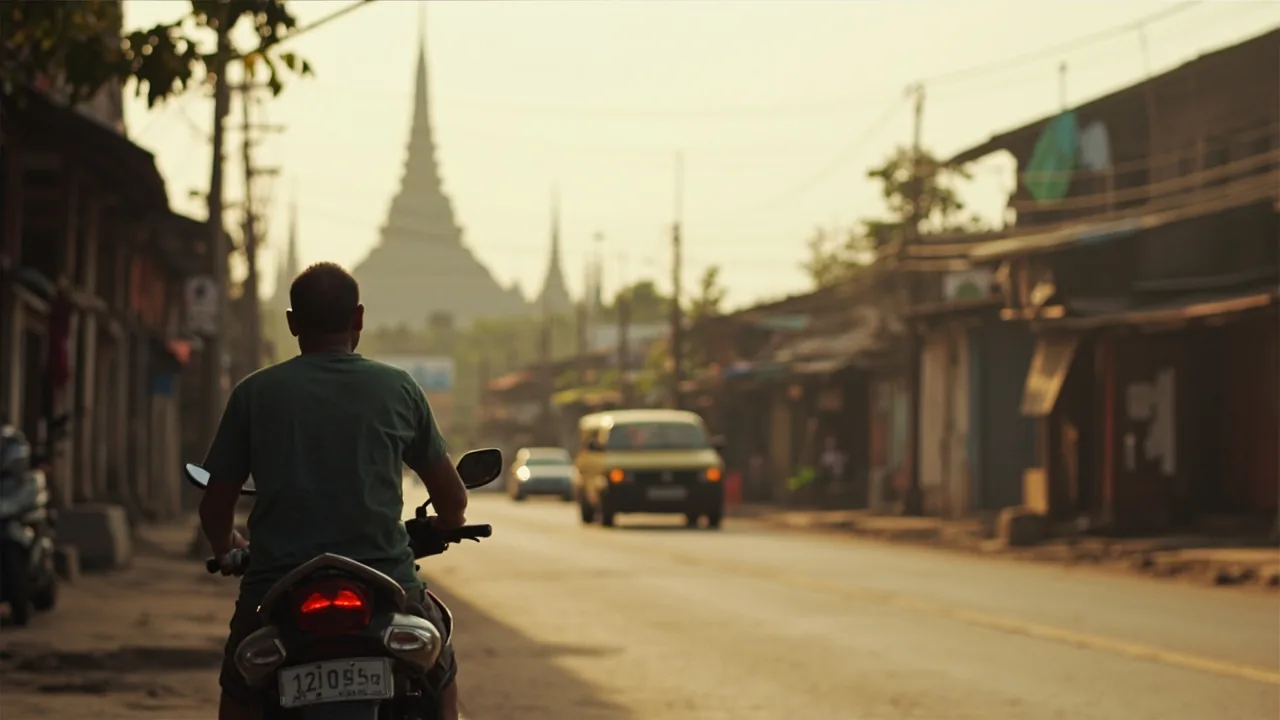
Myanmar vs Thailand for First-Time Southeast Asia: Which is Better for Indian Backpackers?
If this is your first real backpacking trip, here’s the Myanmar vs Thailand first time Southeast Asia short answer: Thailand is the safe default, Myanmar is the adventurous pick. A Thailand-to-Myanmar overland crossing adds a leg most first-timers never consider. For related planning, see our guide on Sea Backpacking Hub.
I’ll walk you through the head-to-head first, then show you the combined-route option at the end so you can pick what fits. You may also find Best Social Hostels Kuala Lumpur Solo Indian Travelers useful for this trip.
Quick Answers
| What | Answer | Price (INR) |
|---|---|---|
| Cheapest dorm bed (Myanmar) | Yangon/Bagan hostels, fan dorm | ₹500 (~$5.19) |
| Cheapest dorm bed (Thailand) | Bangkok/Chiang Mai hostels | ₹550 (~$5.71) |
| Myanmar visa fee (Indian passport) | e-Visa only, single-entry, 28 days | ₹4,826 (~$50.09) |
| Thailand visa (Indian passport) | 60-day visa exemption, free | ₹0 |
| Daily budget (Myanmar, backpacker) | Yangon-style day on hostels + street food | ~₹1,800 (~$18.68) |
| Daily budget (Thailand, backpacker) | Bangkok-style day on hostels + street food | ~₹1,500 (~$15.57) |
One rate to keep in your head: 1 USD = ₹96.5289. I’ll use MMK (Myanmar Kyat) and THB (Thai Baht) on the ground and convert only where it helps your decision. See also: Cebu vs Palawan vs Manila Solo Indian Traveler.
The Honest Vibe Check: Myanmar vs Thailand
Thailand is the school of hard knocks for first-time SEA backpackers, and that’s a feature, not a bug. Bangkok’s Khao San Road has trained a generation of solo Indian travellers to find their feet. Hostels are set up for solo arrivals. Tuk-tuk drivers speak enough English to rip you off politely, which is its own kind of education. The food is forgiving (pad thai, mango sticky rice, and 7-Eleven toasties all taste like home from home). Vegetarian travellers find a Jay (Buddhist) food scene in every major town. You will not feel lost for long, and you will not be the only Indian solo traveller around. For related planning, see our guide on Cebu Digital Nomad Cafes Wifi Workation Guide.
Myanmar, on the other hand, feels like stepping into a quieter, older version of India with pagodas instead of mosques. Yangon has the same humid-colonial chaos you grew up in, but with teashops replacing chai stalls and mohinga (fish noodle soup) replacing your morning vada pav. Travellers report the locals are unusually warm to Indians, and the kyat is so weak right now that your rupee goes shockingly far. But the social infrastructure for backpackers is thinner: fewer hostels, fewer solo-traveller hangouts, less English in the interior, and ATM access for foreign cards has been patchy across the country for the past couple of years. You may also find Solo Male Travel in Southeast Asia Complete Guide for Indian Backpackers useful for this trip.
Subodh’s Pro Tip: For a first-timer who has never been to either country, Thailand is lower-risk and higher-reward. For a first-timer who has already done a Goa or Manali trip on their own and wants the same feeling again but cheaper, Myanmar is the better adventure. Don’t pick Myanmar as your first international solo trip unless you specifically want raw.
Visa and Entry: Where It Tips Heavily
This is where the comparison has the clearest answer.
Thailand introduced a 60-day visa exemption for Indian passport holders (and most other nationalities), and it’s free at the airport. You walk in, you get stamped, you get 60 days. No paperwork before, no embassy visit, no fee.
Myanmar’s e-Visa system is the only reliable route. Visa-on-arrival has been suspended for several years now. You’ll apply at https://evisa.moip.gov.mm, pay ₹4,817 (~50 USD), wait three working days for approval, and get a single-entry 28-day stamp. You then land at Yangon or Mandalay and queue at the e-Visa counter. The fee is real, the processing time is real, and if your dates shift even slightly, the visa is rigid. Extensions are available in Yangon for around ₹4,335 (~45 USD), giving you another 14 days, but the paperwork is heavier than Thailand’s.
For a first-timer planning a 7-10 day trip, that 28-day ceiling is comfortable, but the upfront ₹4,817 (~$50) fee plus the e-Visa planning step adds friction that Thailand does not have.
Safety Alert: Myanmar’s safety situation has been highly variable and outside the scope of any single blog post. Most Indian travellers should check the current MEA travel advisory at mea.gov.in and read Myanmar’s own government announcements before booking. Some border and ethnic-state regions have been advised against by multiple governments, and even Yangon-based travellers are reading the news daily right now.
Budget: Who Wins, and Where Myanmar Punches Back
Myanmar is cheaper on paper, but only if you can access money. The kyat has crashed against the rupee, so street food in Yangon looks absurdly cheap in MMK. A bowl of mohinga from a roadside stall runs 1,500-2,500 MMK. A plate of Shan noodles goes for the same. A long-distance bus ticket from Yangon to Bagan is something like 8,000-12,000 MMK. Converted, those are tiny numbers.
Thailand is more expensive in absolute terms but more transparent in pricing: a bowl of pad thai runs 50 THB (~₹143 or ~$1.48), a hostel dorm starts around 200 THB (~₹574 or ~$5.95), and a Bangkok-Chiang Mai night bus is around 800 THB (~₹2,295 or ~$23.77). You always know what you’re paying, and the FX rate is easy to calculate.
Where Myanmar gets awkward: foreign-card ATM withdrawals at the major banks in Yangon and Mandalay have been intermittent, and banks have at various points put daily withdrawal caps well below what a hostel costs per night. Travellers have been getting around this by bringing USD cash in crisp, unmarked bills and changing at the airport or Yangon’s official money-changers. This works, but it’s a step most first-timers don’t want to take on their first SEA trip.
If you’re a first-timer who hasn’t handled multi-currency cash abroad before, Thailand wins on simplicity, even if the absolute price is slightly higher.
The Solo-Traveller Friendliness Score
Thailand was built for the solo backpacker. Hostel bar crawls, walking tours, Muay Thai classes, day-trips to Ayutthaya from Bangkok: every one of these is set up for people who arrived alone and want to leave with friends. Chiang Mai’s Old City hostels have nightly communal dinners. Bangkok’s party hostels run pub-crawl schedules 3-4 nights a week. The other travellers you’ll meet are also mostly solo, so the awkward “why are you alone?” question never comes up.
Myanmar is more of a couples-and-groups scene, with religious pilgrims, older travellers, and tour-bus groups making up the bulk of foreign visitors. Solo hostel culture exists (Yangon has a few good hostels, Bagan has a couple near the temples), but you won’t get the same instant community, and if you land outside peak season, the dorm might have only 2-3 other people.
On the friendliness scale, both countries feel safe for solo women, and dress code for both is the same as India: shoulders and knees covered at temples, no problem at the beach or in your hostel. Yangon specifically has a strong culture of women walking around alone at night, though travellers do report reading the security situation before going out late.
What Solo Female Travellers Report
Solo women in Thailand generally report the same kind of low-level hassle you’d face in any busy tourist city: tuk-tuk drivers offering “special tours,” occasional catcalling near party zones, and the rare pushy vendor. Standard precautions work well: Grab and Bolt for transport instead of street taxis after dark, a cross-body bag in crowded markets like Chatuchak, modest dress at the Grand Palace in Bangkok, and basic hostel door-locking.
Solo women in Myanmar report similar low-level concerns plus a thicker cultural layer: Myanmar is a conservative Buddhist society in most areas, and how you dress is read by everyone. Long skirts or trousers past the knee, sleeves at temples, no visible shoulders in Bagan’s temple complexes. Travellers report that harassment levels are visibly lower than India in most cities, but the social isolation can feel heavier if you’re on your own for several days without meeting other backpackers. The Yangon backpacker hostels, where they exist, are noticeably female-friendly in dorm setup.
Subodh’s Pro Tip: If you’re a solo woman doing your first SEA trip and you specifically want the “I’ll find a hostel, make friends, and never feel alone” experience, Thailand’s party hostels win by a wide margin. If you’re solo, experienced, and want quiet reflective days where you mostly do your own thing, Myanmar is genuinely better for that.
Food: Where Your Stomach Will Thank You
Thailand wins the variety game: street food is everywhere, the Jay (vegetarian) festival period every October opens up an entire veg menu across the country, and 7-Eleven toasties are a whole subgenre of Indian backpacker culture. Mango sticky rice from street vendors is a budget bucket-list item. The Jay restaurants in Chiang Mai and Bangkok are 100% safe for strict vegetarians, and the labelling on Thai menus is honest enough that “no egg, no fish sauce” works once you know the phrases.
Myanmar’s food is its own reward: mohinga for breakfast (a fish-broth noodle dish), tea-leaf salad (lahpet thoke), Shan-style noodles, and coconut noodles in cold form. In Bagan, Nanda is a local favourite for traditional Myanmar dishes, particularly the Shan-style noodle soup. Travellers with strict-veg Indian diets find Myanmar harder because fish sauce is in everything, eggs are in most noodles, and the “vegetable” word on a menu usually means “with a small amount of meat on the side.” The Indian restaurants in Yangon, Mandalay, and Bagan are genuinely good for dal-chawal rescue missions. Expect to pay 1,000-4,000 MMK per plate at spots like Ingyin Nwe South Indian Food Centre (masala dosa fixes the homesickness) and Indian Hut Restaurant (Mandalay) (rated 4.4, solid North Indian fare).
If you eat fish and eggs and want to try new things, Myanmar’s food is one of the most underrated in SEA. If you’re lacto-veg and don’t want to think about it, Thailand is the safer daily fit.
Connectivity: SIM, eSIM, and Calling Home
Thailand is the easiest country in the world to get connected. AIS Tourist SIM at the Suvarnabhumi or Don Mueang airport counter runs for 8 days with 15GB data, and 7-Eleven prepaid AIS SIMs from the same carrier (AWN) are widely available on arrival. Grab a SIM at Suvarnabhumi or Don Mueang on arrival, activate it with your passport, and you’ve got full-speed 4G for the whole trip.
Myanmar’s setup is leaner but functional. The MPT and Ooredoo tourist SIMs are available at Yangon and Mandalay airports, run around ₹289 (~3 USD), and come with about 5GB of data, which is enough for maps, WhatsApp, and check-ins with home. ESIM options are limited, so if you have a dual-SIM phone and prefer not to swap physical cards, a regional Nomad eSIM regional plans cover Thailand and are a cleaner option for travellers who prefer not to swap physical SIM cards.
In Myanmar specifically, the SIM situation varies and travellers report coverage is fine in Yangon, Mandalay, Bagan, and Inle, but drops fast once you leave those hubs.
Getting Around: The Transport Score
Thailand’s transport network is the gold standard for backpackers in SEA. Overnight sleeper trains from Bangkok to Chiang Mai, sleeper buses to Pai, minivans to Krabi, motorbikes for islands, all cheap, all frequent, all bookable on 12go. Travellers with no Thai language skills can navigate almost the entire country from a phone screen.
Myanmar’s overland network is thinner and slower. Buses from Yangon to Bagan take 8-9 hours; overnight buses are the standard, and conditions range from decent to genuinely sketchy. The Yangon-Mandalay highway is the only fast overland option, and many travellers fly this leg internally (₹3,854-₹5,780 (~40-60 USD) on Air KBZ or Myanmar National Airlines). Train rides are slow but cheap: the Yangon-Mandalay overnight train is a backpacker rite of passage for those who have time.
For most first-timers, Thailand’s transport is the easier introduction. For the curious, Myanmar’s slow train is part of the experience.
Where to Stay
Thailand has hundreds of well-reviewed hostels in every major city: dorm beds in Bangkok from 200 THB (~₹574 or ~$5.95), Chiang Mai from 150 THB (~₹430 or ~$4.45), the islands from 250 THB (~₹717 or ~$7.43). All are bookable on Hostelworld and Booking.
Myanmar’s hostel scene is thinner. Yangon is the easiest place to find a backpacker dorm (expect 8,000-15,000 MMK for a fan dorm in the downtown area). Bagan has guesthouses more than hostels, and Inle has a handful of lake-view hostels that are mid-range in price but unbeatable in location. Mandalay has the fewest backpacker hostels of the four major stops.
For first-timers who like the safety of an established hostel booking system with thousands of reviews, Thailand again wins on simplicity.
Common Solo Mistakes Indians Make on Their First Trip
Overpacking. The single biggest mistake Indian first-timers make across both countries. You don’t need six shirts and three pairs of shoes. A 40-litre pack is the sweet spot for either Thailand or Myanmar, and the second you step on a Thai sleeper train or a Myanmar overnight bus, you’ll see every traveller who overpacked struggling with their bag.
Chasing visas and dates too tight. Myanmar’s 28-day single-entry e-Visa is rigid. If your Bangkok arrival is on day 3 and your Myanmar flight is on day 5, that gives you 30 days of travel from Bangkok, which is fine. If you compress everything into a 10-day window and one delay happens, the whole itinerary jams. Thailand’s 60-day exemption gives you huge breathing room. Build an extra 2-3 days of slack into your first SEA trip, no matter the country.
Ignoring the water and food safety basics. Both Thailand and Myanmar have wonderful street food, and both can punish travellers who don’t follow the same rule: cooked fresh in front of you, no unpeeled fruit, ice from a clean source. Bottled water is 500-1,500 MMK (~₹35-₹105) in Myanmar or 7-15 THB (~₹20-₹43 or ~$0.21-$0.45) in Thailand, and it’s always worth the spend.
Assuming Myanmar is “safer than Thailand” because it’s smaller. Travellers report this assumption regularly, and it’s not accurate in 2026. Thailand is a stable tourism economy with strong police presence in tourist areas. Myanmar’s situation varies and is actively monitored by Indian, US, UK, and Australian travel advisories. Read the MEA travel advisory before booking Myanmar. Don’t let the smaller country fool you into skipping the safety check.
If you want to meet people, stay in a real social hostel (look for the words “social,” “party,” or “common area” in the listing), not in a quiet boutique hotel. Same applies in Myanmar: the hostels that exist are genuinely social. If you want solo time at the hotel, book the right kind of trip.
The Combined Route: Thailand, Myanmar, Laos, Cambodia
Here’s the angle most first-timers miss: you can do Myanmar and Thailand on the same trip, and the logistics are easier than people think. The standard overland path is Bangkok-Myawaddy (by Thai bus to the border, walk across)-Yangon, or in reverse, Yangon-Mandalay-flight to Bangkok. Bangkok to Yangon via the western border takes 1-2 days including the border crossing.
From there, you can extend into Laos (Bangkok-Vientiane sleeper train is a legendary backpacker route), then up to Luang Prabang, then east into Vietnam, and finally south into Cambodia (Phnom Penh-Siem Reap by bus or boat). Or you can do Myanmar first, fly out of Yangon to Bangkok, do a Thailand-only loop (Chiang Mai-Ayutthaya-islands), then continue to Cambodia and Vietnam.
This combined route is genuinely a 4-6 week trip, not a 2-week sprint, so it’s only realistic if you have the time. But it’s the right move if you want to see Myanmar before the tourist infrastructure catches up with Vietnam’s, while still having Thailand as the familiar anchor when you want to step back into the well-trodden backpacker rhythm.
How to Pick Between Them
If this is your first international solo trip and you want the path of least friction and highest social return, pick Thailand. You’ll save the visa fee, save the visa paperwork, save the cash-management headache, and end up with friends from day one. It’s not the most adventurous pick, but it’s the right pick for a first-time solo traveller.
If you’ve already done one international trip and you specifically want something cheaper, less touristy, and culturally closer to India, Myanmar is worth the planning. Just commit to checking the MEA travel advisory at mea.gov.in and reading the news in the weeks before your flight.
If you’ve got 4-6 weeks and you’re ambitious, combine them: Bangkok for arrivals and admin, Thailand’s north for the trek/trekking towns, fly into Yangon, do the Myanmar circuit, fly back to Bangkok (onward to Cambodia). It’s the move that gives you the best of both, at the cost of more time and more careful visa planning.
Frequently Asked Questions
Is Myanmar cheaper than Thailand for Indian backpackers?
On paper, yes. A bowl of mohinga is 1,500-2,500 MMK (around ₹100-₹170 (~$1.04-$1.76)), and a hostel dorm in Yangon is 8,000-15,000 MMK (around ₹550-₹1,000 (~$5.71-$10.38)). Thailand’s equivalent is 50- for a meal and 200- for a dorm. The only catch is that foreign-card ATM access in Myanmar has been intermittent, and you need to plan for this. In practice, Thailand is cheaper once you add the cash-management friction.
Is Myanmar safe for Indian solo travellers right now?
Honest answer: the situation varies and changes fast. Travellers report that Yangon, Bagan, and Inle are calmer hubs for tourists, but border and ethnic-state regions have had periodic advisories against travel. Before booking Myanmar, read the MEA travel advisory at mea.gov.in and check your airline’s cancellation policy. Don’t rely on any single blog post, including this one.
What is the Myanmar vs India time difference?
Myanmar is 1 hour and 30 minutes ahead of India. When it’s 10:00 AM in Delhi, it’s 11:30 AM in Yangon. Travellers report mild jet lag is uncommon on this offset, but the early start to the day (offices, buses, and temples open at 6:00 AM local) can be a feature once you adjust.
Can I use Thai Baht in Myanmar, or vice versa?
No. Both currencies are closed: you cannot legally use Thai Baht in Myanmar or Myanmar Kyat in Thailand. Bring clean, unmarked USD bills for Myanmar cash exchanges if your ATM card doesn’t work reliably, and use either Thai Baht or your forex card in Thailand. The Myanmar Kyat rate is roughly 1 USD ≈ 2,100 MMK at the official rate, more in the parallel market, and knowing this rate in advance saves you from getting short-changed at the airport money-changers.
Do Indians need a separate visa to combine Thailand and Myanmar?
Yes, you need both visas. Thailand is visa-free for 60 days. Myanmar requires the e-Visa from https://evisa.moip.gov.mm, ₹4,817 (~50 USD), single entry, 28 days. Apply for Myanmar’s e-Visa first if your trip starts in Thailand, because processing takes up to 3 working days, and if you don’t have the e-Visa printout at the airport, you don’t fly.
Is Myanmar in South Asia or Southeast Asia?
Geographically and politically, Myanmar is in Southeast Asia. It shares borders with Thailand, Laos, China, India, and Bangladesh, but it’s a member of ASEAN and is classified as part of SEA in every travel and geopolitical framework. Culturally and for Indian travellers, the overlap with South Asia is huge (Buddhist majority, large Indian-descended community in Yangon, hot climate, rice-and-curry rhythm), which is why the question comes up so often, but the country itself sits firmly in Southeast Asia.
Should I book flights into Bangkok or Yangon for a combined trip?
Bangkok is the easier entry point for most Indian travellers (more flight options, lower fares from Delhi, Mumbai, and Kolkata, English signage everywhere, no advance visa). Yangon has direct flights from Kolkata on a few regional carriers, which is convenient if you’re flying out of East India and want to skip Bangkok altogether. For the combined Thailand-Myanmar route, starting in Bangkok and flying back into Bangkok after Myanmar is the cleanest plan.
Subodh’s Take
If you’re reading this on the eve of your first SEA trip, here’s the rule of thumb that holds across a decade of backpacker decisions: pick the country whose visa process your stomach can handle. That’s Thailand on every first-timer trip. You’ll still get the spicy food, the hostels full of other solo travellers, the slow northern treks, and the islands. Once you’ve done Thailand once and want something closer-to-home-but-different, Myanmar is waiting, and the kyat goes shockingly far. But please, yaar, check mea.gov.in before booking Myanmar. The advisory changes faster than any blog post can.
