Diving Trip Packing List for Southeast Asia (2026)
This is our SE Asia backpacking hub activity packing guide, everything to bring for a scuba or freediving trip through Thailand, Vietnam, Cambodia, and Bali.
All prices in this guide use approximate exchange rates: 1 THB ≈ ₹2.87, 1 VND ≈ ₹0.0037, 1 IDR ≈ ₹0.0053, 1 USD ≈ ₹96.33.
Quick Answers
| What | Answer | Price (INR) |
|---|---|---|
| Should I bring my own mask? | Yes, always. Rental masks leak on most faces. | ₹1,800 (~$18.69) |
| Wetsuit: buy or rent? | Rent at the dive shop. 3mm fullsuit covers all SE Asia conditions. | ~₹600/day |
| Reef-safe sunscreen? | Buy in India before flying. Hard to find and expensive on islands. | ₹900 (~$9.34) |
| Underwater phone/dive case? | Only if you have an action cam. IPhone in a flat pouch is a waste. | ₹4,500 (~$46.71) |
| Diving insurance (DAN/SSI)? | Mandatory for serious divers. Cheap, covers chamber evacuation. | ₹4,800 (~$49.83) |
The Core Diving Kit: Buy vs. Rent
The first decision every diver makes is what to bring from home versus what to rent at the dive shop. Most shops in Koh Tao, Koh Lanta, Nha Trang, Phu Quoc, and Nusa Penida rent full equipment for around ₹1,721 (~600 THB or ~$17.87) to ₹4,304 (~1,500 THB or ~$44.68) per day for BCD, regulator, wetsuit, fins, and tank. Mask, snorkel, and computer are usually extra, sometimes mandatory as personal items.
Always bring from India:
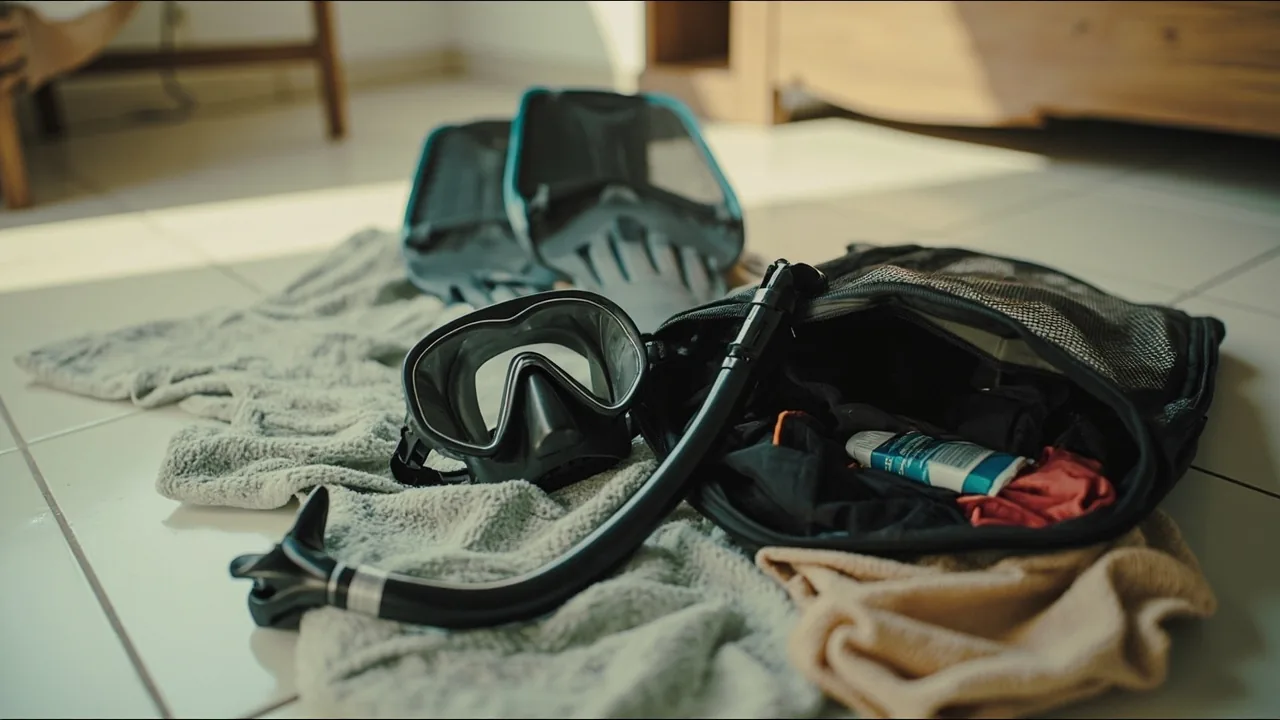
- Mask. This is the one item you never rent. Rental masks sit on hundreds of faces, the silicone hardens, and they leak. A good mid-range silicone mask costs 1,500 to 3,500 in India (ScubaPro, Cressi, Mares). Bring it in a hard mask box inside your backpack.
- Snorkel. Cheap, easy to pack. Skip the dry-valve ones; the simple J-shape is fine.
- Reef-safe sunscreen. SPF 50 mineral sunscreen (zinc oxide or titanium dioxide, no oxybenzone) is banned in some marine parks and rare in island shops. A 50ml tube is 600 to 1,200 in Bangkok 7-Elevens; ₹717-₹1,291 (~250-450 THB or ~$7.45-$13.40) at Thai dive shops. Buy a 100ml stick at a Decathlon or Nykaa in India before you fly.
- Rash guard / long-sleeve swim top. Protects against sun and jellyfish stings. Two of these (one on, one drying) is the right number.
- Reef shoes / booties. Coral entry points are sharp. A pair of 2mm or 3mm neoprene booties cost 1,000 to 1,800 in India, more than double that on Koh Tao.
Always rent at the shop:
- Wetsuit. 3mm fullsuit for Thailand and Vietnam year-round. 5mm for deeper or thermocline-heavy sites. Shops have them sized and clean. Bringing your own wetsuit means a wet lump in your pack for the rest of the trip.
- BCD and regulator. Modern rental kits at PADI/SSI five-star shops are well-maintained. Skip if you only have an Open Water certification.
- Fins. Open-heel with booties is the standard. Full-foot fins only for snorkelling.
- Dive computer. Renting is fine for the first 20 dives. After that, the cost of renting beats owning for casual divers. A Suunto Zoop is 18,000 to 24,000 in India if you want to own.
Optional but worth it:
- Action camera with underwater housing. GoPro Hero 12 with the standard housing is rated to 60m. Don’t use an iPhone in a flat dry-bag pouch for real diving, water pressure breaks the seal below 2m and the footage is unusable.
- Surface marker buoy (SMB). Mandatory at some sites (Richelieu Rock, Koh Lanta), strongly recommended everywhere. A small reel + SMB combo is 2,500 in India.
- Dive log book. A paper logbook is still the cheapest proof of experience for fun dives and liveaboards. 300 to 500 in India.
Subodh’s Pro Tip: If you’re doing your Open Water certification in Koh Tao, your dive school gives you everything. Don’t pre-buy gear. After your 10th dive, you’ll know what you want to own.
The Clothing Side: 7 Days on a Liveaboard
Diving trips skew toward liveaboards or island stays with multiple boat days. Pack like you’re on a small, salt-spray-prone boat for a week. Synthetics beat cotton, every time.
- Swim trunks / board shorts: 2 pairs. Quick-dry nylon. No cotton.
- Rash guards: 2 long-sleeve, one short-sleeve.
- Quick-dry t-shirts: 3, all synthetic.
- Lightweight long-sleeve cotton shirt: 1, for sun on the boat deck between dives.
- Quick-dry shorts: 1 pair, for evenings.
- Lightweight trousers: 1 pair, for boat transfers and bus rides.
- Underwear: 4 pairs, synthetic.
- Light rain shell: For monsoon season squalls, also good as wind protection on boats.
- Microfibre towel: Dries fast, packs small. Standard kit for any SE Asia backpacker.
For shoes, one pair of reef booties (see above), one pair of strap sandals or Chacos for the hostel/deck, and one pair of light trainers if you’re hitting Bangkok or Hanoi at either end of the trip. Skip hiking boots.
Electronics & Tech for a Diving Trip
Saltwater kills electronics faster than anything else in SE Asia. The electronics kit for a diving trip is smaller than a regular backpacking trip, but every piece has to be tougher.
- Universal adapter: Thailand uses A/B/C/F (two flat prongs or two round). Vietnam adds G (three round). Indonesia mixes A/C. A single adapter with retractable pins covers Thailand and most of Vietnam. Bring a second one if you’re bouncing between countries. See the SE Asia plug adapter guide for country-by-country details.
- Power bank: Under 20,000 mAh and under 100Wh to stay within IATA cabin baggage limits. Indian airports are strictest; budget 100Wh max. The Mi Power Bank 3 with 20,000 mAh / 74Wh is the sweet spot. See our electronics guide for SE Asia for more details.
- Action camera + spare batteries: Saltwater cameras eat batteries. Three batteries minimum for a full dive day, charged overnight on the boat.
- Waterproof phone pouch: A flat dry-bag style (₹300 (~$3.11) to ₹600 (~$6.23) from Decathlon) for the boat, NOT for diving. A proper IP-rated case like the ProShot or DIVEVOLK is needed for actual underwater phone use.
- Headlamp: Liveaboard cabins are dark. A small USB-rechargeable Petzl-style lamp.
- Charging cables: USB-C × 2, Lightning × 1 if you’re on an older iPhone. Power surges on boats are real; cheap cables die first.
Safety Alert: Boat power outlets on Thai liveaboards have killed chargers. Bring a small multi-socket surge protector, or charge at the dive shop between days.
For connectivity, most divers don’t need a local SIM after day one: dive boats have weak signal anyway. But for arranging pickups, restaurants, and last-minute hostel changes in Bangkok, Phuket, or Nha Trang, a SIM or eSIM matters. The best option for Indian travelers is to set up an eSIM before flying, since you’ll have data the second you land. Get Nomad eSIM gives you regional SEA data packs that work across Thailand, Vietnam, and Indonesia.
If you’d rather a physical SIM on arrival, see our guides for Thailand’s dtac SIM and Vietnam’s Viettel/Vinaphone options.
Toiletries, Meds, and First Aid
Divers get specific medical problems. Plan for them.
- Reef-safe sunscreen (SPF 50+): SPF 50 mineral sunscreen (zinc oxide or titanium dioxide, no oxybenzone) is banned in some marine parks. Bring two sticks and one tube from India before flying.
- Antihistamine: Cetirizine 10mg. Sea lice, jellyfish stings, and unexplained underwater rashes all respond to it.
- Motion sickness pills: Cinnarizine or Stugeron, sold over the counter in India. Liveaboards hit open water in the Similans and Richelieu Rock. Take one the night before, one in the morning.
- Ear drops: Acetic acid ear drops (Vosol or similar) prevent outer-ear infections, the #1 diving illness after sunburn. Cheap in India.
- Paracetamol + ibuprofen: Standard.
- ORS sachets: Saltwater dehydration is real. Carry 8 to 10.
- Probiotics: One strip. GI bugs after dive-boat buffets are common.
- Lip balm with SPF: Sun + salt kills lips in 24 hours.
For full trip insurance including the diving-specific risk of needing a hyperbaric chamber, the standard backpacker policy covers most of it, but read the fine print. Hyperbaric chamber evacuation in Thailand can cost ₹86,073 (~30,000 THB or ~$893.53) to ₹229,528 (~80,000 THB or ~$2,382.74) for serious cases. A DAN (Divers Alert Network) dive-specific policy is 4,500 to 7,000 for two weeks and worth it if you’re doing more than 10 dives.
Monsoon vs. Dry Season Adjustments
Thailand’s west coast (Phuket, Koh Lanta, Similan) closes from mid-May to mid-October for the Andaman diving season. Liveaboards shift to the east coast (Koh Tao, Koh Phangan) and to Indonesia. Vietnam’s Nha Trang dives year-round, with September-November visibility dropping to 5 to 8 metres. Phu Quoc’s best season is November to April; monsoon months see reduced visibility and some shop closures.
- Monsoon packing additions: Lightweight dry bag (10 to 20L) for electronics on boats. Quick-dry microfibre towel. A second rash guard, since wet gear doesn’t dry between dives. Anti-fog solution for the mask.
- Dry season packing additions: Stronger sunscreen (reef-safe, still). Buff or cap for scalp sun. Saline nasal spray, since dry air on AC boats triggers nosebleeds at depth.
The Diving-Specific Stuff Most People Forget
These are the items divers commonly wish they’d packed more of.
- Mask defog: Baby shampoo works. So does a dedicated defog spray. Don’t use toothpaste, it strips the coating on new lenses.
- Spare mask strap + spare fin strap: Cheap, light, save a dive day when one snaps.
- Dry bag for boat days: 20L roll-top. Even on calm days, spray gets everything.
- Reusable water bottle: 1L minimum. The boat provides water but plastic cups end up in the Andaman.
- Carabiner + clip: For clipping SMB, camera, and weight belt to the boat. Saves you from chasing gear overboard.
- Small notebook + pencil: For dive briefings. Phone batteries die.
- Ziplock bags × 10: Wet stuff stays wet, dry stuff stays dry, and electronics stay alive.
Common Packing Mistakes Indian Divers Make
- Bringing an oversized hardshell suitcase. Airlines lose them. Tuk-tuks can’t fit them. Liveaboard cabins have no storage. A 40 to 50L backpack with a 15L daypack is the standard kit. Hard cases only if you’re driving your own rental car.
- Packing cotton hoodies and jeans for “the boat.” Cotton stays wet for hours. On a 4-dive day you need synthetics. Hoodies are dead weight.
- Buying the cheapest mask on Shopee. Cheap silicone leaks at depth. Spend at least 1,500 to 2,000 on a real silicone mask with tempered glass. Avoid anything with “anti-fog coating built-in,” it’s a gimmick.
- Skipping reef-safe sunscreen. Regular sunscreen with oxybenzone is banned at most Thai marine parks (Surin, Similan, Phi Phi). Officers fine boats ₹2,869-₹14,346 (~1,000-5,000 THB or ~$29.78-$148.92) for non-compliant sunscreen. Check the active ingredient label.
- Forgetting the power bank mAh limit. Anything over 100Wh (about 27,000 mAh at 3.7V) gets confiscated at Indian airport security. Stick to 20,000 mAh / 74Wh.
- Not telling the dive shop your cert level. If you say “I have Open Water” and the shop pushes you to a 30m dive, that’s on them and on you. Bring your physical or digital certification card.
- Packing too many “just in case” dive books and fish ID cards. A single laminated fish ID card or the DiveMate app covers 95% of species. Reef fish in the Andaman and Gulf of Thailand share many common species. Skip the 800g hardcover.
Pre-Flight Checklist
- Certification card (paper or SSI/PADI app screenshot)
- Passport + 6-month validity
- Travel insurance document (printout + digital)
- DAN or dive-specific insurance (if applicable)
- Dive logbook (if borrowing gear or joining a club)
- Visa-on-arrival confirmation (Vietnam e-visa, Cambodia visa-on-arrival fee in USD cash)
- Backup photocopies of passport, kept separately from the main passport
FAQ
Can I bring my full dive kit from India to save rental fees? Yes if you’re doing a 10+ dive liveaboard trip and have your own regulator, BCD, and computer. For a one-week trip with 6 to 8 dives, rentals at ₹1,721-₹4,304 (~600-1,500 THB or ~$17.87-$44.68) per day are cheaper than the airline baggage fees and the hassle.
Is diving safe in Southeast Asia for first-time divers? Yes. Koh Tao alone certifies more Open Water divers per year than any other place on earth. Stick to PADI or SSI five-star shops, never uncertified “schools” that pop up on Klook.
Do I need a wetsuit for Phu Quoc or Koh Tao in December? Yes, 3mm fullsuit. Water temperature is 27 to 29°C but you burn through air faster when warm, and the suit prevents scrapes on coral.
What’s the minimum dive insurance coverage I need? ₹4,816,470 (~50,000 USD) medical, including hyperbaric chamber evacuation. Most standard backpacker travel insurance excludes “extreme sports” or “recreational diving below 30m.” DAN is the safest bet.
Can I fly right after diving? Single dive: 12 hours minimum. Multiple dives over multiple days: 18 to 24 hours. Liveaboard operators and DAN publish the rule. Skipping it puts you at risk of decompression sickness on the flight home.
Is the camera on my phone good enough underwater? For snorkelling at the surface, yes. For actual scuba, no. Pressure flattens the seal on flat pouches and floods the phone. An action cam with proper housing is the only safe option below 2 metres.
Subodh’s Take
The single best piece of dive kit any Indian backpacker can bring is a good mask that fits their face. Everything else is rentable, replaceable, or skippable. Get fitted for a mask at a proper scuba shop (not online), wear it around the store for ten minutes, check the seal, and pack it in a hard case in the centre of your backpack. That one item will save you money, leaks, and three days of blurry frustration across every dive site from Richelieu Rock to Nusa Penida.
