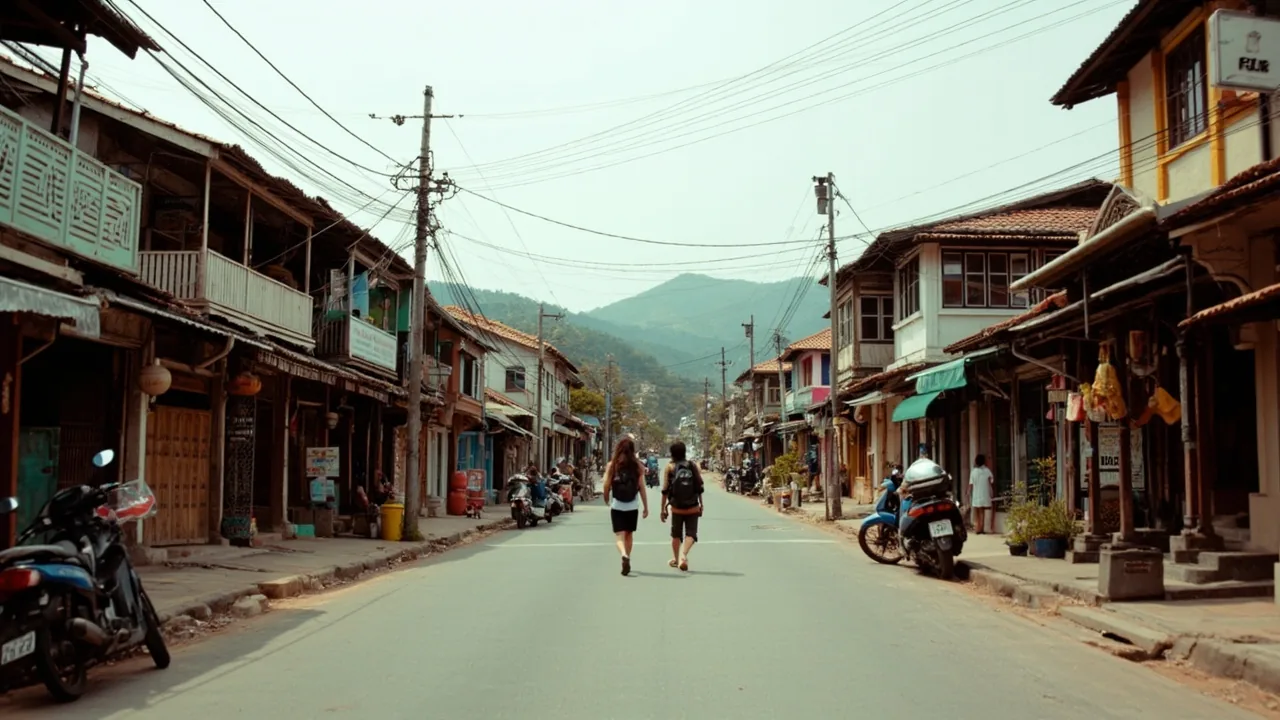
Pai: The Indian Backpacker’s Hippie Town Guide (2026)
Looking for a Pai Thailand guide that understands Indian backpackers? Pai is the hippie mountain town 135 km north of Chiang Mai where Thai locals, Israeli draft-dodgers, and burnt-out Westerners come to do yoga, ride scooters into rice paddies, and pretend time is a concept that no longer applies. For related planning, see our guide on Bangkok.
Whether Pai is worth visiting depends on how much silence you can tolerate before you go a bit mad. If you’re an Indian backpacker plotting the Northern Thailand leg of a longer trip, Pai is the detour that costs a day and gives you back three weeks of peace. Treat this as a working briefing, not a brochure. You may also find Koh Phangan useful for this trip.
Quick Answers
| What | Answer | Price (INR) |
|---|---|---|
| Visa for Indians | 60-day visa-free entry, just complete TDAC online | Free |
| Best way from Chiang Mai | Minivan via 12go, 3h 55m, 135 winding curves | ₹700 (~244 THB or ~$7.27) |
| Dorm bed in Pai | Walking Street hostel dorm | ₹400-700 (~170-300 THB or ~$4-$7) |
| Scooter rental (per day) | Honda Click 110, the standard | ₹430 (~150 THB or ~$4.50) |
| Daily food budget (street) | Khao Soi, pad Thai, mango sticky rice, fruit shakes | ₹300-500 (~100-180 THB or ~$3-$5) |
How to Get There (From Chiang Mai)
You’ll almost arrive from Chiang Mai, since Pai is the standard detour off the northern backpacker loop. The road is famous for one reason: it has 1,864 curves in 135 km, and you will feel every single one of them if you sit anywhere near the back of a minivan.
The cheapest practical option is a minivan from Arcade Bus Terminal 2 (the Chiang Mai Gateway) to Pai, which takes about 4 hours and drops you in town. Book through 12go for the fixed fare; walk-ups at Arcade are similar in price but lock you into a specific departure. Premier/VIP minivans have 12 seats instead of the standard 15, with softer suspension; drivers on these services usually stop at the halfway viewpoint instead of just ploughing through.
| Option | Duration | Approx Cost | Where to book |
|---|---|---|---|
| Standard minivan | 3h 55m - 4h 30m | ₹430-₹574 (~150-200 THB or ~$4.46-$5.94) | Book on 12go |
| Premier/VIP minivan | 3h 55m | ₹717-₹1,004 (~250-350 THB or ~$7.43-$10.40) | Walk-up at Arcade 2 |
| Motorbike (rental) | 4h - 5h | ₹861 (~300 THB or ~$7) | Local Chiang Mai rental shops |
| Songthaew (local share taxi) | 4h | ₹430-₹574 (~150-200 THB or ~$4.46-$5.94) | Chiang Mai Old City pickup |
If you’re riding your own scooter from Chiang Mai, the road is manageable if you’ve ridden before. Take it slow on the first 20 km out of Chiang Mai city (highway traffic, fast trucks), and check the brakes at the halfway viewpoint. Travellers report that the descent into Pai on a wet road is where most accidents happen, not the curves themselves.
For the Indian backpacker specifically: if you haven’t ridden a geared bike or scooter before, pay for the minivan. Pai hospital is real but small, and travel insurance rarely covers “I wanted to look cool on Instagram.”
Where to Stay
Pai’s hostel scene clusters around two areas: Walking Street (the noisy centre, market every night, bars until 2am) and the quieter east-side guesthouses around Mae Yen Waterfall road. Hostels here lean bungalow-style: bamboo walls, hammocks, garden, communal breakfast. Dorms are genuinely social and most have a pool.
| Hostel / Guesthouse | Cost/night | Vibe | Book Here |
|---|---|---|---|
| Buzzas@PaiChan | ₹488-₹861 (~170-300 THB or ~$5.05-$8.92) | Social, Walking Street, pool, walking-distance to everything | Check prices |
| Revolution Hostel Pai | ₹574-₹1,004 (~200-350 THB or ~$5.94-$10.40) | Loud, party-leaning, late-night common area, central | Check prices |
| Common Grounds Pai | ₹488-₹803 (~170-280 THB or ~$5.05-$8.32) | Quieter social hostel, good for couples and solo travellers, garden | Check prices |
| K-Bunk Hostel Pai (Walking Street) | ₹516-₹918 (~180-320 THB or ~$5.35-$9.51) | Newer dorms, central, good WiFi for remote work | Check prices |
| Butterfly Hostel Pai | ₹488-₹803 (~170-280 THB or ~$5.05-$8.32) | Garden bungalow dorms, calmest of the central options, slightly older | Check prices |
| Revolution Pai In Town | ₹516-₹861 (~180-300 THB or ~$5.35-$8.92) | Slightly removed from Walking Street, pool, chill vibe | Check prices |
| Subodh’s pick: if you want to meet people and don’t mind noise, stay on Walking Street at Buzzas or Revolution. If you want quiet and a hammock, Common Grounds is the move. Book 2-3 days; the rest of Pai you’ll spend on a scooter, not at the hostel. |
What to Eat
Pai is one of the easier Thai towns for Indian vegetarians. There’s a small but real Indian-food scene (mostly run by Punjabi expats), and Thai food in Pai leans heavily toward Northern Thai, which means more coconut-milk curries, fewer pork-heavy dishes than Bangkok or Chiang Mai.
Northern Thai staples to start with:
Khao Soi is the dish Pai does best. Egg noodles in a coconut-curry broth, topped with crispy noodles, lime, and pickled mustard greens. Kwanjai Thai food and Na’s Kitchen both do a strong version. Kwanjai’s Khao Soi is the one travellers keep coming back for, with rich broth and generous portions. Expect to pay around ₹172-₹230 (~60-80 THB or ~$1.78-$2.38) per bowl.
Gaeng Hang Lay is the Burmese-influenced pork curry that Pai adopted as its own. Slow-braised pork belly in a tamarind-turmeric gravy, eaten with rice. If you eat pork, try it at Na’s Kitchen. If you don’t, skip it and move to the next dish.
Som Tam (green papaya salad) is the standard Thai side. The version at Thai food bar is more sour than spicy, which works if you’re heat-sensitive. Around ₹115 (~40 THB or ~$1.19).
Pad Thai is everywhere and costs ₹143-₹201 (~50-70 THB or ~$1.49-$2.08) anywhere in town. Don’t order it at the “best restaurant in Pai” type places. Order it at a roadside stall with plastic chairs. The street version is better.
Mango sticky rice is a daily staple when mangoes are in season (March-June). ₹143 (~50 THB or ~$1.49) per portion, eat it for breakfast like every other backpacker in town.
For vegetarians and Indians missing home: Earth Tone is the go-to. Their menu has a clear veg section and the pumpkin curry is famous among vegetarian travellers. Earth Tone leans farm-to-table, organic ingredients, and a quiet garden setting. Budget around ₹344-₹516 (~120-180 THB or ~$3.57-$5.35) per dish. Don’t expect South Indian dosas; expect North Indian curries, dal, and roti.
Drinks: Fruit shakes are ₹115-₹172 (~40-60 THB or ~$1.19-$1.78) at any Walking Street stall. Pai has decent local coffee (the highlands grow Arabica), and most hostels give you a free brew at breakfast.
What to Do
Pai’s “things to do” list is half scooter loops, half day trips. Most travellers rent a scooter for 2-3 days, ride out at sunrise, and come back before the Walking Street market gets loud. Here’s what matters:
1. Pai Canyon at sunset is the single most photographed view in Pai. Walk to the rim 30 minutes before sunset, find a narrow ridge, sit. It’s genuinely beautiful. Bring water; the canyon has no shade. Free entry, motorcycle parking ₹29 (~10 THB or ~$0.30).
2. Wat Phra That Mae Yen is the white Burmese-style stupa on the hill overlooking Pai. The temple itself is small; the climb up and the view back over the valley are the point. Visit at sunrise to beat the heat and the tour buses. Free entry.
3. Mae Yen Waterfall is a 30-minute scooter ride from town. Cold, swimmable, set in a proper jungle. The water level drops in dry season (November-March) so check with locals before going. Free entry.
4. Kho Ku So Bamboo Bridge is a long bamboo bridge over the rice paddies, rebuilt every year by the local community. Entrance is ₹86 (~30 THB or ~$0.89) and the walk is about 1 km out, 1 km back. Do it at golden hour.
5. Jungle Ziplining is what Pai does instead of treks. The standard course has 16-20 platforms through the canopy and costs about ₹4,017 (~1,400 THB or ~$41.61). Wear closed shoes, bring bug spray, and don’t expect easy Grab back. Book Hawk Adventure Zipline tour and Book Jungle Ziplining Adventure with 16 Platforms tour
6. Thom’s Pai Elephant Camp is the ethical-elephant option. The “take care and bathing with them” course means you help wash and feed rescued elephants. Budget ₹4,304-₹7,173 (~1,500-2,500 THB or ~$44.58-$74.30) per person for a half-day. Avoid any camp that offers elephant riding. Book Thom’s Pai Elephant Camp (Course : take care and bathing with them) tour
7. Walking Street Night Market is the nightly event whether you like it or not. Starts around 6pm, runs until 11pm. Street food, sarongs, hemp clothing, dodgy tattoo shops, live buskers. Don’t buy the “original” hippie pants. They are not original.
Optional day trips: If you’ve got an extra day, Pai is the gateway to Chiang Dao, a quieter mountain town with Thailand’s third-tallest peak and a famous cave temple. Or skip south toward Mae Hong Son loop, a 600-km motorcycle circuit that Pai is the start of.
Getting Connected
AIS and TrueMove both sell tourist SIMs at Chiang Mai airport and at any 7-Eleven in Pai. The AIS 15-day tourist SIM runs ₹1,145 (~399 THB or ~$11.86) with about 15 GB of data, which is more than enough for a week in Pai. Top-up at any 7-Eleven if you run out. The 4G coverage in Pai town is solid; once you’re out at waterfalls or the canyon it drops to 3G.
If you’d rather skip the airport queue and have data the moment you land, Get Nomad eSIM lets you install before you fly and activate on landing. Coverage in Northern Thailand works on the same AIS/TrueMove towers.
WiFi at hostels is reliable in Pai; most have fibre and the WiFi is fast enough for video calls. Cafes along Walking Street all have free WiFi and most don’t care if you nurse a single coffee for two hours.
Where to Go From Here
Most travellers use Pai as a 2-4 day detour, then go back to Chiang Mai and continue south. Here are the practical options:
| Destination | Mode | Duration | Price | Book |
|---|---|---|---|---|
| Chiang Mai | Minivan | 3h 55m | ₹430 (~150 THB or ~$4.46) | Book on 12go |
| Chiang Mai Airport | Minivan | 3h 55m | ₹574 (~200 THB or ~$5.94) | Book on 12go |
| Bangkok | Sleeper van | 9-11h | ₹2,295-₹3,443 (~800-1,200 THB or ~$23.78-$35.67) | Book on 12go |
| Phuket | Bus (via Bangkok) | 6h 40m (to hub) | ₹12,066 (~125 USD) | Book on 12go |
| Krabi | Sleeper train+bus | 22h | varies | Book on 12go |
Subodh’s Pro Tip: The sleeper van from Pai to Bangkok is cheaper than the flight once you add airport transfers, and you save a hotel night. Book it through 12go two days ahead; the 12-seat VIP sleeper vans sell out by Friday for Sunday departures.
Daily Budget Breakdown
Here’s what an Indian backpacker spends per day in Pai, based on hostel reports and the canonical mid-2026 rates:
| Category | Budget/day |
|---|---|
| Dorm bed | ₹450 (~170 THB or ~$4.70) |
| Food (3 meals, mix of street + restaurant) | ₹400 (~150 THB or ~$4.15) |
| Scooter rental (split with 1-2 others) | ₹150 (~50 THB or ~$1.50) |
| Activities (waterfalls, canyon, temple entries) | ₹200 (~70 THB or ~$2) |
| Beer / drinks | ₹150 (~50 THB or ~$1.50) |
| Total | ₹1,350 (~490 THB or ~$14) |
These are working-traveller numbers, not Instagram numbers. If you add a zipline day (₹4,017 (~1,400 THB or ~$41.61)) or an elephant camp visit (₹5,738 (~2,000 THB or ~$59.44)), budget ₹8,607-₹11,476 (~3,000-4,000 THB or ~$89.17-$118.89) for that specific day.
Verified 2026-07-21.
Visa / Entry Notes
Most Indians arrive in Pai via Chiang Mai, which is the standard 60-day visa-free entry under the bilateral agreement. You’ll need:
- Passport valid 6+ months
- TDAC digital arrival card, completed before boarding at tdac.immigration.go.th (free, takes 5 minutes, screenshot the QR code)
- No visa fee for the visa-free entry
If you’re extending beyond 60 days, the on-arrival extension is ₹5,406 (~56 USD) at the Chiang Mai immigration office, not at Pai (Pai doesn’t have an immigration office, you’d have to ride back).
For the full Thailand visa breakdown, see the Thailand entry guide.
Common Mistakes
1. Renting a scooter without checking the brakes or the tyres. Pai’s scooter rental shops are fine, but the bikes are beaten up. Travellers report that the Honda Click 110s are the most reliable. Photograph every scratch on the bike at pickup. If the rental shop doesn’t give you a helmet that clips, ask for one (Pai police do spot checks).
2. Riding the Pai Canyon at sunset without water and closed shoes. The trail is fine until you try to come back down in the dark. Bring a headlamp and water.
3. Going to every “ethical” elephant camp you see advertised. Pai has multiple elephant camps and quality varies. The “no riding, bathing only” camps are the ones to support; riding camps should be skipped. Thom’s is one of the more established options.
4. Mistaking Pai for a quiet mountain town. It is not. Walking Street is loud every night until 2am. The east-side guesthouses are quieter. Pick your hostel accordingly.
FAQ
Is Pai safe for solo Indian travellers? Yes. Pai is one of the safer towns on the Northern Thailand trail. Petty theft is rare, violent crime is rare. Standard backpacker precautions: lock your dorm locker, don’t ride the scooter drunk, watch your phone at Walking Street. The Indian community in Pai is small but visible (you’ll spot the Indian restaurants near Walking Street). For the Indian government’s travel advisory, check mea.gov.in before you fly.
Can I get Indian food in Pai? Yes. There are 2-3 North Indian restaurants around Walking Street serving dal, roti, paneer, and thalis at ₹344-₹574 (~120-200 THB or ~$3.57-$5.94) per meal. Quality is decent, not great. For vegetarian Thai food specifically, Earth Tone is the standout.
Is Pai worth visiting if I only have 3 days in Chiang Mai? Yes, if the trade-off matters to you. Pai is the most atmospheric mountain town in Northern Thailand, and the scooter loop is one of the better 1-day rides in the country. 2 nights in Pai, 1 day back to Chiang Mai is the standard.
Should I ride a scooter from Chiang Mai to Pai? Only if you’ve ridden scooters before. The road is the most accident-prone stretch of highway in Northern Thailand. If you’re new to two wheels, take the minivan and rent a scooter locally.
How many days do I need in Pai? 2-3 days covers the highlights. 4 days lets you do the Mae Hong Son loop as a side trip. Past 5 days, you’re either doing a yoga retreat or starting to lose the plot.
Is Pai good for couples? Yes, quieter than Chiang Mai and better vibe for couples. Common Grounds and Butterfly Hostel are the calmer picks.
What’s the best season to visit Pai? November to February, the cool dry season. Temperatures 15-28°C, low humidity. February-April is burning season (smoke from agricultural fires, AQI issues). May-October is rainy season; the waterfalls are full but the scooter riding is sketchy.
Subodh’s Take
Pai is the town I’d send any first-time backpacker to in Northern Thailand. It’s slower than Chiang Mai, smaller than Chiang Mai, and the food scene is more honest. But I’d send them with a hard cap: 4 nights. By day five, the magic fades and the inertia sets in, and suddenly you’ve been in Pai for 11 days wondering how it happened. Bring a scooter, bring a swimsuit, bring a book. Don’t bring a 2-week plan.
