Penang Halal Food Guide: Best Nasi Kandar Spots & Street Eats for Budget Travelers
Penang is Malaysia’s food capital, and for Indian backpackers, halal food is the default. Nasi kandar, char koay teow, mee goreng, and roti canai all come from Indian-Muslim, Malay-Muslim, or Chinese-Muslim kitchens with JAKIM halal certification. Prices here are among the cheapest in Southeast Asia for the quality you get. For more on backpacking Southeast Asia, see our SEA Backpacking Hub.
If you land in Penang and eat three meals a day at the spots listed here, you will spend roughly RM 25-40 per day on food (₹590-₹945 (~$6.12-$9.80)). That is one of the cheapest food budgets in Southeast Asia for the sheer quality you get back.
Quick Answers
| What | Answer | Price (INR) |
|---|---|---|
| Most famous Penang dish | Nasi kandar (steamed rice + curries + fried chicken/squid) | RM 8-15 |
| Budget nasi kandar plate | Bhai Biryani or Rempah Ratus, both with JAKIM halal | RM 8-12 |
| Cheapest halal meal on the island | Roti canai + teh tarik at any mamak | RM 4-7 |
| JAKIM halal certification | Displayed at the entrance, 4-year validity, must show expiry | Free to verify at halal.gov.my |
| Is tap water safe? | No, use bottled or filtered | RM 1 per 1.5L bottle |
The Local Culinary Landscape
Penang’s food scene is shaped by three communities: Malay-Muslim, Indian-Muslim (Mamak), and Chinese. The Malay-Muslim and Mamak communities operate almost every nasi kandar stall, every roti canai shop, and every satay cart on the island, which makes halal food the baseline, not the special request. The Chinese community runs the hawker centres, dim sum spots, and char koay teow stalls; most of these are halal-certified too, but a few still use lard in their woks, so check the JAKIM certificate before ordering.
The one ingredient to watch out for is lard. Some Chinese hawker stalls in Penang still use pork fat in their noodles and rice dishes for flavour, even when the meat served is halal. JAKIM-certified stalls cannot use lard, period. If you do not see the certificate, ask: “Ada sijil halal?” (Do you have a halal certificate?). A genuine stall will point to the laminated JAKIM card on the wall.
Vegetarian food in Penang is harder than in Kuala Lumpur. Indian vegetarian restaurants exist (more on those below), but if you are a strict vegetarian travelling through the island, plan to eat at dedicated South Indian banana-leaf spots rather than hoping to improvise at hawker stalls. Most noodle and rice dishes at hawker centres contain dried shrimp, shrimp paste (belacan), or egg.
Subodh’s Pro Tip: Download the “Muslim Pro” or “HalalTrip” app before you land. Both pull JAKIM certification data and let you filter by certification status. Muslim Pro also has a Qibla finder and prayer time alerts, which matters because many nasi kandar stalls close briefly during Maghrib (sunset) prayer.
Key Phrases in Local Script
| English Phrase | What it Means | Local Script | Pronunciation |
|---|---|---|---|
| I am vegetarian | Tells the stall you want no meat | Saya vegetarian | ”sah-yah veh-jeh-tah-ree-an” |
| No shrimp paste | Critical for stir-fried noodles | Tiada belacan | ”tee-ah-dah beh-lah-chan” |
| No egg | Common request at hawker centres | Tiada telur | ”tee-ah-dah teh-loor” |
| Is this JAKIM halal? | Verifies official certification | Ada sijil halal JAKIM? | “ah-dah see-jeel hah-lal JAKIM?” |
| Less spicy | For dishes that default to fiery | Kurang pedas | ”koo-rang peh-das” |
| No pork, no lard | Double-check Chinese hawker stalls | Tiada babi, tiada lemak babi | ”tee-ah-dah bah-bee, tee-ah-dah leh-mak bah-bee” |
Safe Halal Street Food Dishes
These are dishes where the default preparation is halal across nearly every stall in Penang. Prices are for a standard portion in George Town or Bayan Lepas.
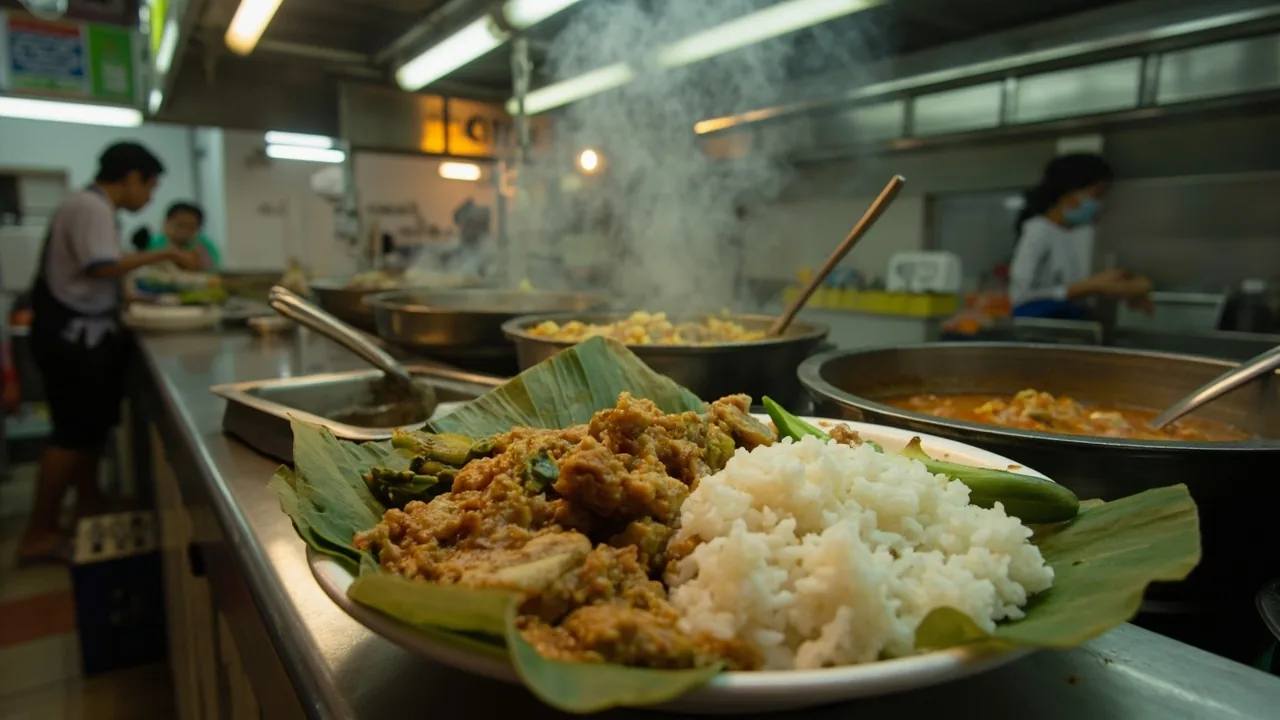
Nasi Kandar (RM 8-15): The signature dish. Steamed white rice drowned in a mix of curries (fish curry, chicken curry, dhal, sambal) with optional fried chicken, squid, or prawns. Order at the counter, point to what you want, and the server ladles it onto your plate. The trick is the “kuah campur” (mixed gravy): ask for a little of every curry, including the squid ink version if you are adventurous. Book a Penang food tour if you want a guide to walk you through the top nasi kandar stalls.
Roti Canai (RM 1.50-2.50 per piece): Flaky flatbread served with dhal curry or fish curry. Cheap, filling, and available 24 hours at any mamak stall. The “Maggi Goreng” (fried instant noodles) cooked by mamak stalls is also reliably halal and costs RM 5-7.
Char Koay Teow (RM 6-10): Stir-fried flat rice noodles with prawns, egg, bean sprouts, and chives. The famous Penang version is cooked over high heat with pork lard, but JAKIM-certified stalls use vegetable oil instead. Ask before ordering; most tourist-area stalls have switched to halal.
Mee Goreng (RM 5-8): Indian-Muslim style fried noodles with tomato, chilli, egg, and vegetables. The mamak version is reliably halal and vegetarian-friendly if you ask for “tanpa telur, tanpa ayam” (without egg, without chicken).
Teh Tarik (RM 2-3): “Pulled tea,” a sweet milk tea frothed by pouring between two vessels from a height. The national drink of Malaysia. Order “teh tarik kurang manis” (less sweet) if you find the default too sugary.
Murtabak (RM 6-12): Stuffed pan-fried bread with minced mutton, egg, and onion. A mamak staple. Heavy, but cheap, and a full meal by itself.
Recommended Halal Restaurants in Penang
These are the spots in the shortlist that I or recent traveller reports have flagged as worth the trip. I have grouped them by type so you can find the right fit for what you are craving.
For Nasi Kandar & Mamak Classics
Rempah Ratus - Banana Leaf Cafe Penang is the pick for South Indian banana-leaf meals. The claypot biryani here runs RM 15-26 per person and is the closest thing to a Chennai-style meal you will find outside Tamil Nadu. Sit on the ground floor, order the banana leaf with dhal, rasam, and a vegetable side, and add a masala chai for RM 3. Expect to queue at lunch on weekends.
Bhai Biryani Penang runs Hyderabadi-style biryani that travellers consistently rate above the Kuala Lumpur competition. Plates are RM 15-40 depending on the protein (chicken, mutton, or prawn). The dum biryani is the one to order; the chicken 65 is the one to share.
Oh Yeah Palace - Bamboo Briyani, Western & Banana Leaf Penang is the family-friendly option, with traditional South Indian banana-leaf meals and a separate Western menu for the kids or the homesick. The bamboo biryani is the signature, served inside bamboo that is cracked open tableside.
For Indian Comfort Food
Bombay Kitchen And Bar Penang does Mumbai street food in a casual setting: pav bhaji, vada pav, Bombay sandwiches, and bhel puri. Prices run RM 10-18 per dish. Good for a quick lunch when you want chaat rather than a full thali.
Rockafellers Straits Quay, Penang is the upscale option, fusing Western technique with Indian spices and a focus on seafood. This is the spot for a dinner splurge (RM 40-80 per person) or a birthday meal with a view of the marina. The tandoori platter is consistently well-reviewed.
Olive Kitchen + Bar Penang sits at the high end, blending Mediterranean and North Indian flavours. The paneer preparations and the dal makhani are reliable for vegetarians. Expect RM 50-90 per person with drinks.
For Local & Regional Variety
Maejouzs Penang and Me’nate Penang both serve traditional Malay dishes in cozy settings. Me’nate is stronger for classic Malay plates like rendang, ayam percik, and ikan bakar, with most mains at RM 12-22.
Siam Social Penang does Thai street food with a modern twist. Most of the menu is halal-certified Thai (pad thai, tom yum, green curry), useful when you are tired of rice and want noodles. Expect RM 15-25 per dish.
CHIAS PENANG and Firewood Penang lean toward wood-fired cooking and shared plates. Both are good for a group dinner when you want to order several dishes and pass them around. CHIAS is more casual; Firewood is the date-night pick.
Spitfire Penang Restaurant is the wood-fired pizza outlier, useful when you are craving something that is not rice or noodles. Pizzas run RM 25-40.
Damas Penang and Halab Penang Arabic Restaurant are your Arabic food options, both serving shawarma, kebabs, hummus, and mixed grills. Damas is slightly more upscale; Halab is the casual everyday pick. Mains run RM 15-30.
Sora Penang is the late-night option, a chill lounge bar with live bands on weekends. Order the cocktails (RM 25-40) and grab a snack plate if you want something to soak up the drinks.
JAKIM Halal Certification: How to Verify
Every restaurant listed above either displays JAKIM certification at the entrance or has been flagged as halal-compliant in traveller reports from 2026. If you want to verify yourself before visiting, the official JAKIM halal directory is at halal.gov.my. Search by restaurant name; the certificate number, expiry date, and certifying body are all listed.
Safety Alert: JAKIM certificates expire every 4 years. A laminated card on the wall with no expiry date is a red flag. Real certificates include the certificate number (starting with “MS”) and a 4-digit year. If you are unsure, ask to see the certificate, not just the wall display.
For a broader Malaysian context beyond Penang, our Malaysia food guide for vegetarians covers KL, Ipoh, and Melaka, and our mamak stall guide explains how the 24-hour Indian-Muslim coffee shop culture works across the country.
Food Safety & Hygiene
Penang’s food hygiene is generally good, but street stalls are still street stalls. Five rules that have kept me and every backpacker I know out of the clinic:
- Eat where locals queue. A nasi kandar stall with a 10-person line at 1pm is safer than an empty one with a friendly host. High turnover means fresh food.
- Drink bottled or filtered water. Tap water in Penang is not potable. Bottled water is RM 1 per 1.5L at any convenience store.
- Avoid raw vegetables at low-end stalls. The dhal and the cooked curries are fine; the raw cucumber garnish at a budget stall is where problems start. Wash fruit yourself with bottled water.
- Skip ice from unknown sources. Mamak stalls and hawker centres use commercial ice, which is safe. Roadside drink vendors sometimes use home-frozen ice. Stick to bottled drinks or teh tarik (served hot).
- Carry oral rehydration salts (ORS). Available at any pharmacy (RM 5-8 per packet). If you do get food poisoning, ORS plus rest is the standard recovery; the clinic is only needed if symptoms last more than 48 hours.
Getting Connected
You will want mobile data for Google Maps (to navigate George Town’s one-way streets), Grab (for rides), and the Muslim Pro app (for prayer times and JAKIM Physical SIM: Yes 5G or Unifi Mobile prepaid. RM 30 for 30 days of 30GB data. Buy at the airport kiosk or any telecommunications store. Passport required.
eSIM: If you want to skip the airport queue, Get Nomad eSIM and activate before you fly. Data packages start at ₹482 (~5 USD) for 5GB.
Common Food Mistakes Indians Make
-
Assuming “vegetarian fried rice” is safe. Most nasi kandar stalls fry their rice in the same wok as the chicken and squid. If you want vegetarian fried rice, ask for “nasi goreng sayur, tanpa telur, tanpa ayam” (vegetable fried rice, no egg, no chicken) and watch the cook wipe the wok first.
-
Ordering “veg curry” without specifying no egg. The standard dhal and the fish curry are both vegetarian, but the “vegetable curry” at hawker stalls often contains dried shrimp. Ask for “kuah sayur tanpa udang kering” (vegetable gravy without dried shrimp).
-
Trusting the green “Muslim-friendly” sticker over JAKIM certification. Some stalls put up a generic “Muslim-friendly” sign without being JAKIM-certified. Only the official JAKIM certificate with a valid expiry date counts. The “Muslim-friendly” label is marketing, not certification.
-
Eating at the most famous stall without checking the queue. Penang’s most Instagrammed nasi kandar spots sometimes trade quality for volume. If the food is sitting under a heat lamp for 20 minutes, skip it. A smaller stall with a fresh batch is better.
-
Forgetting that char koay teow is risky by default. The traditional Penang version uses pork lard. Only order it at a JAKIM-certified stall that explicitly uses vegetable oil. Otherwise, skip it and order mee goreng instead, which is reliably halal at mamak stalls.
How to Eat in Penang on a Budget (Daily Breakdown)
| Meal | What to Order | Cost (MYR) | Cost (INR) |
|---|---|---|---|
| Breakfast | Roti canai + teh tarik at a mamak | RM 4-7 | ₹95-₹165 (~$0.99-$1.71) |
| Lunch | Nasi kandar plate at Rempah Ratus or Bhai Biryani | RM 10-20 | ₹236-₹473 (~$2.45-$4.91) |
| Afternoon snack | Murtabak or teh tarik at a mamak | RM 5-8 | ₹118-₹189 (~$1.22-$1.96) |
| Dinner | Banana leaf at a South Indian spot, or nasi kandar | RM 12-25 | ₹284-₹591 (~$2.95-$6.13) |
| Bottled water (1.5L) | For the day | RM 1 | ₹24 (~$0.25) |
| Total | RM 33-62 | ₹780-1,465 |
At current rates (1 MYR = ₹23.64), even the high end of this daily food budget (RM 62) is under ₹1,500 (~$15.56). Penang is one of the cheapest cities in Southeast Asia for food quality.
FAQ
Is McDonald’s or Burger King safe for vegetarians in Penang? Yes. Both chains in Malaysia are JAKIM-certified halal, and the “McVeggie” and the bean burger at Burger King are reliable vegetarian options. Prices run RM 10-15 per meal.
Can I get Jain food (no onion, no garlic) in Penang? Strict Jain food is rare in Penang. Some South Indian banana-leaf spots can prepare dhal and sambar without onion and garlic if you ask, but the default menu uses both. Travellers report that Bombay Kitchen has been accommodating on request.
Is fish sauce used in everything? Fish sauce is common in Chinese-Malay cooking, especially in the assam (sour) curries and the stir-fried noodle dishes. Mamak-style Indian-Muslim food uses less fish sauce and more curry powder. Stick to mamak stalls if you want to avoid it.
What is the best area to stay for food? George Town’s UNESCO zone (around Lebuh Chulia, Lebuh Armenian, and Lebuh Penang) puts you within walking distance of most of the spots in this guide. Stay near Komtar or at a hostel in the heritage core.
Is the famous chendul (shaved ice dessert) still worth it? Yes, but only for the chendul (shaved ice with pandan noodles, coconut milk, and palm sugar), not as a meal. Look for JAKIM-certified stalls, and expect a bowl to cost RM 3-4.
Do I need to tip at nasi kandar stalls? No. Tipping is not expected at hawker stalls or mamak restaurants. Round up the bill at upscale spots like Rockafellers or Olive Kitchen if the service was good, but it is never required.
What if I have a severe food allergy? Carry a translation card in Bahasa Malaysia. The standard phrase “Saya ada alergi terhadap [X]” (I have an allergy to X) works. For nut allergies, specify “kacang” (peanut/nut); for shellfish, “kerang, udang, ketam” (clam, prawn, crab).
Subodh’s Take
Penang is the easiest food city in Malaysia for Indian backpackers because the food culture here is already Indian-Muslim . Nasi kandar is not a “halal adaptation” of some other cuisine; it is the original, and it is what the locals eat every day. You do not need to hunt for a JAKIM certificate at most stalls; you need to verify it, which is a different thing. Eat at the spots in this guide, drink bottled water, and you will spend less on food in Penang than you would in any Indian metro, while eating some of the best Indian-Malay food in the world. Don’t overthink it. Walk into Rempah Ratus, order the banana leaf, and let the sambar do the rest.
