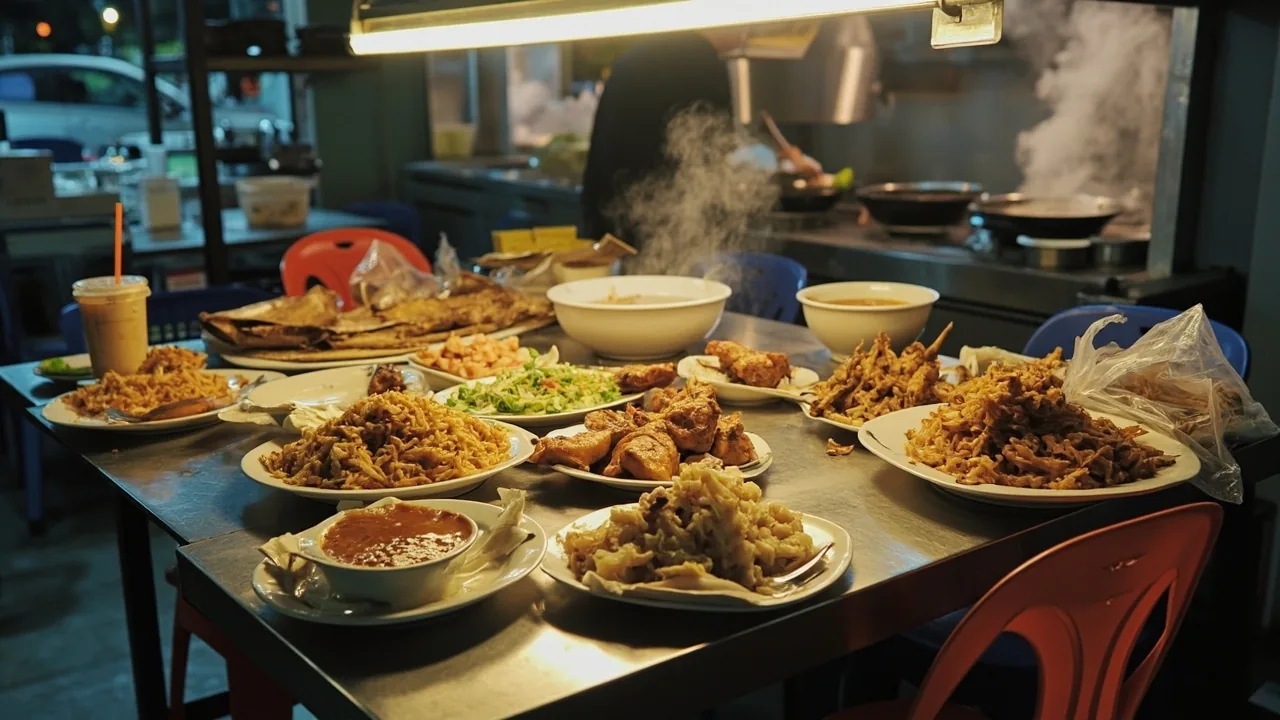
Malaysia Food Guide: Must-Try Dishes, Street Food & Vegetarian Options
Malaysia is one of the easiest countries in Southeast Asia for Indian travellers to eat well. The street-food scene is mostly Muslim-friendly, and you can find a thali in almost every city. The catch: most “vegetarian” stalls are not vegetarian, and many Malay vegetable dishes hide sambal belacan (shrimp paste). Read this guide once and eat without stress for the whole trip. For related planning, see our guide on Sea Backpacking Hub.
Quick Answers
| What | Answer | Price (INR) |
|---|---|---|
| Cheapest street food meal | Nasi lemak or mee goreng at a mamak stall | ₹94-₹236 (~4-10 MYR or ~$0.98-$2.45) |
| Cost of a sit-down veg meal at a local restaurant | Mixed rice (nasi campur) with 2-3 veg sides | ₹188-₹353 (~8-15 MYR or ~$1.96-$3.67) |
| Cost of a proper Indian veg thali | Bombay Grand or Sentral Spice, full meal | ₹424-₹707 (~18-30 MYR or ~$4.40-$7.34) |
| Bottle of water | Any 7-Eleven or supermarket | ₹23 (~1 MYR or ~$0.25) |
| Pulled teh tarik at a mamak stall | Strongest on the menu, sweet, frothy | ₹59 (~2.50 MYR or ~$0.61) |
| Cheapest Malaysian food overall | Penang (George Town) or Melaka (older notes put it at around ₹141-₹283 (~6-12 MYR or ~$1.47-$2.93) for a full meal) | , |
The Local Culinary Landscape
Malaysian food is a layered thing. You’ve got Malay cooking (coconut milk, sambal, lemongrass, belacan), Chinese cooking (wok hei, pork-free variants for the Muslim market), Indian cooking (the mamak stall is a South Indian cafe transplanted to a tropical sidewalk), and Peranakan / Nyonya cooking which is the Chinese-Malay fusion you mostly find in Penang and Melaka. On top of that, Borneo (Sabah and Sarawak) has its own thing: more freshwater fish, more jungle greens, less coconut milk.
The thing that catches Indian vegetarians out is hidden animal products. Sambal belacan is the big one. It’s shrimp paste pounded into chilli paste and it goes into most Malay vegetable dishes. Oyster sauce is the Chinese equivalent. Fish sauce (kicap ikan) sneaks into stir-fries. Chicken stock is the default base for noodle soups unless you ask. Even “vegetarian curry” at a Chinese stall often has dried shrimp in it.
Local attitudes toward vegetarianism are practical, not ideological. Many Chinese and Malay people eat vegetarian on certain Buddhist holy days (the 1st and 15th of the lunar month), so most food courts have a temporary “vegetarian” stall on those days. You’ll see yellow signs with green Chinese characters. These stalls use no meat, no seafood, no onion, no garlic. They’re the single best thing about eating vegetarian in Malaysia and most travellers miss them.
Indian-Muslim mamak stalls are the everyday go-to. They’re open late, they’re cheap, and the cooks are mostly Tamil Muslim, so they understand a Gujarati vegetarian’s order. Tell them “no egg, no meat, no seafood” and they’ll usually point you to a specific dish instead of just removing the meat.
Key Phrases in Local Script
| English Phrase | What it Means | Local Script | Pronunciation |
|---|---|---|---|
| I am vegetarian | Tells the cook you want no meat/fish | Saya vegetarian / 我吃素 | sah-yah veh-jeh-tah-ri-an / wo chi su |
| No meat | Standard exclusion | Takde daging / 没有肉 | tak-de dah-ging / mei you rou |
| No seafood (fish, prawn, squid) | Critical for Chinese-style veg | Takde seafood / 没有海鲜 | tak-de see-food / mei you hai xian |
| No egg | Important for some Jains | Takde telur / 没有鸡蛋 | tak-de teh-lur / mei you ji dan |
| No onion, no garlic | For strict Jains | Takde bawang / 没有葱蒜 | tak-de bah-wahng / mei you cong suan |
| No shrimp paste (belacan) | The big Malay gotcha | Takde belacan / 不用虾酱 | tak-de beh-lah-chan / bu yong xia jiang |
| Vegetarian stall, please | Asking for the Buddhist veg stall | Kedai sayur / 素食档 | keh-dai sah-yur / su shi dang |
Print the table on your phone or screenshot it. The Chinese phrases matter more than the Malay ones because the hidden-animal-product problem is mostly in Chinese cooking, not Malay cooking.
Safe Local Street Food Dishes
These are the dishes Indian vegetarians can eat without too much interrogation. Prices are the on-the-ground amount in Malaysian Ringgit.
Nasi Lemak (nasi lemak) is the national dish and it’s one of the safest veg bets. It’s coconut rice served with sambal, cucumber, peanuts, hard-boiled egg, and a choice of side (anchovies, chicken, sambal squid, or sambal tempeh). Ask for the tempeh version and skip the egg. Around ₹82 (~3.50 MYR or ~$0.86) at a basic stall.
Mee Goreng Mamak (mee goreng mamak) is the Indian-Muslim fried noodle. Yellow noodles wok-fried with tomato, chilli, vegetables, and either tofu or egg. Specify “no seafood, no egg” and you’ll get the tofu version. ₹118-₹188 (~5-8 MYR or ~$1.22-$1.96). This is the single most-ordered dish at any mamak stall.
Roti Canai (roti chanai) is the flaky flatbread served with dhal or curry. The dhal is always vegetarian. The chicken or mutton curry on the side is the meat version; just point at the dhal. ₹35-₹59 (~1.50-2.50 MYR or ~$0.37-$0.61) for a plain roti. Comes with a sweet condensed-milk coffee for around ₹94 (~4 MYR or ~$0.98) total.
Teh Tarik (teh tarik) is the pulled milk tea. Strong, sweet, frothy, and the national drink. It’s vegetarian by default (black tea, condensed milk, evaporated milk). ₹59 (~2.50 MYR or ~$0.61) at any mamak. The “teh halia” version adds ginger, “teh ais” is iced.
Mixed Rice / Nasi Campur (nasi campur) is the buffet-style “choose your vegetables and rice” stall. Point at the vegetable dishes, ask the auntie what’s vegetarian, she’ll usually tell you honestly. Watch out for the curry that looks vegetable but has dried shrimp. ₹141-₹236 (~6-10 MYR or ~$1.47-$2.45) for rice plus 2-3 veg sides.
Char Kway Teow (char kway teow) is Penang’s signature. Flat rice noodles wok-fried with prawns, egg, Chinese sausage, bean sprouts. Skip it for the most part unless you find a vegetarian version at a Buddhist-veg stall. The Penang original runs ₹141-₹188 (~6-8 MYR or ~$1.47-$1.96).
Asam Laksa (asam laksa) is the sour fish-broth noodle soup from Penang. Skip it (fish stock), but order the laksa lemak version (coconut-based, vegetarian option exists) if you want laksa.
Cendol (cendol) is the shaved-ice dessert with pandan jelly, coconut milk, and palm sugar. Vegetarian, often accidentally vegan. ₹47-₹71 (~2-3 MYR or ~$0.49-$0.73). Perfect in Penang after a hot day.
Tau Fu Fah (tau fu fah) is the warm soy pudding with syrup. Pure soy, sweet, completely safe. Found at most Chinese night markets.
Recommended Vegetarian Restaurants
Local / Plant-Based
Seeds Origin in Kuala Lumpur is a healthy plant-based cafe with a 4.8 rating. The kind of place with smoothie bowls, plant-based burgers, and good coffee. Around ₹424-₹660 (~18-28 MYR or ~$4.40-$6.85) for a main. Worth a stop if you’re in Bangsar or wherever their branch is, just to reset from heavy street food.
niàn Cafe is a fully plant-based spot rated 4.9. The menu rotates, the portions are real, and the vibe is “chill KL cafe with WiFi.” Expect to pay ₹471-₹707 (~20-30 MYR or ~$4.89-$7.34) for a proper meal with a drink.
Armani Food Garden at 4.9 is Malay food in a garden setting. Ask for the vegetable dishes and they’ll steer you around the sambal belacan.
Pia’s the Padi at 4.4 is a homey spot for local Malaysian comfort food. Look at the vegetable options and ask what’s in them.
Pauline’s at 4.9 is the casual everyday Malaysian food option. Don’t expect a menu, expect auntie-cooking.
Food Stalls is the generic name for street-food clusters. The big ones are Jalan Alor in KL (evening, touristy), Gurney Drive in Penang (hawker centre by the sea), and Jonker Street night market in Melaka (Fri-Sun evenings). At any of these, look for the yellow vegetarian signs first.
For Penang, see the Vegetarian Food in Malaysia guide for a deeper dive.
Indian / Veg-Friendly
Bombay Grand Indian Cuisine in KL’s Brickfields (Little India) at 4.8 is the upmarket choice. Mumbai street food and North Indian curries, full thali around ₹94-₹234 (~4-10 MYR or ~$0.98-$2.45). Good for a proper sit-down after a week of street food.
Bombay Kitchen And Bar in Penang at 4.8 is the Penang version. Same Mumbai street-food focus, more casual.
Solh Restaurant & Bar in KL at 4.8 is modern Middle Eastern with the saffron biryani. Strict vegetarians should specify no meat stock in the biryani base.
FOOD PARADISE RESTAURANT & BISTRO at 4.8 is Pakistani and North Indian, lively setting, around ₹353-₹518 (~15-22 MYR or ~$3.67-$5.38) for a main.
RESTORAN SENTRAL SPICE at 4.7 is the casual North Indian option. Fusion Malaysian-North Indian, decent biryani.
Ponmalar Indian Stall in the Cameron Highlands at 4.8 is the South Indian stall. Family-run, simple, exactly what you want after a jungle hike.
For more on the Indian food scene in Malaysia, see the Indian restaurants in Malaysia guide.
Food Safety & Hygiene
Malaysian street food is generally safer than most of Southeast Asia because the Muslim-Halal certification system is real and enforced. A stall with a halal sticker has been inspected. Mamak stalls are everywhere and the turnover is high enough that food doesn’t sit.
Specific rules:
- Drink bottled or filtered water only. 1 MYR for a 1.5L bottle at any 7-Eleven. Tap water in KL and Penang is technically treated but don’t risk it.
- Eat at busy stalls, not empty ones. If 20 people are waiting for fried noodles, the noodles are fresh.
- Watch the sambal. If it’s been sitting out for hours in the sun, skip it.
- Ice from street vendors is usually fine in cities. In smaller towns, ask for “ice no” or skip cold drinks.
- Carry ORS sachets. Pharmacies (Caring, Guardian) sell them for under ₹47 (~2 MYR or ~$0.49). If you get a 24-hour stomach bug, you want them before, not after.
For a full safety breakdown across Southeast Asia, see the Street Food Safety guide.
Getting Connected
You will want Google Translate (for the Chinese character menus at Buddhist-veg stalls) and Grab (for getting to/from food spots). For both, you need data. Buy a local SIM or an eSIM before you land.
Subodh’s Pro Tip: Hotlink and Yes are the tourist-friendly prepaid SIMs. Yes has better 4G coverage outside KL. At KLIA airport the tourist SIM counter is more expensive than the same SIM in a 7-Eleven in the city, but the airport version is faster if you’re in a rush.
Get Nomad eSIM if you’d rather skip the airport queue entirely. It lands in your email before you fly and activates the moment you land.
Common Food Mistakes Indians Make
Mistake 1: Ordering “vegetarian curry” at a Chinese stall without specifying anything. What happens: you get a curry with dried shrimp and pork lard in it. How to avoid: say “no seafood, no oyster sauce, no lard” or just stick to the Buddhist-veg stall with the yellow sign.
Mistake 2: Assuming “sayur” means purely vegetable. What happens: “sayur lemak” is vegetables in coconut milk with sambal belacan. How to avoid: ask “ada udang tak?” (any prawn?) and “ada belacan tak?” (any shrimp paste?).
Mistake 3: Skipping the Indian vegetarian stalls at mamak joints. What happens: you eat one plate of mee goreng for three days straight. How to avoid: mamak stalls have separate veg and non-veg sections of the menu. Ask for the “vegetarian section.”
Mistake 4: Going to Jalan Alor in KL expecting a chill local experience. What happens: it’s a tourist trap with prices 2x higher than a regular hawker centre. How to avoid: go to Imbi or Pudu for similar food at real prices.
Mistake 5: Drinking teh tarik with every meal. What happens: sugar crash, dehydration, mild stomach upset from all that condensed milk on a hot day. How to avoid: alternate with plain water or teh-O (tea without milk).
For more on budget eating specifically in KL, the Cheap Halal Food in KL under RM15 guide is worth a look.
FAQ
Is McDonald’s or Burger King safe for vegetarians in Malaysia?
Yes, both have certified vegetarian menu items. McDonald’s has the “Upsize Veg” wrap (with McMushroom sauce) and Burger King has the Vege Whopper. They are halal-certified, so no pork anywhere in the kitchen. Price is around ₹188-₹283 (~8-12 MYR or ~$1.96-$2.93).
Can I get Jain food (no onion, no garlic) easily?
It’s harder than regular vegetarian. The Buddhist-veg stalls skip onion and garlic anyway, so those are your best bet. For Indian Jain-specific, you need to call ahead at North Indian restaurants and they’ll usually accommodate. Sentral Spice and Bombay Grand have done it before on request.
Is fish sauce used in everything?
No, but it’s used in more things than you’d think. Most stir-fried vegetable dishes at Chinese stalls have a splash of fish sauce or oyster sauce. The fix: order from the Buddhist-veg stall, or ask explicitly. Malay cooking uses less fish sauce than Chinese cooking does.
What about Borneo (Sabah/Sarawak)? Is the food scene different?
Yes. Less Indian influence, more Chinese-influenced, more jungle greens (pucuk paku fern shoots, midin), more freshwater fish. Vegetarian options are fewer than in Peninsular Malaysia. Stick to rice and vegetable dishes, look for Chinese-run vegetarian stalls.
Do I need to worry about alcohol in food?
For a vegetarian, no. For Muslims (the cooks), also no. Malaysian food is overwhelmingly halal. The only place you’ll find alcohol in a dish is in some Peranakan / Nyonya desserts or in fancy fusion restaurants.
How do I read a Chinese character menu if I don’t read Chinese?
Use Google Translate’s camera feature. Point camera at menu, it overlays the English. Works offline if you download the Chinese language pack before you fly.
Is Penang the food capital?
Yes, no contest. Penang has the densest concentration of good food per square kilometre anywhere in Southeast Asia. If you have time for one food city in Malaysia, it’s Penang. Melaka is a close second.
Subodh’s Take
Malaysia is one of the few Southeast Asian countries where you can eat well as a vegetarian without constantly negotiating. Learn the phrase “vegetarian, no seafood, no egg” in one language, learn to spot the yellow Buddhist-veg sign, and you’ll eat like royalty on a backpacker budget. The mamak stalls are your everyday saviour, the Buddhist-veg stalls are your safety net, and the Indian restaurants are your home-cooking reset. Don’t overthink it.
