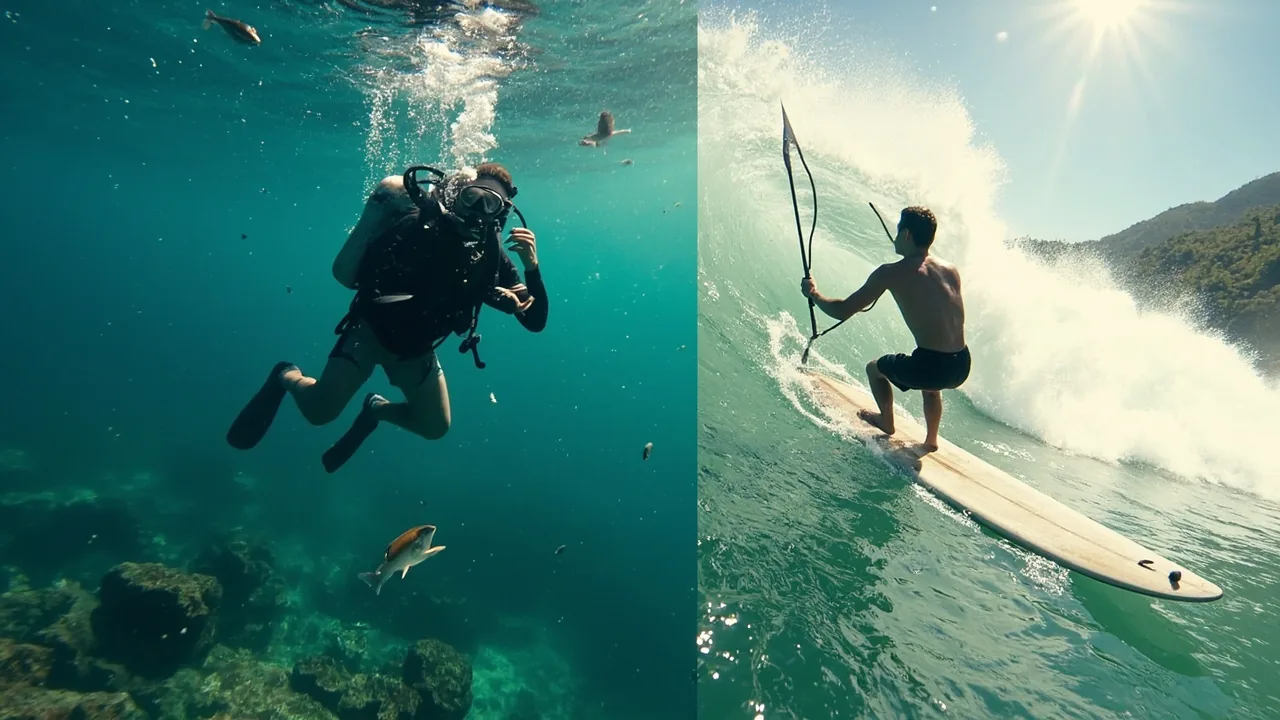
Philippines Scuba Diving & Surfing Season: Month-by-Month Guide for Indian Adventure Travelers (2026)
The Philippines scuba diving surfing season by month splits into four regional calendars. Dry season (December to May) favours western coasts; the wet season flips that picture. For related planning, see our guide on Sea Backpacking Hub.
For a broader typhoon-month view across the whole country, see our Philippines weather by month guide. You may also find Philippines Weather Solo Female Indian Backpacker Safety useful for this trip.
Quick Answers
| What | Answer | Price (INR) |
|---|---|---|
| Cheapest PADI Open Water in the Philippines | Moalboal, Cebu, January shoulder season | ₹18,500 (~$192.05) |
| Best month to dive Tubbataha | April | ₹95,000 (~$986.20)+ (~57,000 PHP liveaboard) |
| Best month to see thresher sharks (Malapascua) | November to May, peak March | ₹4,500 (~$46.71) |
| Best surfing swell window in Siargao | August to November | ₹3,400 (~$35.30) |
| Cheapest dorm bed (Manila, low season) | Z Hostel or similar, August | ₹500 (~300 PHP) |
FX note: 1 PHP ≈ ₹1.69 (July 2026).
FX verified 2026-07-14: 1 INR = 0.5915 PHP (1 PHP = ₹1.6905).
Month-by-Month Breakdown
The Philippines does not have one “best” month for water sports. It has four regional calendars. The table below assumes you’re choosing one region per trip, which is what most Indian backpackers do on a 7 to 14 day window.
| Month | Visayas (Cebu, Moalboal, Malapascua) | Anilao (Batangas, Luzon) | Tubbataha (Palawan, Sulu Sea) | Siargao Surf | Verdict |
|---|---|---|---|---|---|
| January | 25-30 m viz, calm, sardine run active at Moalboal | 15-25 m viz, mild thermoclines | Closed (season runs Mar-Jun) | Shoulder swell, small, inconsistent | Best for Visayas diving on a budget |
| February | 25-30 m viz, flat seas, thresher sharks reliable at Malapascua | 20-30 m viz, nudibranch peak | Closed | Small, offshore winds clean | Peak macro photography at Anilao |
| March | 20-30 m viz, thresher sharks peak, slight wind pick-up | 20-30 m viz, calm | Opens mid-March, manta and shark action starts | Increasing, fun beginner waves | Best balance: Visayas diving + early Tubbataha |
| April | 20-25 m viz, hot (32°C air), thresher sharks still reliable | 20-30 m viz, hot | Peak Tubbataha season, pelagic-rich | Small to medium, mixed winds | Peak Tubbataha liveaboard window |
| May | 15-25 m viz, early rains Luzon only, Visayas still good | 15-25 m viz, last month before rain | Last dives, season closes late May | Flat to small, off-season for surfers | Last call for Visayas before monsoon shift |
| June | 10-20 m viz, rain starts, typhoon risk low | 5-15 m viz, heavy rain | Closed | Increasing south swell, shoulder | Avoid Anilao, Siargao wakes up |
| July | 10-20 m viz, typhoon risk rises | Poor, full rain | Closed | Solid south swell, Cloud 9 lights up | Siargao peak season begins |
| August | 10-15 m viz, typhoon risk peaks | Poor | Closed | Biggest south swell, expert-only at Cloud 9 | Best Siargao surf, worst diving |
| September | 10-20 m viz, typhoons common | Poor | Closed | Solid swell, less consistent than Aug | Avoid diving, Siargao still firing |
| October | 15-25 m viz, typhoon risk drops late month | 10-20 m viz, recovering | Closed | Last solid swell, CO2 (Cloud 9) still rideable | Siargao wind down, Visayas recovering |
| November | 20-30 m viz, flat seas, macro life excellent | 15-25 m viz, calm | Closed | Inconsistent, mostly small | Best all-round diving, surf flat |
| December | 25-30 m viz, calm, holiday crowds | 20-30 m viz, peak macro season starts | Closed | Flat, Christmas swell rare | Peak Visayas + Anilao, busy in Cebu/Bohol |
Prices in the diving sections below assume the 2026 PHP rate above. A 3-dive fun dive package at a mid-range shop runs 1,500 to 2,500 PHP; liveaboards are priced in USD per pax.
Where the Real Dives Are (and When)
Anilao, Batangas (Luzon, year-round macro)
Anilao is the Philippines’ macro capital. Nudibranchs, frogfish, pygmy seahorses, and rare shrimp peak between February and May, with water clarity at 20 to 30 m and air temperatures around 28 to 32°C. Visibility drops hard from June to September, when the southwest monsoon (habagat) brings rain and runoff from Manila Bay. October and November are recovery months; December to February is the second-best window for macro photography. January to February is typically the cheapest window for a PADI course here, because Anilao fills up with Manila weekenders from March onwards.
A two-tank day dive at a reputable Anilao shop runs 2,000 to 3,000 PHP (~₹3,400 to ₹5,100). A PADI Advanced Open Water course (5 dives over 2 days) is 18,000 to 22,000 PHP (~₹30,500 to ₹37,200). The dive shops themselves are spread across Mabini and Anilao proper; book via your hostel or through GetYourGuide Philippines water sports for fixed-price packages.
Moalboal, Cebu (Visayas, sardine run + thresher day trips)
Moalboal’s signature is the sardine run at Panagsama Beach, visible year-round in the 30 m drop-off just offshore, and turtles that feed on the same stretch. Sea conditions are calmest from November to May, with visibility typically 20 to 30 m. The monsoon (June to October) brings rain and reduced visibility (10 to 20 m), but the sardines don’t leave, and dive shops price accordingly.
A 3-dive day trip from Moalboal runs 1,500 to 2,000 PHP (~₹2,500 to ₹3,400) at most shops. A PADI Open Water course in low season (August to September) is sometimes discounted to 11,000 PHP (~₹18,500), versus 14,000 to 16,000 PHP in peak. From Manila, the cheapest route to Moalboal is a Cebu Pacific flight to Mactan-Cebu (around 4,500 to 7,000 PHP one-way), then a bus to Moalboal. See our Cebu to Moalboal bus schedule for the overland option.
Malapascua, Cebu (thresher sharks, year-round but season-dependent)
Malapascua’s Monad Shoal is one of the few places on Earth where you can reliably see thresher sharks at cleaning stations, with the experience running from 5 a.m. Dawn dives almost every day of the year. Visibility is best from November to May (20 to 30 m), with March and April as the peak reliability months. Monsoon (June to October) brings rougher crossings from Maya port and 10 to 20 m viz, but shark sightings continue.
A 3-dive day (including thresher at Monad Shoal) runs 2,500 to 3,500 PHP (~₹4,200 to ₹5,900). Most Malapascua dive shops bundle accommodation and dives. Note that Malapascua is a typhoon-exposed island, so September dives get cancelled outright in bad years. Check PAGASA bulletins before booking.
Tubbataha Reefs, Sulu Sea (liveaboard only, March to June)
Tubbataha is a UNESCO World Heritage site, accessible only by 5 to 7 day liveaboard from Puerto Princesa. The season is strictly mid-March to late June, with April and May as the peak pelagic months: manta rays at cleaning stations, whale sharks, reef sharks, and large schools of jacks and barracuda. Visibility hits 30 to 45 m in calm years. Liveaboard pricing in 2026 runs from 57,000 PHP (~₹96,400) per pax for a budget boat up to 95,000 PHP (~₹160,600) for mid-range, twin-share, full board. Book 4 to 6 months ahead for April and May.
Subodh’s Pro Tip: The Tubbataha booking window for April 2027 opens in October 2026. If you want a specific boat (the Aggressor and the M/Y Philippine Siren fill first), lock in 5 to 6 months ahead. Last-minute Tubbataha deals exist in May only.
Where the Real Surf Is (and When)
Siargao, Surigao del Norte (Cloud 9, August to November)
Siargao’s main break, Cloud 9, picks up south swell from June through November, peaking in August and September with consistent shoulder-to-overhead waves. The dry season (December to May) is mostly flat, with offshore winds but no real groundswell. August through October is also typhoon season, and surfers track storms as much as swell charts: a typhoon passing south of Mindanao can flatten the lineup for 2 to 3 days, then send solid groundswells in its wake. Beginners should aim for July (smaller, more forgiving) or late October (still consistent, fewer crowds).
Surfboard rental runs 400 to 600 PHP per day (~₹680 to ₹1,000). A 90-minute beginner lesson with board is 1,200 to 1,800 PHP (~₹2,000 to ₹3,000). Guided boat trips to outer breaks like Rock Island or Stimpy’s are 2,000 PHP (~₹3,400) per head for a half day. The island fills up for the Siargao International Surfing Cup in late September, so book hostels 6 to 8 weeks ahead.
Other Philippine breaks
- Catanduanes (Luzon east coast): November to February is the typhoon-swell window for experienced surfers. Virtually no crowds. Access is via Virac airport.
- La Union (Luzon west coast): October to March is the main swell season, with smaller, beginner-friendly waves. Two hours by bus from Baguio, four hours from Manila.
- Boracay (White Beach, Bulabog): November to April, with the famous “Amihan” northeast wind. Bulabog Beach is the kiteboarding and surfing side. Best for intermediates.
For a head-to-head beginner breakdown, see Siargao vs Boracay for beginner surfers.
Season Pros and Cons
Pros of the dry season (December to May):
- Calm seas and 20 to 30 m viz in Visayas and Anilao
- Tubbataha liveaboards run March to June
- Christmas and Easter are high-energy, with festivals in Cebu (Sinulog, January) and many provinces
- Reliable flights, less chance of typhoon cancellations
Cons of the dry season:
- Peak prices: dorm beds in Cebu and Moalboal hit 1,200 to 1,400 PHP (~₹2,000 to ₹2,400)
- Cebu Pacific and AirAsia fares from Manila climb for Sinulog (January) and Holy Week (March/April)
- Crowded dive boats at Apo Reef and Moalboal, especially weekends
- Visayas in April can hit 32 to 34°C air temperature, which makes surface intervals exhausting
Pros of the wet season (June to November):
- 30 to 50% off on hostels, dive courses, and inter-island ferries
- Siargao at peak, La Union and Catanduanes waking up
- Marine life at Anilao is at its most unusual (cold-water oddities drift in)
- Fewer tourists, easier to haggle on multi-day dive packages
Cons of the wet season:
- Typhoon risk peaks August to September, especially for Luzon and Visayas
- Visibility drops to 10 to 20 m in many sites
- Liveaboards cancelled with little notice; always book refundable
- Some ferry routes (especially to Malapascua) get suspended for 2 to 3 days at a stretch
Month Costs Comparison
| Item | Peak (Dec-May) | Shoulder (Jun, Nov) | Low Monsoon (Jul-Oct) |
|---|---|---|---|
| Flight Manila-Cebu (one-way) | 4,500 PHP (~₹7,600) | 3,200 PHP (~₹5,400) | 2,000 PHP (~₹3,400) |
| Dorm bed Manila | 600 PHP (~₹1,000) | 450 PHP (~₹760) | 300 PHP (~₹510) |
| Dorm bed Moalboal | 940 PHP (~₹1,600) | 670 PHP (~₹1,130) | 400 PHP (~₹680) |
| Dorm bed Siargao (General Luna) | 800 PHP (~₹1,360) | 600 PHP (~₹1,020) | 330 PHP (~₹560) |
| 3-tank fun dive (Moalboal) | 2,000 PHP (~₹3,400) | 1,700 PHP (~₹2,880) | 1,500 PHP (~₹2,540) |
| PADI Open Water (Cebu) | 16,000 PHP (~₹27,100) | 13,500 PHP (~₹22,850) | 11,000 PHP (~₹18,500) |
| Surfboard rental Siargao (per day) | 500 PHP (~₹850) | 500 PHP (~₹850) | 450 PHP (~₹760) |
What to Pack for Diving and Surfing Seasons
For the dry season (December to May):
- Reef-safe sunscreen (the Philippines banned oxybenzone and octinoxate sunscreens in 2022, and dive boats enforce it)
- 3 mm wetsuit for Anilao and Malapascua (water drops to 25 to 26°C from January to March)
- Rash guard for surface intervals in peak April heat
- Dry bag for electronics on ferries
For the wet/surf season (June to November):
- 2 mm springsuit or boardshorts for Siargao (water is 28 to 30°C)
- Reef booties if you surf rocky entries like Rock Island
- Poncho, not umbrella, for typhoon squalls
- Headlamp with spare batteries (Siargao brownouts run 1 to 4 hours during storms)
- Refillable water bottle: most Siargao surf camps filter their own
Where to Eat and Recover Between Dives
Long dive days and dawn surf sessions end with two food groups: cheap Filipino carinderia fare and, eventually, a desperate search for roti or dal.
For real local food near Manila’s dive shops and the Batangas ferry terminal, Kantina Manila is the spot for sisig and adobo in a rustic setting, with mains around 200 to 350 PHP. If you’re based in Quezon City between dive trips, Leandro’s Bistro delivers solid Filipino comfort food at similar prices. Down in Moalboal and Cebu, the shortlist gives you Treasure Island and The New White Gold House Rest for local plates, both with strong ratings and budgets under 200 PHP per meal.
For the days when your body wants dal-chawal, three solid bets:
- Royal Indian Curry House, Quezon City (~1,700 PHP per head): upscale, strong butter chicken and paneer, good for a post-flight meal in Manila before heading to the boats.
- Seven Mannah Indian Fusion Food (300 to 500 PHP per head): the budget rescue. Reviewers specifically call out the chicken biryani.
- Biryanista: Hyderabadi biryanis in a modern setting, useful if you’re stuck in Manila on a typhoon day.
Getting Connected
For real-time PAGASA typhoon bulletins, Surfline swell forecasts, and WhatsApp calls back home, get connected before the boat leaves. Globe and Smart prepaid SIMs are sold at Manila, Cebu, and Siargao airports (200 to 300 PHP for a tourist SIM with 8 to 12 GB), but the easier alternative is a Nomad eSIM, which activates before you fly and works on both 4G and 5G across the country.
Safety Alert: Before booking any liveaboard or surf camp in July to October, check the official India MEA travel advisory (mea.gov.in) and PAGASA’s tropical cyclone bulletins. Typhoon paths in 2025 surprised several liveaboards that hadn’t checked the 5-day cone. The same applies to ferry tickets to Malapascua, which get cancelled 24 to 48 hours ahead of a typhoon.
FAQ
When is Tubbataha open, and how do I book it? Mid-March to late June. Book through a Cebu- or Manila-based dive travel agent. April and May sell out 4 to 6 months ahead.
Is November a good month to dive in the Philippines? Yes, and it’s underrated. Visayas viz is back to 25 to 30 m, the typhoon risk has dropped, and prices are 20 to 30% below January peak. The main downside is that Siargao is flat and you won’t catch swell.
Can I learn to dive in the Philippines on a budget? Yes. Moalboal and Anilao offer PADI Open Water courses for 11,000 to 14,000 PHP (~₹18,500 to ₹23,700) in low season (July to October), versus 16,000 PHP (~₹27,100) at peak. Check that the shop is PADI- or SSI-certified before paying.
Is Siargao safe for beginner surfers outside typhoon season? July through October is the surf season. Beginners should aim for July or late October to November, when waves are smaller and less crowded. Avoid Cloud 9 itself in August and September unless you’re an advanced surfer; head to Jacking Horse or Stimpy’s for friendlier take-offs.
Do I need a visa as an Indian traveller? Indians are visa-free for 30 days, with an extension of up to 29 days available at any Bureau of Immigration office for 3,030 PHP, for a maximum stay of 59 days. There is a separate airport terminal fee of 550 to 850 PHP. For the full breakdown, see our Philippines visa guide for Indian passport holders.
How much cash should I bring for a 10-day dive trip? Around 25,000 to 35,000 PHP (~₹42,300 to ₹59,200) covers dorm beds, food, local transport, and 6 fun dives. Liveaboards and PADI courses are extra. ATMs in Cebu, Moalsoal, and General Luna (Siargao) accept international Visa and Mastercard, but Banco de Oro and Metrobank have the most reliable ATM networks.
Subodh’s Take
The Philippines gets typecast as a typhoon-risk destination, which keeps the prices honest. If you’re a diver, go in January, February, or November for the calmest viz and lowest crowd levels. If you’re a surfer, accept that August and September come with weather risk and plan around PAGASA. Trying to combine both in one trip is doable in March, but you’ll compromise on at least one of them. Pick the sport, then pick the month.
