Philippines Visa for Indians: Fees, Rules & How to Apply (2026)
Indians get 30-day visa-free entry to the Philippines, no pre-arrival paperwork beyond a boarding pass and a hotel address at immigration. If you’re an Indian passport holder wondering about a Philippines visa for Indians with Schengen visa (US/UK), here’s the part most guides get wrong: that visa doesn’t get a separate faster track or a longer stay.
The one caveat worth flagging before you go: this 30-day arrangement is bilateral, and it’s been quietly expanded in recent years. If you’ve read older guides saying Indians need a visa or a visa-on-arrival sticker, those were correct before 2024 and wrong in 2026. For the full breakdown of all visa types available to Indian passport holders, see our Philippines visa guide for Indian passport holders. Skip to the Step-by-Step section if you just want what to do at the Manila immigration counter; read on if you want to understand whether your Schengen/US/UK stamp changes anything at all.
Subodh’s Pro Tip: Don’t pay for an “e-visa” or “visa-on-arrival sticker” that an OTA tries to sell you on the way out. Since the 2026 visa-free rule took effect, the Philippine government itself has warned about third-party sites advertising fees for a document that is now free and automatic at the border. If anyone at Manila airport tries to redirect you to a “visa desk,” walk past.
Quick Answers
| What | Answer | Price (INR) |
|---|---|---|
| Visa required for Indians? | No, visa-free for 30 days | ₹0 |
| Primary visa type | Visa-free entry stamp | ₹0 |
| Fallback / alternative | Extension at Bureau of Immigration for 29 more days | ₹3,030 (~$31.73) |
| Processing time | Instant at immigration counter | ₹0 |
| Validity / max stay | 30 days per arrival, extendable to 59 days total | ₹0 |
| Extension possible? | Yes, at BI office, PHP 3,030/29 days | ₹3,030 (~$31.73) |
| Mandatory arrival form | eTravel (optional online pre-fill; walk-in available at immigration counter) | ₹0 |
Source: Philippines Bureau of Immigration, June 2026. Note: eTravel is the official arrival form. Pre-register at etravel.gov.ph before your flight to get a QR code for faster processing at the immigration counter.
Visa Types Compared
There’s only one visa type most Indian travellers need: the visa-free stamp. The Philippines offers an “eVisa” system for countries that don’t have the visa-free arrangement, but Indian passport holders do not need to apply. Let me walk through what’s available, because search results will throw a lot at you and most of it doesn’t apply to a 2026 Indian traveller.
Visa-Free Entry (for Indians)
This is the entry that applies to you. As of 2026, the Philippines grants Indian passport holders 30 days visa-free, automatic, free of charge, with extendable validity. The stamp is issued at the immigration counter on arrival. The 30 days is per arrival, meaning each fresh entry gets a fresh 30-day window. The fee is zero. The processing time is instant. The only thing it requires is a passport with at least 6 months validity, a confirmed return or onward ticket, and a hotel address (a host’s details) on the landing card.
This is a recent expansion. Earlier arrangements had India in a 14-day visa-free tier; the 30-day version has been in force for the last 24 months and was confirmed again in the Bureau of Immigration’s June 2026 circular. If you’re reading an article from 2023 or earlier, ignore its advice about pre-applying through the Philippine embassy.
Extension Visa (Bureau of Immigration)
If 30 days isn’t enough (and it won’t be for a serious backpacking trip that hits Manila, Cebu, Palawan, and Boracay in one go), you extend at a Bureau of Immigration (BI) office before your initial 30 days run out. The extension costs PHP 3,030 for 29 additional days, and is renewable once more, giving you a total of 59 days without ever leaving the country. This is the standard practice for Indian travellers doing longer Philippines trips, and it’s covered in detail in our extension guide.
9A Temporary Visitor Visa (Embassy / Consulate Stamping)
This is the visa that would apply if you were from a country not in the visa-free tier (China, India until recently, certain Middle Eastern states). It’s what older guides still recommend, but it doesn’t apply to a 2026 Indian passport holder unless you have a specific reason to want a stamped visa in your passport before flying (e.g. Onward travel to a country that requires proof of Philippines visa validity). Costs vary by consulate; processing runs 3 to 5 business days. You will not need this.
9D Treaty Trader / Investor / 47A Special Visa (Long-Term Non-Tourist)
Out of scope for short trips. Skip.
Does having a Schengen, US, UK, or Australian visa help?
The honest answer: not in any operational sense. The visa-free rule is unilateral; it doesn’t matter what’s already in your passport, you stamp in on the same line, under the same rules, paying zero. Where a strong-visa passport sometimes helps:
- Officer attitude. Traveller reports suggest holders of valid US/UK/Schengen visas are sometimes waved through Manila immigration quickly, while travellers with blank passports may receive more questions (return flight, hotel, funds, intent). Neither was denied. If your Schengen/US/UK visa is current (even if expired within the past year or two), print a copy and bring it.
- Connections onward to third countries. Hong Kong, Singapore, and other transit cities often grant visa-free transit to holders of strong US/UK/Schengen visas. That’s a Hong Kong or Singapore benefit, not a Philippines one.
- Asylum/refugee concerns. If you’ve ever had an Indian visa refusal in any country, that’s a separate matter. Clean passport, no prior refusals, 30 days free.
What a Schengen/US/UK visa does NOT give you:
- No premium line at immigration. Same queue as everyone.
- No extension of stay beyond 59 days without a BI visit.
- No entitlement to work or study.
- No automatic conversion into a long-stay visa category.
Verified against the Philippines Bureau of Immigration circulars and consular guidance, June 2026.
Step-by-Step: How to Apply
You don’t apply. You fly in and walk through.
Before You Fly
- Passport validity: 6 months remaining past your departure date from the Philippines. If your passport is at 5 months, travel now will probably get you in but you’ll be flagged as overstay risk on exit.
- Return or onward ticket: Print it. Have the booking reference handy. Immigration can ask for it at any point, and a printed PDF on your phone has been enough in every traveller report I’ve seen, but a paper printout closes the loop faster.
- Hotel address for first night: Either a confirmed booking (Booking.com works, official confirmation email shown on phone is fine) or a host’s details. Some travellers report giving just the name of a guesthouse and a neighbourhood.
- Proof of funds: Rarely asked, but carry a forex card statement and a recent bank statement screenshot. The number is rarely inspected but having it ready saves ten minutes if an officer pulls you aside.
On the Plane
Cabin crew will hand out the arrival card (point you to the eTravel digital form on the seat-back screen). If you’d rather pre-register and skip the paper step, do it at the official Philippine eTravel portal before you take off. It is free, takes four minutes, gives you a QR code that you scan at the immigration e-gates or at the manned counter.
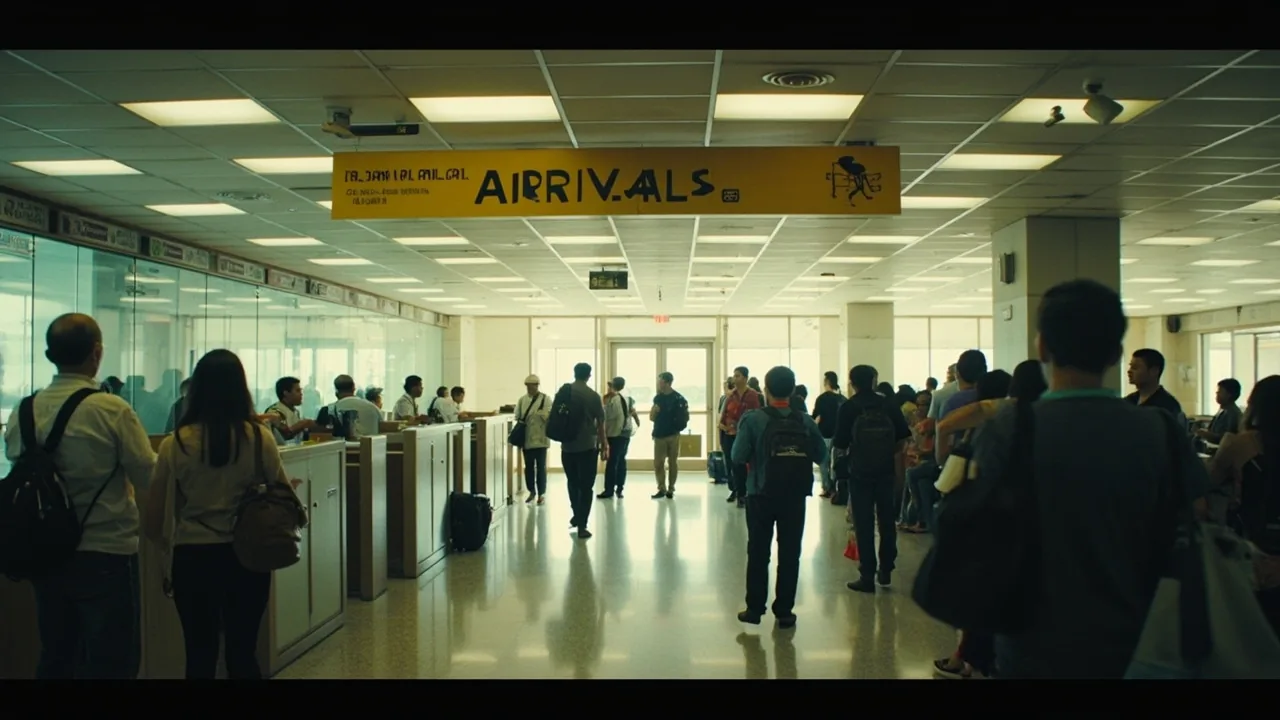
At NAIA / Cebu / Davao / Clark Immigration
- Walk to the “Foreign Passport” line. Most airports have separate counters.
- Hand over your passport, arrival card (QR code), return ticket printout, hotel address.
- Officer asks 0 to 4 questions, stamps you in for 30 days.
- Pick up checked luggage, walk through customs (nothing to declare for typical backpacking kit), exit to arrivals.
Total time at immigration: 8 to 25 minutes depending on queue and officer luck. Traveller reports from Manila NAIA Terminal 3 show off-peak arrivals clearing in under 15 minutes, while peak-hour Friday evening queues can stretch to 90 minutes, with most of the time spent waiting, not processing.
Subodh’s Pro Tip: Bank your first 30 km of post-immigration logistics. Have your Grab app loaded and your hotel’s address copied to clipboard before the plane lands, because airport WiFi at NAIA Terminal 1 is unreliable and you’ll burn half your data downloading it on arrival.
At the Airport / Border
For Indian passport holders specifically, here’s what happens at Manila (NAIA), Mactan-Cebu (CEB), Clark (CRK), Davao (DVO), and Iloilo (ILO) airports:
- Counter: Look for “Foreigners” or “All Passports” signs. There is no longer an exclusive “Indian Visa” line.
- Documents checked: Passport bio page, arrival card/eTravel QR, return ticket (sometimes), hotel address (sometimes).
- Common questions: “How long are you staying?” “Where are you staying first night?” “What is the purpose of your trip?” “Do you have a return ticket?” None is hard. If you’ve got an existing Schengen/US/UK visa in your passport, officers will sometimes ask where you’re heading next (“USA?” if you have B1/B2) and that’s it.
- Photo requirements: No photo at immigration. For your visa-free stamp, you only need your passport.
- Printed vs digital copies: Both work. Digital copies on a phone are universally accepted. The old “must be printed” advice is outdated; immigration at NAIA Terminal 3 has accepted phone screenshots for years.
Land borders follow different practical rules. The most common one is at Zamboanga (to Sulu) and the southern island routes. Land border control is less standardized, and Indian passport holders should add an extra 30 minutes for processing. The fee structure is the same (zero), but the officer may need to call Manila to confirm. Don’t expect an e-gate anywhere outside Manila.
Maritime arrivals (ferries from Sabah or Indonesian ports) are processed by port immigration offices. Entry is still visa-free for Indian passport holders with the same 30-day window and zero fee, but expect additional processing time as port immigration may need to verify details on-site.
For broader Southeast Asia backpacking logistics, see our Southeast Asia Backpacking Hub.
Extensions & Overstay
The Bureau of Immigration extension is the second step of any India→Philippines trip that runs longer than a month.
Where to extend:
- Manila main office: Magallanes Drive corner Aurora Boulevard, Intramuros. Open Mon-Fri 8 AM to 5 PM, closed Philippine public holidays. Most travellers report the process taking 2 to 4 hours including queue.
- Cebu BI office: 4th floor, Capitol Compound, Osmeña Boulevard. Smaller queue, faster process.
- Other major BI offices exist in Davao, Clark, Pampanga, and Subic.
Fee: PHP 3,030 per 29-day extension. The price is fixed and published; resist anyone offering to “expedite” for an extra fee. The process is the same speed for everyone.
When to extend: At least 7 days before your current 30-day visa expires. Last-minute extensions (within 48 hours) are technically possible but you’ll pay a PHP 500 late fee, and the queue tends to be longer because everyone else is also panicking.
Maximum stay without leaving the country: 59 days. After that, the bureau stops extending tourist statuses and you’d need to do a visa run to Hong Kong, Thailand, or another neighbouring country and re-enter to reset.
Overstay penalty: Above the legal stay, fines are PHP 500/day for overstay under 1 month, scaling up sharply for overstays of 2-6 months (PHP 1,000/day), 6-12 months (PHP 2,000/day), and 1 year or more (PHP 5,000/day). At the top end, durations over 5 years can trigger blacklisting, deportation, and a Philippine visa fraud file that may travel. The fines are paid at the BI office at NAIA before you check in. Travellers report bills of PHP 5,000 to 30,000 for typical 1-to-6-month overstays. Verify the current schedule with immigration.gov.ph before relying on this — fine rates and tier thresholds have been adjusted in past circulars.
For step-by-step BI extension walkthrough including the documents you need, see our extension guide.
Common Mistakes & Rejection Reasons
Most Indian passport holders get stamped in cleanly, but several mistakes keep showing up in traveller reports and BI advisory notes:
1. Paying a third-party “e-visa fee” for a visa that is now free
What happens: An OTA or a travel agent offers a “Philippines e-Visa” for ₹4,775 (~$50) to ₹14,325 (~$150) ahead of your flight. You pay it, you print the PDF. At immigration, the officer looks at the document and tells you it’s not needed, and you wasted the fee and the lead time.
How to avoid: Anything that says “Philippines eVisa” charged as a separate fee in your pre-departure booking is a scam. The visa-free stamp is the entry permit, and it has no associated fee. Always verify against the official Bureau of Immigration site before paying anyone.
2. Presenting a work or business reason at the wrong visa tier
What happens: You tell the officer “I’m here to work remotely” or “I’m joining a business meeting.” The visa-free stamp is strictly for tourism and short-term non-commercial purposes. Phrases like “I’m here to work / earn income” can trigger a switch to a 47A or 9D long-stay permit review, which you don’t have time to apply for on arrival.
How to avoid: Tourism framing only. “I’m here for vacation, sightseeing, beaches.” Save the remote work disclosure for the visa extension office where it matters less.
3. Passport name mismatch with Aadhaar / India visa
What happens: You’ve updated your Aadhaar or PAN to a new name after marriage or a legal change but not your passport. At some point in the trip you’ll need to show your Aadhaar card, forex card, or RBI compliance document, and a mismatch triggers a flag. The Philippine immigration officer may not catch it but your bank’s fraud detection can freeze your forex card mid-trip.
How to avoid: Use a passport-name-matching forex card and a photocopy of Aadhaar (which need not match) only where legally required. Update your passport first.
4. Booking one-way flights as a budget move
What happens: A budget trick travellers try: book a one-way ticket to Manila to save ₹4,000 (~$41.89) on airfare. The immigration officer asks for the return ticket and you’re in a 20-minute second-line discussion about intent.
How to avoid: Always travel with a return or onward ticket, ideally a fully refundable one you cancel once stamped in. Or use an onward ticket proof service (Onwardticket and similar, ₹1,146 (~12 USD)) if you want to keep the one-way.
5. Trying to skip the eTravel / arrival form
What happens: You skip the eTravel pre-registration to save 4 minutes. At the immigration e-gate, you’re asked to fill it on the spot. The e-gate kiosks are slow. You miss your domestic connection or your Grab surge window.
How to avoid: Pre-register. Even if immigration officers are supposed to accept printed arrival cards, the e-gate trend is making the digital form standard.
6. Not bringing a hotel address for the first night
What happens: You booked a guesthouse on Agoda but cancelled it the morning of departure. You’re en route to a homestay whose address you can’t remember. Immigration asks for the first-night address and you’ve got nothing.
How to avoid: Keep a current booking in your Gmail inbox and pull the confirmation page on your phone before landing. Save the PDF offline.
Getting Connected
Coverage in the Philippines is excellent in Manila, Cebu, Boracay, El Nido, and Coron, mostly good in Davao and Bohol, and patchy anywhere rural. Three networks: Globe, Smart, DITO. The cheapest physical option is the Globe or Smart tourist SIM at the airport counter, 50 PHP (~₹75) for a 7-day starter with about 5 GB of data. Walk past the prepaid SIM shops in the arrival hall; look for the official Globe and Smart kiosks by the exit doors, not the resellers inside the secure area.
If you’d rather not queue for a physical SIM and you don’t need a Philippine mobile number (most travellers skip it now that Grab, Google Maps, and WhatsApp all work on data-only), the Get Nomad eSIM covers the Philippines on a 3-day to 30-day plan you buy before takeoff, install on your phone via QR, and turn on after landing. Plans start around ₹573 (~6 USD) for 5 GB and climb from there. Good for keeping your Indian number working on WhatsApp at the same time. For a deep comparison of physical SIM vs eSIM vs Pocket WiFi, see our SIM guide.
FAQ
Do Indians need a visa for the Philippines?
No. Indian passport holders get 30-day visa-free entry under the Philippines’ visa-free regime, effective as of 2024 and reaffirmed in Bureau of Immigration circulars through June 2026. No pre-application is required.
Can Indians get a Philippines visa-on-arrival with a Schengen visa?
India is not in the visa-on-arrival tier; it’s a tier above that. Indian passport holders get visa-free entry, which is automatic and free. A Schengen visa doesn’t change the entry type, only the speed of the immigration process in some cases.
Does a Schengen visa help Indian citizens anywhere in Southeast Asia?
Yes, in several countries, but it varies. Indonesia, Singapore (the airport transit facility at Changi, with limitations), and a few others grant visa-free transit to Schengen visa holders. Thailand and Vietnam have separate visa-on-arrival rules for Indians and don’t depend on a Schengen visa. None of this affects Philippines entry, which is bilateral and applies to Indian passport holders directly.
Can I get a Schengen visa on arrival with an Indian passport?
No. Schengen visas are not issued on arrival for any nationality. India specifically must apply through a consulate (VFS Global operates most of the Schengen visa application centres in India), with biometric submission and personal interview, typically 15 to 21 days processing for a short-stay Schengen C visa.
Do Indian citizens need a Schengen visa?
Yes, for any Schengen Area trip. There is no visa-free Schengen arrangement for Indian passport holders as of 2026, although discussions on one have been ongoing.
How many blank passport pages do I need for a Philippines visa-free stamp?
One blank page is enough. The Philippines stamps visa-free entries in the back half of the passport, not on the bio page, and the stamp is small. If your passport is 90% full, the immigration officer may ask you to a side desk; plan extra time but it’s almost always resolved.
Can I enter the Philippines visa-free if my Schengen/US/UK visa has expired?
Yes. The visa-free rule is independent of any third-country visa status. Expired or current, the Schengen/US/UK stamp has zero bearing on Philippines admission. Many Indian travellers carry an expired US visa in their passport and use it as a general “previous Western travel” signal.
Is the 30-day visa-free rule still in effect for Indians in 2026?
Yes, confirmed in the Philippines Bureau of Immigration circular dated June 2026, with no scheduled reduction or rollout to a different category. Indian travellers using this in late 2026 or planning for early 2027 should still re-check immigration.gov.ph within a month of travel for any new policy note. Also consider travel insurance for your Philippines trip (it’s not required at immigration but covers medical and trip interruption costs).
Subodh’s Take
The honest answer to “Philippines visa for Indians with Schengen/US/UK” is that the framing of the question is half a step behind reality. As of 2026, Indians don’t need a Philippines visa of any kind, regardless of what’s already in their passport. What your Schengen/US/UK visa buys you is faster immigration processing at NAIA, not a different entry tier. Travellers who arrive with a clean passport and a printed return ticket get stamped in cleanly. Travellers who arrive expecting a “premium” entry because of their Western visa waste time waiting in the same queue as everyone else. If your trip is the standard 2-3 weeks covering Manila, Boracay, and Palawan, the 30-day window is more than enough. If you’re doing the slow boat through Siquijor, Cebu, and Apo Reef, plan a BI extension at week three and you’ll get to 59 days for about PHP 3,000. Anything beyond that, you’ll need a visa run. Don’t pay anyone for a “visa” or “e-visa” before flying. The Philippines is one of the most visa-free destinations in Southeast Asia for Indian passport holders right now, and that’s a much better story than the one the older guides tell.
